UPS for Apartment Buildings and Residential Complexes: Common Areas, Entrance, Cameras, and Security Booth

When the electricity goes out in the complex, the first thing residents notice is the elevator; but the manager's real problem lies elsewhere. The camera recording stops, the entrance door and barrier remain in their positions, the intercom goes silent, and the screen in the security booth goes black. Even if the outage lasts for ten minutes, there is no image of those ten minutes and it is not known who entered through the door. This article describes the UPS decision that apartment and site managements will make for common areas: what will be protected, where the UPS will be placed, how many minutes are enough and who will take care of it. Since the elevator rescue system is a separate issue, it Elevator Rescue Systems We discussed it in the article.
What Stops on the Site in Outage?
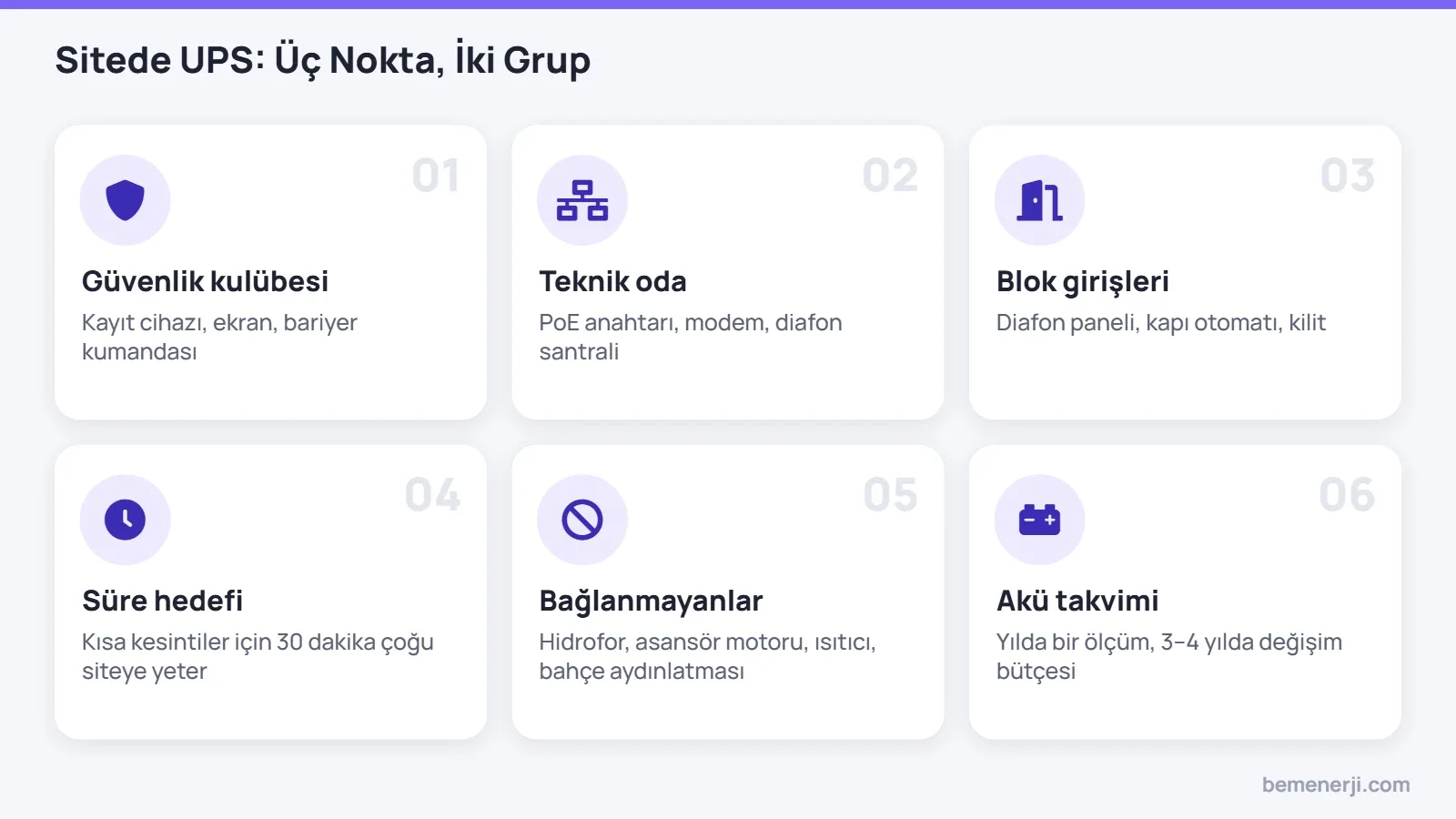
Dividing the electrical systems in common areas into two groups makes the decision easier. The first group is those that are expected to continue to work during an outage: cameras and recording devices, screens and communications in the security booth, intercom switchboard, door automata and lock, barrier control, network devices. The second group is those that are neither possible nor necessary to be connected to the UPS: hydrophore, elevator motor, garden lighting, boiler room pumps, heater or air conditioner in the shed. Those in the second group either draw a lot of power or it is acceptable for them to stop during an outage; in long outages, the solution is the generator, not the UPS.
Site managements often start from the point of "let's buy a big UPS, connect everything". As soon as the starting current of the booster or the elevator motor is taken into account, both the device and the battery group grow several times and the work approaches the cost of the generator. The right approach is small but correctly placed UPSs.
Three Load Points: Shed, Technical Room, Block Entrances
In a medium-sized site, the loads to be protected are usually collected in three places. The point at which the UPS will be placed is determined by where the loads are located and the cable distance.
| Dot | Typical loads | Approach |
|---|---|---|
| Security booth | Recorder, monitor, barrier control, radio charging, telephone | 1–2 kVA line-interactive in locker in shed |
| Technical room / weak current cabinet | PoE switch, modem and router, recorder (if not in the shed), intercom switchboard | 1–2 kVA; online if the number of cameras is high |
| Block entries | Intercom panel feed, door automatic, lock | Small UPS per block or intercom power supply's own battery |
If the recorder is in the booth but the PoE switch that feeds the cameras is in the tech room, just putting a UPS in the booth won't protect the image; the cameras will go out with the switch. Fix all the links of the camera chain UPS for camera and recorder We explained in the article; This key is the most frequently skipped link on sites.
Typical Power Ratings
The following values are for giving an idea; the label of each device and, if possible, its measurement are taken as basis. For final calculation How to calculate UPS power and Power Calculation You can look at the vehicle.
| Device | Typical power | Note |
|---|---|---|
| Recorder (NVR / DVR) | Roughly 30–60 W | Increases with the number of discs |
| 8-port PoE switch | Self-consumption + cameras | Roughly 5–12 W per camera, with infrared on |
| Monitor | Roughly 20–40 W | The hut is usually always open |
| Intercom switchboard | Roughly 20–50 W | By number of blocks |
| Modem + router | Roughly 20–30 W | Remote monitoring depends on them |
| Barrier motor | Roughly 100–370 W | Draws several times the current on takeoff |
The barrier is a separate head. The engine load continuously pulls several times its value at the time of departure; if it is connected to a small UPS selected for the camera, it gives an overload alarm at every boot or turns off the entire security system. There is a separate article for sites that want to take the barrier to the UPS: UPS for car park barrier and license plate recognition.
How Many Minutes Is Enough?
Most of the outages in sites are short: transformer maneuver, insurance, a few minutes of outage. A target of 30 minutes is sufficient for most sites to keep the camera recording intact and for the door to work during these outages. In sites with generators, the task of the UPS is only to fill the 10-30 second gap until the generator is activated; then even 10 minutes is more than enough.
In an outage that lasts for hours on a site without a generator, the goal changes: at least the proper closing of the recorder, knowing the last position of the door. It is not expensive to extend the time because the loads are small; by adding an external battery cabinet to the same UPS, it can be increased to more than an hour. What determines the duration How to calculate battery time You can find it in the article.
Which Type of UPS is Placed Where?
A line-interactive UPS with pure sine output is sufficient for the recorder, display and network devices in the shed. If the number of cameras is high, if the barrier is to be connected or if the mains voltage fluctuates frequently on the site, an online UPS is preferred; the difference of types Types of UPS We explained it in the article.
The most forgotten thing in the layout is the environment. Security booths heat up in the sun in summer, heated by a heater in winter, often damp. The UPS should not stand on the floor in the booth, but in a ventilated and locked cabinet; the heater and teapot should never be plugged into the UPS's socket. The same goes for the UPS in the technical room: humid and hot places, such as a booster room, shorten the battery life. Details of the layout Technical exploration before installation in his article.
How to Explain to the Flat Owners Board?
Since the UPS expense is covered by the dues, the manager must provide the board with a short and concrete justification. The most effective reason is the gap in the security record: there is no footage of an event during the outage, there is no door record. The second reason is the device life: sudden outages wear out the recorder's disk and switchboard cards. The third is the maintenance plan: the UPS's battery is a consumable item that changes every three to four years; if this expense is mentioned from the beginning, it will not be a surprise in the future.
UPSs are often forgotten during management changes. The location and model of the UPS, battery replacement date and service information should be written on the handover list; what to do when it gives an alarm should be kept as a one-page instruction in the shed.
Common Mistakes on Sites
- Trying to connect the hydrophore or elevator to the UPS; these loads are the subject of the generator.
- Plugging the heater, air conditioner or tea maker in the cottage into the UPS socket.
- Forgetting the switch and modem that feeds the cameras while protecting the recorder.
- Connecting the barrier motor to the small UPS selected for the camera.
- Leaving the UPS on the floor in the shed, in a sunny or damp corner.
- Not replacing the battery for years; seeing the UPS shut down in seconds at the first long outage.
- Laying long cables to pull the intercom of all blocks to a single UPS.
The UPS doesn't always tell you when the battery is aging. A battery measurement and a short outage trial once a year is the cheapest assurance for the site; what is measured What is a UPS battery test We explained in the article. For installation, battery replacement and annual check periodic battery and UPS maintenance page.
Brief Summary for Site Management
On site, the UPS is not installed to run everything; it is installed so that the camera recording is not broken, the door works and the shed is not blinded.

Small but placed in the right place, UPSs are both cheap and safe than the only large device to power the entire site. Motorized loads are the job of the generator.
Frequently Asked Questions
01How many kVA of UPS capacity does our site need?
02If we have a generator, do we still need a UPS?
03Does a water pump work with a UPS?
04Should we get a separate UPS for the barrier?
05Who performs maintenance on the UPS?
Discovery and Quote for Your Website
We measure the power loads of cameras, doors, intercoms, and guard booths in your building’s common areas on-site and recommend a UPS of the appropriate size for the correct location. We provide services throughout Istanbul and the surrounding provinces; our service area is Our Service Network You can see it on the page. For the entire process, from installation to annual maintenance, UPS Installation and Setup Check out our page, Contact Contact us through this link.