UPS Initial Commissioning and Acceptance Tests: Pre-Delivery Checklist

Once a new UPS is installed and the cables are connected, it may seem like the job is done. However, the real test of the installation is the initial commissioning: the unit is powered on for the first time, configured, put through a series of tests, and only then is the critical load connected. This article describes the initial commissioning of a new installation and the pre-delivery acceptance tests. Commissioning after a failure or a battery replacement involves different steps; those Commissioning After UPS Repair and Commissioning after a battery replacement We explained this in our articles.
The Difference Between Installation, Commissioning, and Acceptance
| Stage | What should be done? |
|---|---|
| Setup | The device is installed, the battery compartments are mounted, and the cables and panel connections are made |
| Initial commissioning | Inspection, initial power-up, adjustments, and functional tests before power is applied |
| Accept | The test results are reviewed with the user, and the delivery receipt is signed |
Installation Steps How to Set Up a UPS, cabling and panel preparation Cabling and Panel Preparation was described in those articles. This article picks up where the setup left off.
Before Providing Energy
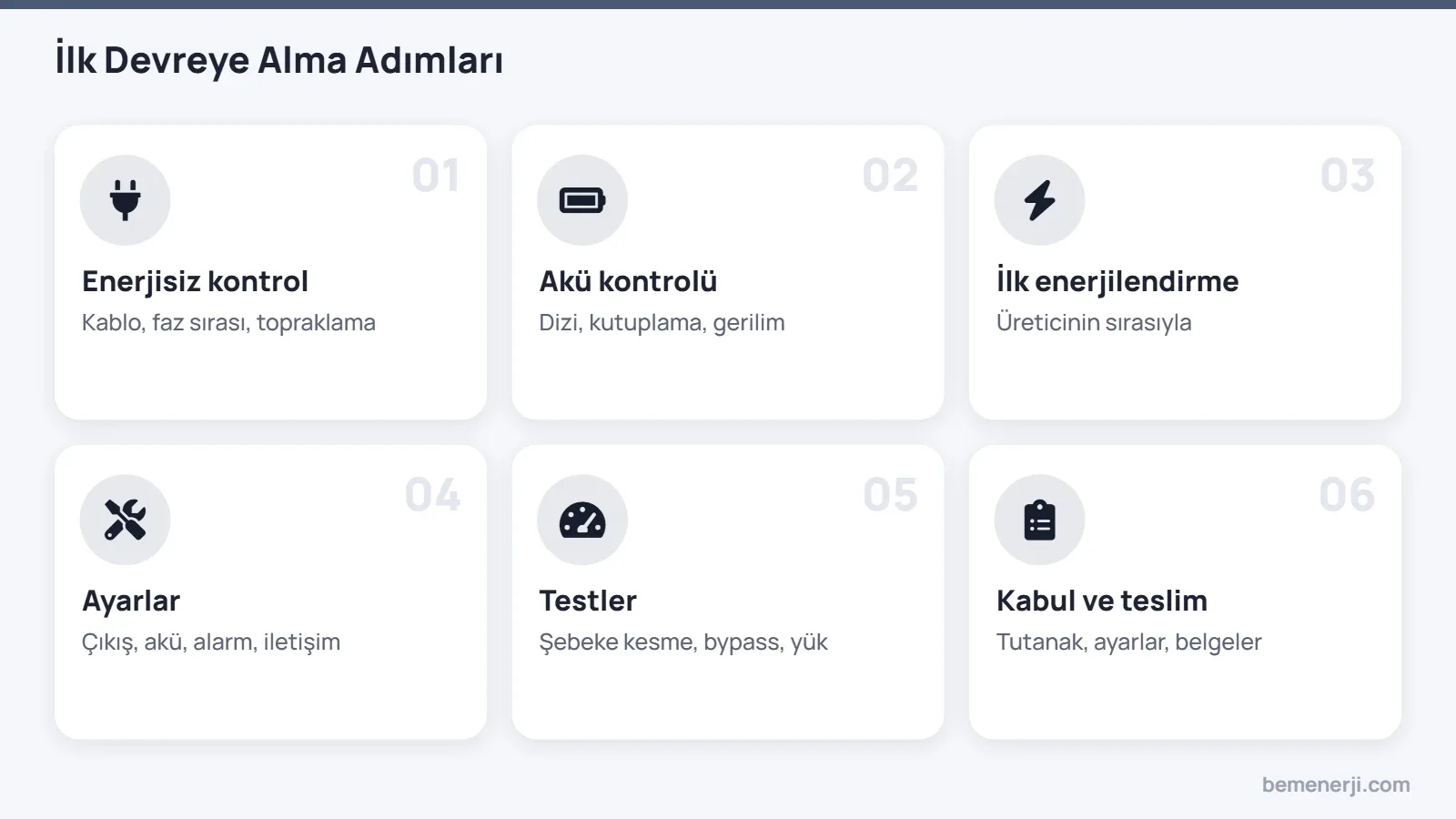
- The cross-sections and connections of the inlet, bypass, and outlet cables are compared with the project specifications.
- The phase sequence, neutral, and protective (grounding) conductors are checked.
- The ratings and selectivity of protective devices (fuses, circuit breakers) are reviewed.
- The number of battery strings, their polarity, and the tightness of the connections are checked; the string voltages are measured.
- The ambient temperature, ventilation, and clearances around the device are checked.
Why Grounding Is Critical UPS Grounding, protection selectivity short circuit, overcurrent, and selectivity We explained this in our articles.
Initial Power-Up and Settings
The initial power-up is performed in the order specified by the manufacturer. Next, the device settings are configured according to the installation conditions: output voltage and frequency, number and type of batteries, charging voltages and current limit, alarm thresholds, and communication settings. Ensuring that the battery settings are appropriate for the battery type and manufacturer is critical for the batteries’ lifespan.
Functional and Load Tests
- Measurements: Input and output voltage, frequency, battery charge voltage, and current.
- Power Outage Test: When the power goes out, you can see that the UPS switches to battery power seamlessly and then switches back.
- Bypass routes: Switching to and from the static bypass; using the maintenance bypass in the correct order.
- Alarm and communication: Alarms, contact outputs, the network card, and remote monitoring are tested.
- Load test: If necessary, measurement of the operating time and autonomy at the load determined by the load bank.
Types of Bypass and the Order of Execution What is a UPS bypass?, test with a load bank What is a load bank test? in their articles. If a remote monitoring system is to be set up, testing it at this stage prevents any shortcomings from being discovered later.
Who Should Participate in the Commissioning Process?
The service team performs the commissioning; however, it is important for the facility management team to be present during the acceptance phase. The electrical engineer oversees the panel and protection system; the IT engineer manages the connection sequence of critical loads and remote monitoring; and building management handles access and ventilation issues. Having these individuals observe the tests on-site ensures that everyone has a clear and consistent understanding of what to do in the event of an alarm.
The order in which critical loads will be transferred to the UPS should also be discussed in advance. Loads are connected in a controlled manner, not all at once, and the UPS load percentage is monitored at every step. This ensures that any unexpected overload or inrush current issue is detected without interrupting operations.
Documents Required for Acceptance and Delivery
- Commissioning and Testing Report: Measurements Taken and Results
- The serial numbers of the device and the batteries, and the batteries' date of manufacture
- List of entered settings
- Brief information for the user: what to do in the event of an alarm, who is authorized to use the maintenance bypass
- Warranty documents and date of first service
These documents serve as the starting point for the initial inspection and any subsequent malfunctions: subsequent measurements are compared to these initial values. Why the production date of the batteries is important battery shelf life We explained this in our article.
Common Mistakes
- Connecting the critical load immediately without conducting tests
- Leaving the battery settings at their factory defaults
- Skipping bypass and alarm tests
- Failure to record measurement results
Commissioning is the responsibility of authorized technical personnel. For new installation and commissioning services, UPS Installation and Setup You can check out our page.
- IEC 62040-1 — Uninterruptible Power Systems (UPS), Part 1: General and Safety Requirements
- IEC 62040-3 — Uninterruptible Power Systems (UPS), Part 3: Method for Specifying Performance and Test Requirements
- Installation and Commissioning Instructions from the UPS Manufacturer
Sources
Before Securing the Load
The new UPS undergoes a power-off inspection, initial power-up, configuration, and functional tests before a critical load is connected.

Measurements and settings are documented in a report upon delivery; this serves as the starting point for subsequent maintenance.
Frequently Asked Questions
01Are commissioning and installation the same thing?
02How long does commissioning take?
03Is a load test required for every installation?
04What documents should I receive upon delivery?
05When is the first maintenance check after installation?
For Installation and Commissioning
For new UPS installation, commissioning, and acceptance testing UPS Installation and Setup Check out our page, Contact Contact us through this link.