


Uninterrupted Power for Poultry and Livestock Facilities: Ventilation, Incubation and Milking

Electricity in a modern poultry house, hatchery or dairy cattle facility; It is not only for lighting or feeding, but also for a "life support" infrastructure that provides the air the animal breathes, the temperature at which the egg develops and the milk stays cold. When the power is cut off, the links of this chain stop at the same time. The cost of the interruption is often not due to device failure, but to the lost animal, spoiled brood party or spilled milk.
In this guide, we discuss which load should be protected with UPS (uninterruptible power supply) and which should be protected by generator in poultry and livestock facilities, separately for ventilation, incubation and milking. A numerical calculation sample, checklists and common mistakes are also inside. Article; It was prepared for farm owners, business and technical officers, and purchasing units that collect information before installation.
Let's be clear at the outset: the UPS is not the "run everything" device in this industry, but a very valuable layer when put in the right place. Large motor loads are the job of the generator; the UPS, on the other hand, maintains control, alarm and the moment of passage.
Why is the power outage so critical in the livestock facility?
Fan, heating, feeding, irrigation and lighting systems are automatic in poultry farming. The poultry equipment module of the Ministry of National Education states that automatic equipment saves labor and emphasizes that it is mandatory to have a generator in the enterprise in order to use them; it reminds that automatic feeding may also be disrupted in case of interruption (MEGEP, Poultry Equipment) .
The result of the cessation of ventilation is also recorded: A malfunction in the electrical panel in a poultry house in the Mudurnu district of Bolu completely stopped the ventilation and Approximately 4 thousand chickens perished . This example is a panel failure, not a grid outage; however, the lesson is the same: if the critical load is connected to a single point, a single failure affects the entire flock.
The insurance side also shows this. The general conditions of state-sponsored poultry insurance include having a written emergency action plan for situations such as power outages and equipment breakdown, staffing the farm 24 hours a day, seven days a week, having the electrical system checked by a qualified electrician at least once every three months, and testing and keeping a record of generators under full load once a week (TARSİM General Conditions, 2026) . For the coverage of your policy, take the current general conditions and your insurance company as a basis.
Which Load is Protected by UPS and Which by Generator?
The main criterion of selection is the power and nature of the load. The battery of the UPS is not sized to run a large engine for hours, but to build a short and clean bridge. To compare the options against power outages in general Differences between a UPS and a generator You can look at the article; Here we give a special table for animal husbandry.
| Load | Typical character | Recommended protection |
|---|---|---|
| Large ventilation fans | A large number of high-power motors; high starting current | Generator with automatic transfer switch |
| Climate control unit and sensors | Low power, precision electronics | UPS (or own battery) |
| Alarm, GSM module, network device | Very low power, must report outage | UPS or DC power supply + battery |
| Incubator control board | Low power, precision | UPS + generator |
| Heaters and humidifiers | High power, long lasting | Generator |
| Milking automation computer | Low power, susceptible to data loss | UPS |
| Vacuum pump, milk pump, refrigeration compressor | Motor load, high inrush current | Generator |
| Lighting | Medium power | Emergency lighting or generator |
If you're wondering why motorized loads are a challenge for UPS connecting motors, air conditioners and laser printers to UPS and inrush current problem article explains the subject in detail.
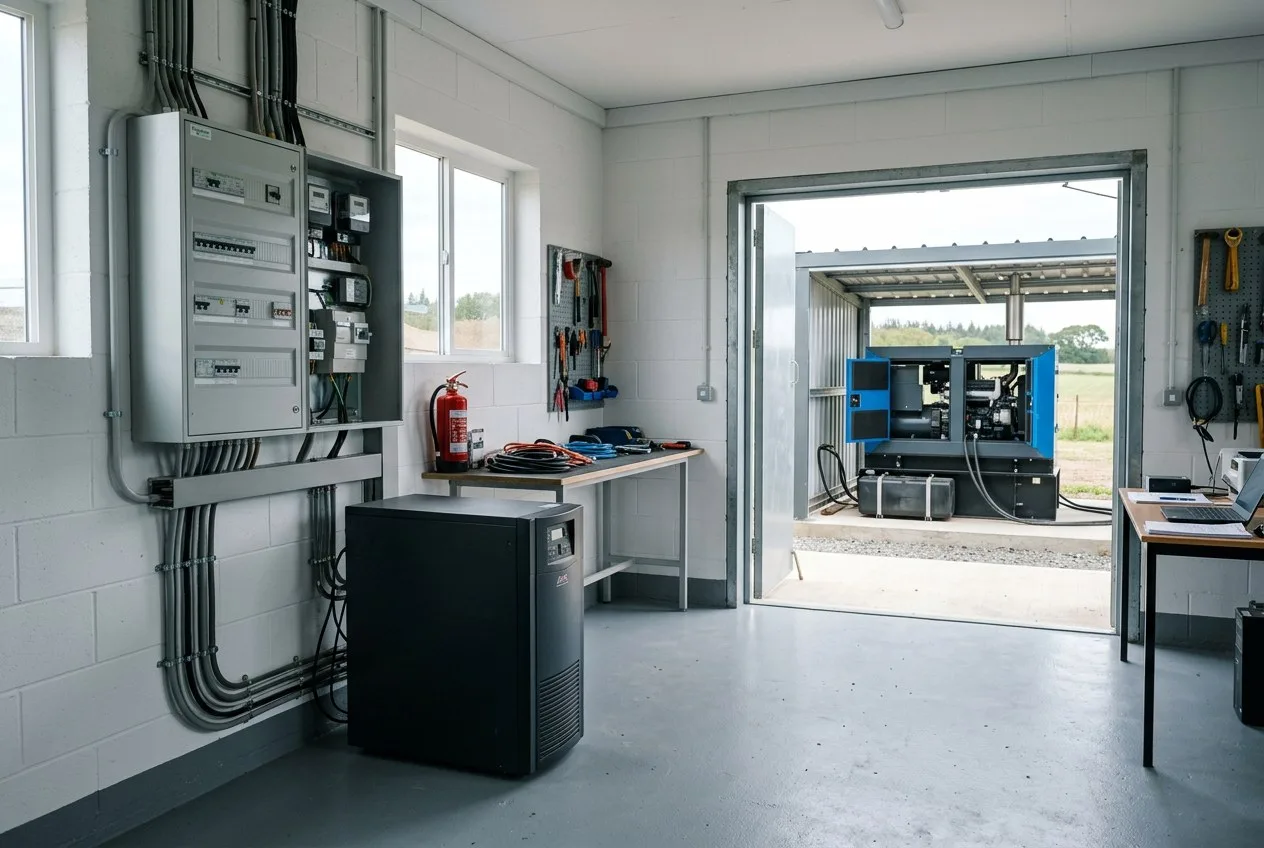
Poultry Ventilation: What Happens in Case of Outage, What Should Be Done?
In closed-system poultry houses (tunnel or negative pressure ventilation), when the fans stop, ammonia, carbon dioxide and heat accumulate rapidly; in the building, which is densely livestock, this accumulation is combined with a decrease in oxygen. It would be misleading to give an exact figure in time, because bird age, density, outside temperature and humidity determine the result. The rule is: in the warm season, the response time is measured in minutes.
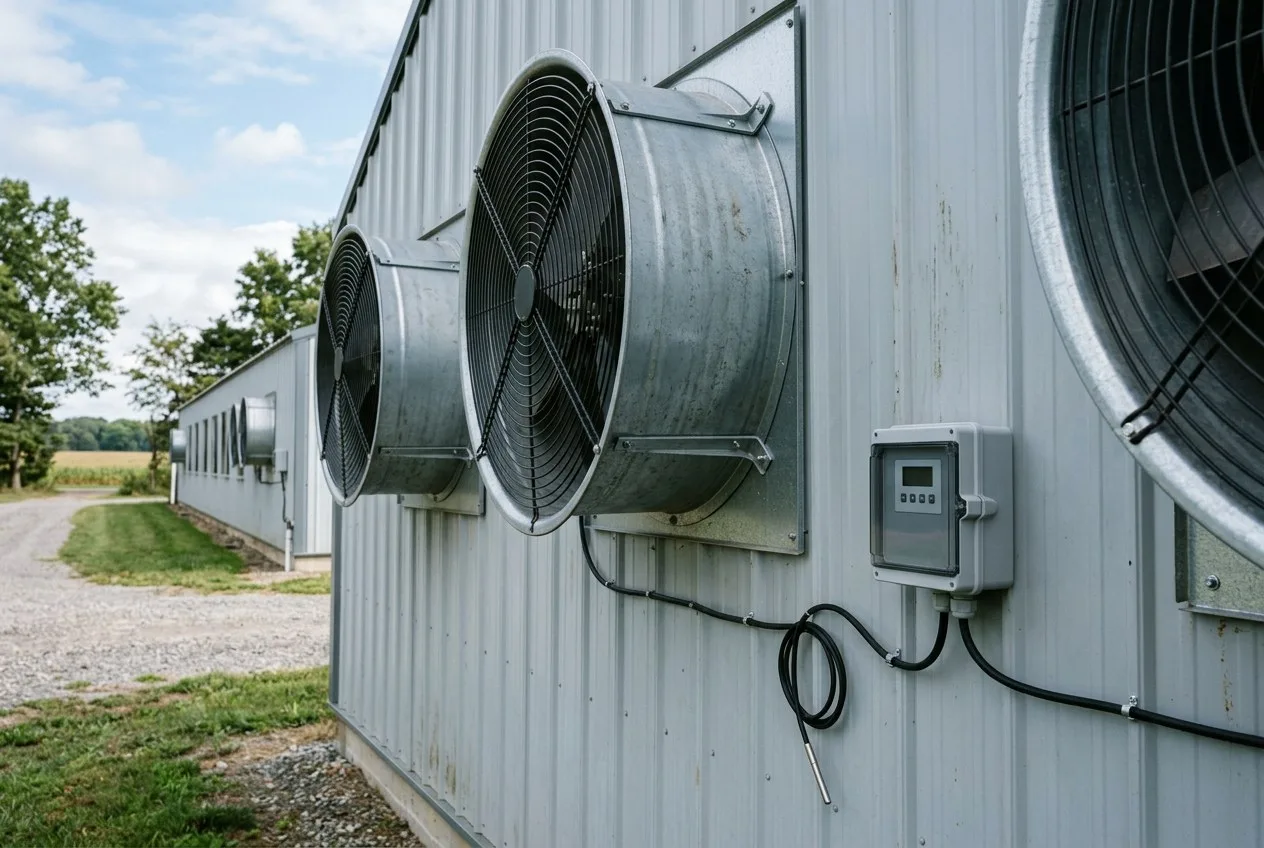
Does it make sense to power fans with UPS?
Let's see it with a hypothetical calculation. Let's assume that the motor power of a common tunnel fan is around 1.1 kW (the actual value is written on the fan's data label). If there are 24 fans, the total is about 26 kW. Even just 10 minutes of transportation requires 26 kW of energy ≈ 26 kW × (10/60) hours; taking into account the inverter efficiency and the usable capacity of the battery, a 7-8 kWh battery and a corresponding motor load-resistant UPS are required. Moreover, all motors drawing starting current at the same time can overload the UPS. Therefore, the backup of the fan group is the generator economically and technically.
The real role of the UPS in the coop
- Keeping the climate controller afloat: If the controller restarts when the power goes and the generator is restored, the fans may lose their stage and set values. If the controller remains in the UPS, the system will not reset itself during the transition.
- Protecting alarm and communication: The temperature sensor, alarm siren and GSM notification module also work in case of outage; you learn about the outage before the animal in the coop.
- Bridging the generator passage gap: It usually takes about ten seconds for the generator to start. During this interval, the control and communication circuit remains uninterrupted.
- Reducing single-point failure: Have a separate backup alarm line and manual intervention plan for situations such as panel failure.
In sectors such as incubators and poultry houses, the frequency and synchronization compatibility of the UPS working with the generator is also important; this issue Frequency and synchronization problems in generator-fed UPS We mention it in the article.
Uninterrupted Power in Hatcheries: Temperature, Humidity, and Airflow
The incubator (setter and hatcher) keeps three things in balance: temperature, humidity and air exchange. The target temperature for the egg varies depending on the species and stage; in the poultry, a narrow band is usually used, usually in the range of 37-38 °C, the exact values are determined by the machine builder and hatchery protocol. Cutback tolerance also depends on the stage of development; therefore, there is no single "safe period".
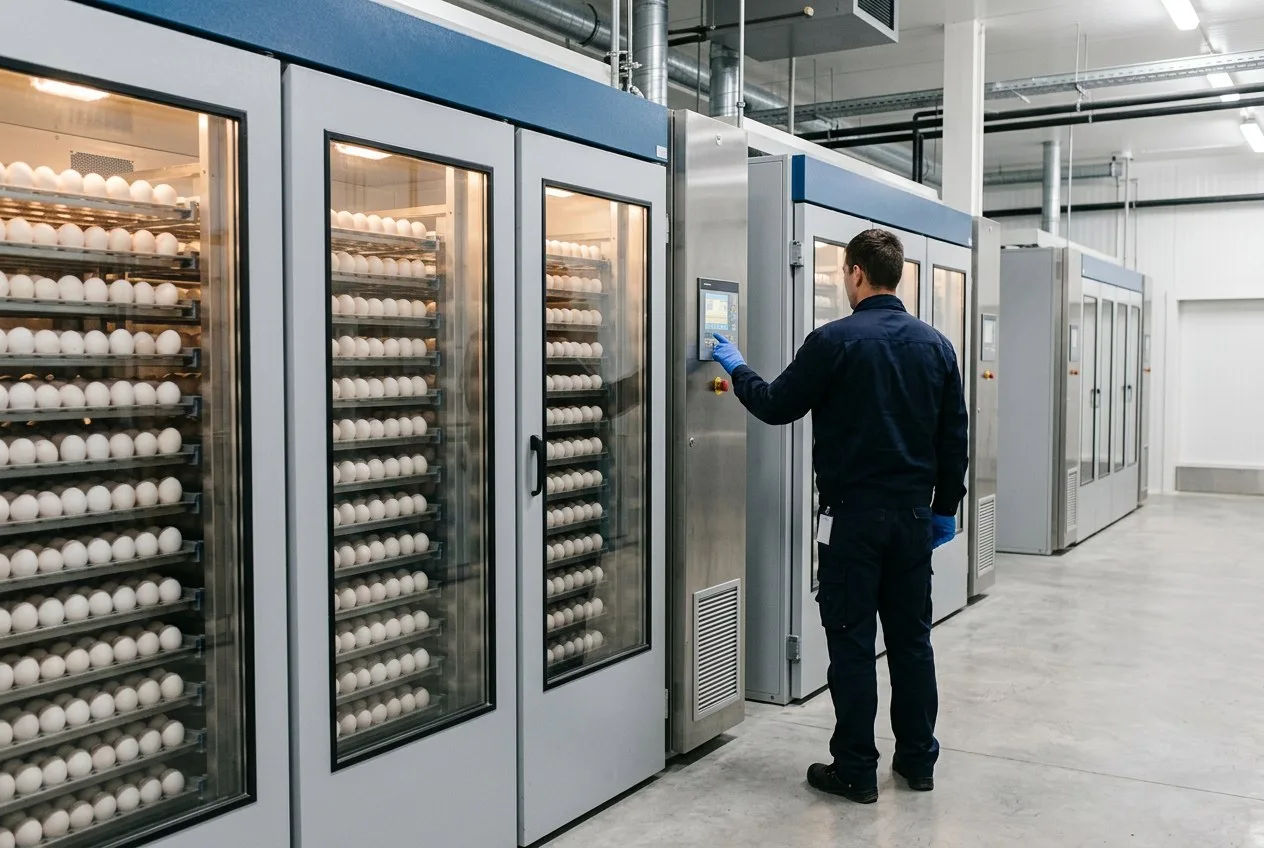
Small and large incubation units
- Small, single-machine units: If the heater load is limited, a properly sized UPS can carry the machine in short interruptions. However, the heater load should be read from the machine label and it should be checked whether the UPS can carry this load as actual power (W).
- Large multi-machine hatcheries: Heating, humidification and fan load are high. It is the main backup generator; UPS protects machine control boards, sensor lines, monitoring computer and alarm.
Control questions for the hatchery
- Does the machine retain the program (flip, temperature curve) when the control card restarts in the interrupt?
- How is the inrush between machines sequenced during generator transition?
- Who is notified at the time of the outage and in what way?
- How long will the hatchery manager be able to intervene and is the manual plan written?
Milking Units and Milk Cooling Tank: What Does a UPS Carry and What Does a Generator Carry?
Milking in dairy cattle is a routine one-hour workflow; animals are used to being milked at certain times, and delay affects both animal health and milk quantity. The vacuum pump, milk pump, cooling tank compressor, and mixer are the motor loads. These loads are connected to the generator.
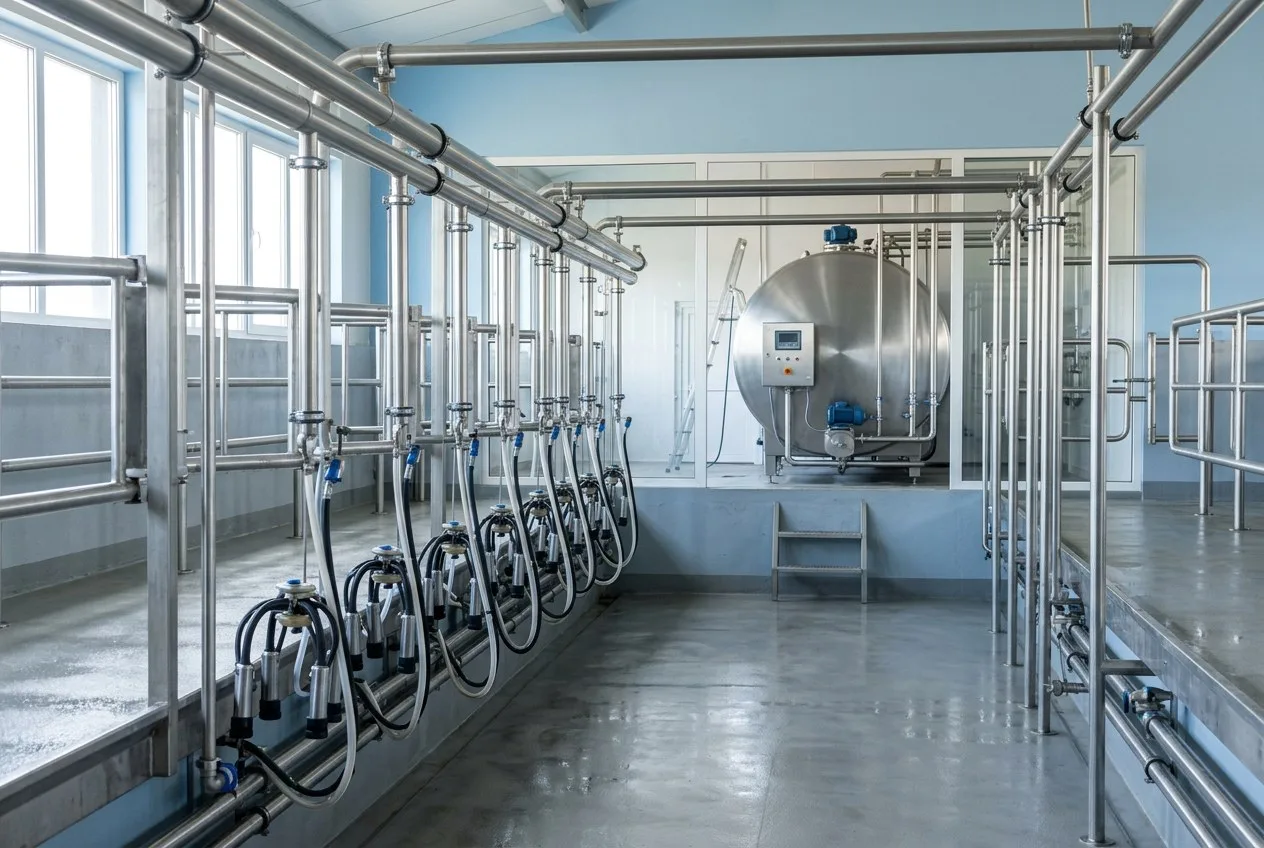
UPS's role is the software and registration side:
- Milking automation and animal recognition system: Milk data, activity and feeding records per animal can be corrupted in a momentary outage; UPS protects computer and readers.
- Cooling tank temperature monitoring and alarm: The device, which monitors the temperature of the milk tank and warns when it rises, should continue to work even when the power is cut off.
- Network and remote access: The cameras, router, and data logger must remain standing to monitor and report the outage.
For a more general version of cold chain logic Cold Storage and Cold Chain Monitoring The approach in the article also applies to the milk tank: The UPS does not start the compressor, it allows the temperature to be monitored and the alarm to go away.
In more complex systems such as robotic milking, the robot arm, hydraulics and compressors should be evaluated separately; if there is an interruption during milking, the safety of the animal and the safe stance of the robot should be planned according to the manufacturer's instructions.
Example Calculation: UPS Sizing for Control and Alarm Layer
The following example is for maintaining the control and communication load in a poultry house technical room. Values are assumptions; device labels should be measured in the actual project.
| Device | Power (W) |
|---|---|
| Climate control unit | 100 |
| Sensor and I/O modules | 60 |
| Alarm, siren and GSM module | 40 |
| Router and switch | 40 |
| Monitoring computer and display | 160 |
| Total | 400 W |
Step 1 – UPS power. If we accept the power factor as 0.8, 400 W / 0.8 = 500 VA. Leaving a 25 percent share, approximately 625 VA; 1000 VA, the upper standard class in the market, can be selected. For the difference between wattage and VA How to calculate UPS power See the article.
Step 2 – Battery energy. Let the target backup time be 2 hours. If the inverter efficiency is accepted as 90 percent, the power drawn by the battery is 400 / 0.9 ≈ 445 W. The energy required is 445 W × 890 Wh ≈ 2 hours.
Step 3 – Battery capacity. Assuming a usable depth of discharge of 80 percent and a battery aging allowance of 20 percent, the nominal energy required is 890 / (0.8 × 0.8) ≈ 1390 Wh. In a 24 V array, this corresponds to about 58 Ah (1390 / 24); in practice, a battery block of 24 V, 65-100 Ah is chosen. If the ambient temperature is low or high, the capacity changes.
This result indicates that the control and alarm will be standing for about 2 hours; in a plan where the generator is activated in a short time, this time is a very comfortable margin of safety. For detailed calculation of battery time How to calculate battery time on UPS and battery inverter You can check the article. The discharge curves in the manufacturer's data sheet should be taken as basis.
UPS and Generator Together: Crafting the Transition Moment
When the power goes out, the sequence of events works as follows: The UPS switches to the battery within a few milliseconds, the automatic transfer switch detects the mains loss, the generator starts, and when the voltage and frequency settle, the load is taken to the generator. The UPS sees the generator again as the mains and starts charging the battery.
- The generator capacity should also include the UPS charging load. Otherwise, the generator may become overloaded after the switch.
- Fuel and maintenance continuity: In the general conditions of insurance, there is a weekly full load test and generator service contract requirement for this (TARSİM General Conditions, 2026) .
- Selectivity: If a fan motor experiences a short circuit, the entire output of the UPS must not collapse; protection devices must be selected staggered. For details Short circuit, overcurrent and selectivity in UPS output See the article.
- Redundancy: Only one UPS becomes a single point of failure. Critical hatchery and large enterprises Redundancy in UPS (N+1, 2N, parallel) options.
Farm Environment Is UPS and Battery: Settlement and Protection
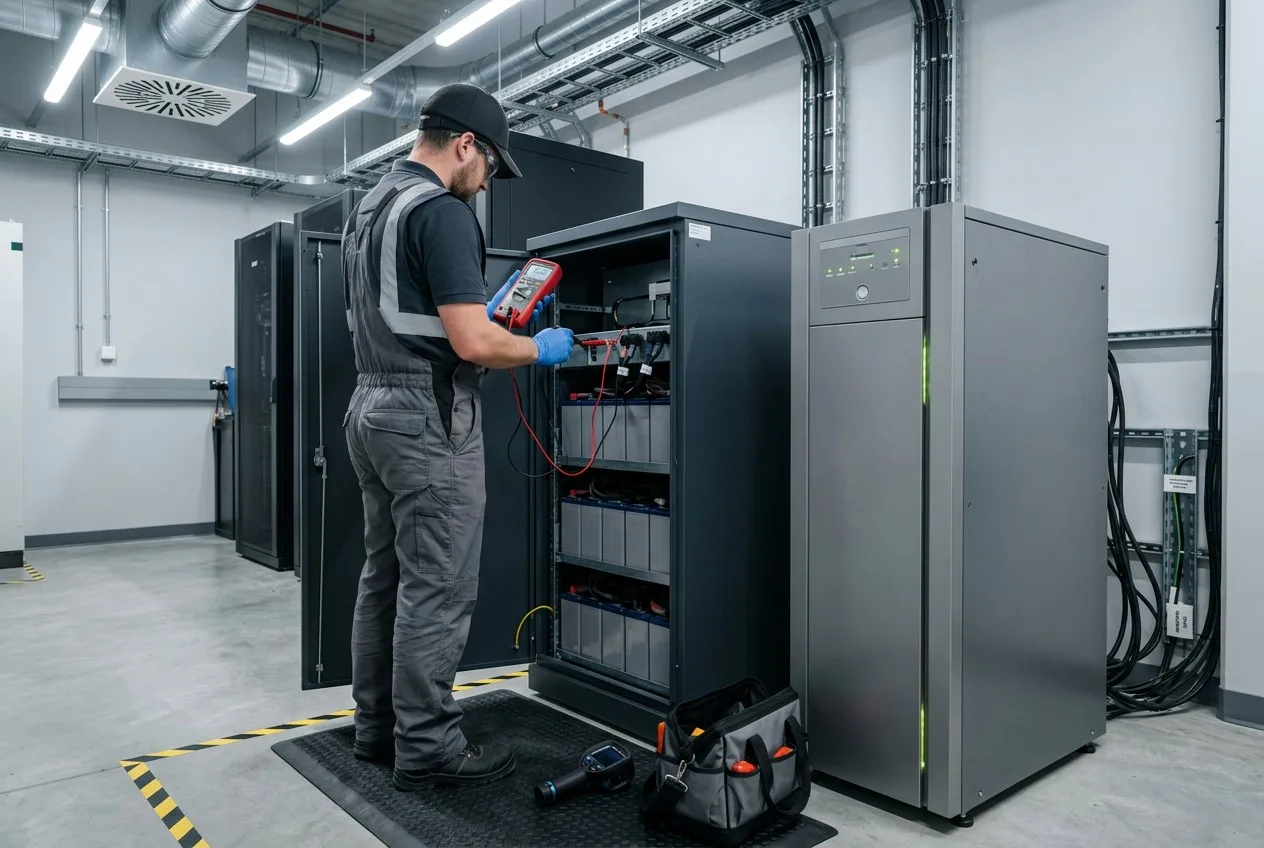
In livestock facilities, dust, ammonia, moisture, rodents and temperature fluctuations are the biggest enemies of electronic devices. A UPS left exposed in the house can cause fan and board failure in a short time. Battery life is also temperature sensitive; typically lead-acid battery life is noticeably shorter as the ambient temperature increases (the exact effect should be read from the manufacturer's data sheet).
| Problem | Possible cause | Caution |
|---|---|---|
| UPS fan stops frequently / overheating | Dust and lint accumulation, closed closet | Transport to clean technical room, filter and regular cleaning |
| Corrosion on the board and connector | Ammonia and moisture | Separate room from gases, protected panel, humidity control |
| Shortening battery life | Warm environment, summer period | Ventilated cool room, annual battery test |
| Cable gnawing | Rodents | Cable tray, closed enclosure, regular inspection |
| Failure after lightning and network impact | Rural line, long overhead network | Surge arrester, grounding control, post-impact UPS control |
Network quality on rural lines may differ from the city; in areas where the risk of voltage fluctuations and sudden impacts is high Sudden Voltage Impulses and Surge Arrester protection should be considered in conjunction with UPS. Planned outages are announced by distribution companies; rural neighborhoods and cluster houses are frequently included in these programs, so keeping an eye on planned outage announcements is part of the preparation.
When working with the battery, there is a risk of high DC voltage, arcing and short circuit. Battery connection, wiring and commissioning of the UPS must be carried out by authorized electrical personnel or technical service.
Outage Alarm and Remote Monitoring
A good uninterruptible power plan doesn't just keep appliances afloat, it keeps you in the know. This is even more important when the farm is far from the settlement.
- Power outage notification: When the network voltage is lost, a notification should be sent via GSM or the internet.
- Temperature threshold alarm: If the temperature inside the poultry house exceeds the specified limit, it gives a warning even if the fan is running.
- Generator failure to start alarm: If the load is still not in the generator after a certain period of time after the outage notification arrives, the second warning should go away.
- UPS tracking: Network card or communication module that shows the battery level and remaining time. About the topic UPS remote monitoring and alarm management You can take a look at the article.
The alarm device itself must also be fed with a backup. If the alarm system is fed from the same panel and silenced with the panel failure, the failure of a single panel can silently turn into a disaster, as in the case where 4 thousand chickens were lost. For this reason, it is good practice to feed the alarm with a separate circuit and a separate battery.
Emergency Action Plan and Periodic Checklist
A registered business order is as important as the technical solution. The emergency action plan, qualified electrician control and generator test required in the general conditions of insurance are part of this order (Insurance Association of Turkey, General Conditions of Poultry) . The table below is a starting point; tailor frequencies to your business and manufacturer recommendations.
| Control | Recommended frequency | Note |
|---|---|---|
| Generator full load test and recording | Weekly | The application stipulated in the general conditions; fuel, oil and battery are also checked |
| General control of the electrical system | At least once every three months | By a qualified electrician, registered |
| UPS visual and alarm control | Monthly | Fan, dust, display alerts, ambient temperature |
| UPS battery test | Annual or pre-season | Capacity and condition test; recommended before summer |
| Outage simulation | At the beginning of the season | Planned and observed, when there are no animals or by managing risks |
| Alarm and notification testing | Monthly | Does the SMS/call really arrive? |
For battery test types and interpretation What is a UPS battery test and for maintenance order UPS maintenance agreement His articles will be useful to you.
Common Mistakes
- Trying to protect the entire facility with one UPS. For large engine loads, it creates battery cost and starting current problems.
- Putting the UPS into the chicken coop, dust and ammonia environment. It seriously shortens the life of the device.
- Not trying the generator. A generator with a dead fuel and a weak battery will not start in the event of an outage.
- Leaving the alarm unprotected. When the electricity goes out, the alarm goes silent, leaving the system blind.
- Sizing without measuring the actual load. The device label and typical values may differ from the actual consumption.
- Not testing the old battery in pre-season. The battery status should be known before summer heat and busy periods.
Issues Related to Other Sectors
If there are units such as clinics, warehouses or refueling points next to the farm, you can find additional tips in the relevant articles: for units that provide animal health services UPS for veterinary clinics, for feed and product storage UPS for warehouses and fulfillment centers, for on-farm fuel points UPS for fuel stations can be consulted.
How to Get Started? Short Road Map
- List critical loads: those that affect life (fan, heating, cooling), those that affect data (control, recording), those that affect communication (alarm, network).
- Read the strength of each load on the label, note the starting current for the motors.
- Review generator capacity and automatic start-up pattern.
- Size the UPS for the control and alarm layer similar to the example above.
- Choose a clean, ventilated layout; create a periodic maintenance and battery testing plan.
- Prepare a written emergency action plan and simulate an outage at the beginning of the season.
If you want to determine your UPS and battery needs on-site to protect the control, alarm and communication loads in your poultry, hatchery and milking facilities, the Bempower team is at your side with exploration, installation, periodic maintenance and technical service services. For on-site service in Istanbul and surrounding provinces from the contact page You can contact us.
- General Conditions for State-Supported Poultry Life Insurance - 2026 — TARSİM (Agricultural Insurance Pool), 2026. https://www.tarsim.gov.tr/staticweb/krm-web/mevzuatlar/genel-sartlar/2026/kumes-genel-sartlar.pdf
- General Conditions for State-Supported Poultry Life Insurance (2024) — Insurance Association of Turkey, 2024. https://tsb.org.tr/content/Legislations/kumes-genel-sartlar-2024.pdf
- Poultry Life Insurance — Serik Insurance, 2026. https://seriksigorta.com/kumes-hayvanlari-hayat-sigortasi/
- 4 thousand chickens perished when the ventilation of the coop was disabled — Yeni Adım Newspaper, 2026. https://www.yeniadimgazetesi.com/kumesin-havalandirmasi-devre-disi-kalinca-4-bin-tavuk-telef-oldu
Resources
