


How Long Does a 20 kVA UPS Work? Duration Table and Calculation

20 kVA UPS; It is used for small data rooms, control systems of production lines, laboratories, building automation and critical office floors. At this power, 12 V batteries are connected in series of more than 30 units, and the battery cabinet is as big an investment as the UPS itself. In this article, we explained the time table, calculation method and how many batteries can be connected to the UPS.
Short answer
The DC voltage of a 20 kVA UPS varies depending on the model. For most three-phase models, it is around 360-480 V (30-40 x 12 V batteries). Some models have 240 V (20 batteries). Refer to the label and data sheet for the number of batteries. Approximate times for 384 V (32 batteries):
- At full load (approx. 18000 W) with 26 Ah batteries: 10-12 minutes
- At half load (approx. 9000 W) with 26 Ah batteries: 25-30 minutes
- At half load with 65 Ah batteries: approx. 1 hour 30 minutes
- At half load with 100 Ah batteries: approx. 2 hours 40 minutes
There is practically no work with small (7-9 Ah) batteries of this power.
How many watts does a 20 kVA UPS carry?
- In a UPS with a power factor of 0.9, 20 kVA is approximately 18000 W does.
- In the model with a power factor of 1.0 20000 W does.
- In the old model with a power factor of 0.8 16000 W does.
The power factor is written in the data sheet. See What is Power Factor?.
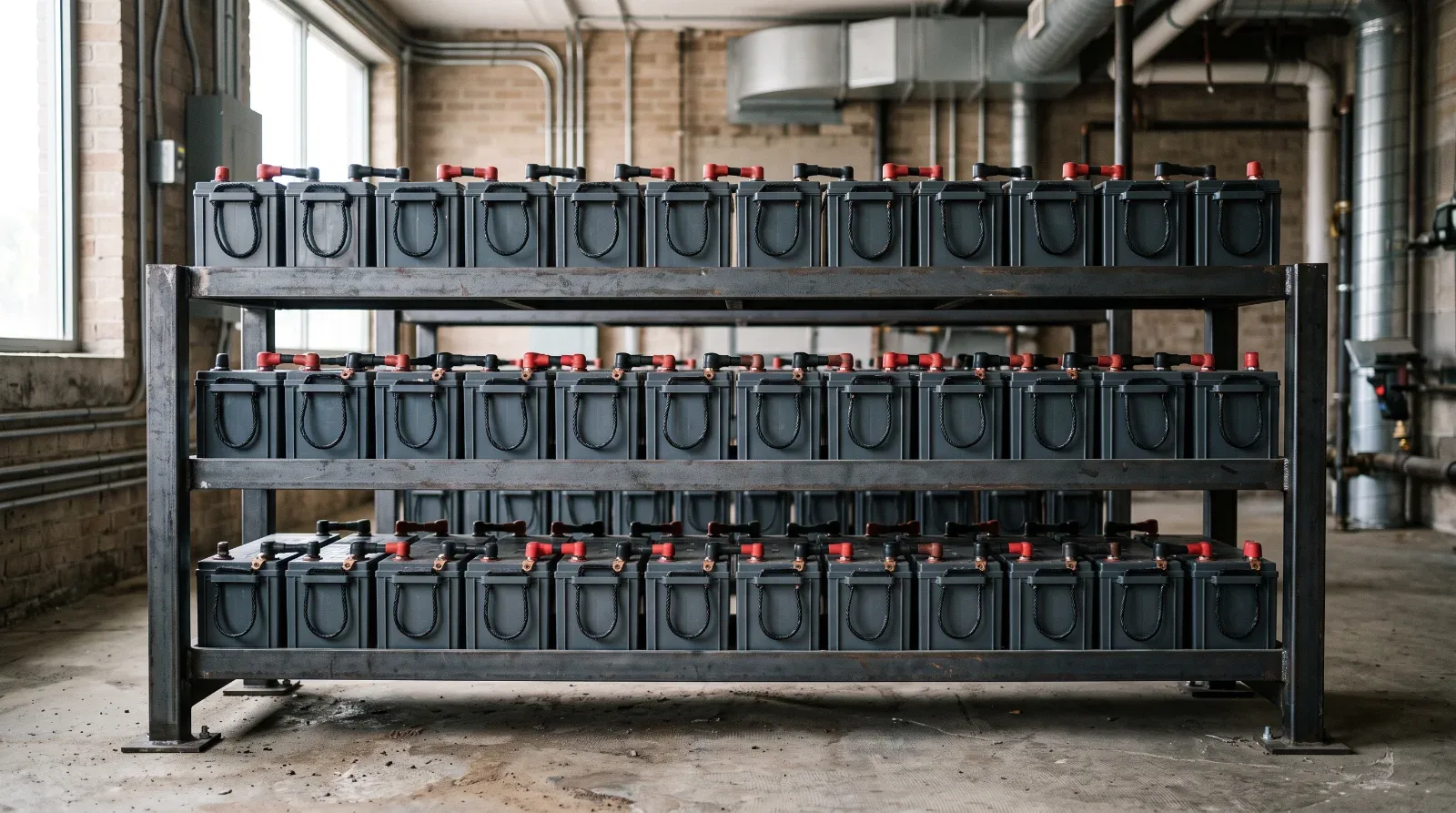
Time table for 20 kVA UPS (32 x 12 V batteries, 384 V DC)
Durations for new VRLA/AGM battery, 25 °C and 0.9 power factor and 90% UPS efficiency They are rough calculations. The actual time may deviate by 20-30% ± depending on the model.
| Ah on each battery | Full load (18000 W) | 75% load (13500 W) | Half load (9000 W) | 25% load (4500 W) |
|---|---|---|---|---|
| 26 Ah | 11 min | 16 min | 28 min | 1 hr 10 min |
| 40 Ah | 20 min | 29 min | 48 min | 2 h |
| 65 Ah | 37 min | 54 min | 1 hr 30 min | 3 hr 40 min |
| 100 Ah | 1 hr 5 min | 1 hr 35 min | 2 hr 40 min | 6 h |
| 150 Ah | 1 hr 50 min | 2 hr 40 min | 4 hr 20 min | 9 hr 30 min |
| 200 Ah | 2 hr 40 min | 3 hr 45 min | 6 h | Over 12 h |
On 240V (20 cord) version times are much shorter. For example, you get about 6 minutes at full load with 26 Ah batteries, about 20 minutes with 65 Ah batteries, and about 35 minutes with 100 Ah batteries. Because more current is drawn from each battery. Therefore, a high-voltage UPS with the same Ah value gives a longer time.

Example calculation: 12000 W load in data room
In a data room, servers, storage, network devices and control equipment draw a total of 12000 W. The UPS is 384 V, there are 32 65 Ah batteries in the battery cabinet.
- Battery energy: 32 × 12 V × 65 Ah = 24960 Wh.
- Current: 12000 ÷ (0.9 × 32 × 11.5 V) = approximately 36.2 A.
- C-rate: 36.2 ÷ 65 = approximately 0.56.
- Available rate: Since the C-ratio is between 0.5-1, it is 0.50 (for the ratio table 1 kVA inscription see).
- Duration: 24960 × 0.50 ÷ 12000 = 1.04 hours, so about 62 minutes.
If the goal is 30 minutes, also look with 40 Ah batteries: Wh = 15360, C-ratio approx. 0.9, ratio 0.50. Duration = 15360 × 0.50 ÷ 12000 = approx 38 min. So 40 Ah is enough for the 30-minute target.
What is the maximum amount of battery connected to a 20 kVA UPS?
The number of batteries is fixed
Depending on the model, the DC voltage is generated by connecting 20, 30, 32 or 40 12 V batteries in series. You cannot change this number. To extend the time, you can switch to batteries with larger Ah or add parallel from the same string. The number of parallel strings is usually limited to 2-4. Refer to the manufacturer's data sheet. See What is a Battery String?.
Charging current is the most important limit
At this power, the charging current is between a few and 10 A in standard models. In long-run models, it can be 20 A or more. The exact value is in the data sheet.
Rule: Ah = charging current × 10 (comfortable) to 20 × (limit).
| UPS charging current | Recommended maximum battery (Ah) | Full charge time (roughly) |
|---|---|---|
| 4 A | 40-80 Ah | 12-24 hours |
| 8 A | 80-160 Ah | 12-24 hours |
| 12 A | 120-240 Ah | 12-24 hours |
| 20 A | 200-400 Ah | 12-24 hours |
Coarse charging time: Ah × 1.2 ÷ charging current (hours). For 65 Ah in the data room example above, 4-6 A is sufficient. For a group of 200 Ah, at least 10 A is recommended.
DC current, cable and protection
At full load, the DC current is approximately 54 A in the 384 V model and approximately 87 A in the 240 V model. 87 A requires serious calculation in cable cross-section and DC fuse selection. Therefore, structures with high voltage (384 V and above) at 20 kVA are preferred.
Weight, space and ventilation
32 12 V 65 Ah batteries hold approximately 610-670 kg. Floor load, cabinet size, and ventilation should be checked before installation. Battery rooms require ventilation to prevent hydrogen build-up. See Lithium Battery Cabinet Installation: Layout, Ventilation, and Safety Distances (written for lithium, the principles of settlement are similar).
Highest Ah battery
The practical upper limit for single-block 12 V batteries is around 200 Ah. At this level, 2 V cells (OPzV/OPzS) and lithium solutions come to the fore. See What is OPzS and OPzV Battery? and Lithium-Ion UPS Batteries.
Security: 360-480 V DC is life-threatening. Battery addition, cabin connection and insurance are the work of authorized personnel.
How do you plan to grow at 20 kVA?
- Parallel UPS: If two UPSs run in parallel, capacity is increased or redundancy (N+1) is provided. See Parallel UPS Installation and Load Sharing and What is Redundancy in UPS?.
- Modular UPS: Power grows with the module. See What is a Modular UPS?.
- Generator: Installed with UPS for long outages. See Differences Between UPS and Generator.
- Data center design: See UPS Architecture in Data Centers.
Summary for all kVA classes on one page: How Long Does a UPS Work? kVA Guide
Frequently Asked Questions
01Does a 20 kVA UPS run for 1 hour?
02Should a 20 kVA UPS be three phase?
03How many years do batteries last?
04How do I verify duration?
Let's Choose the Right UPS Together
Tell us your load and the time you want, and we will determine the UPS power, battery cabinet and capacity together. Our three-phase online UPS models or You can contact us.
