What is UPS Bypass? Differences Between Static Bypass and Maintenance Bypass

Many users who see the text "bypass" on the UPS screen think that there is no problem because the devices continue to work. However, bypass means that the load is fed directly from the mains, not from the inverter of the UPS. In the meantime, the loads work, but The protection provided by the UPS is disabled.
In this article, we explain why bypass is needed, the two different types of bypass, and what it means for the UPS to remain in bypass.
Why is Bypass Necessary?
In an online (double conversion) UPS, the load is normally fed through the continuous inverter. When the inverter fails, is overloaded, or the UPS needs to be serviced, a second path is required to keep the load supplied. This path bypasses the inverter and connects the load to the grid bypass line.
The bypass line is fed from the UPS's own inlet or, in some systems, from a separate bypass inlet. The difference in the operation of UPS types Types of UPS We explained it in our article.
How Does Static (Automatic) Bypass Work?
A static bypass is a semiconductor switch inside a UPS. It has no moving parts; the control system of the UPS transfers the load to the grid in a very short time without human intervention when necessary. In small online models, the same task can be done with a relay; in this case, there may be an interruption of a few milliseconds in the transition. The main reasons for tripping are:
- Overload: The UPS can carry the load exceeding its power for a short period of time, which varies depending on the size of the load and the model; when the time is up, it transfers the load to the bypass.
- Inverter or internal fault: Inverter error, a problem with the internal circuitry or overheating.
- Short circuit at the output: Some models take advantage of the network's higher short-circuit current to blow the fuse of the faulty line at the output.
- User or service command: Switching the UPS menu to bypass mode.
When the cause disappears, many UPSs automatically switch to inverters. If there are many transits in a short period of time, some models remain in bypass and wait for service intervention.
Synchronous condition
In order for the transition to be uninterrupted in terms of load, the output of the inverter and the voltage, frequency and phase of the bypass line must follow each other. The UPS monitors this continuously. If the bypass source is out of bounds, for example in a generator whose frequency changes, the UPS either blocks the passage or passes through it with a short interruption according to its setting. This interruption can shut down sensitive loads.
Maintenance (Manual) Bypass
The maintenance bypass consists of manually operated switches. It can be inside the UPS or a separate on the external bypass panel can also be found. The external panel allows the UPS to be completely de-energized, dismantled and replaced if necessary; while with the internal bypass, parts of the UPS cabinet can remain energized.
There is a sequence for switching to maintenance bypass: the load is first taken to static bypass, then the maintenance bypass switch is activated (the load is connected to the mains), then the output, input and battery switches of the UPS are deactivated. This is a general order; in practice, the instructions of the UPS manufacturer apply and only trained personnel perform the operation. If the sequence is disturbed, the load may be de-energized or two non-synchronous sources may be connected to each other, damaging the UPS. For this reason, many bypass panels have locking mechanisms that prevent incorrect ordering. Location of the panel in the installation How to set up a UPS We explained it in our article.
Differences Between the Two Bypass
| Static bypass | Maintenance bypass | |
|---|---|---|
| Structure | Semiconductor switch in UPS | Manually operated switches |
| Engaging | Automatic, in a very short time | By hand, in a specific order |
| When? | Overload, internal failure, inverter error | Scheduled maintenance, repair, UPS replacement |
| The state of UPS | Works, energizes | Can be disabled |
| Is the load protected? | Nope | Nope |
Eco (High Efficiency) Mode
In eco mode, which is available in many online UPSs, the load is deliberately fed through the bypass line when the grid is smooth; the inverter hibernates. Efficiency increases as conversion loss decreases. When the grid fails, the UPS switches to the inverter, but this transition may involve a short transfer time depending on the model. In this mode, the UPS does not provide the protection provided by the VFI class in IEC 62040-3 (ECO mode) Types of UPS We briefly explained it in our article). Turning on echo mode at critical loads should be a conscious decision.
Load is unprotected during bypass
During the time spent in the bypass, voltage fluctuations, pulses and frequency deviations in the network reach the load directly. In eco mode, the load passes to the inverter with a short transfer in case of interruption, since the inverter is on standby; in the maintenance bypass and in the static bypass due to fault or overload, this backup is also absent. When the power is cut off:
- If the load is in maintenance bypass, it shuts down directly; the UPS is not activated.
- If the load is in static bypass, whether the UPS can return to the inverter depends on the reason for switching to the bypass. If there is an inverter malfunction or an ongoing overload, it cannot return most of the time.
Therefore, maintenance and repair works are planned when the network is stable and the risk to loads is minimal.
If UPS Stays on Bypass All the Time
If the eco mode was not deliberately selected, the cause of a UPS that has been in bypass for a long time should be investigated. Common causes:
- Connected load exceeds UPS power; approximate load Power Calculation You can check with our tool
- Inverter or control circuit failure
- Overheating: clogged filters, faulty fans, hot room
- Leaving the UPS in manual bypass after maintenance or forgetting the maintenance bypass switch in operation
- UPS locking itself in bypass after successive passes
Alarm and event records on the UPS screen are the first clue to understand the cause. Other signs of malfunction Why does a UPS fail You can find it in our article.
Don'ts
- Using bypass switches without training or authorization
- Turning switches on and off without knowing the passage sequence
- Resetting the alarm repeatedly without knowing the reason
- Adding new load to the UPS in the bypass
- Opening the covers of the UPS; even when the device is turned off, there may be dangerous voltage inside
Bypass passes, Authorized Technical Personnel and should be tried in periodic maintenance as well as commissioning. What is looked for in maintenance UPS maintenance checklist We collected it in our article.
Major Cases of Bypass
Situations where the UPS transfers the load from the inverter to the grid and things to keep in mind during bypass.

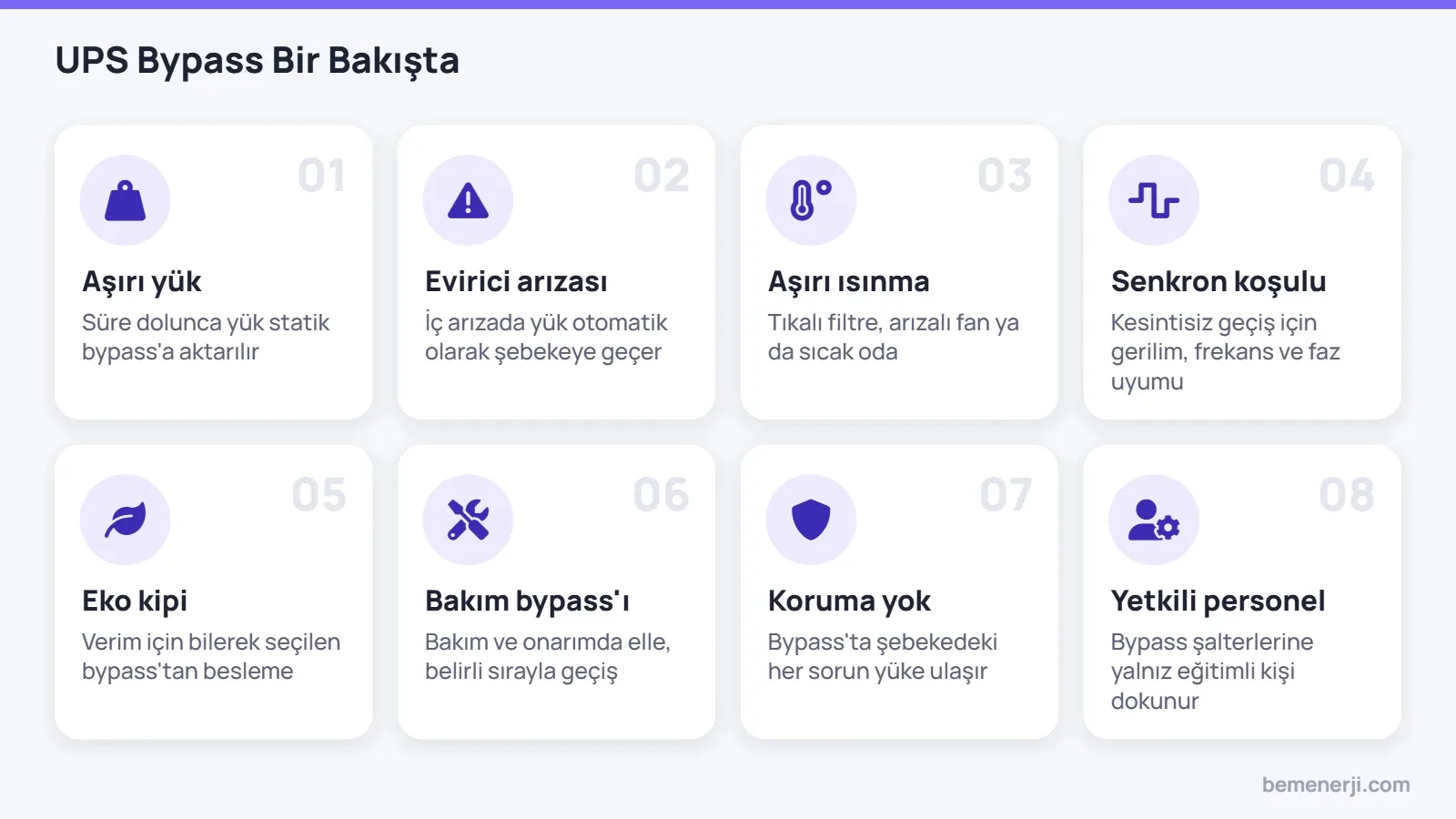
Static bypass is automatic, maintenance bypass is activated manually; in both, the load is removed from the protection of the UPS. You can find the details in the rest of the article.
Frequently Asked Questions
01Are my devices protected while on UPS bypass?
02Do devices turn off when switching to bypass?
03Why does a UPS give a bypass warning when working with a generator?
04Should I turn on Eco mode?
05UPS won't exit bypass; can I reboot?
Is Your UPS Stuck in Bypass?
We diagnose UPS of all brands and models on-site throughout Istanbul and in the surrounding provinces, and undertake the repair; Fault detection in Istanbul is free of charge. Process Fault Detection and Technical Service On our page, we can install the new system including the maintenance bypass panel. UPS Installation and Assembly We explained it on our page. The brand and model of your UPS, the alarm on the screen Send us; Let's evaluate it together.