What are the Factors Affecting Battery Life? How to Extend Battery Life?

Of two sets of batteries of the same make and model, one may easily reach the end of its design life, while the other may lose its charge within a few years. The difference is often not in the battery itself, but under the conditions in which he works. In this article, we discuss the factors that determine the lifespan of UPS batteries and what can be done to extend that lifespan.
Design Life and Service Life Are Not the Same Thing
Design life, the duration specified by the manufacturer under ideal conditions (typically 20 °C, or 25 °C for some manufacturers; proper charging, infrequent discharging). Service life ...is actually how long the battery lasts in your environment, and it’s usually shorter. Battery classes and how temperature shortens their lifespan When should a UPS battery be replaced? We explained this in our article; here, we’re examining the factors one by one.
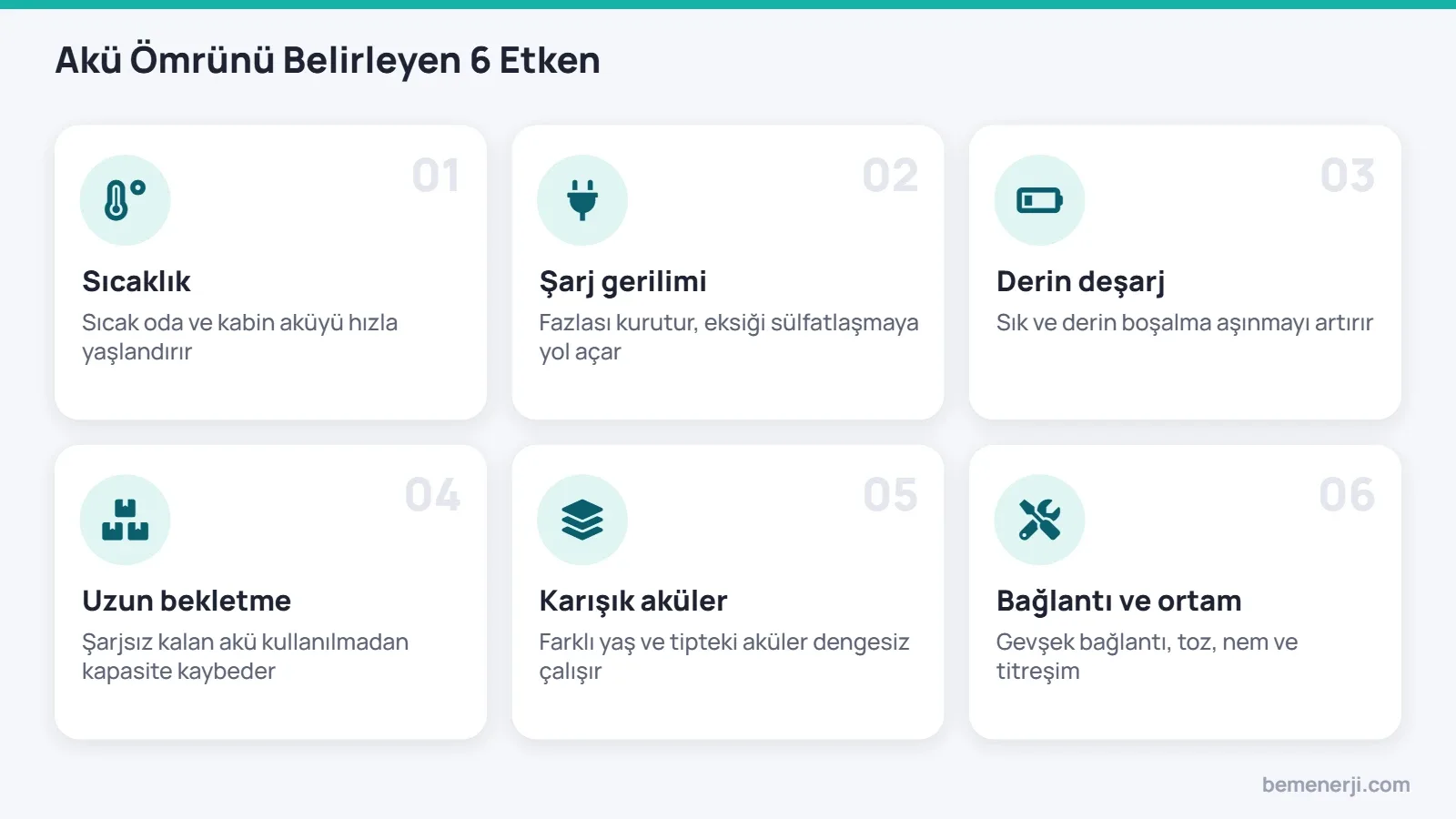
Temperature: The Most Significant Factor
The temperature in the battery room alone does not provide sufficient information. The batteries’ the point where it actually is You need to check the temperature:
- Battery cabinets located near the UPS's hot air outlet may be significantly warmer than room temperature.
- The upper shelves inside the cabin may be warmer than the lower ones; as a result, batteries in the same group age at different rates.
- Environments exposed to direct sunlight, located near a heater, or with ventilation shut off can rapidly shorten its lifespan.
What is a thermal leak?
In sealed (VRLA) batteries, when high temperature and high charging voltage occur simultaneously, the charging current increases, the battery heats up, and the heated battery draws even more current. This vicious cycle thermal leak ...is known as; the result is battery swelling and damage. This is rare in systems with proper charge settings, active temperature compensation, and adequate ventilation; these precautions largely prevent it. Regular monitoring allows for early detection of the problem.
Charging Voltage: Neither Too High Nor Too Low
A UPS keeps the batteries at a constant with buffer (float) voltage maintains a fully charged voltage. This value varies by manufacturer; for 12-volt VRLA batteries, it is typically in the range of 13.5–13.8 V at 20–25 °C.
- Overcharging: A battery emits gas; in sealed batteries, this loss is irreversible; over time, the battery dries up, it heats up and the plates corrode.
- Insufficient charge: The battery never fully charges; crystals form and harden on the plates (sulfation) and capacity decreases permanently.
- Temperature compensation: As the temperature rises, the charging voltage must be reduced slightly. If the UPS has a battery temperature sensor, it should be positioned near the batteries.
Discharge Depth and Number
Every power outage causes minor wear on the battery; the deeper the battery discharges, the greater the wear. This is why batteries wear out sooner in areas with frequent power outages. During long outages, the generator taking over the load quickly prevents the batteries from discharging deeply. It is also important to fully recharge the batteries without delay after a power outage: a battery left half-charged for a long time will become sulfated. Since a capacity test also involves a discharge, it should be performed as planned and at the required frequency; details battery discharge test in our article.
Holding and Storage
Lead-acid batteries gradually discharge even when not in use; this process is faster in warm environments. A battery left uncharged on a shelf for a long time can lose capacity even if it is never used. Therefore:
- Check the production dates of the batteries in the warehouse and perform a maintenance charge at the intervals recommended by the manufacturer.
- Batteries that have been sitting on a construction site or in a warehouse for months should be tested and, if necessary, recharged before being put into service.
- The backup time of new batteries connected to the UPS should not be measured before they are fully charged.
What factors were taken into account during the installation process? How to Set Up a UPS You can find it in our article.
Overlooked Factors
Ripple current
The direct current supplied by the charging circuit is not perfectly smooth; it contains a slight ripple. As this ripple increases, it causes the battery to heat up unnecessarily. Aging rectifiers or capacitors can increase the ripple; this is monitored by taking measurements during maintenance.
Batteries of mixed ages and types
In a series-connected battery bank, all batteries carry the same current. If there is a weak battery in the bank, that battery will charge and discharge more quickly, while the others will become overcharged or undercharged; as a result, the entire bank will wear out prematurely.
Links and Media
A loose connection creates resistance, generates heat, and can damage the battery terminal; a connection that is overtightened can also damage the terminal. For this reason, connections are made using the torque specified by the manufacturer. Dust and moisture cause corrosion and leakage currents at the terminals, while vibration can cause connections to loosen.
Monitoring Through Measurement
| Measurement | What does it indicate? |
|---|---|
| Internal resistance per battery | It alerts you to a weakening battery before the loss of capacity becomes noticeable |
| Buffer voltage per battery | The instability in the series and issues with the charging settings |
| Temperature and Thermal Imaging | Overheated battery and loose connections |
| Capacity (discharge) test | The group's actual backup time |
Rather than a single measurement, the values change over time It is important. What internal resistance tells us What is the internal resistance of a battery? We explained this in our article.
Practical Tips for Extending Battery Life
- Keep the area where the batteries are located cool and well-ventilated; position the battery cabinet away from the UPS's hot air outlet.
- Have the charging voltage and temperature compensation checked according to the manufacturer's specifications.
- After a power outage, allow the batteries to fully recharge; plan to use a generator for extended outages.
- Check the manufacturing date of spare or new batteries, and don’t leave them uncharged for long periods of time.
- Do not add batteries of different ages or types to the same group.
- Have the tightness of the connections and the terminals checked during routine maintenance.
- Record and compare internal resistance and voltage measurements.
Do not tamper with the battery terminals or the interior of the cabin; Battery banks carry high DC voltage; this work must be performed by authorized technical personnel. Despite all precautions, every battery will eventually wear out; how to determine when it’s time to replace it When should a UPS battery be replaced? We explained this in our article.
- EUROBAT — Guide to VRLA Stationary Batteries (2022) (shelf-life categories; half-life decreases by half for every 10 °C increase above 20 °C)
- Searles, K. — Understanding and Distinguishing Between Design Life, Service Life, Warranty, and Accelerated Life Testing, 2014
- Battery University — BU-403: Charging Lead-Acid Batteries (float voltage and temperature compensation)
- IEEE Std 1188-2005 — Recommended Practice for the Maintenance, Testing, and Replacement of Valve-Regulated Lead-Acid (VRLA) Batteries for Stationary Applications
Sources
Factors Determining Battery Life
Battery life is often determined by the conditions in which it operates rather than the battery itself.

Many of these factors are detected early with regular measurement and maintenance. With temperature, charge adjustment and connections under control, batteries get closer to their design life.
Frequently Asked Questions
01What is the ideal temperature for a battery room?
02Does keeping the battery room too cold extend life?
03Can a sulfated battery be saved?
04How should I store spare batteries?
05Does maintenance really extend battery life?
Let's Extend the Life of Your Batteries Together
We perform on-site measurement and periodic maintenance for UPS and battery packs of all brands and models. Maintenance scope Periodic Battery and UPS Maintenance, the process of change Battery Replacement and Reconditioning page. Your UPS model and battery information Send us, let's evaluate the condition of your batteries together.