


What is the Lifespan of a UPS? Life-Determining Components

There is no single answer to the question "How many years does this UPS last?" Because the UPS ages not like a single piece of device, but like a system where components with very different lifespans come together. While the battery completes its life in a few years, the body and power electronics can operate for more than ten years. This difference directly affects both budget planning and renewal time.
In this article, we discuss how the lifespan of the UPS is determined, the typical life ranges of the battery, capacitor, fan and other components, the effect of ambient temperature and load, together with simple calculation examples. Article; It was prepared for home and small office users, business owners, technical managers and purchasing units. The aim is to help you approach the question "when should I change it?" with measurable criteria, not predictions.
What is the lifespan of a UPS?
As a typical range for the body and electronic part in the sources published by the manufacturers about 7 to 10 years given; If the conditions are very good, the device can run longer than that . For large three-phase systems, evaluations based on field experience show that the device can serve much longer as long as its components are regularly renewed. Still, these figures are not a guarantee but a typical range; it is necessary to refer to the manufacturer's data sheet and service records for the exact value.
Design life, service life, and recommended replacement time
Three concepts related to life are often confused:
- Design life: It is the time that the manufacturer targets assuming ideal conditions. In the actual field, it usually falls below.
- Service life: It is the average time actually achieved in the field with the actual environment and load.
- Recommended replacement time: It is the time selected for the preventive replacement of the part before the probability of failure increases; it is shorter than the service life.
Eaton's white paper on the aging of three-phase UPSs tabulates this tripartite distinction by component. For example, in a design used The service life of capacitors inside the power modules is given as 11 years . For closed-type lead-acid (VRLA) batteries, fans, and external capacitors, the same table contains much shorter values. These values refer to specific product designs; you should refer to the manufacturer's documentation for your specific device.
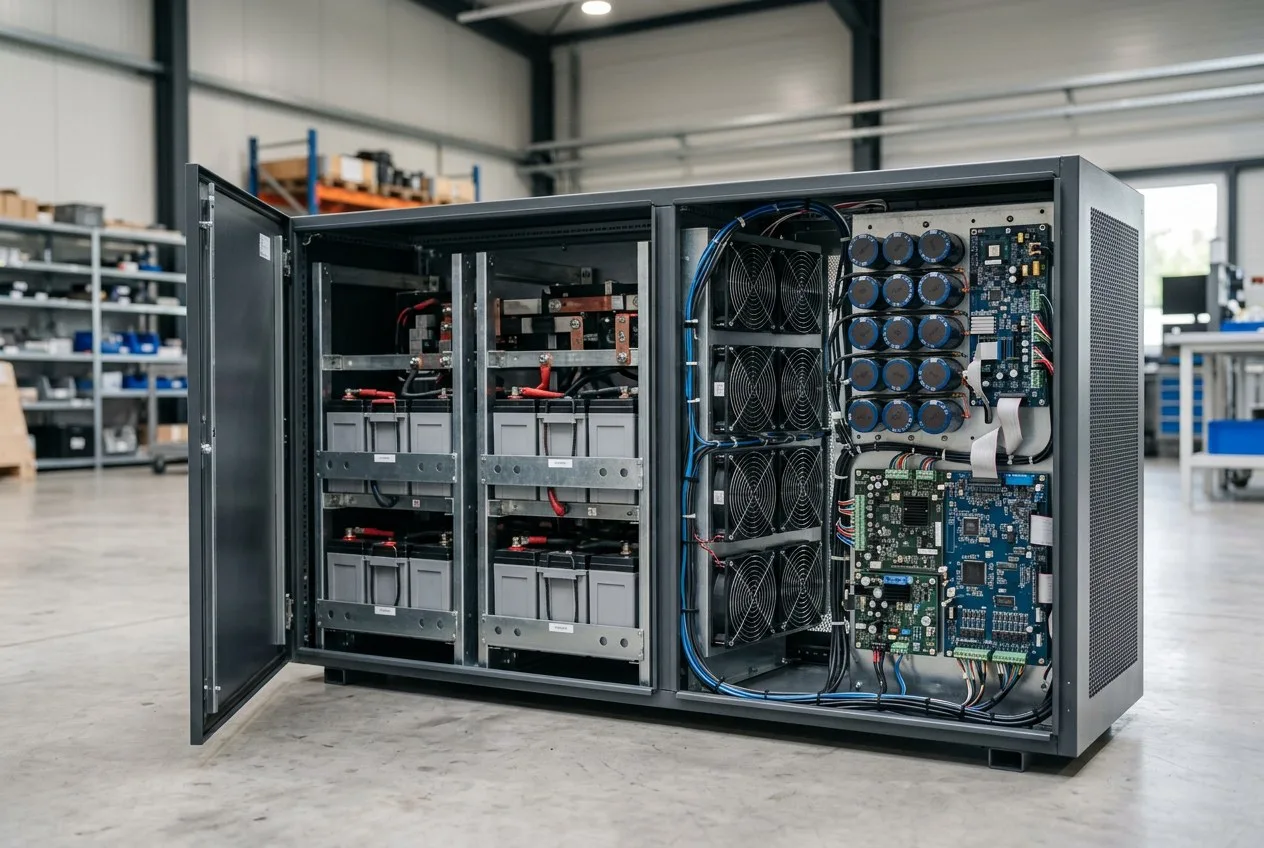
What components determine the lifespan of a UPS?
The life of the UPS (uninterruptible power supply) is not limited to the life of the weakest link; because the weak links can be replaced. The question is, which parts Consumables (expected to change within a certain interval), which Permanent parts. The following table summarizes the typical ranges in the sources.
| Component | Typical life range | The factor that affects life the most |
|---|---|---|
| VRLA (closed-type lead-acid) battery | 3-5 years under favorable conditions | Temperature, charge voltage, number of discharges |
| Lithium-ion battery | 8-10 years under favorable conditions | Temperature, number of cycles, BMS quality |
| Electrolytic capacitors | Estimated service life of about 10 years ; Some service sources recommend 5-7 years of preventative replacement | Operating temperature, ripple current |
| Cooling fans | Forecast for about 10 years ; Values between 3-8 years are seen in continuously operating fans | Dust, bearing wear, operating hours |
| Relay, contactor, MOV (surge protective element) | Variable; mainly dependent on network quality | Number of switching, sudden voltage pulses |
| Body, power semiconductors, cards | Usually 7-10 years and above | Heat, moisture, dust, overload |
Some of the lines in the table are based on different values published by different manufacturers and service companies; this is why the ranges are wide. The important thing is the order: first comes the battery, then the fan and capacitor, finally the housing and electronics.
Battery: The shortest-lived part of the UPS
Since the battery provides the stored energy through a chemical reaction, it is inevitable that it will age. There are two separate concepts in this regard: the design life written on the battery (e.g. 5 or 10 years) and the service life actually achieved in the field. The service life is often shorter than the design life; because the design life assumes ideal temperature and charging conditions.
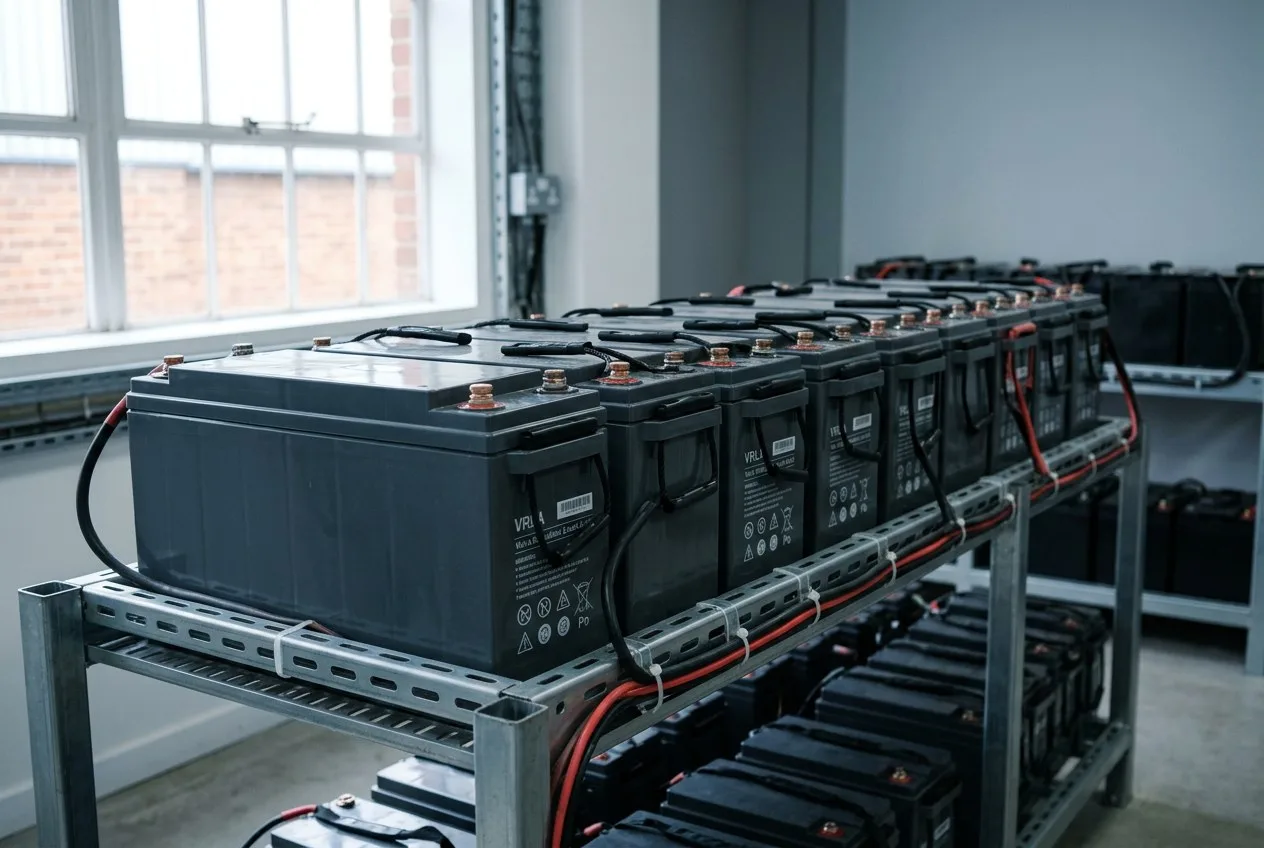
When is a battery considered "at the end of its life"?
The common criterion for stationary lead-acid batteries is capacity. As seen in studies referring to the IEEE 1188 approach, Replacement of VRLA batteries is based on the measured capacity reaching 80 percent of the nominal value . In other words, the battery does not "die" all at once; when the backup time is reduced by 20 percent compared to its new state, it is time for a replacement. After this threshold, capacity loss may accelerate. How to measure capacity Battery discharge test From our article, how to interpret the measurement results, Interpreting Battery Test Results You can learn from our article.
A simple example: Let's consider a system that gives a 30-minute backup in its new form (assumption: the load is fixed, the battery bank is the same). When the capacity drops to 80 percent, the time is reduced to roughly 24 minutes at the same load (30 × 0.80). If the system is designed for a minimum duration of 20 minutes, it is still safe; however, the capacity reduced to 65 percent corresponds to around 19-20 minutes, approaching the design limit. In reality, the capacity-time relationship is not linear, so the test results are only approximate.
Temperature and charging conditions
Battery life is very sensitive to temperature; aging accelerates as the ambient temperature rises, so batteries must be kept within the temperature range of the manufacturer's recommendation. Which factor is effective Factors Affecting Battery Life article. Lithium-ion batteries offer longer life, but the initial investment and management requirements are different; differences lithium-ion UPS batteries You can find it in the article.
An important point: Battery replacement does not reset the life of the UPS; it only resets the risk to the battery. When to renew batteries When to replace a UPS battery We explained it with symptoms in the article.
Capacitors: the silent aging component
The rectifier and inverter stages of the UPS have large electrolytic capacitors that buffer energy and correct ripple. The liquid electrolyte evaporates over time, the capacity decreases, and the internal resistance (ESR) rises. Eaton's white paper also states that capacitors that it wears out over time like batteries highlights and recommends planned replacement based on the manufacturer's stated service life.
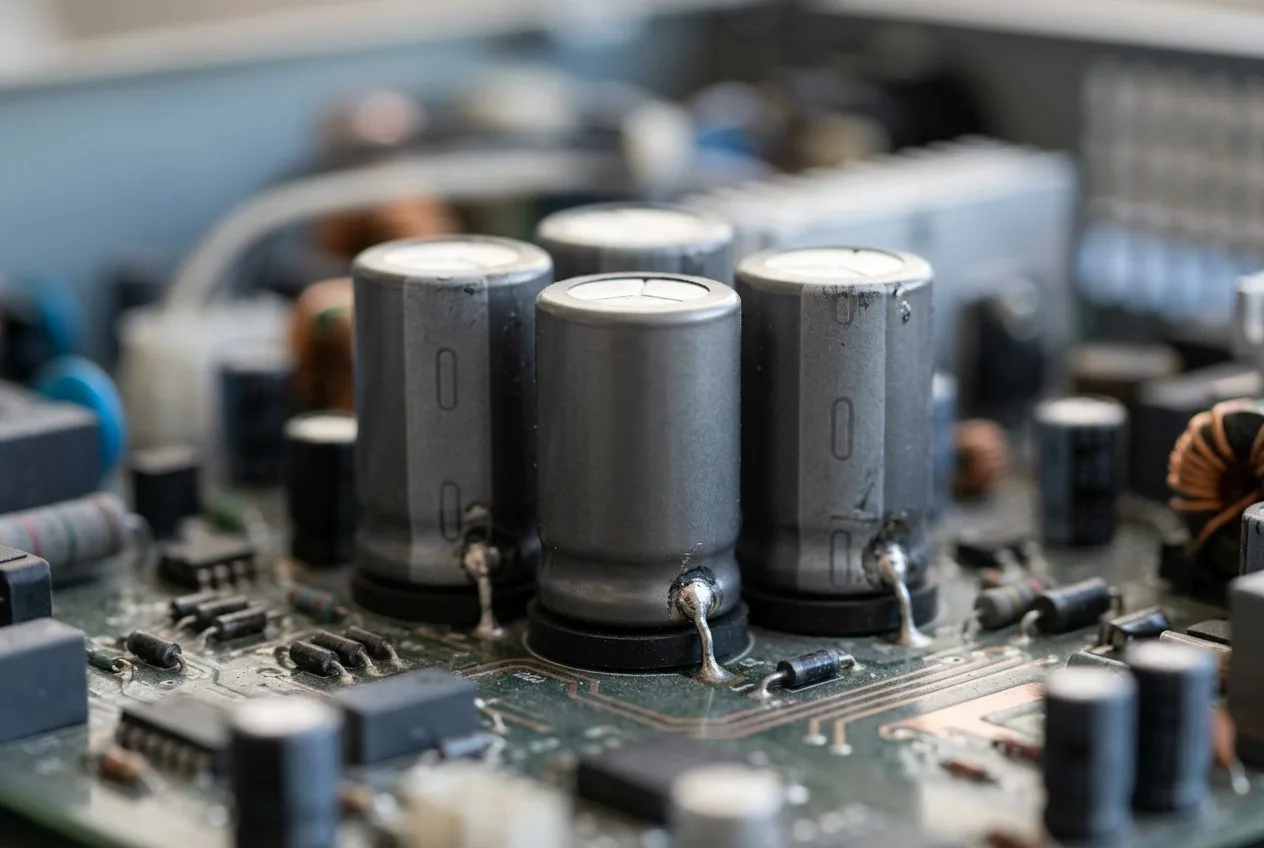
10 °C rule and calculation example
Electrolytic capacitor life is very dependent on temperature. According to the common rule based on Arrhenius' law a 10 °C increase in operating temperature halves the service life, and a 10 °C decrease doubles the service life . This rule is an approximation; the capacitor manufacturer's calculation tool or data sheet should be used for the final calculation. Calculators from manufacturers such as Nichicon are also temperature, surge current and operating voltage It takes into account stressors such as.
Let our assumptions be as follows: According to the data sheet, the capacitor has a lifespan of 5,000 hours at 105 °C, the UPS operates 24/7 (about 8,760 hours per year), and the internal (core) temperature of the capacitor is calculated. Formula: Life = 5,000 × 2^((105 − T) / 10).
| Capacitor internal temperature | Calculation | Estimated life (hours) | Approximate year (7/24) |
|---|---|---|---|
| 75 °C | 5.000 × 2³ | 40.000 | 4,6 |
| 65 °C | 5.000 × 2⁴ | 80.000 | 9,1 |
| 55 °C | 5.000 × 2⁵ | 160.000 | 18 (other factors limit in practice) |
The conclusion from the table is clear: When the internal temperature drops by 10 °C, the life is roughly doubled. It is important to note that the internal temperature is not only equal to the ambient temperature; the surge current generates heat within the capacitor itself. Therefore, even if the UPS is in the same room, the capacitors of the device operating under high load age more quickly. Why and when capacitor and fan replacement is necessary UPS capacitor and fan replacement We discussed it in the article.
Fans, relays and other wear parts
Fans are mechanical parts; their bearings wear out over time, and dust accumulation creates instability and noise. While manufacturer sources show estimated lifespans of around 7-10 years for fans, some service guides recommend much shorter replacement intervals for fans that operate continuously. This difference depends on the dustiness of the environment and the speed control of the fan. When the fan is weak, the internal temperature of the UPS rises; this indirectly wears out the capacitors and power semiconductors. For details on temperature alarms UPS overheating and fan failure You can look at the article.
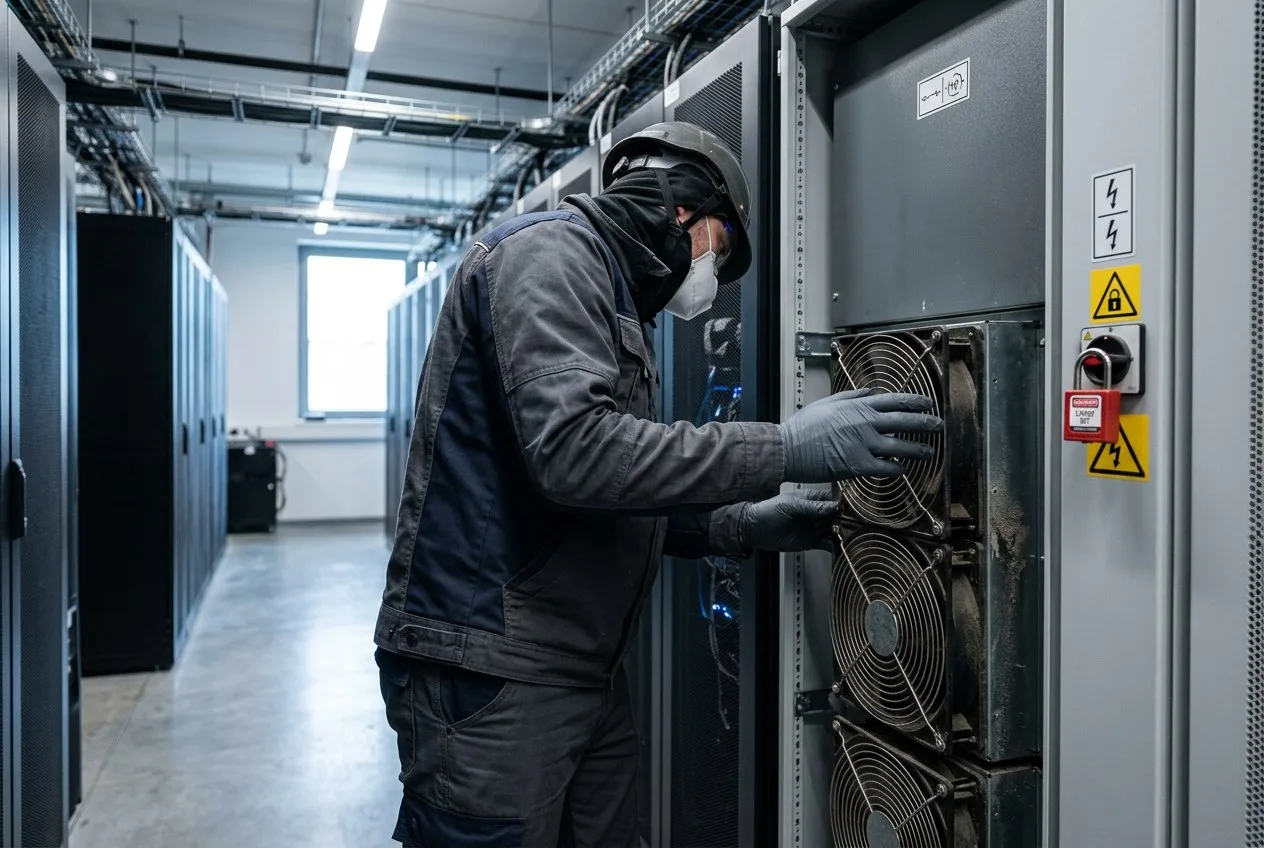
Relays, contactors, and MOVs wear out based on the number of runs and pulses from the grid. These parts of a UPS in a facility with a fluctuating grid will tire faster than the same device in a quiet grid. Determine how much voltage spikes are suppressed by the UPS and why additional protection is needed Sudden Voltage Impulses and Surge Arrester We explained it in the article.
How do ambient and usage conditions change UPS life?
The same model can exhibit two different lifetimes in two different places. We can list the factors as follows:
- Ambient temperature: It is the most decisive factor for both the battery and the capacitor. Air conditioner failure or a closed, stuffy room shortens life.
- Load Ratio: A UPS that constantly operates with a load of 90-100 percent heats up more than a person operating with a load of 40-60 percent and tires the capacitors more. In addition, working close to overload erodes the margin of safety.
- Grid quality: Frequent interruption, voltage fluctuation, and harmonics increase the number of battery discharges and the operation of relays.
- Dust and moisture: It affects fans, heat surfaces, and connectors; humid environment leads to corrosion.
- Care discipline: Timely testing, cleaning, and tightening checks catch minor issues before they escalate.
- Operating mode: The difference between double-conversion operation and ECO-like efficient modes can alter the stress experienced by components; for details ECO mode on UPS You can check our article.
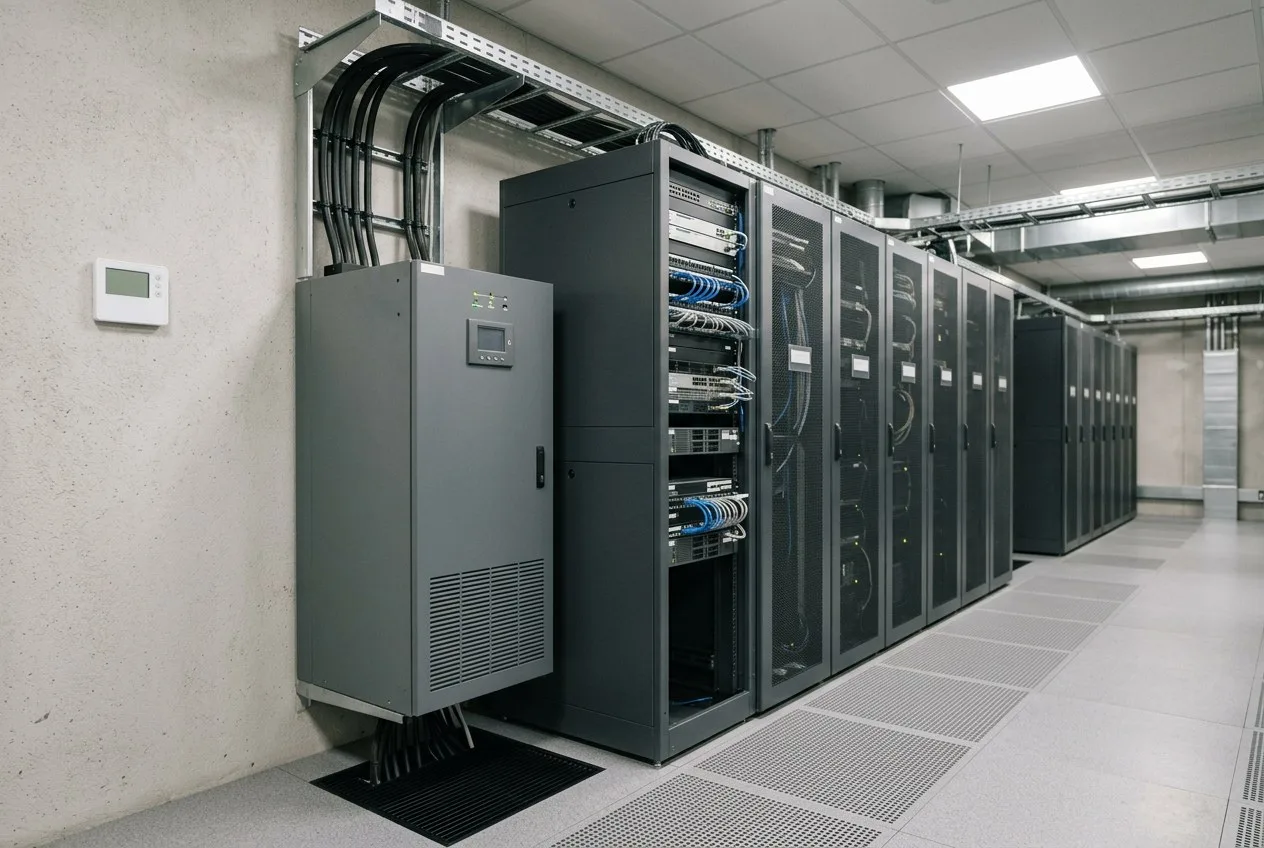
Invisible factors such as electrical noise and ground problems can also strain electronic cards over time; for this topic electrical noise (EMI/RFI) article may be useful.
How many times does which part change in a 10 year period?
When considering total cost of ownership, it is more realistic to come up with a component-based change schedule rather than a single "device lifetime". The following example is for a hypothetical mid-range single-phase/three-phase double-conversion UPS, and is only to illustrate the planning logic.
Assumptions: VRLA battery service life is 4-5 years, anti-fan replacement is every 6-8 years, anti-capacitor replacement is in 8-10 years, UPS will be operated for 10 years. Actual values vary according to manufacturer data.
| Year | Planned work | Reason |
|---|---|---|
| 0 | Initial commissioning, battery and load testing | Registration of reference (initial) values |
| 1-3 | Annual periodic maintenance, internal resistance measurement | Trend monitoring |
| 4-5 | Battery pack replacement (VRLA) | Capacity approaching the 80 percent threshold |
| 6-8 | Fan replacement, capacitor status check | Risk of mechanical wear and internal temperature |
| 9-10 | Second battery replacement, capacitor replacement or renewal decision | The consumables of the device reach the end of their life |
In this plan, the VRLA battery pack changes twice in 10 years. With a lithium battery, a single replacement in the same amount of time may suffice; however, the initial cost and installation requirements differ. The financial side of this comparison UPS efficiency and total cost of ownership You can find it in the article. To adapt the plan to your own device, you can use your maintenance records and UPS maintenance frequency and maintenance schedule You can use the approach in the article.
How do I know when my UPS is nearing the end of its life?
Some symptoms may not be serious on their own; but if they occur together or recurrently, it indicates aging.
| Symptom | Possible cause | What should be done? |
|---|---|---|
| Backup time significantly shortened | Battery capacity decreased | Have a capacity and internal resistance test |
| Frequent "low battery" or test failure alarm | Battery aging, individual cell/block failure | Evaluate block or group change according to the test result |
| Fan noise increased, device hot | Fan bearing worn, dust accumulated | Have the service team clean and check the fan |
| Difficulty in start-up, output voltage fluctuation | Capacitor aging or power stage problem | Have the device checked by an authorized service center |
| Frequent breakdowns and falling into bypass | Expiration of multiple components | Analyze whether to repair or refurbish |
| Spare parts cannot be found | End of production of the model | Make a renewal plan |
For a detailed interpretation of the symptoms most common UPS failures The text guides the way. An important warning in terms of safety: The inside of the UPS and the battery pack carry the risk of high DC voltage and arcing; opening the cover, removing the battery or changing the card should be done by authorized electrical personnel and technical service.
What should and should not be done to extend the life of the UPS?
Recommended do's
- Operate the UPS within the manufacturer's specified temperature range, where airflow is unobstructed.
- Monitor the load rate regularly; do not use the capacity close to 100 percent continuously. For how to calculate the load How to calculate UPS power See the article.
- Do not skip periodic maintenance and battery tests; keep the reference values from the first commissioning.
- Keep fan filters and ventilation paths clean.
- Create a replacement schedule for consumable parts (battery, fan, capacitor).
Don'ts
- Do not connect devices that draw high inrush currents, such as motors, air conditioners or laser printers, without control; why these devices cause problems In the article Inrush We explained.
- Do not cover the top or front of the UPS, do not place it in a closed cabinet without ventilation.
- Don't mute alarms; a recurring alarm is usually a sign that a component has reached the end of its life.
- Do not take shortcuts such as adding a new single block to the aged battery group; when a single battery changes and when the whole group changes. Single battery or whole group We explained it in the article.
- Do not open the UPS that has been turned off for a long time without control; consult the technical service first.
Repair or renovation? Decision criteria
The age of the device alone is not sufficient for a decision. The following questions provide a healthier assessment:
- Can spare parts be found? Parts procurement for finished models can be both expensive and take a long time.
- Are the main power components intact? If the rectifier, inverter and static switch are intact, it makes sense to renew the consumables.
- Has the load changed? If the existing capacity is not enough in a growing facility, capacity increase or renewal is required instead of repair.
- Efficiency and energy cost: Older appliances can operate with lower efficiency; the annual energy difference adds to the total cost.
- Cost of the deduction: Reducing the risk of failure at critical load can be more valuable than a few years of additional use.
Details of this analysis When to renew old UPS and UPS capacity expansion and refurbishment projects You can find it in the articles. If you are considering only battery renewal instead of holistic renewal, for compatibility Is every battery installed in every UPS? The checklist in the article will also be useful to you.
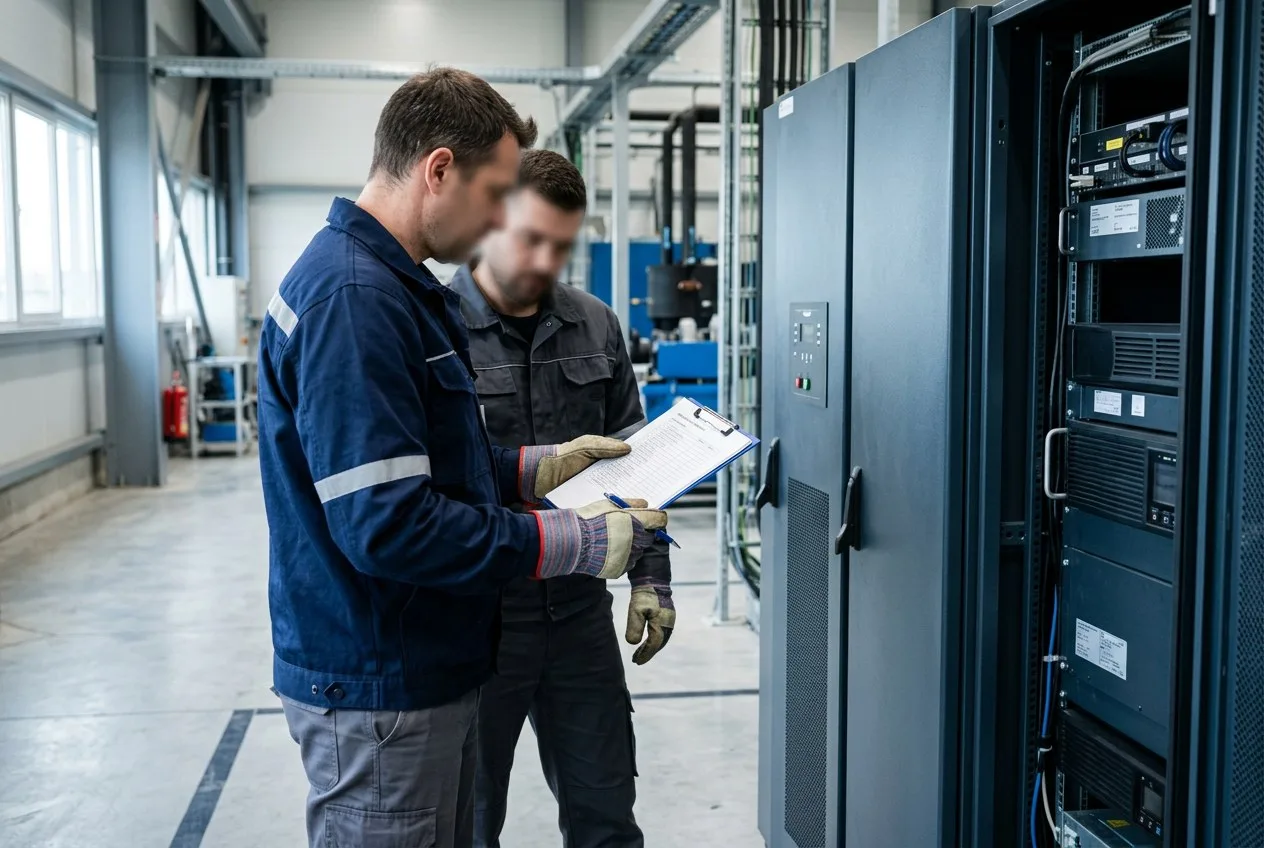
Another approach in critical facilities is to install redundancy rather than relying on a single UPS; so that the load is not interrupted when a device goes offline for maintenance or refurbishment. This topic Redundancy in UPS: N+1, 2N and parallel UPS We examined it in the article.
Working with Bempower for UPS life
It is not possible to predict which component of your UPS will expire and when without measuring the actual condition of the device. Bempower; It provides discovery, installation, periodic maintenance and technical service for all brands of UPS, battery packs and inverters on-site in Istanbul and surrounding provinces. For battery testing, component control or renewal plan From our contact page You can contact us.
- Comparison of VRLA-AGM batteries lifetime charging with different currents waveforms for use on low power UPS — IEEE, 2016. https://ieeexplore.ieee.org/iel7/7413933/7420013/07420201.pdf
- Estimated Life Calculator for Capacitors — Nichicon, 2025. https://www.nichicon.com/en-us/design-support/lifetime-calculator/
Resources
