


What are OPzS and OPzV Batteries? Long-Lasting Industrial Batteries

If a facility has a really critical load (telecom switchboard, substation DC system, hospital UPS, data room or an off-grid energy storage system), the battery is not just expected to "work". It is expected to behave predictably for fifteen years, to give full capacity in the event of an outage once or twice a year, and to recover from deep discharge when necessary. OPzS and OPzV batteries are industrial lead-acid batteries designed for this expectation, with a tubular positive plate, in a 2 V cell structure.
In this article, we discuss what the names OPzS and OPzV mean, the difference between the tubular plate and the classical plate, how the two types differ from each other, the charging and temperature behavior, the battery room requirements, and the decision to maintain and renew. Article; It was prepared for technical officers, purchasing units, facility managers and business owners planning energy storage projects. Installation and connection works should be carried out by authorized electrical personnel and technical service. The information here helps you make a decision, it does not replace the application instructions.
What is OPzS and OPzV battery?
OPzS and OPzV are not a variant of the general-purpose small UPS battery, but a separate class of products. The names are abbreviations of German origin. The letters describe the armored (tubular) positive plate cell, designed for stationary facilities. The last letter indicates the electrolyte and cover structure: S liquid electrolyte (vented) cell, V indicates a valve-controlled, closed structure. The nominal voltage of both types is 2 V per cell. System voltages such as 24 V, 48 V, 110 V or 220 V DC are obtained by connecting the cells in series.
These batteries are generally manufactured according to the DIN family of standards. Manufacturer's documentation refers to DIN 40736 for OPzS cells, DIN 40742 for OPzV cells, and DIN 40744 for block formats. Tests and requirements for valve-controlled types are defined in the IEC 60896-21 and 22 series. IEC 60896-21 specifies test methods for valve-controlled lead-acid cells and monoblocks in stationary, float-charged applications such as telecom, UPS, switchgear, and emergency power.
If you want to compare other members of the lead-acid family (AGM, gel, general purpose) VRLA, AGM and Gel battery differences is a good start. Our focus here is on the longest-lived and largest capacity group of this family.
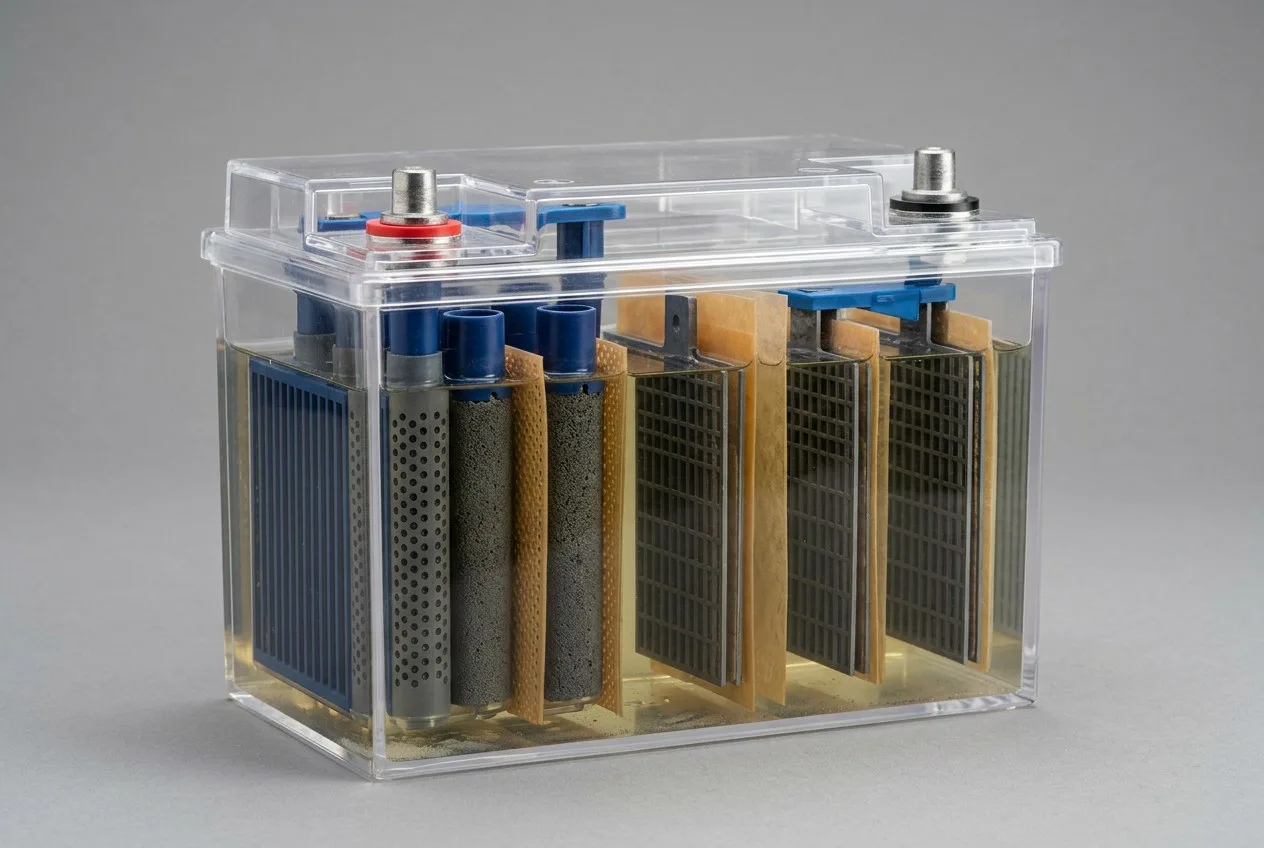
What is a tubular plate and why does it provide longevity?
The life of the battery is often Positive plate determines. In float charge, the positive grid gradually corrodes and swells. In the classic pasted flat plate, the active ingredient is applied to the grid as a paste. In the tubular structure, the positive plate consists of the active material enclosed in a series of narrow and durable tubes. The tubes (gauntlets) are usually made of non-woven polyester fabric and hold the active material in place. There is a lead alloy backbone in the middle. This structure slows down the shedding of the active material and maintains plate integrity during deep discharge cycles.
According to the manufacturer's information, the alloy of the positive plate is also important. Low-antimony (less than 2 percent) or lead-selenium alloys can be used on the OPzS side. The TAB data sheet specifies the special alloy with less than 2 percent antimony on the OPzS positive plate. On the OPzV side, lead-calcium-tin alloy stands out. It is not correct to mix different alloy cells in the same system, as the choice of alloy affects water consumption, corrosion rate, and charge voltage.
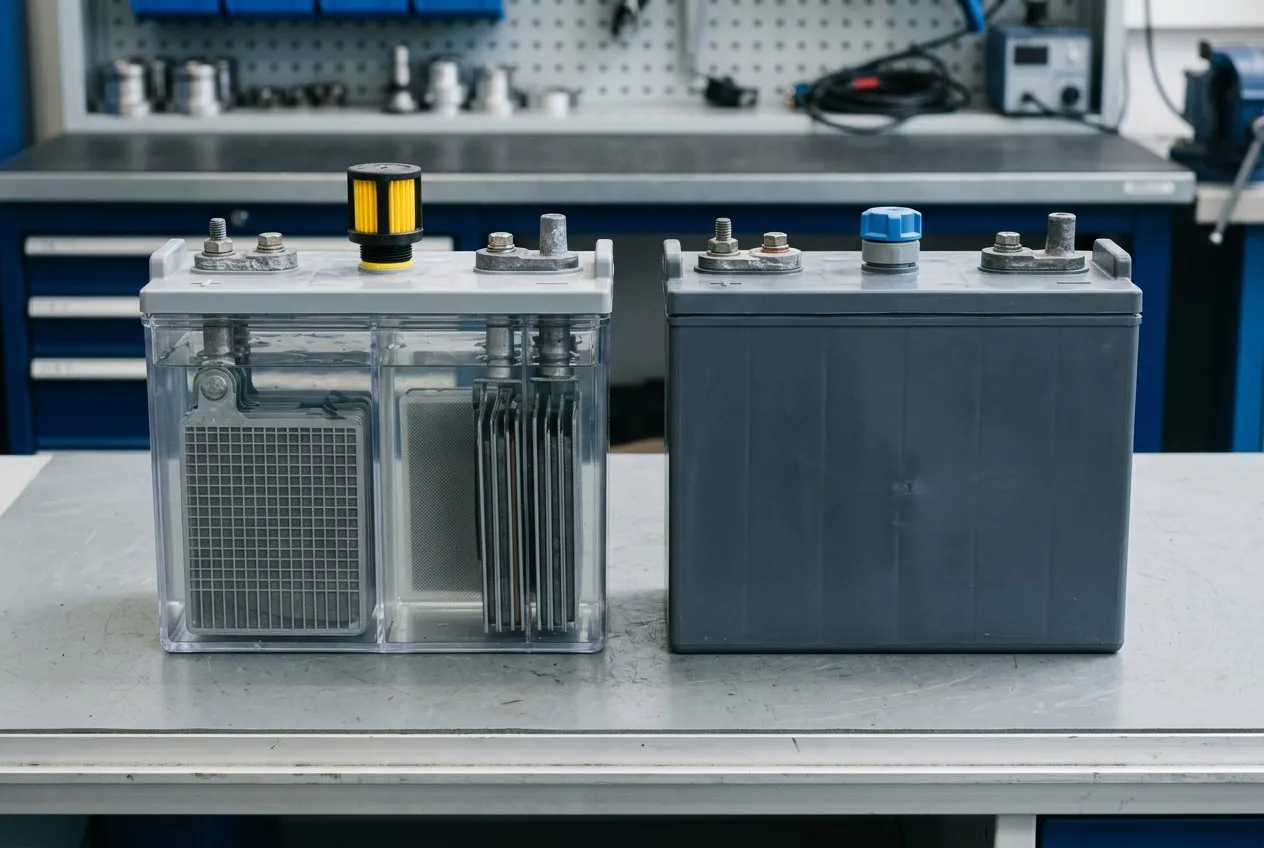
Differences between OPzS and OPzV
OPzS In their cells, the electrolyte is liquid sulfuric acid. The cell usually sits in a transparent container, which makes it easy to monitor the electrolyte level and plate condition by eye. The gases generated during charging are released into the atmosphere through the outlet plug, and water is lost over time. For this reason, distilled water is added at regular intervals. Manufacturers most often give the interval of water addition as "a few years". For example, a manufacturer 3-year water addition interval and 20-year service life at 20°C specifies the product page, while another is on the product page Water addition interval over 2 years at 20 °C writes. This range varies with the alloy, charging voltage and temperature.
OPzV The electrolyte in the cells is a silica-based gel. The cell is valve-controlled closed and in normal operation the gases recombine with the internal oxygen cycle. If the pressure exceeds a certain value, the valve discharges the gas. Manufacturer documentation The silica-based gel electrolyte does not lose water and therefore requires no maintenance. tells. This means that no water addition is required. The need for cell voltage, connection, and temperature monitoring remains.
| Feature | OPzS (with liquid electrolyte) | OPzV (gel, valve-controlled) |
|---|---|---|
| Electrolyte | Liquid sulfuric acid | Gelled acid |
| Adding water | Must (range according to manufacturer) | Not required |
| Outgassing | There may also be hydrogen output on normal charging, it increases on additional charging | Normally too low, the valve opens at overpressure |
| Level and visual control | Level and plate status can be monitored in the transparent container | Visual inspection is limited, based on measurement |
| Settlement | Often upright, ventilated room or cabin | Depending on the manufacturer, vertical or horizontal mounting may be possible |
| Charging sensitivity | More tolerant, equalization charging can be applied | More sensitive to voltage limits and temperature compensation |
| Typical design life | About 15-20 years (depends on the datasheet) | About 12-20 years (depends on the datasheet) |
| Maintenance burden | Higher: water, level, density measurement | Lower: electrical measurements and connection check |
The life ranges given in the table vary between manufacturers. Some OPzV data sheets give a design life of up to 18 years for a 2 V cell and up to 15 years for a 6 V and 12 V blocks. Another manufacturer specifies a design life of 12 years in a controlled environment. Therefore, the value to be taken as a basis for your project should be the data sheet and specification of the selected model.
Where are OPzS and OPzV batteries used?
The common application area of the two types is systems in which the battery sits for years on float charge and must deliver reliable energy in times of need. Manufacturers count areas such as telecommunications, power generation and distribution, railway, airport and port signaling, computer systems and emergency lighting for OPzS. Typical examples include:
- Substations and power plants: 110 V or 220 V DC system for protection relays, breaker coils and SCADA. This structure Battery and rectifier compatibility It is carefully designed in terms of
- Telecom and base stations: 48 V DC power system and long backup time. For details UPS, rectifier and battery in telecom facilities You can look at the article.
- Large UPS systems: Battery banks that require long autonomy or high reliability in data centers, hospitals, and industrial facilities.
- Energy Storage: Battery banks that cycle daily in off-grid or hybrid structures. For the logic of choice on the solar energy side Choosing a battery for solar energy is complementary.
The same type is not true in every application. For a small office UPS or a one-room home system, the OPzS/OPzV can be both too large and costly. These batteries are more relevant in banks well above 100 Ah, hundreds and thousands of Ah. For OPzV in manufacturer catalogs 54-3718 Ah , for OPzS 216-3360 Ah Wide ranges such as are seen.
Charge voltage, float and temperature compensation
Float voltage is the continuous voltage at which the battery is kept fully charged. It is given in volts per cell (V/cell) and multiplied by the number of cells for the system voltage. For detailed operating logic Battery Charging and Discharging You can look at the article. For OPzV, manufacturers mostly give a range of 2.23-2.25 V/cell at 20 °C. A guide The recommended float voltage at 20 °C is 2.25 V per cell and another based on 2.23 V. A manufacturer's brochure on the OPzS side 2.23-2.25 V/cell for float, 2.35-2.40 V/cell for equalization range. These are just typical values. The correct setting is the value in the datasheet of the cell you are using.
Example calculation: Float voltage in a 48 V system
Assumptions: 48 V nominal DC system, 24 x 2 V cells, manufacturer's float value at 20 °C 2.25 V/cell, temperature compensation coefficient −3 mV/°C/cell (this value differs from manufacturer to manufacturer), battery room average temperature 30 °C.
- Float at 20 °C: 24 × 2.25 V = 54.0 V
- Temperature difference: 30 − 20 = 10 °C
- Correction: 10 °C × 3 mV × 24 cells = 0.72 V (downgraded)
- Target voltage at 30 °C: 54.0 − 0.72 = approx. 53.3 V
Why is temperature compensation so important? In gel and VRLA cells, the same charging voltage at high temperature draws more current and can lead to drying out or overheating. Compensation shifts the voltage according to temperature to compensate for this effect. Some manufacturers give the coefficient as −3 mV/°C/cell, others as −4 mV. Some guidelines do not require compensation if the temperature deviation is low (e.g., less than ±5 °C). The guidance for the model you choose tells you which approach is valid.
For measurement methods used when setting up batteries, rectifiers or chargers how battery voltage is measured and interpreted The article will work. The charger setting should be done by the authorized technical service. Incorrect adjustment can shorten the life of the entire bank with a single error.
What does the lifespan depend on? Temperature, depth of discharge and charge quality
The "20 years" in the datasheet is the design life given for certain conditions and does not imply the warranty period. There are three main variables that affect this figure.
Temperature
Battery room temperature is the factor that most affects life. A manufacturer's manual states that the expected life can drop from 20 years to about 4 years when the temperature increases from 20 °C to 4 °C. Another manufacturer gives a more practical rule: For every 8 °C increase above 20 °C, the battery life is halved . These rules vary by manufacturer, but the message is the same: keeping the battery room cool and balanced is one of the cheapest items of the battery budget. Low temperature, on the other hand, affects capacity more than life. A manufacturer's certificate says that capacity decreases at low temperature, and life shortens at high temperature. For general life factors Factors Affecting Battery Life The article is also useful.
Depth of discharge and number of cycles
Depth of discharge (DoD) indicates how much of the capacity is drawn. Tubular plate batteries are known for their deep discharge endurance. Manufacturer data usually shows a cycle range of about 1,200-1,800 cycles at 80 percent DoD. An OPzS brochure also specifies a cycle strength of over 1,500 at 80 percent DoD. These figures are approximate and model-based. In an energy storage system that cycles daily, limiting DoD extends life. Depth of discharge and cycle life explains this relationship in detail.
Charging quality and imbalance
Too high a charge voltage increases corrosion and water loss. Too low a voltage leads to sulfation. Voltage unbalance between cells connected in series is also an indicator of aging. During the initial commissioning and float period, cell stresses are expected to stabilize over time. A guideline says that after 6 months of continuous float charging, cell voltages stabilize to about ±4.5% of the average. For imbalance Battery balancing and Unbalanced stress and pole head corrosion Their writings provide additional information.
How is capacity calculated? Label values and example
In the OPzS and OPzV catalogs, the capacity is mostly given as C10 (10-hour discharge). Some manufacturers write values at 20 °C according to the end-discharge voltage of 1.80 V per cell. The capacity of the same cell in 1 hour or 30 minutes of discharge is different from this figure. Because the usable capacity decreases at high current. Label reading Battery label In his article, the C-ratio and the Peukert effect Discharge rate You can find it in the article.
Example calculation: 5 kW load, 4 hours backup, 48 V DC
Assumptions: constant 5 kW AC load, inverter efficiency 92 percent, system voltage 48 V nominal (24 cells), usable DoD 80 percent, coefficient of 1.25 for battery aging allowance. The Peukert effect and detailed discharge tables are not taken into account in this simple example.
- Power drawn from the battery: 5,000 W ÷ 0.92 = approx. 5,435 W
- Required energy (4 hours): 5,435 W × 4 h = approx. 21,740 Wh
- Average DC current: 5,435 W ÷ 48 V = approx. 113 A
- Usable capacity requirement: 21,740 Wh ÷ (48 V × 0.80) = approx. 566 Ah
- Aging allowance: 566 Ah × 1.25 = approx. 708 Ah (rounding)
This result gives a preliminary magnitude. In the actual selection, the value in the manufacturer's discharge table for the discharge current of 4 hours is taken into account, because the capacity that can be obtained in 4 hours is different from the C10 value. In addition, the minimum temperature, the end of discharge voltage and the operating voltage range of the inverter are taken into account. With the same logic, the process from the load analysis to the quotation is UPS and battery capacity project design You can look at the article.
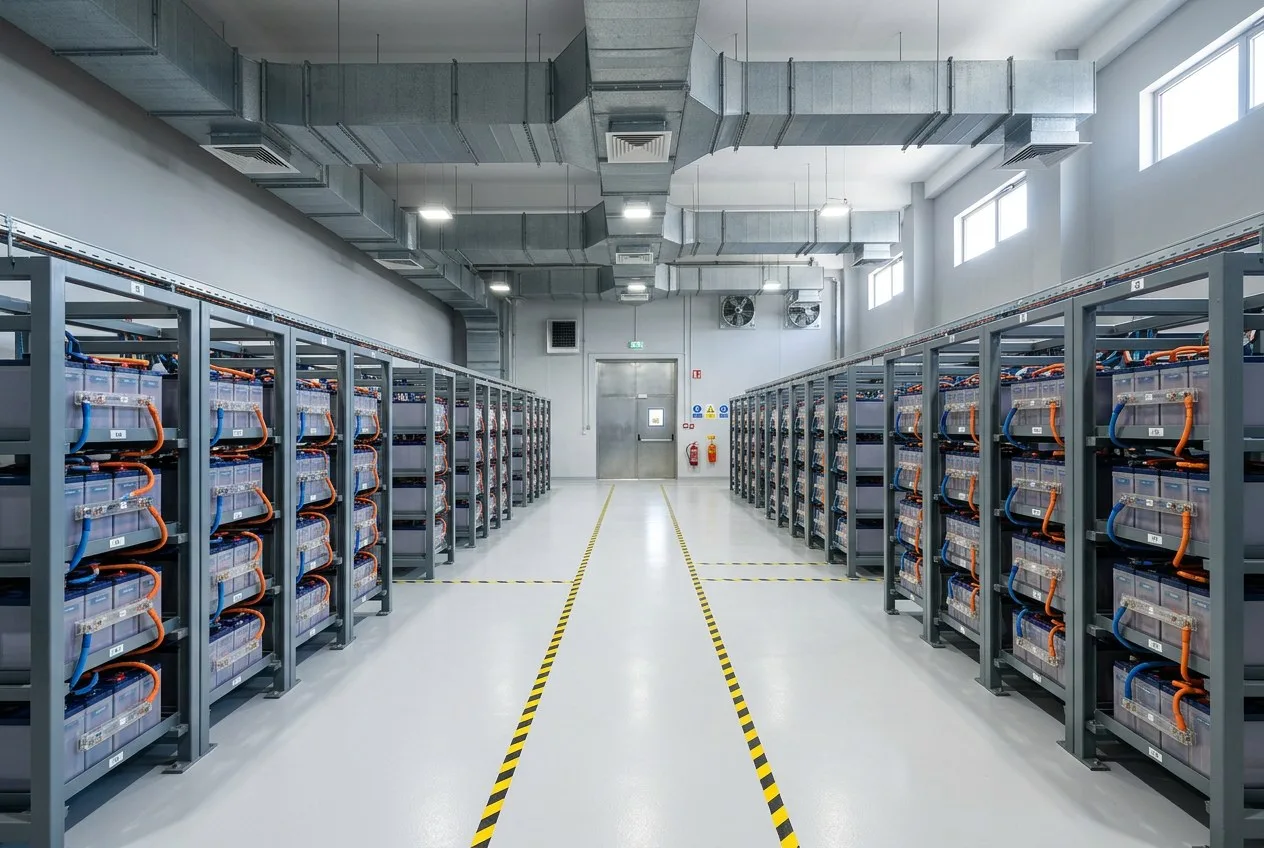
Battery room, ventilation and safety
In lead-acid batteries, hydrogen and oxygen can form during charging. In OPzS, these gases are released into the atmosphere. In OPzV, the oxygen cycle largely combines the gas inside, but the valve can open in the event of overcharging or failure. Therefore, both types require environment planning. OPzV manufacturers specify compliance with stationary battery safety standards such as EN 50272-2. Local legislation and project specifications determine which standards apply.
For detailed room layout Battery room, ventilation and safety Check out the article. A practical checklist could be:
| Subject | What should be done? | Why is it important? |
|---|---|---|
| Temperature | Keep the room temperature around 20-25 °C and stable as much as possible | Heat directly shortens life |
| Ventilation | Let the authorized engineer calculate the air change | Prevents hydrogen buildup |
| Source of fire and spark | Do not allow work such as smoking, welding, grinding near the battery | The gas mixture can be explosive |
| Settlement | Check rack payload, cell weight, and service clearance | Cells are heavy, wrong shelf creates risk |
| Temperature difference | Reduce the temperature difference between cells in the array (window, heater, air conditioner outlet) | Some manufacturers recommend limiting the temperature difference inside the bank |
| Marking and PPE | Have warning signs, eye washing, and insulated appliances ready | There is a risk of acid and high DC voltage |
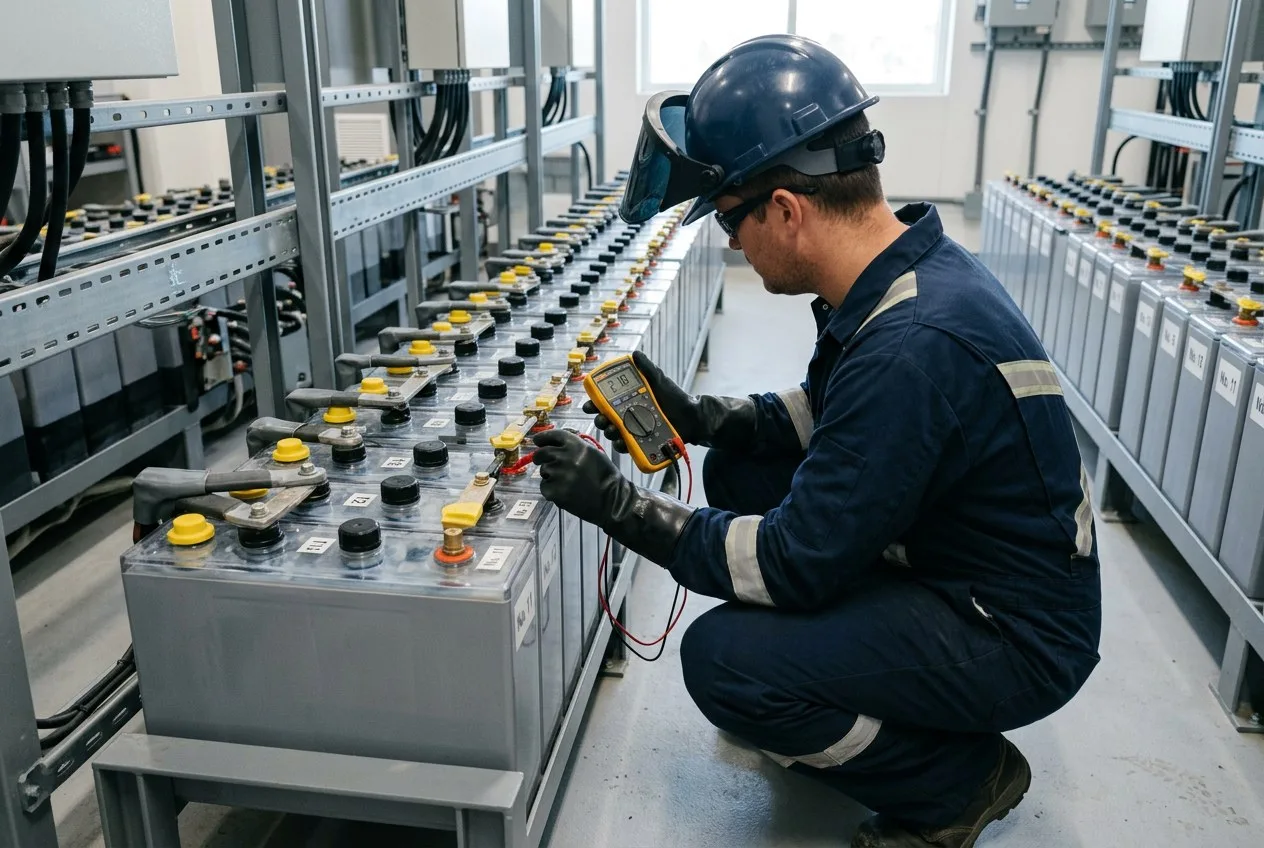
Large battery strings operate at high DC voltage and can deliver very high current in the event of a short circuit. Even a single uninsulated switch on a bank with long arms poses a risk of arcing and severe burns. Leave the connection, maintenance and measurement work to trained, authorized personnel using appropriate PPE. For the occupational safety framework Occupational safety in UPS and battery work We can also recommend the article.
Maintenance: What is checked in OPzS and OPzV?
The phrase "OPzV is maintenance-free" is often misunderstood. The truth: no water is required. Measurement is required to capture aging. IEEE 450 is one of the reference documents that provides the maintenance and test framework for Vented (OPzS) batteries. This document Maintenance, test program, procedure and analysis recommendations for vented lead-acid batteries in stationary applications includes. Similar functionality is seen in the case of valve-controlled batteries with IEEE 1188. These documents are advisory. The program applicable at your facility is determined in conjunction with the manufacturer's manual and specification.
| Control | OPzS | OPzV |
|---|---|---|
| Float tension (total) | Yes | Yes |
| Cell/block voltage | Yes | Yes, it is especially important |
| Electrolyte level and water addition | Yes | Nope |
| Density measurement | As recommended by the manufacturer | Not applicable |
| Pole head and connection tightness | Yes | Yes |
| Body, bonnet and valve view | Cracks, leaks, sediment | Swelling, crack, buildup around the valve |
| Room temperature | Yes | Yes |
| Internal resistance/conductivity | Limited interpretation for trend following | Frequently used for trend tracking |
| Capacity test | At scheduled intervals | At scheduled intervals |
Internal resistance measurement may be more valuable to capture the tendency to stay dry and sulphate in a valve-controlled battery. In the case of a vented battery, on the other hand, its interpretation alone is limited. An industry presentation also emphasizes this. For what internal resistance means Battery internal resistance You can look at the article. Capacity verification is a separate task and only the discharge test under load shows the actual capacity of the battery. Also for the general maintenance approach UPS battery maintenance text can be used.
What criteria are considered when choosing OPzS or OPzV?
The decision depends more on the question of "which one fits our facility" than on the question of "which one is better". The following criteria provide a framework.
- Maintenance Capacity: Is your team able to regularly add water, check the level and intensity? If not, OPzV may be more suitable.
- Room Policies: Do you have a separate, ventilated battery room? If not, the cabinet and OPzV may be preferable. Still, ventilation consideration is required in both cases.
- Temperature Profile: If the room frequently rises above 30 °C in the summer, the lifespan is shortened in both types. Gel cells can be more sensitive to high temperature and overcharging. Temperature compensation and room cooling should be added to the budget.
- The need for visual tracking: If it is valuable to see the level and plate status in the transparent container, OPzS is an advantage.
- Layout flexibility: Some OPzV series can be installed upright or horizontally, depending on the manufacturer, giving flexibility in space-constrained locations. This only applies to certain models and should be based on the installation instructions.
- Charging infrastructure: Does the rectifier, UPS or inverter charging profile match the selected battery, can the temperature sensor be connected?
- Standard and Certificate: Does the cell have a certificate of conformity and test report to the relevant DIN/IEC standards?
- Total cost of ownership: Battery price alone is not a decision criterion. Life, maintenance labor, room and ventilation costs, and replacement time should be evaluated together.
If you are selecting a battery for an existing UPS or rectifier system, also check the voltage window, charge current limit, and cell count compatibility. For compatibility logic Is every battery installed in every UPS? The article is useful.
Comparison with lithium, NiCd and sodium-ion
Since OPzS and OPzV belong to the lead-acid family, the question "why is it still tubular lead-acid when there is new technology?" is natural. The answer is shaped by plant conditions and expectations. The table below summarizes the general approach. Values vary by type and manufacturer.
| Subject | OPzS / OPzV | Lithium (LiFePO4 etc.) | NiCd |
|---|---|---|---|
| Initial cost | Usually lower | Usually higher | High |
| Weight and volume | Heavy, big | Lighter and more compact | Medium-high |
| Electronic protection | No need (monitoring recommended) | BMS mandatory | Not required |
| Care | Water and metering by type | Low, BMS data is monitored | Periodic water and metering |
| Hot environment tolerance | Limited, life decays rapidly | It could be better, it depends on the manufacturer | Generally good |
| Waste and recycling | Built-in infrastructure | Developing | Special administration due to cadmium |
To take a closer look at the lithium option LiFePO4 and NMC lithium battery differences article, for alkaline battery NiCd batteries You can look at it. New technologies such as sodium-ion are still at a different stage of maturity and In a separate article discussed.
Time to renew: when to replace the battery?
The longevity of OPzS and OPzV does not mean "no need to replace". Planned replacement is the way to avoid surprise downtime and sudden costs. The decision to renew is usually not based on a single indicator, but on a combination of several symptoms.
- Capacity test result: If the measured capacity has fallen below the acceptance limit of the rated value, the plan should be made. IEEE documentation commonly addresses this threshold at around 80 percent, but in critical facility, the specification may set a tighter limit. The actual threshold for retrofit should be determined by looking at the facility specification and the relevant standard itself.
- Cell aberration: If some cells are constantly and by increasing difference from the mean.
- Physical finding: Swelling, cracks, leaks, deposits, plate warping or pole head corrosion.
- Internal resistance trend: Significant increase compared to the reference in the first commissioning.
- Life and environment history: A battery that has operated at high temperatures for years may end well below its design life.
Mixing old and new cells while adding new cells can create an imbalance due to the difference in capacity and internal resistance. The question of whether to replace a single cell or a whole group requires a separate evaluation.
Common mistakes
| Error | Possible outcome | What should be done? |
|---|---|---|
| Failure to adjust the float voltage according to the datasheet | Desiccation, corrosion or sulfation | Enter the manufacturer value, enable temperature compensation |
| Temperature sensor not connected or placed in the wrong place | Incorrect compensation | Place the sensor in a representative spot close to the battery housing |
| No measurements to OPzV | Failure to notice senescent cells | Plan cell voltage, internal resistance, and capacity testing |
| Uncontrolled addition of water to OPzS | Level error, dilution | Distillate only or water of suitable purity, as directed by the manufacturer |
| Mixing different brands, ages or capacities in the same array | Unbalanced load sharing | Use the same type, age, and capacity class |
| Loose connection, maintenance-free pole head | Heating, voltage drop, arc risk | Apply torque values from the manufacturer's manual |
| Heating of the battery room | Rapid decline in life, possible risk of thermal runaway | Install cooling, ventilation and temperature alarm |
Thermal runaway is a risk that can be seen in valve-controlled batteries, especially at high temperatures and under improper charging conditions. Subject In the thermal leakage article You can find it in detail. Manufacturers also recommend monitoring the battery temperature during charging. An OPzV guideline says that the temperature during charging should not exceed 45 °C and that charging should be interrupted or the voltage reduced if the limit is reached.
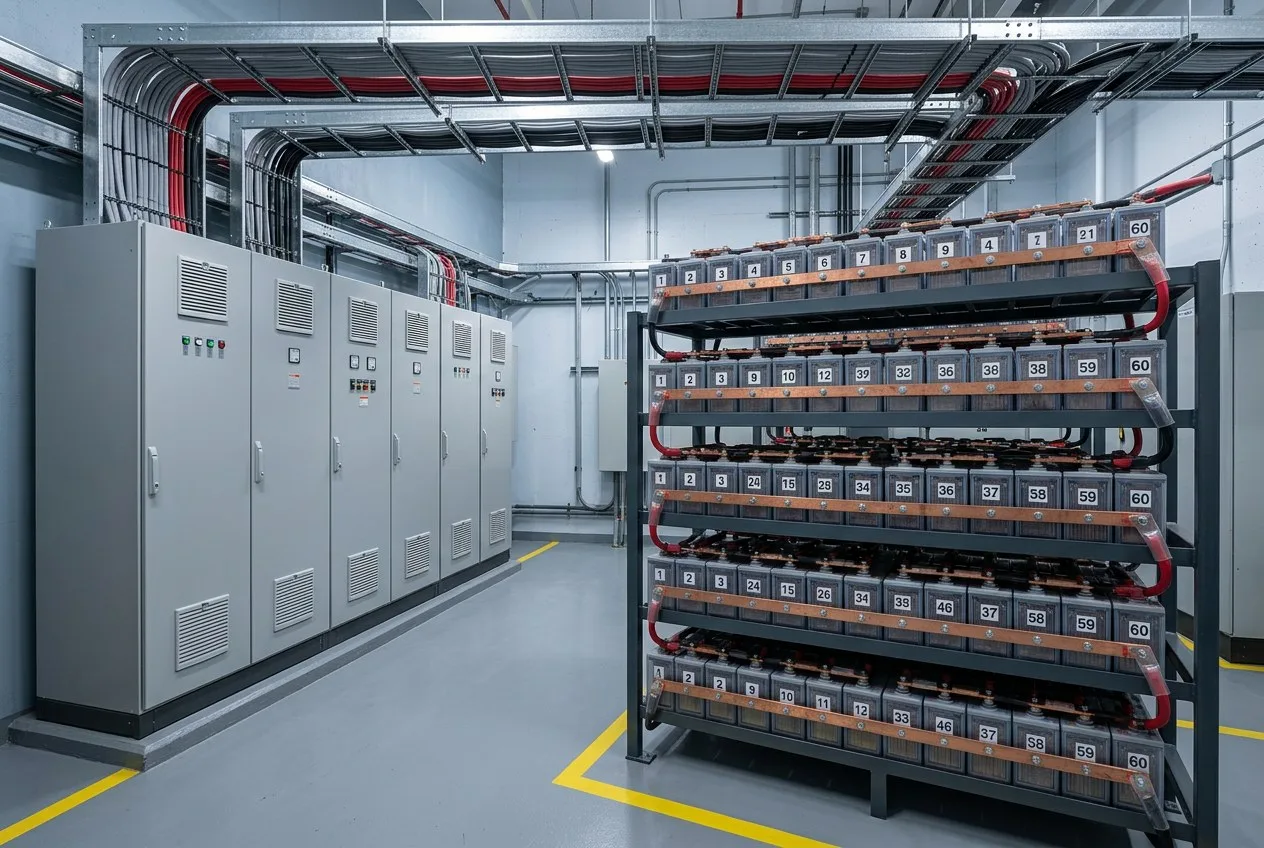
Initial commissioning and capacity testing
In a critical system, the first day of a new battery bank sets the benchmark for subsequent years. During commissioning, the following topics are usually checked: polarity and series connection accuracy, cell voltages, torque control, charger settings, room temperature, and the first recorded internal resistance values. It may take time to reach full capacity after the first charge. An OPzV guideline states that full capacity can be reached after 4-6 weeks, depending on the system condition, on float charging. Therefore, it can be misleading to perform a capacity test on the first day and interpret the result as "low". The manufacturer and specification determine the test timing.
For checks after battery replacement Commissioning after battery replacement and for the test method measuring the actual capacity Battery discharge test Their lettering offers detail. Load bank, current and voltage recording, cell-based measurement and safety measures are required during testing. These should be implemented by the competent team.

What is looked for on the legislation, standard and document side?
Keep in mind that "OPzS" or "OPzV" alone is not sufficient in the purchasing process. Request the following documents in the offer and specification:
- Declaration of conformity and test report to the relevant DIN (e.g. 40736-1, 40742) and IEC 60896 series. For valve-controlled types such as OPzV, this series; defines the test methods (part 21) and requirements (part 22) separately.
- Capacity table: C10, plus values for your application's discharge time (e.g. 1 hour, 4 hours) and end of discharge voltage.
- Charging instruction: float, equalization and temperature compensation values.
- Design life and warranty conditions. It should be clearly written according to which temperature and usage conditions it is given.
- Label, date of manufacture and serial number. The date of manufacture is important to avoid buying batteries from stock that have waited a long time. A manufacturer's data sheet specifies a shelf life of up to approx. 2 years for OPzV due to self-discharge in storage. This time depends on the model and warehouse temperature.
- Responsibility and documentation process for recycling old batteries.
Legislation and standards may be updated over time. Confirm the validity of the version referenced in your project specification with the relevant standards body and project consultant.
Plan your battery system with Bempower
The selection, chamber, charging setting and initial test of OPzS and OPzV battery bank are interdependent decisions. Bempower provides exploration, installation, periodic maintenance and technical service for all brands of UPS, battery packs and inverters. It provides on-site service in Istanbul and surrounding provinces. If you want to learn the status of your current bank or have a preliminary evaluation for a new project, From our contact page You can contact us.
- PowerSafe OPzS Batteries — EnerSys, 2025. https://www.enersys.com/en/products/batteries/powersafe/powersafe-opzs/
- Sunlight OPzV Batteries — Sunlight Group, 2025. https://www.sunlight-group.com/en/products/sunlight-opzv/
- OPzV Batteries for Stationary Applications (white paper) — Sunlight / Norwatt, 2020. https://norwatt.es/files/products/pdf/batteries_lead_stationary_sunlight_opzv_en.pdf
- IEC 60896-21:2004 Stationary lead-acid batteries - Part 21: Valve regulated types - Methods of test — IECEE / IEC, 2004. https://www.iecee.org/certification/iec-standards/iec-60896-212004
- IEC/EN 60896-22 Valve regulated types - Requirements — Battery Standards, 2004. https://batterystandards.info/standard/iecen-60896-22
- IEEE 450-2020 Recommended Practice for Maintenance, Testing, and Replacement of Vented Lead-Acid Batteries for Stationary Applications — IEEE Standards Association, 2020. https://standards.ieee.org/ieee/450/6772/
- Tubular Gel Technology NSB OPzV Batteries (user manual) — NorthStar Battery, 2019. http://evecsa.com/wp-content/uploads/2019/06/NorthStar-OPzV-Manual.pdf
- OPzS and OPzV Stationary Batteries Technical Data — TAB, 2024. https://tab-polska.pl/wp-content/uploads/2024/09/TAB_Stationary_tech.pdf
- CELLYTE 2ETG OPzV Gel Stationary Batteries Installation and Operating Manual — Deco Line / Cellyte, 2013. https://decolineinc.com/wp-content/uploads/2013/03/005D-CELLYTE-2ETG-Gel-OPzV-range-I-O-Manual.pdf
Resources
