


How to Read the Battery Label? C10, C20, Wh, W/Cell and Other Values

When replacing a battery, choosing a new battery, or evaluating an offer, the first place you look is the label. On the label, phrases such as 12 V, 100 Ah, C10, C20, 1.80 V/cell, 15 min, W/cell or Wh are next to each other. These are not independent values. Each tells you the condition under which the battery was tested. Comparing the number without reading the condition is the most common way to get the wrong battery.
In this article, we explain the main values on the battery label one by one. We discuss the difference between Ah and C10 and C20, the W/cell value used in the UPS battery, the Wh value in the lithium battery, the last discharge voltage and other information about charging and life. There is a numerical example in each section. Article; It was prepared for home and small office users, business owners, technical officers and purchasing units.
The values described here are the general reading guide for lead-acid (VRLA, AGM, gel, OPzS/OPzV) and lithium batteries. Exact figures should always be based on the battery's own label and the manufacturer's data sheet. Battery connection, dismantling and testing work must also be carried out by authorised personnel.
What information is on the battery label?
Label; Regardless of the brand, it mostly carries the same groups of information. The table below summarizes these groups and what they do.
| Label information | What does it tell? | Where is it important? |
|---|---|---|
| Nominal voltage (V) | Rated voltage of the battery (such as 6 V, 12 V, 2 V cell) | Series connection, UPS or inverter compatibility |
| Capacity (Ah) | Current-hour value that can be received at a certain discharge time | Duration calculation, solar energy systems |
| C10, C20, 10 HR, 20 HR | At what discharge time the Ah value is measured | Capacity comparison |
| Final discharge voltage | Cell voltage at which discharge ends during the test (V/cell) | Comparing Ah and W/cell values correctly |
| W/cell | The power that can be delivered per cell in a certain period of time | UPS batteries |
| Wh or kWh | Amount of energy stored | Lithium batteries, energy storage systems |
| Charging and float voltage | Recommended charging settings | Charger or UPS setting |
| Maximum charging current | Safe charging current limit | Charging unit selection |
| Production date and serial number | Age and traceability of the battery | Shelf life, warranty, registration |
The entire label may not be that long. Small monobloc batteries only say voltage, Ah, and C ratio. The rest of the information is in the datasheet. Still, the following headings cover the entire label reading.
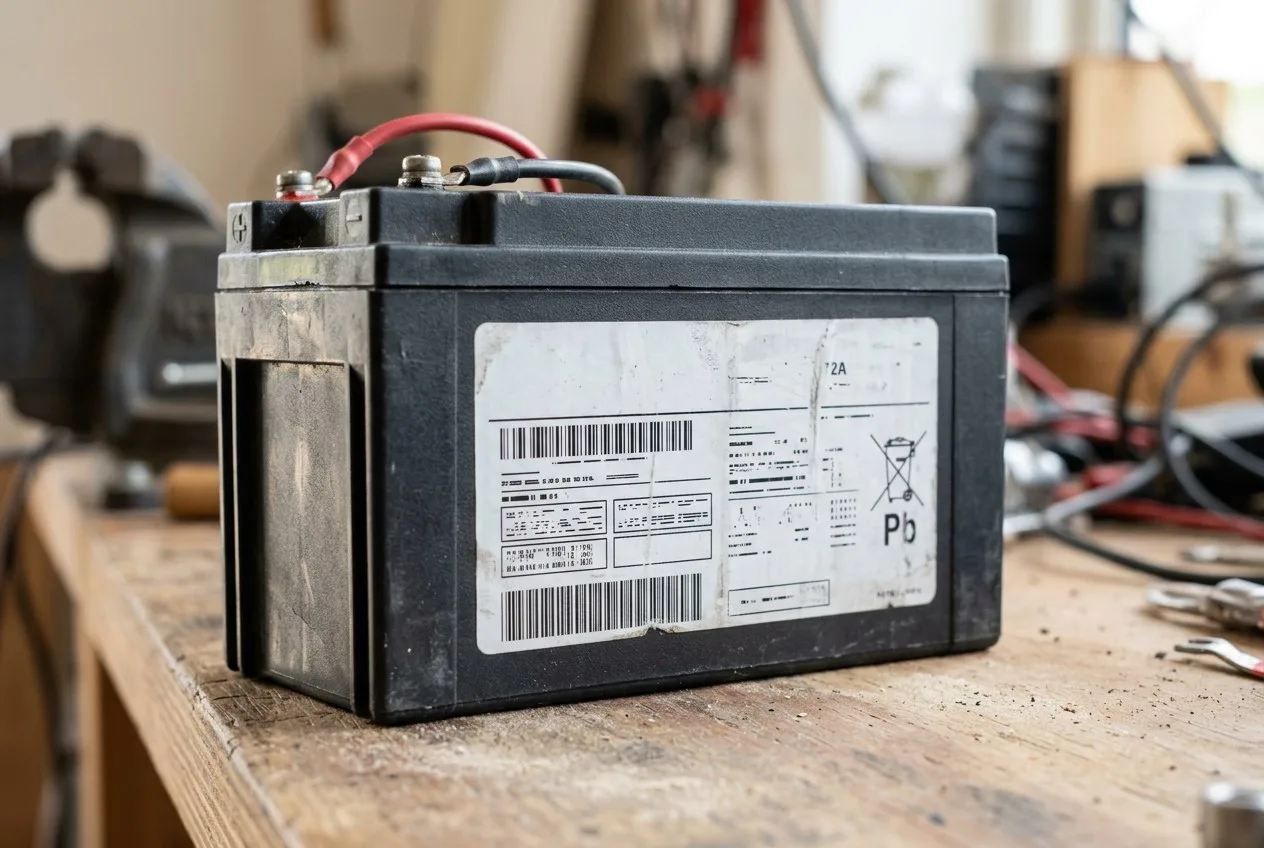
Nominal voltage and number of cells: 12 V Six cells in fact
One cell of a lead-acid battery is about 2 V. Therefore, a 12 V monobloc battery consists of six cells connected in series inside the same box. A 6 V battery is three cells, while a 2 V battery is a single cell. This information is required when reading the W/cell and V/cell values used for UPS batteries. A lithium iron phosphate (LiFePO4) cell, on the other hand, is about 3.2 V; a 12.8 V lithium battery has four cells.
The value of the voltage written on the label is nominal, that is, the rated value. The voltage you measure will be different from this. A charged lead-acid battery may appear to be around 12.6 V at idle, but rises above 13.5 V at the float. How to interpret the measured value How battery voltage is measured We discussed it in the article. How voltage and capacity change when connected in series and parallel Battery Array and Series-to-Parallel Connection It is explained in the article.
What is Ah (ampere-hour) and what does the value on the label guarantee?
Ampere-hours (Ah) is the amount of charge that indicates how long the battery can operate with a given current. In its simple form, 100 Ah can supply a load drawing 5 A for 20 hours. However, this calculation only applies to the test condition on the label. The Ah value on the label is a measurement result: it is obtained at a certain temperature (usually 25 °C), with a certain current and by discharging it to a certain final voltage.
Therefore, "100 Ah" alone is not enough information. The same battery can give different results, such as 100 Ah in a 20-hour test and 88 Ah in a 10-hour test. The C value on the label tells the duration of this test. General concept What is battery capacity (Ah) You can also find it in the article.
What do C10, C20 and C5 mean?
The letter C indicates the capacity, and the number next to it indicates the discharge time in hours. C20 is the capacity measured in constant current that will discharge the battery in about 20 hours. C10 is the 10-hour version of the same process, and C5 is the 5-hour version. The 1C current of a battery is numerically equal to the capacity value. For example, for a 100 Ah battery, 1C means 100 A. For these concepts, there are also battery discharge rate and the Peukert effect You can look at the article.
| Label | Test duration | Test current for 100 Ah | Typical use |
|---|---|---|---|
| C20 | 20 hours | 5 A | Small enclosed batteries, general purpose batteries |
| C10 | 10 hours | 10 A | Stationary VRLA, OPzV/OPzS, solar cells |
| C5 | 5 hours | 20 A | Deep cycle, traction batteries |
| C3, C1 | 3 hours, 1 hour | 33 A, 100 A | High-current use, fast discharge |
The international test standard for fixed-installation VRLA batteries is IEC 60896-21. According to the published summaries of the standard, capacity tests are carried out in C10 and C3 ratios. For nominal capacity, it is reduced to 1.80 V per cell per 10-hour discharge. The capacity measured in the acceptance test is expected to be at least 95 percent of the rated value. Eurobat's VRLA guide also states that the nominal capacity is defined according to the value of 1.80 V/cell. In other words, the writing "C10" on a battery is not a random marketing language, but a test condition that corresponds to the standard.

Why does the same battery give less Ah in C10 than C20?
In a lead-acid battery, internal chemical reactions cannot reach the entire plate material at a rapid discharge. As the current increases, the total charge that can be taken decreases. This behavior is called the Peukert effect. In the example in Victron's white paper, a battery with 100 Ah at C20 can deliver about 56 Ah at a much faster discharge. The closer the Peukert exponent is to 1, the less the capacity is affected by the current. In a true lead-acid battery, this exponent is greater than 1.
As a rule of thumb, the C10 value in a lead-acid battery is roughly 80-90 percent of the C20 value. This is an estimate; it varies based on the series, plate design, and temperature. The exact value should be taken from the table on the manufacturer's data sheet.
Example: Reading Ah from the datasheet
In a published 12 V UPS series datasheet (bibliography), the following values are read for the 1.67 V/cell after-discharge voltage from the constant current table: 22.7 A in 15 minutes, 7.33 A in 60 minutes, and 5.20 A in 90 minutes. Let's multiply the current by the time to find the total Ah value of each row.
| Discharge time | Table current | Account | Received capacity (approximate) |
|---|---|---|---|
| 15 min | 22.7 A | 22.7 × 0.25 hours | 5.7 Ah |
| 60 minutes | 7.33 A | 7.33 × 1 hour | 7.3 Ah |
| 90 minutes | 5.20 A | 5.20 × 1.5 hours | 7.8 Ah |
The same battery gave about 5.7 Ah in 15 minutes and about 7.8 Ah in 90 minutes. The capacity received in fast discharge is about a quarter lower than in slow discharge. If you consider that a UPS battery is used for 10-15 minutes, you will see why it is misleading to calculate the time by looking at the 20-hour Ah value. For the method of calculating the time How to calculate battery time on UPS and battery inverter You can look at the article.
Final discharge voltage (V/cell): Latent condition of Ah and duration value
The final discharge voltage tells you up to which cell voltage the discharge is sustained. On the label or data sheet, it is written as "1.80 V/cell", "1.75 V/cell" or "1.67 V/cell". The lower this value, the more time or energy is taken from the battery. Therefore, when comparing the capacity of two batteries, it is not enough to just look at Ah or minutes, the final voltage must also be the same.
Let's give a numerical example. For another 12 V battery in the same data sheet, the table shows 19.7 A for 1.67 V/cell (10.02 V) and 18.2 A for 1.80 V/cell (10.80 V) in 15 minutes of discharge. In other words, when the lower end voltage is reduced for the same period, approximately 8 percent more value can be obtained in the current. Although this difference may seem small, the wrong final voltage selection in UPS project is enough to make the battery look bigger or smaller than it is.
| End voltage (V/cell) | Equivalent in 12 V block | Where does it usually take place? |
|---|---|---|
| 1,80 | 10.8 V | Standard C10 capacity test, slow and medium discharge |
| 1,75 | 10.5 V | Final voltage in numerous UPS specifications |
| 1,67 | 10.0 V | Short-term, high-current UPS discharge |
| 1.60 and below | 9.6 V | Very short discharge at high power (around 5 minutes) |
The UPS's own power-off voltage must match the final voltage in the battery. The UPS shuts down when the battery voltage drops to this value; if the data sheet is based on a lower voltage, the time you are measuring may be shorter than the data sheet. For voltage and actual time measurements during discharge Battery discharge test You can look at the article.
W/cell (watt per cell): The actual size of the UPS battery
UPS batteries deliver high power in a very short time. The duration is usually 5, 10 or 15 minutes. Therefore, instead of Ah, manufacturers write the power that can be delivered per cell (W/cell) for these batteries in a certain period of time. For example, in the data sheet, there is a W/cell value given with the condition "15 minutes, 1.67 V/cell". In a 12 V block with six cells, the total power is six times this value.
In a published UPS battery datasheet, the 5-minute W/cell value for a second model is given around 94 W. In the table on the same page, the 15-minute value for the same battery is much lower. So the W/cell is not a single number, but a curve that varies according to the time, and the label or data sheet necessarily indicates the duration for which it was given.
Example calculation: 10 kW load, 15 minutes
Assumptions: UPS output power 10 kW, desired time 15 minutes, UPS inverter 95 percent efficient in battery mode, battery group 20 12 V blocks (120 cells in total). We leave an additional 25 percent reserve for aging and safety allowance.
- Battery power: 10,000 W ÷ 0.95 ≈ 10,530 W
- Reserved power: 10,530 × 1.25 ≈ 13,160 W
- Power per cell: 13,160 ÷ 120 cells ≈ 110 W/cell
- Power per block: 660 W/block ≈ 6 cells × 110
Therefore, a battery that gives at least about 110 W/cell is required at the same final voltage and in the datasheet for 15 minutes. The method used in this calculation is based on dividing the W/block value by the number of serial blocks and parallel strings and reducing it to the number of cells; It is explained with the same logic in sources such as AKCP. This is a preliminary calculation. In the actual project, the UPS efficiency, temperature, battery aging coefficient and the final voltage of the UPS are evaluated together with the manufacturer's data. This process UPS and battery capacity project design We discussed it more broadly in the article.
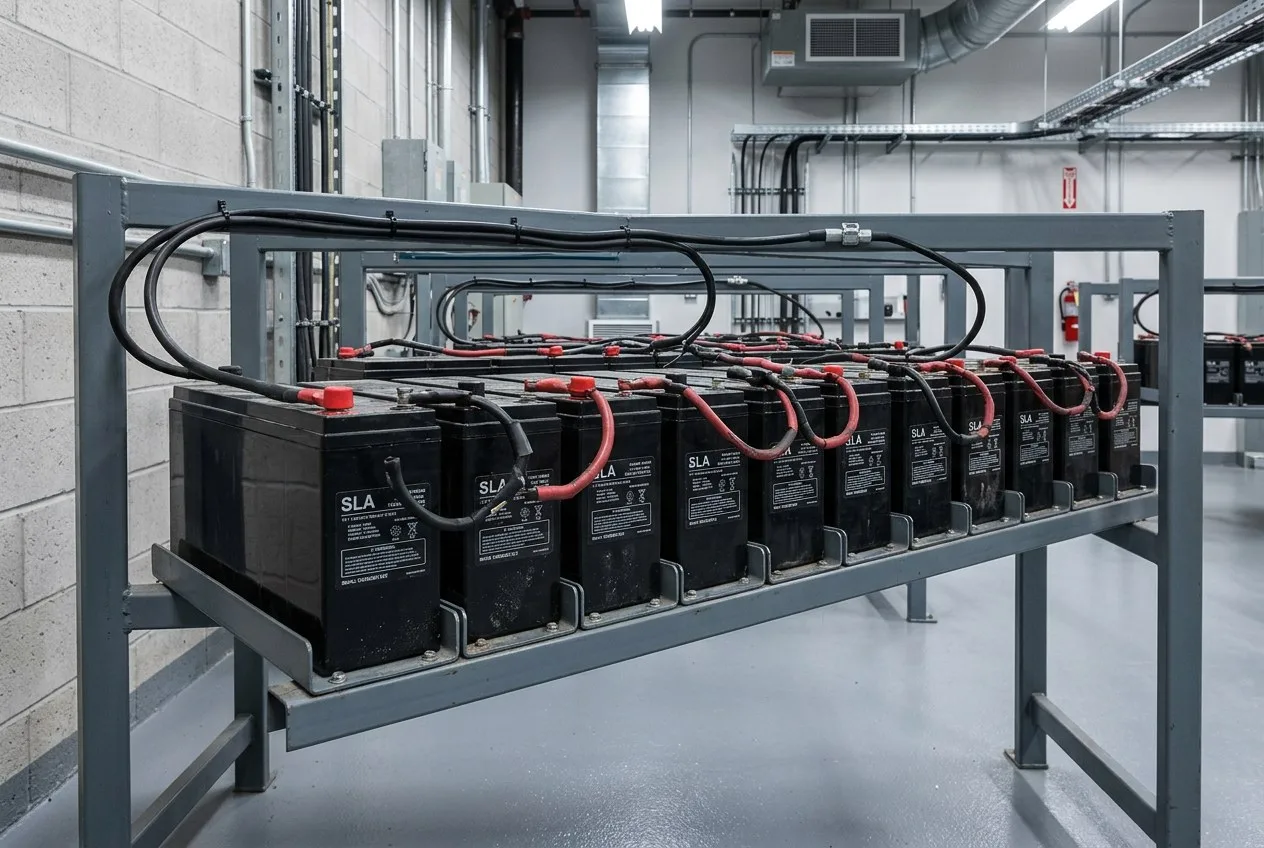
Wh and kWh: Lithium batteries and energy storage labels
Lithium batteries and household energy storage products are most often identified by Wh or kWh. Wh indicates the stored energy and is found by multiplying the rated voltage by Ah: Wh = V × Ah. This facilitates a direct comparison with the power of the loads in watts.
Example: 12.8 V, 100 Ah LiFePO4 battery
- Nominal energy: 12.8 V × 100 Ah = 1,280 Wh
- Usable energy (assumption: 90 percent depth of discharge): 1,280 × 0.90 ≈ 1,150 Wh
- Inverter efficiency (assumption: 90 percent): 1,150 × 0.90 ≈ 1,040 Wh on the AC side
- Duration for a load of 100 W: 1,040 ÷ 100 ≈ 10 hours
1,280 Wh on the label does not mean that it will give 1,280 Wh at the load at the output. The manufacturer sometimes writes the "nominal energy" and "usable energy" values separately. One is the total cell energy and the other is the part that can be taken in accordance with the BMS limits. Do not confuse the two when comparing. For the relationship between depth of discharge and cycle life Depth of discharge and cycle life You can check our article.
The Peukert effect in lithium batteries is significantly less than in lead-acid; therefore, the capacity on the label decreases less with rapid discharge. However, the maximum continuous discharge current and BMS limits are written on the label or data sheet, and these are just as important as the capacity. The difference between the two chemistries lithium-ion UPS batteries In his article, the difference in terms of safety and life is In LiFePO4 and NMC comparison You can find it.
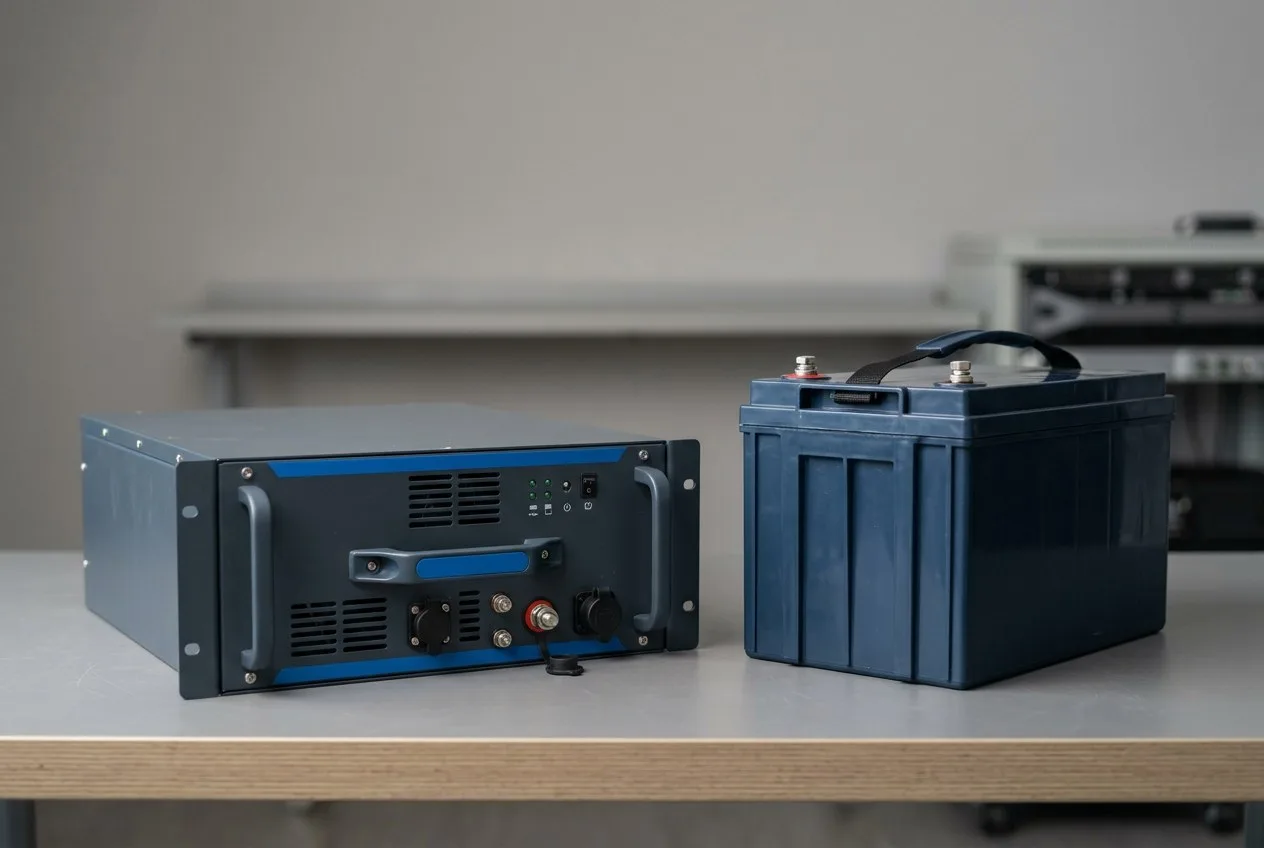
Other common values on the label
Information other than capacity is necessary for you to charge the battery correctly and use it safely. The table below summarizes these values with typical ranges. The figures are typical values; the manufacturer's data is consulted for the exact adjustment.
| Value | Typical range (VRLA, 25 °C) | Point to consider while reading |
|---|---|---|
| Float voltage | Approx. 2.25-2.30 V per cell (13.5-13.8 V in a 12 V block) | It is corrected by temperature; a high setting leads to drying, a low setting leads to sulfation |
| Boost voltage | Approximately 2.35-2.40 V per cell in cyclic use | Generally not recommended in fixed standby use |
| Maximum charging current | Mostly around 0.05-0.10 times the C10 value | Do not exceed the limit written in A on the label |
| Maximum discharge current | Short-term high values are given | Continuous and instantaneous value are different |
| Internal resistance (mΩ) | Varies by model and capacity | Keep as a new battery reference |
| Short-circuit current (A) | Hundreds of amps in large batteries | Required for protection element selection |
| Operating Temperature | Reference is usually 20-25°C | Life shortens as temperature increases |
| Design life (years) | Roughly 3-5, 6-10, 10-12 and above by series | Not a guarantee, but a reference for specific conditions |
The ranges for the charging voltage are in line with the values in the operating instructions published by the manufacturers: for example, a VRLA manual specifies 2.35-2.40 V/cell for cyclic charging and 0.05-0.10 times C10 for charging current. Check the value on your own label before applying them to your own battery. How voltages behave during charging and discharging How Battery Charging and Discharging Works We explained it in the article.
The internal resistance value is an early indicator of ageing in the battery. Record the first value on the label or data sheet. A comparison will be made with this value in future measurements. Detail of the topic What is battery internal resistance? It is in the article.
How to read the production date and serial number?
The date of manufacture is often written as a short code on the edge of the label or on the case. Some manufacturers give the year and month in letter-numerical codes, others write the month/year directly. The meaning of the code varies by brand, so verify with the manufacturer or supplier. This date is important for two reasons: it shows how long the battery has been in storage and determines the beginning of the warranty and life account.
It is possible that a battery that has been on the shelf for a long time will discharge on its own and require a refresh charge. This issue Shelf life of the battery It is detailed in the article. Record the serial number in the battery records along with the date of assembly; so you can monitor the test results on a block basis.
Example tag: Step-by-step reading
The following label is fictional and intended to show the reading order only:
- 12 V
- 100 Ah / C10 (1.80 V/cell, 25 °C)
- Float voltage: 13.6 V (25 °C)
- Maximum charging current: 25 A
- Production code: 2509
- Voltage and cell: 12 V is a six-cell block. If the float voltage is 13.6 V, it is 13.6 ÷ 6 ≈ 2.27 V per cell; this is within the typical range.
- Capacity: 100 Ah is written according to C10. The test current is 10 A and the final voltage is given as 1.80 V/cell (10.8 V).
- Energy: 12 V × 100 Ah = 1,200 Wh nominal. In lead-acid, not all of this is used in practice; the depth of discharge is limited.
- Charging current: 25 A is a fairly high limit as it is a quarter of the capacity. The charging case must not exceed this value. If the charging case uses a lower current limit, a longer charging time is expected.
- Date: The code is decoded from the manufacturer's table and the age of the battery is determined.
Common mistakes and what to do?
| Error | Conclusion | The truth |
|---|---|---|
| Directly comparing C20 Ah vs. C10 Ah | The battery looks bigger than it actually is | Look at the same C value and the same final voltage |
| Choosing a UPS battery with Ah | Backup time remains below expected | Check the W/cell value for the desired time on the datasheet |
| Thinking Wh is AC output energy | Time is overcalculated | Take into account the depth of discharge and inverter efficiency |
| Connecting batteries of different capacity, age or type to the same string | Unbalanced voltage, premature failure | Use blocks of the same model, capacity, and age |
| Adjusting the float voltage without reading the label | Desiccation or sulfation | Apply manufacturer value and temperature correction |
| Considering the old battery intact with the label information | Aged battery cannot back up | Perform capacity and status testing |
The mixing of different or old blocks in the series leads to tension imbalance. About this Unbalanced voltage in the battery bank and Should a single battery or the whole group be replaced? articles are useful for you. Capacity or status testing is required to see the actual status over the label values; the difference between the tests Status test with capacity test It is explained in the article.

Label reading on different types of batteries: What to look for
Depending on the battery chemistry, the information highlighted by the label varies. A quick guide:
- UPS type VRLA monoblock: W/cell, 15-minute value, final voltage, design life. Ah value is of secondary importance.
- Solar and deep cycle batteries: C10 or C20 Ah, cycle life and depth of discharge. The number of cycles determines the life of the battery used in the daily cycle.
- Stationary 2 V cells (OPzS/OPzV): C10 Ah and W values per cell. About these batteries OPzS and OPzV batteries You can check our article.
- Lithium batteries: Wh, rated voltage, maximum continuous current, BMS limits, and operating temperature range.
- NiCd batteries: Ah value and cell voltage; preferred for hot and difficult environments (NiCd batteries).
More generally, which battery is used in which system Which battery is used in which system You can find it in the article. For choosing a battery suitable for UPS How to choose a UPS battery and for compliance checking Is every battery installed in every UPS? Their writings provide additional information.
Label or datasheet? Which one to trust?
The label is a short summary; the datasheet shows which value applies under which condition. When comparing, look for:
- For which C ratio and for which end voltage is the capacity given?
- Is the reference temperature 20 °C or 25 °C?
- What time and for what last voltage is the W/cell written in the UPS battery?
- Are the charge and float values given with temperature correction?
- According to which temperature and usage conditions is the design life specified?
- Has the product been tested according to the appropriate test standard (e.g. IEC 60896-21/-22 for fixed VRLA batteries)?
The difference between the label and the actual behavior is only visible by measurement. Acceptance and commissioning tests after installation are valuable in this respect: Commissioning after battery replacement explains which values should be recorded in the first checks. If you keep the first measurements you have obtained together with the label values, it will be very easy to interpret future test results.
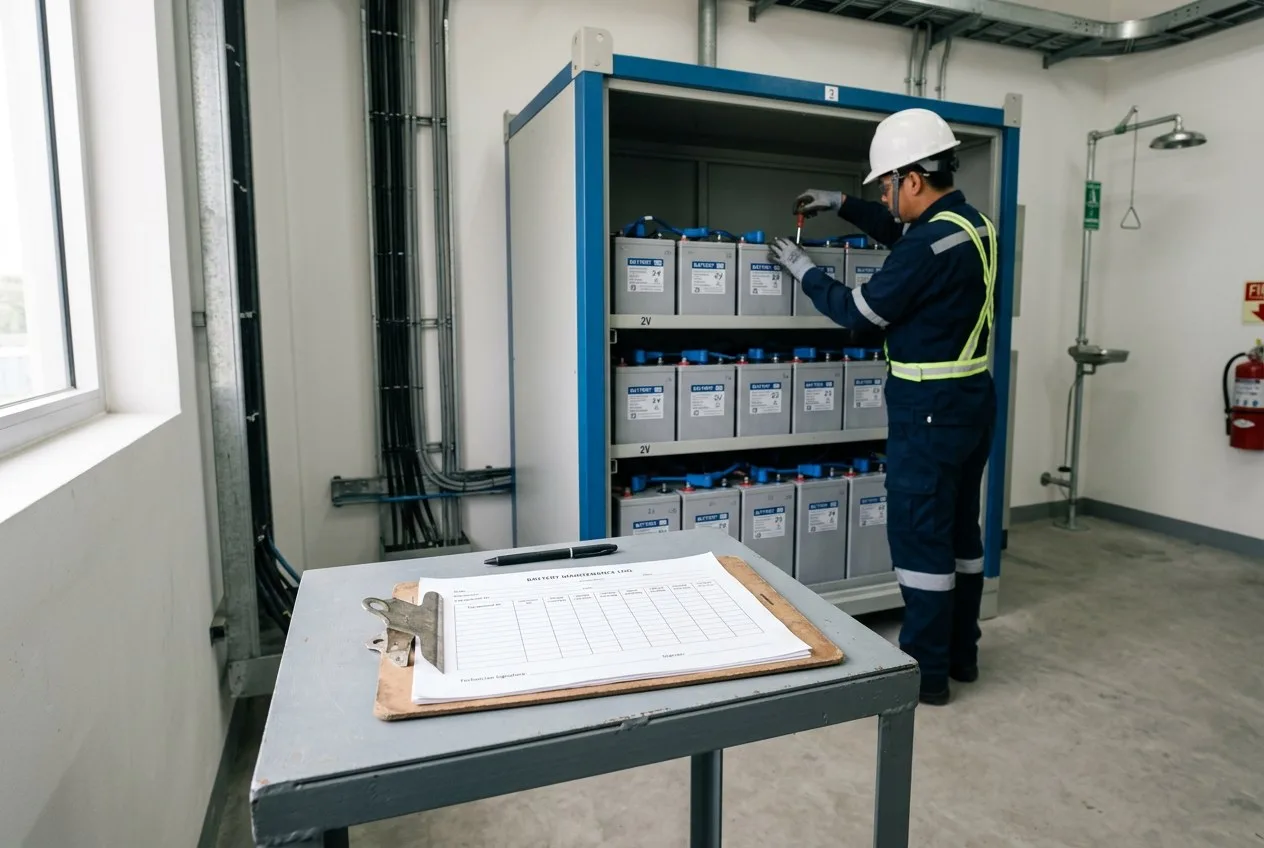
Where do label values take you?
When you read the battery label correctly, you can ask "in what time, at what current and up to what final voltage?" instead of "how many Ah?". This is a sufficient start for choosing the right battery and realistic time expectation. If you want to verify what the values on the label mean in the system, see the real condition of the current battery group, or check compatibility when choosing a new battery, you can benefit from Bempower's exploration, installation, periodic maintenance and technical service. For detailed information and request contact page You can take a look.
- EN 60896-21:2004 Valve regulated types - Methods of test — iTeh Standards / CENELEC, 2004. https://standards.iteh.ai/catalog/standards/clc/27ac471f-d0ba-4c19-9d99-9b24a8953afa/en-60896-21-2004
- Battery capacity and Peukert exponent — Victron Energy, 2025. https://www.victronenergy.com/media/pg/SmartShunt/en/battery-capacity-and-peukert-exponent.html
- Peukert's law — Wikipedia, 2025. https://en.wikipedia.org/wiki/Peukert%27s_law
- VRLA Valve Regulated Lead Acid Batteries user manual — WEG, 2024. https://static.weg.net/medias/downloadcenter/hb2/h4a/WEG-VRLA-batteries-user-manual-10005922959-en.pdf
- UPS 12580 Datasheet (watts per cell, constant current discharge tables) — CSB Battery, 2024. https://csb-battery.com/wp-content/uploads/2024/08/CSB-Datasheet-UPS12580-%E2%80%93-053124.pdf
- UPS Battery Sizing Made Simple for Users — AKCP, 2026. https://www.akcp.com/2026/10/13/ups-battery-sizing-calculator/
Resources
