What Are Harmonics? Their Effect on UPSs and Generators

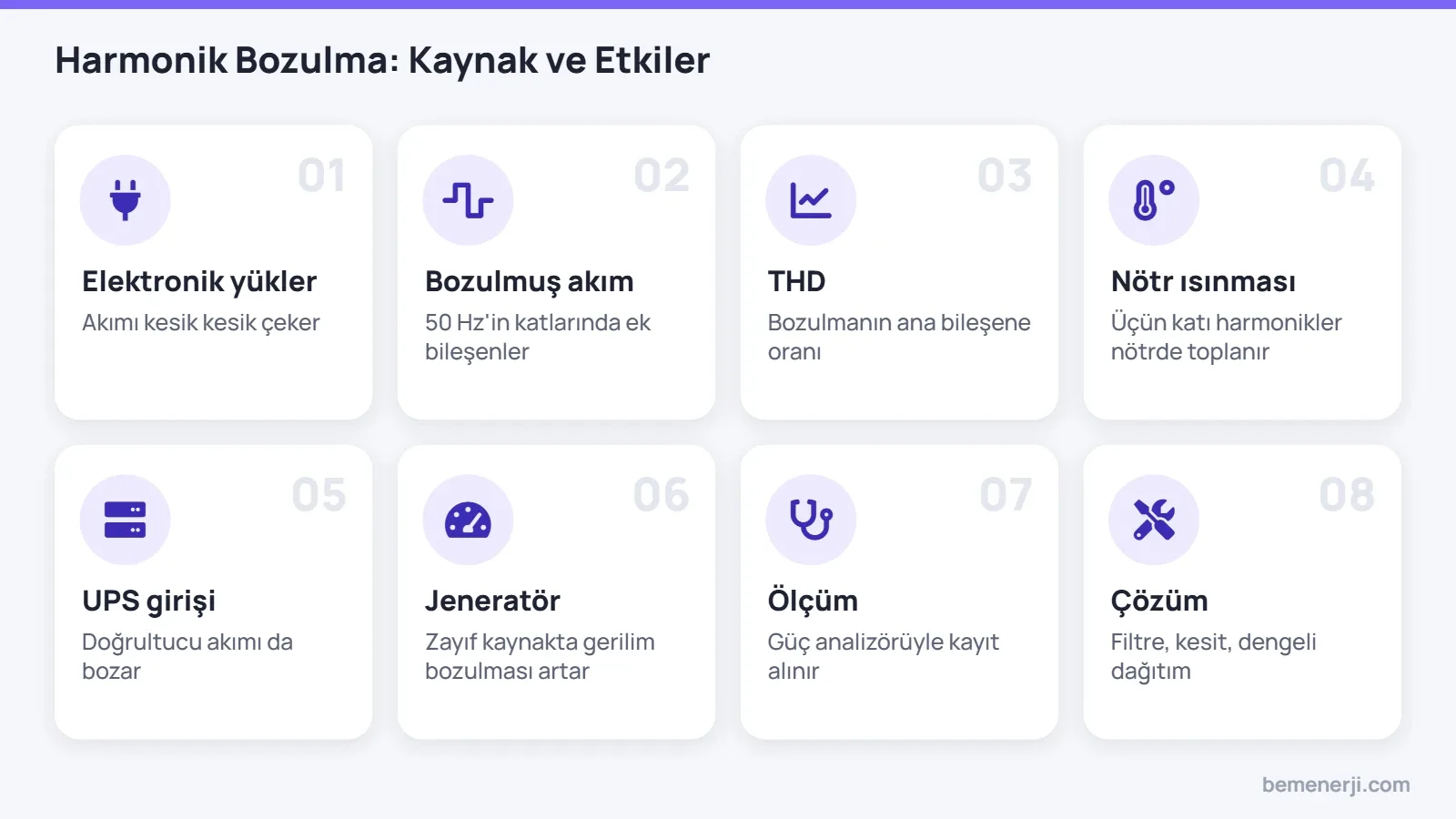
Ideally, the electricity in the grid is a smooth sine wave. There is no problem when devices draw current proportionally from this waveform. However, computer power supplies, motor drivers, and many electronic loads draw current in a choppy manner rather than in a sinusoidal waveform. The result is additional current components—known as harmonics—at frequencies that are multiples of 50 Hz.
In this article, we explain what harmonics are, their relationship to UPS systems and generators, and why they can cause overheating in the electrical panel.
What Is a Harmonic?
A distorted wave can be viewed as the sum of a 50 Hz fundamental component and components at its integer multiples (such as 150 Hz and 250 Hz). The fundamental component is the active power; harmonics, on the other hand, are currents that do no work but place a load on conductors, transformers, and the power source.
THD (total harmonic distortion), which expresses the ratio of this distortion to the fundamental component as a percentage. It is reported separately for both current and voltage. It is important to understand what this number measures: the THD of the current indicates the nature of the load, while the THD of the voltage indicates the extent to which the source is affected by these currents at that point.
The damage caused by harmonic current is often not immediately apparent. The cable heats up slightly more, the transformer experiences slightly higher losses, and the capacitors wear out sooner. Because of this gradual effect, the problem is usually noticed only when a failure occurs—that is, it is detected too late. This is why regular measurement and maintenance are so important.
Nonlinear Loads
- Switched-mode power supplies without a rectifier stage (without PFC)
- Motor speed controllers and frequency converters
- Some LED drivers and electronic ballasts
- Rectifiers at the input of uninterruptible power supplies
- Welding machines and certain industrial rectifiers
Since an office or data center consists of a large number of small electronic loads, it can generate a significant amount of harmonic current overall. Regarding the role of harmonics among power quality issues: What is power quality? You can check out our article.
Why Does the Neutral Conductor Heat Up?
In a three-phase, four-wire system, very little current flows through the neutral conductor when the loads are balanced and linear. However, third-order harmonics (such as the 3rd and 9th) do not cancel each other out in the phases; instead, they accumulate in the neutral. For this reason, in a facility with a large number of single-phase electronic loads, the neutral current may exceed the phase current. If the neutral conductor’s cross-sectional area is selected to be smaller than that of the phase conductors, the conductor will overheat.
These same currents cause additional losses in the transformer and heat up the connection points. How thermal imaging is used to monitor signs of overheating Thermal Camera Inspection During UPS Maintenance We explained this in our article.
Effect on the UPS Input
The UPS itself is also a nonlinear load: the rectifier at its input may draw current in short bursts. The input current THD depends on the rectifier’s design; in some models, this value is kept low, while others may require an additional filter. Since these values vary by manufacturer and load ratio, you should consult the data sheet.
The key is to properly size the UPS input cables and circuit breakers and to avoid increasing voltage distortion in the utility grid. What the power factor means at the input and output What is the power factor? We discussed this in our article.
In summary, the UPS input is both a load that generates distorted current and a device that is sensitive to distortion. This dual nature must be supported by measurements during the design phase.
Generator Compatibility
A generator is a much weaker source compared to the utility grid; it has high internal impedance. For this reason, the same harmonic current causes much more pronounced voltage distortion at the generator output. As a result, the UPS input connected to the generator may push the input voltage beyond its acceptable range, causing the UPS to frequently switch to battery power or causing the generator’s regulator to become unstable.
For this reason, the generator and UPS are planned together: the generator’s power is selected to handle the current drawn by the UPS’s input and its load capacity, while the UPS is equipped with features such as soft-start. Details The Difference Between a UPS and a Generator We explained this in our article.
The heat generated by harmonics can also shorten the lifespan of components inside the UPS, such as capacitors and fans; for the maintenance of these components, UPS Capacitor and Fan Replacement You can check out our article. The continuous deviations that appear at the input, however, are different from sudden impacts; for impacts, sudden voltage surges and surge arresters Read our article.
Solution Approaches
- First measurement: To record current and voltage THD and neutral current using a power analyzer.
- Choose a UPS with low input harmonics or an input filter.
- Select the neutral conductor and transformer appropriately based on the load.
- Size the generator to provide ample capacity for the UPS load.
- Distribute the loads evenly across the phases.
Since measurement and panel work is performed while the system is energized, only qualified technical staff is carried out by. When planning a new system, these steps Pre-installation technical survey is evaluated within it.
- IEC 62305-4 — Protection against lightning, Part 4: Electrical and electronic systems within structures
- IEC 61643-12 — Low-voltage surge protective devices: selection and application principles
- Surge arrester manufacturer's rating (coordination) tables and installation manual
Sources
Harmonics at a Glance
Nonlinear loads distort the current; this distortion affects the conductors, the transformer, and the generator.

The correct solution is determined not by guesswork, but by the data recorded using a power analyzer.
Frequently Asked Questions
01If the THD is high, does that necessarily mean there’s a problem?
02Why can the neutral conductor be selected to be larger than the phase conductor?
03Why does the UPS switch to the battery?
04Is a harmonic filter always necessary?
05Can I measure the harmonics myself?
Let's Measure Your Power Quality
We conduct on-site inspections for issues such as your UPS frequently switching to battery power, overheating at neutral, or generator incompatibility. Troubleshooting within Istanbul is free of charge; the process Troubleshooting and Technical Support We explained this on our page. The symptoms and system information Please let us know.