UPS Efficiency and Total Cost of Ownership (TCO)

When buying a UPS, the first question is usually, “How many kVA and how much does it cost?” However, the unit operates continuously for years and consumes a certain amount of energy every hour. The purchase price is only a portion of the unit’s total cost; the rest consists of electricity, cooling, battery replacements, and maintenance.
In this article, we provide a conceptual explanation of what efficiency means and which components make up the total cost of ownership (TCO). We do not provide specific figures, as these vary depending on the device, workload, and pricing plan.
What Does "Efficiency" Mean?
Efficiency is the ratio of the power the UPS delivers at its output to the power it draws at its input. The difference is converted into heat inside the device. In other words, inefficiency costs you in two ways: once on your electricity bill, and once in the cooling required to dissipate that heat.
Efficiency is not a single fixed number. The values listed on the manufacturer’s data sheet are measured at specific load ratios and in a specific operating mode; the actual values in your system will vary depending on your load. When making comparisons, you should look at values provided under the same conditions.
Dual Conversion and Eco Mode
An online (double-conversion) UPS first converts the incoming power to direct current, then uses an inverter to generate alternating current again. It completely isolates the load from power grid disturbances; however, because all the energy passes through two conversion stages, there is greater energy loss. The structure of the types Types of UPSs We explained this in our article.
Many online models feature an eco mode (high-efficiency mode). In this mode, as long as the grid is available, the load is supplied through the bypass line and the inverter remains in standby; if the grid fails, the system switches to bidirectional conversion within a very short time. Losses are reduced, but the load remains more vulnerable to grid disturbances.
| Mood | Advantage | Point to Note |
|---|---|---|
| Double conversion | The load is completely isolated from power grid disturbances | Continuous conversion loss results in more heat |
| Eco Mode | Lower losses and heat | Transition time and dependence on network quality; the sensitivity of the load must be evaluated |
For sensitive or critical loads, the decision to use eco mode is based on the quality of the power grid and the load’s tolerance range; What is power quality? Our article provides the basis for this assessment.
The Relationship Between Load Factor and Efficiency
A UPS's efficiency typically decreases significantly at very low loads. This is because the device's internal power consumption remains high regardless of the load; as the load decreases, the proportion of this constant consumption increases. As a result, a UPS that is oversized is costly both to purchase and to operate.
The opposite is also true: a device that constantly operates near its load limit will overheat and have no room for expansion. The goal is to keep the load within a reasonable range. The logic behind sizing Choosing a UPS In our article, the account Power Calculation You can find it in our vehicle. The modular design can help achieve this balance by adjusting the load based on the number of modules; details What is a modular UPS? in our article.
Heat Means a Heating and Cooling Load
The UPS’s power loss is dissipated as heat into the room. In a small device, this is negligible, but in a server room or in large systems, the heat means the air conditioner has to consume additional electricity. In other words, the true energy cost of a UPS is its own power loss plus the energy consumed by the cooling system required to dissipate that loss.
An excessively hot room also shortens battery life; Factors Affecting Battery Life We explained this in our article. To diagnose heating problems, UPS overheating and fan failure You can check out his article.
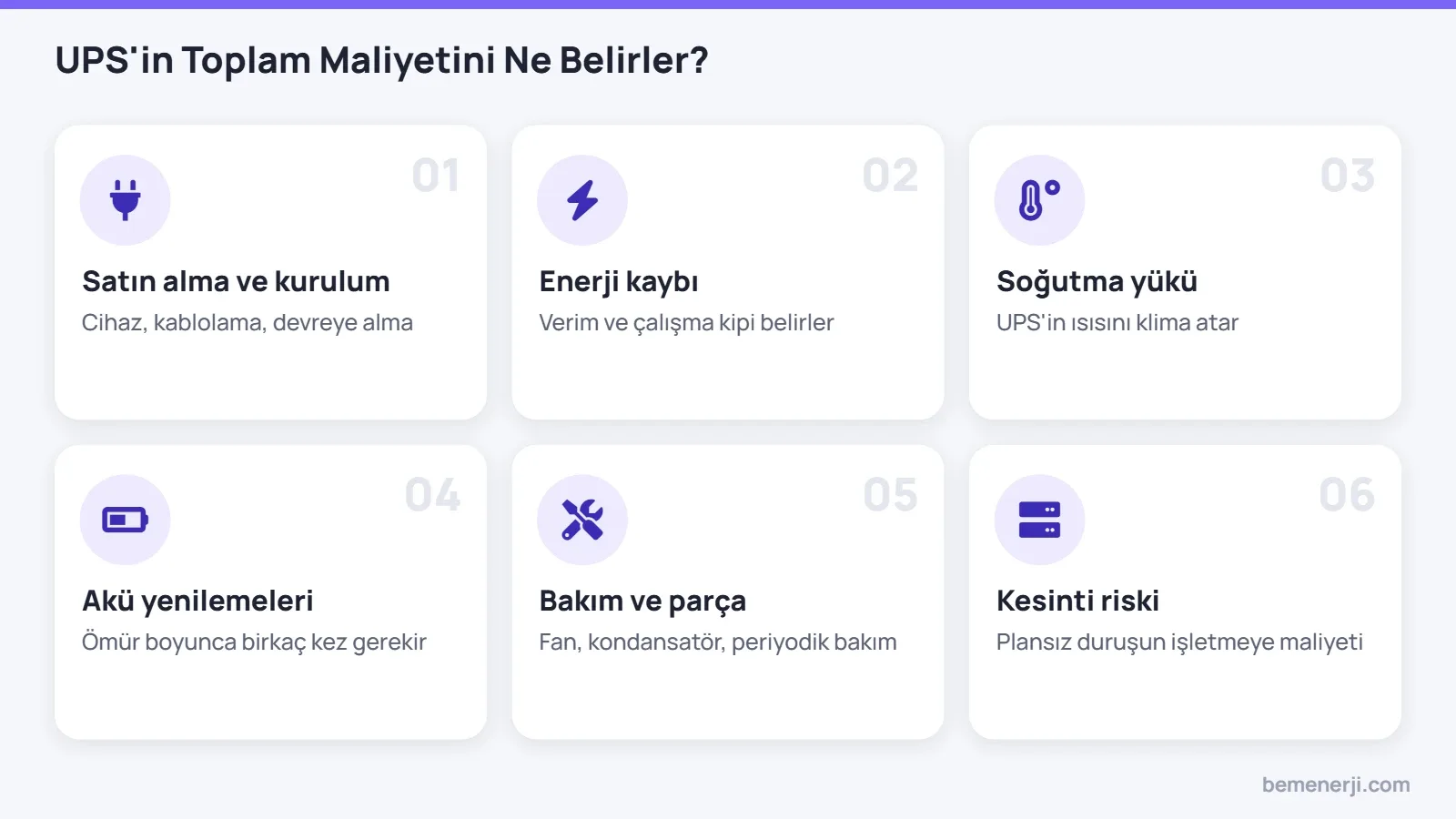
Components of TCO
- Purchase and installation: Equipment, wiring, panel modifications, commissioning.
- Energy: The UPS's own power loss and the power consumption of the cooling system that dissipates that loss.
- Battery replacements: The battery pack is replaced several times over the device's lifespan; in most systems, it is a significant component of the TCO.
- Maintenance and service: Routine maintenance, replacement parts, and components with a limited lifespan, such as fans and capacitors.
- Risk of outages and malfunctions: The cost to the business of unplanned downtime; this item is the most difficult to quantify, but it is often the largest.
- Deactivation: Dismantling of old devices and proper disposal of batteries.
When to Replace the Battery When should a UPS battery be replaced?, why the old device ended up being so expensive after a certain point When should an old UPS be replaced? We explained this in our article. Regarding the effect of maintenance on this table, Preventive and predictive maintenance You can also check out our article.
What is included in the battery replacement coverage? What does the battery replacement service include? In this article, we'll discuss what to do next with removed batteries Disposal of Used Batteries As we explained in our article, these are also the hidden components of TCO.
What Factors Are Considered When Making a Decision?
Compare quotes not only based on the cost of the equipment, but also on efficiency at the selected load rate, battery type, expected number of replacements, and maintenance conditions. Of two devices with the same capacity, the cheaper one may end up being more expensive over the years when operating costs are factored in. It is helpful to work with a technical team that understands the system’s operating profile when making such a comparison.
- NICEIC — Effects of triplen harmonics (the accumulation of third-harmonic components at neutral)
- Mirus International — Triple Harmonics
- IEEE Std 519-2022 — Harmonic Control in Electric Power Systems
Sources
Beyond the Price Tag
The true cost of a UPS is spread out over the years; it is determined by the total of energy, cooling, battery, and maintenance costs.

Proper sizing, the appropriate operating mode, and regular maintenance are the three main factors that reduce total cost.
Frequently Asked Questions
01Is Eco Mode safe?
02Is a larger UPS always safer?
03What is the most commonly overlooked item in a TCO calculation?
04How do I find out the yield in my own system?
05Does maintenance reduce total costs?
Let's Evaluate the Total Cost Together
Let’s work together to develop a maintenance and battery replacement plan for your UPS and battery systems. The approach and steps Periodic Battery and UPS Maintenance On our page, options based on visit frequency maintenance plans We explained this on our page. Your system's information Please let us know.