UPS Selection by Sectors: Which UPS in Which Facility, How Many kVA, How Many Minutes?

There is no single answer to the question "Which UPS for my business?" A small UPS that is right for an apartment building's door and camera system is insufficient at the first outage in a call center; the right redundant architecture for a data center is an unnecessary investment for a pharmacy. But the same five questions are asked in every industry, and the answers determine UPS. This guide collects those five questions first, then the protected loads, typical power band, time target and topology in a single table; it links to the detailed text of each row. Finally, we explain the loads that should never be connected to the UPS in all industries and the discovery process. If you are new to what UPS is What is UPS and How to choose a UPS You can start with the articles.
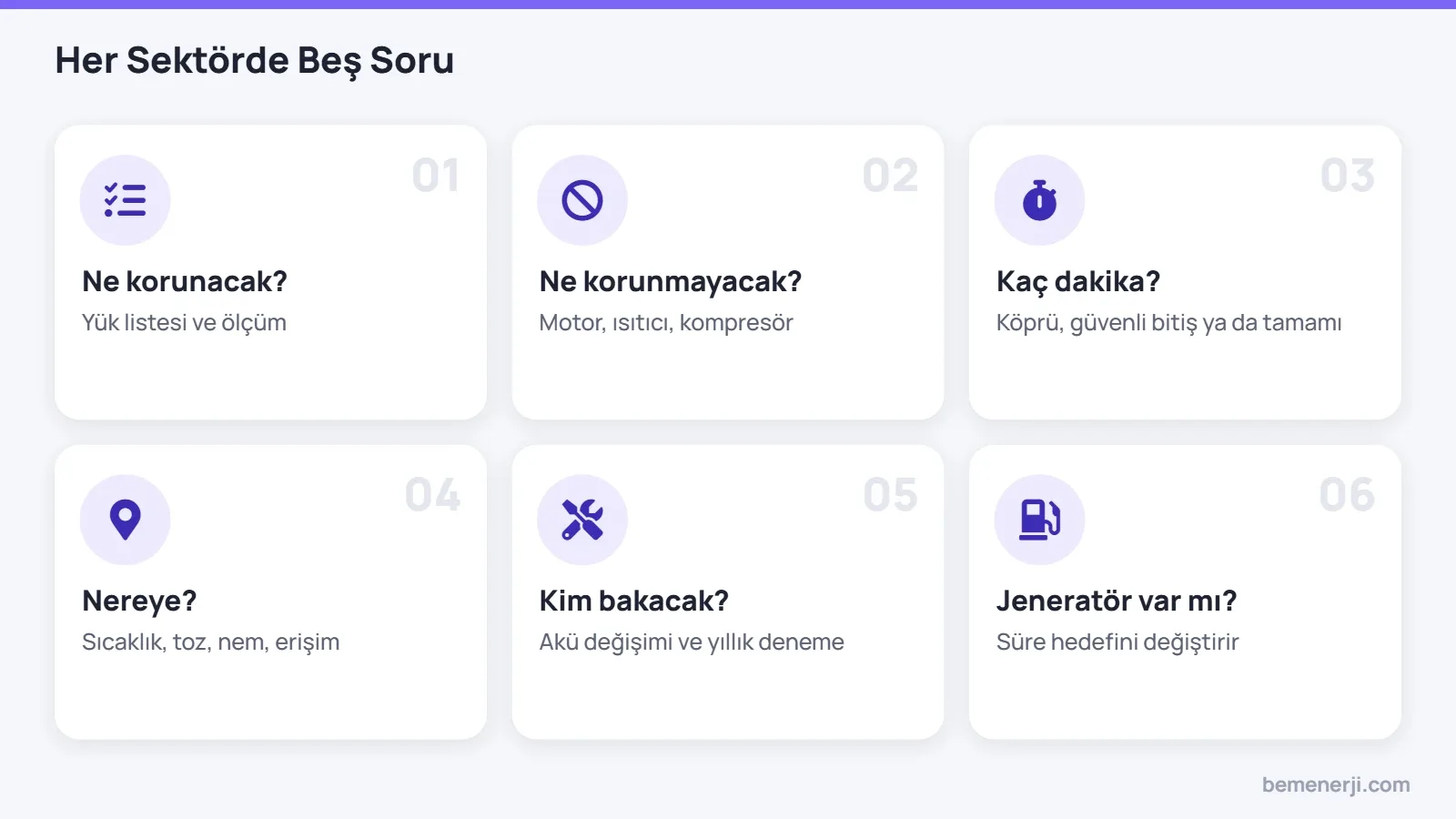
Five Questions Asked in Every Industry
- What will be preserved? Loads that are damaging to stop in an outage: computer, server, network, control, recording, communication. The load list and measurement are the beginning of each account.
- What will not be protected? Motors, heaters, compressors, and large loads. Removing them from the UPS often cuts the UPS in half.
- How many minutes? Bridge to the generator, finish the job safely, or carry the entire outage? The time is determined with the load.
- Where? The environment of the UPS and battery — temperature, dust, humidity, access — can halve battery life.
- Who will take care of it? The battery is a consumable; without a maintenance and replacement plan, the UPS will not work at the first actual outage.
The method of power calculation How to calculate UPS power, calculate the duration How to calculate battery time We explained in your articles; with your device list Power Calculation You can immediately make a preliminary calculation in the vehicle.
Housing and Building Systems
| Industry | Protected loads | Typical power | Duration target | Topology |
|---|---|---|---|---|
| Apartments and sites | Camera, intercom, door, common area network | 0.5–3 kVA | 1–2 hours | Line-interactive |
| Residences and smart buildings | Building automation, servers, floor cabinets | 10–40 kVA + floor UPSs | 10–15 min (with generator) | Online |
| Villa and cottage | Modem, camera, alarm communication, combi boiler | 1 kVA | 2–4 hours | Pure sine |
| Elevator | Rescue manoeuvre (or the entire engine) | 1–3 kVA / 10–30 kVA | Several manoeuvres / 15–30 min | Rescuer / three-phase online |
| Parking | License plate camera, inspection PC, kiosk, barrier | 1–1.5 kVA | 15–30 min | Online (if engine) |
| Access control | Server, network, turnstile; locks DC at source | 1–1.5 kVA | 15 min + DC 4–8 hrs | Line-interactive / online |
| Intercom | Power plant, PoE switch, lock transformer | 0.6–1 kVA | 1–2 hours | Line-interactive |
| Fire Alarm | The battery of the panel is mandatory; For UPS announcement and monitoring | By load | According to the project | Online |
| Places of worship | Sound system, time clock, camera, modem | 1–2 kVA | 30–45 min | Pure sine |
Retail, Accommodation & Service
| Industry | Protected loads | Typical power | Duration target | Topology |
|---|---|---|---|---|
| Market and store | Cash register, POS, scale, modem, back office | 0.6–1 kVA per case | 15–30 min | Line-interactive |
| Restaurant and café | Safe, kitchen screen, printer, Wi-Fi | 1–1.5 kVA | 20–30 min | Pure sine |
| Hotel | Reservation system, card encoder, switchboard, floor network | 3–10 kVA + layers | 10–15 min | Online |
| Shopping Mall | Security center, camera, announcement, parking lot | 20–60 kVA redundant | 10–15 min | Online N+1 |
| Pharmacy | Computer, modem, data matrix, cash register, cabinet alarm | 1–1.5 kVA | 30 min | Pure sine |
Office, Institution and Education
| Industry | Protected loads | Typical power | Duration target | Topology |
|---|---|---|---|---|
| Office and plaza | Desks, server, network | ~150 W per person | 10–15 min | Online / line-interactive |
| Call center | Switchboard, VoIP, seats, PoE phone | 100–170 W per seat | 10–30 min | Online, redundant |
| Bank | Toll booth, counting, camera, ATM | Branch 5–10 kVA, ATM 1–3 kVA | 15–60 min | Online |
| School | Presenter, IT classroom, exam hall | 2–3 kVA + laboratory | 15–30 min | Online / pure sine |
| University | Data center, faculty, laboratory | Layered | By Tier | Online |
| Municipality and public | Cashier, system room, field devices | 10–20 kVA + DC UPS | 15–30 min | Online VFI |
| Network and communication | Modem, switch, PoE, switchboard | 0.6–2 kVA | 1–2 hours | Rack, line-interactive / online |
Healthcare, Laboratory & Broadcasting
| Industry | Protected loads | Typical power | Duration target | Topology |
|---|---|---|---|---|
| Polyclinic and dental clinic | Admission, ultrasound, dental unit electronics | 1–3 kVA | 15–30 min | Online |
| Laboratory and pharmaceutical | Analyzer, chromatography, LIMS | By device | 15–30 min | Online |
| Medical imaging | Console, control, video computer | According to the manufacturer's certificate | Bridge to generator | Online |
| Cold chain | Temperature recording, alarm, notification | 0.6–1 kVA | Hours | Line-interactive |
| Publisher and studio | Broadcast PCs, audio, networking | 1.5–3 kVA | 5–10 min | Pure sine |
Industry, Energy and Transportation
| Industry | Protected loads | Typical power | Duration target | Topology |
|---|---|---|---|---|
| Control Room | Server, console, video wall | A/B two lines | 30–60 min | Online 2N |
| CNC | NC control unit, machine PC | 1–3 kVA | Safe stop | Online |
| PLC and automation | PLC, I/O, HMI, switch | 50–500 W per panel | Minutes | 24 V DC / AC |
| Warehouse and logistics | Warehouse management, access points, shipping | Regional | 15–30 min | Online + rack |
| Food production | Process control, coding, control points | Per board | 10–15 min | DC / industrial AC |
| Printing Press | Prepress, machine control, exposure | 1–3 kVA + machine | 10–15 min | Online |
| Energy and transformer | Protection, control (DC); control room (AC) | 110/220 V DC | By design | Rectifier + battery |
| Airport | Screens, check-in, baggage check, screening | Redundant + zonal | 10–15 min | Online 2N / N+1 |
| Metro and railway | Information, announcement, camera, turnstile | N+1 per station | Evacuation time | Online |
The values in the table are typical starting points, not the exact size; it is calculated by measuring the load of each plant. For topology differences Types of UPS, for redundancy options UPS redundancy: N+1, 2N, parallel You can look at the articles. We have two complementary articles on the battery side: Is every battery installed in every UPS? and Which battery is used in which system.
Those Who Don't Connect to UPS in Any Industry
As the sector changes, the loads protected change, but the loads that should not be connected to the UPS are the same almost everywhere. What they have in common is that they constantly draw several times their power when they take off or require kilowatts of energy for hours:
- Motors: booster, pump, conveyor, spindle, elevator motor (except recovery), escalator.
- Heaters: electric heater, under-carpet heating, water heater, water heater, coffee machine, oven, autoclave, dryer.
- Loads with compressor: refrigerator, freezer, cold room, air conditioner, dental compressor.
- Laser printer and copier.
- Fire pump, smoke extraction and pressurization fans — they have their own safety supply.
If these loads need to operate in an outage, a generator is the solution; the UPS's job is to keep control, recording and communication alive alongside them. The most frequently asked question for supercharged loads cold chain monitoring and UPS We answered in detail in the article.
Generator and UPS Together
Most corporate and industrial facilities have generators, and the UPS's role changes: instead of carrying the entire outage, it bridges the 10-30 seconds the generator kicks in, allowing time for an orderly shutdown if the generator doesn't arrive. This shortens the time target and shrinks the battery investment; but the UPS's compatibility with the generator — frequency tolerance, harmonics, synchronization in transit — becomes important. More The difference between UPS and generator and Harmonic and generator effect We explained it in the articles. In small businesses without generators, UPS is better than completing the job safely.
What Do We Look For in Discovery?
A UPS proposal for a facility is prepared in the field, not at the desk. A list of loads to be protected in the exploration is drawn up and, if possible, measured while in operation; electrical panel, line structure and grounding are examined; if there is a generator, the transfer pattern and the lines it feeds are learned; the temperature, ventilation and access of the place where the UPS and battery will be placed are evaluated; the time expectation of the operation and the interruption scenario are discussed. The result is a proposal that includes the kVA value as well as the duration, topology, layout and maintenance plan. Discovery process Technical discovery before UPS installation We explained step by step in the article; What will be inspected after installation Initial commissioning and acceptance tests You can find it in the article.
Maintenance: The Common End of Every Industry
Regardless of the industry, the UPS's ability to give the expected time at the time of an outage depends on the condition of the battery. VRLA batteries change in a few years in favorable conditions; earlier in a hot environment. Battery measurement, battery operation trial, and visual inspection at least once a year show most problems before an outage arrives. Inventory and remote monitoring are essential in businesses with a large number of UPSs. By number of visits per year to our maintenance plans You can look at the scope of periodic maintenance periodic battery and UPS maintenance page.
The sector changes, the questions do not change

Frequently Asked Questions
01How many kVA UPS do I need for my business?
02Online UPS or line-interactive?
03How many minutes should a UPS last?
04I have a generator, do I need a UPS?
05Will the air conditioner and heater be connected to the UPS?
06Which industries require redundant UPS?
07When does the battery of a UPS change?
08My sector is not in the table, what should I do?
Discovery for Your Property
No matter what sector you are in, let's measure your loads and determine the UPS length, duration, layout and maintenance plan together; For on-site projects in Istanbul and surrounding provinces, and for industrial-scale projects in distant cities Contact Us.