Cold Storage and Cold Chain Monitoring: UPS Doesn't Start the Compressor, But What Does It Protect?

From the grocery store to the pharmacy, from the laboratory to the food warehouse, every business that works with the cold chain has the same first question: "Can't we run the cabinet with UPS during an outage?" The answer is often no, and knowing why prevents the wrong investment. But no, it doesn't mean being helpless in an outage: the temperature is maintained in the closet for hours, what is really lost is knowing what is happening and getting timely news. This is exactly the real job of UPS in the cold chain. This article first explains why the compressor is not connected to the UPS, then how the temperature behaves during the outage, and finally the monitoring layer and action plan that the UPS will maintain.
Why Compressor Not Connected to UPS
The refrigeration compressor is the worst load of the UPS with two features. The first is the inrush current: the compressor draws 5-7 times its continuous power each time it is activated; For a 1 kW cold room unit, the UPS must carry an instantaneous load of 5-7 kVA. The second is the duration: interruptions are measured in hours, not minutes, in the cold chain, and the compressor runs several times per hour; the battery pack that will carry its energy is disproportionate even for a small cold room. Third, efficiency: the compressor powered by the UPS works even more expensive with cycle losses. If outage operation is required for market cabinets, cold rooms and freezers, the answer is a generator; for very small loads (single vaccine cabinet, small medical refrigerator), the option of a battery-powered inverter or a battery-powered cabinet from the manufacturer is considered. Limits of the generator and inverter what is an inverter, what is the difference with a UPS We explained in the article; how the compressor load overloads the UPS UPS overload alarm You can see it in the article.
How Does the Temperature Rise in Outage?
The good news is that the cold volume retains itself for a while. A full freezer with a closed door stays frozen for hours; a full cold room heats up much more slowly than a half-full one because the mass of the product stores the cold. In contrast, thin-walled grocery store display cabinets and cabinets with opening doors heat up quickly. Each facility has its own curve; it is necessary to measure it rather than predict it. Once, with a planned outage trial or from records, the number of minutes the temperature approaches the limit is determined, and the action plan is written according to this time. To make this measurement, a temperature recorder operating during the outage is required — and this is where the UPS comes in.
The Real Job of UPS: Monitoring, Alarm, Notification
| Layer | Devices | Typical power | Importance in interruption |
|---|---|---|---|
| Temperature recording | Data logger, sensor centre | 5–30 W | Registration is not interrupted during the interruption; proof in audit |
| Alarm and notification | Alarm panel, GSM modem, internet modem and router | 20–60 W | If the news does not reach, no one will come |
| Control | Cooling control panel, PLC, touch screen | 20–100 W | Properly restarting when power comes on |
| Access | Cold room door lock, lighting | 10–50 W | Staff staying inside; product transport |
| Non-binding | Compressor, condenser fan, defrost heater | kW order | Generator or manufacturer's battery-powered solution |
The total load of this layer is less than 100 W in most plants; A 600–1000 VA UPS can survive for hours on its own battery and overnight on an external battery. The investment is small, the gain is big: in the event of an outage, an SMS is sent to the person responsible, the temperature curve is recorded, and when the power is restored, the control panel restarts the compressors sequentially and correctly. If the notification is connected to the Internet, the modem and router must be on the same UPS; this chain UPS for network and communication systems We explained in the article. The monitoring order for the alarm to reach a place UPS remote monitoring and alarm management You can establish it with the logic in the article.
Vaccine and Medicine Cabinets
Vaccine cabinets and pharmaceutical refrigerators are the most sensitive end of the cold chain: the temperature range is narrow, the product is expensive, and the health regulations require uninterrupted temperature recording. There are two ways here. The first is to operate the cabinet itself in an interruption: battery-powered models from medical cabinet manufacturers or a battery-powered inverter of suitable size for a small cabinet; since the compressor is small (usually 100–300 W), it can be implemented on this scale, but the starting current and time are still calculated. The second, and in any case necessary, is to protect the data logger and alarm with a UPS; the answer to the question "what happened during the outage" in the audit is recording. Pharmacy and polyclinic-scale application UPS for pharmacies and UPS for outpatient clinics and practices We also discussed it in his articles.
Outage Action Plan
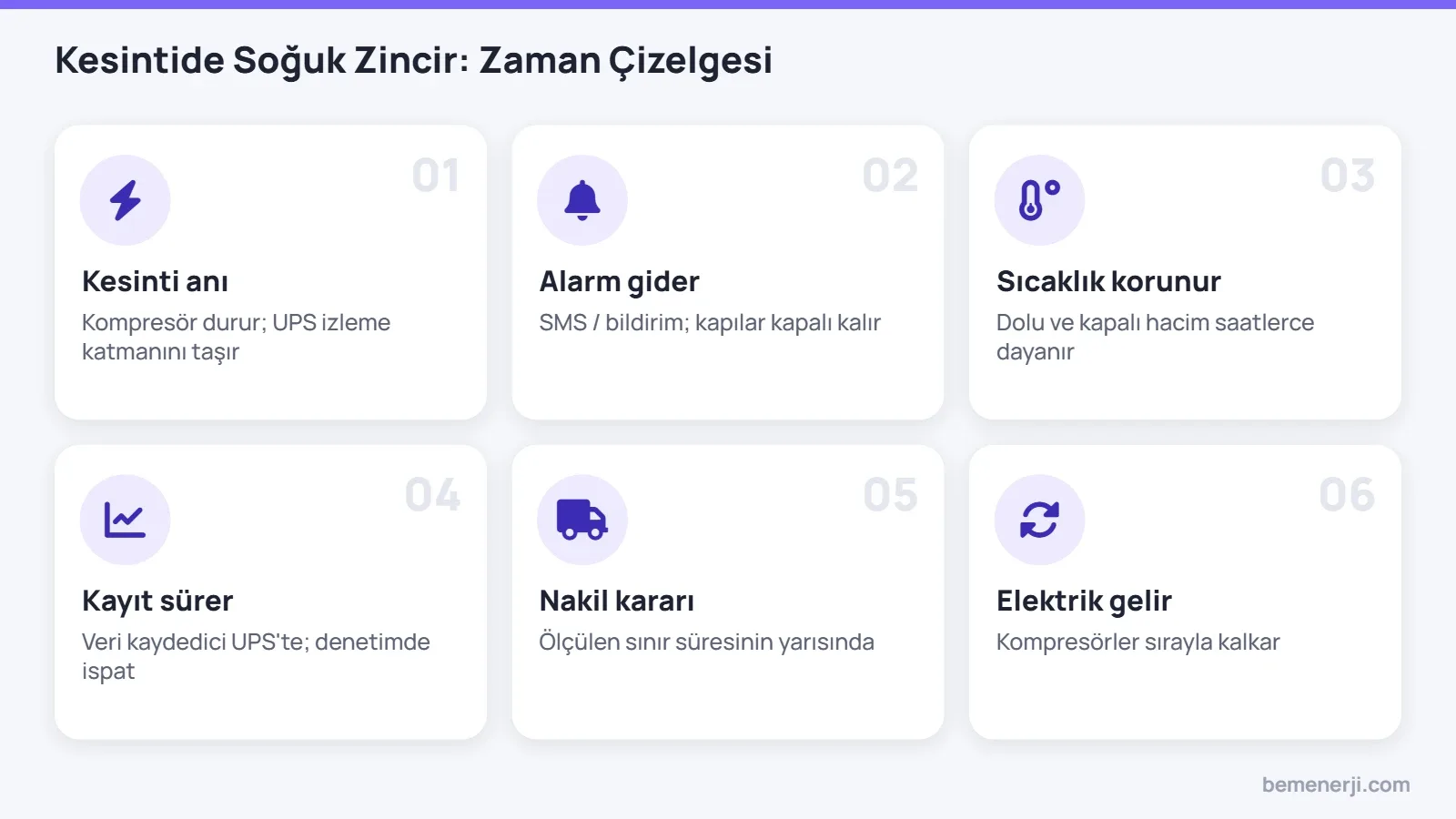
- 0th minute: The alarm with UPS notifies the person in charge; the doors are kept closed, no one opens them "to look".
- First half hour: The temperature record is monitored; if there is a generator, it is verified that it has been commissioned, and it is seen that the compressors are taken up in turn.
- Half of the measured limit time: Transplant decision: to nearby branch, contracted warehouse, or reinforcement with dry ice. This decision requires a measured curve; the decision made by prediction is either early or late.
- As for electricity: Do not start the compressors at the same time (demand load and blown fuse); if the control panel is stuck in the UPS, sequential start will occur automatically.
- After: The record is exported, if the limit is exceeded, the product evaluation is based on the record.
Common Mistakes
- Attempting to connect a grocery cabinet or cold room to a 3 kVA UPS; overload on first start, the UPS shuts down.
- Taking the alarm panel to the UPS and not buying the GSM modem or internet modem; the alarm sounds, it does not reach anyone.
- Not measuring at all how many hours the temperature rises in the outage; the action plan is based on guesswork.
- Opening and "checking" the cabinet door frequently during an outage; each opening loses cold for minutes.
- Allowing all compressors to take off at the same time when the electricity is restored; the main fuse blows, the interruption is prolonged.
- Not noticing that the data logger's own battery has not been changed for years; there is no recording in the outage anyway.
Just as servers shut down properly in an outage, the cooling control panel restarts properly is a communication job; Automatic shutdown The logic in the article is also valid here. Our sector articles for food facilities and warehouses: UPS for food production facilities, UPS for warehouses and fulfillment centers, UPS for grocery stores and stores, UPS for laboratories and pharmaceutical companies. If you want to set up a small UPS and alarm pattern for your monitoring layer Contact Us.
UPS does not cool, notifies

Frequently Asked Questions
01Will the refrigerator or cold room work with UPS?
02What to do for the vaccine cabinet?
03How many hours does the cabinet heat up during an outage?
04How to set an alarm?
05What should be considered when electricity is on?
Does Your Cold Chain Notify of an Outage?
Let's set up the right UPS and monitoring pattern for your temperature recording, alarm and notification layer together; For on-site installation in Istanbul and surrounding provinces Contact Us.