UPS Runtime Test: How Is Actual Backup Time Measured?

The runtime is the number of minutes the UPS can power the load from the battery when the mains power is cut off. This time is listed in the table on the data sheet, but the actual runtime in the field is often different: the batteries may be aged, the load may have changed, or the ambient temperature may be different. The only way to determine the actual runtime is to measure it through a controlled test. In this article, we explain how to plan such a test.
Why Is the Time on Paper Different from the Actual Time?
- Battery age: Batteries lose capacity over time; the runtime of a new battery will not be the same years later.
- Load: The time table is provided for a specific load; the actual load on-site may be greater or less than this.
- Temperature: Battery capacity decreases at low ambient temperatures, while high temperatures shorten its lifespan.
- Battery status: A weak block determines the duration of the entire group.
- End-of-discharge voltage: The UPS shutdown threshold directly affects the duration.
For the logic behind the time calculation How is battery life calculated? You can check out our article. The topic of this article is taking measurements instead of relying on calculations.
Test Methods
The duration of autonomy can be measured in two ways:
- Live load test: The mains power at the input is intentionally cut off, and the actual load carried by the UPS is measured. The result is the closest to real-world conditions, but this puts the load at risk.
- Load bank test: A known artificial load is connected to the UPS output, and the time is measured. The actual load is not at risk, but this requires equipment and setup. For details, What is a load bank test? Check out our article.
The "battery test" function built into UPS units typically performs a brief discharge to check the battery's condition; it does not measure the full runtime. The difference between tests designed to assess the battery's health How to Perform a Battery Discharge Test We explained this in our article.
Pre-Test Preparation
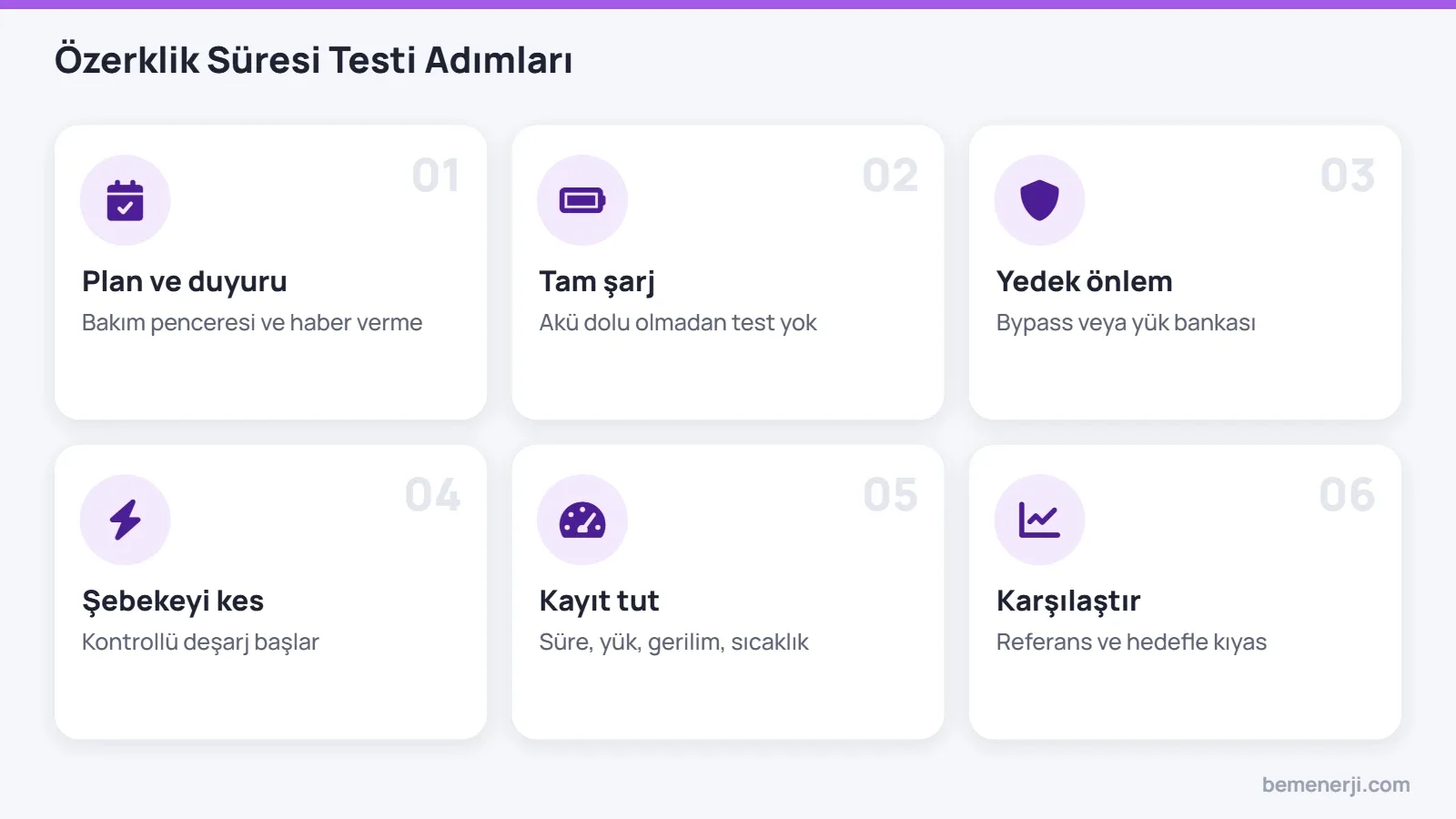
- The batteries must be fully charged. A set that has recently been discharged will show a shorter runtime than it actually is.
- The time when the test will be conducted should be designated as a maintenance window, and the relevant departments should be notified.
- For critical systems, the load is first routed to a bypass or tested using a test load bank; this ensures that service is not interrupted even if a problem arises.
- The measuring instruments to be used during the test should be prepared, and the initial voltage, load, and temperature should be recorded.
- The termination criterion must be determined in advance: for example, the test is terminated when the target duration expires or when the discharge end voltage is approached.
Discharging the battery completely during testing shortens its lifespan and is unnecessary. The goal is to determine whether the required runtime is achieved. The required runtime should be considered in conjunction with other measures, such as redundancy and a generator set; for this perspective, Redundancy in a UPS You can check out our article.
Recording and Interpreting Results
The following data is recorded at the end of the test: test date, initial group voltage, load (kW or percent), ambient temperature, elapsed time, and final voltage. This record serves as the reference value for the first test; subsequent tests are compared to it. A decrease in runtime over time indicates that the battery is aging and supports the decision to replace it. If the target runtime is not met, options include replacing the battery, adding an additional battery bank, or reducing the load.
| Finding | Possible meaning | Next step |
|---|---|---|
| Time is ahead of schedule | The battery is sufficient | Use the record as a reference |
| The duration is close to the target and trending downward | The battery is aging | Increase the frequency of testing |
| Well below the time target | Loss of capacity or weak block | Block-Based Measurement and Change Plan |
| The duration is very short; sudden shutdown | Serious battery problem | Emergency check |
For interpreting the results and deciding whether to replace the battery When should a UPS battery be replaced? To schedule your testing with us, please contact us Discharge and Load Tests You can check out our page.
Who Should Take the Test?
The autonomy test must be performed by authorized technical personnel familiar with the structure of the UPS and the battery bank. Connecting the load bank, monitoring the battery bank, and safely interrupting the test in the event of a problem require experience. On the operational side, the day and time of the test, which systems may be affected, and who will approve it are clarified in advance. After the test, the report is retained as a basis for comparison for the next test; thus, each test serves as a continuation of the previous one.
- IEC 62040-3 — Uninterruptible power systems (UPS) — Performance and test requirements (standard title).
- IEEE Std 450 — Recommended practices for the maintenance, testing, and replacement of vented lead-acid batteries; IEEE Std 1188 — Equivalent for VRLA batteries (as per the standard title).
Sources
Measuring Time Is More Reliable Than Calculating It
The runtime listed on the data sheet is based on ideal conditions. Actual runtime varies depending on the load, battery age, and temperature; only a measurement can determine this.

With a planned, documented, and precautionary test, the actual autonomy time is known, and the decision to replace the vehicle is based on data.
Frequently Asked Questions
01How many times a year should we perform the autonomy test?
02Does the test damage the battery?
03Is the UPS's built-in battery test sufficient?
04Is the load maintained during the test?
05The runtime has decreased—is it absolutely necessary to replace the battery right away?
Find Out Your Actual Backup Time
We measure how many minutes of backup your UPS actually provides through a controlled test. Discharge and Load Tests Check out our page, Contact Request an appointment on our website.