


Lithium Battery Capacity Test: How It Differs from Lead-Acid Test

The label value on a battery does not tell how much energy that battery can deliver today; it only indicates the expectation in new and ideal conditions. The way to see the real situation is the capacity measured by a controlled discharge. In lead acid batteries, this test has been done with established standards for decades. With the widespread use of lithium batteries in UPS and energy storage systems, the question "Can we apply the same test to lithium?" is frequently asked.
The answer is partly yes, partly no. The basic idea is the same: discharge a fully charged battery under a certain condition, measure the energy output, and compare it to the label value. However, who determines the endpoint, how much information can be extracted from the voltage, how the temperature is taken into account, and how the result is interpreted are significantly different in the two technologies.
This article; It was written to technical officers who operate UPS and energy storage systems, business owners, purchasing units and home users who are considering switching to lithium. You will find the logic of the lead acid test, what changes in the lithium battery, step-by-step calculation examples and how to read the results. The test itself should be performed by authorized personnel as it involves high DC voltage and energy; the article is not an application instruction, but a guide to understanding the process.
Why is capacity testing necessary, why is measuring voltage not enough?
Capacity is the electric charge (Ah) or energy (Wh) that the battery can deliver at a certain current up to a certain terminal voltage. As the battery ages, the capacity decreases; however, this decrease is often not reflected in the terminal voltage or float voltage. While the voltage appears to be correct, the battery can collapse within minutes under load. If you want to see the concept of capacity in detail, What is battery capacity (Ah) You can check our article.
The limit of voltage measurement is even more pronounced in lithium. In LiFePO4 and similar chemistries, the discharge curve is very flat; Approximately 80 percent of the stored energy remains in the straight-through voltage zone And therefore, the voltage can only distinguish between "full" and "about to discharge", it cannot read the middle region correctly. In lead acid, the voltage of a rested battery gives a reasonable idea of the charge. In other words, the assumption of "good voltage, good battery" in lithium does not even work as well as in lead acid.
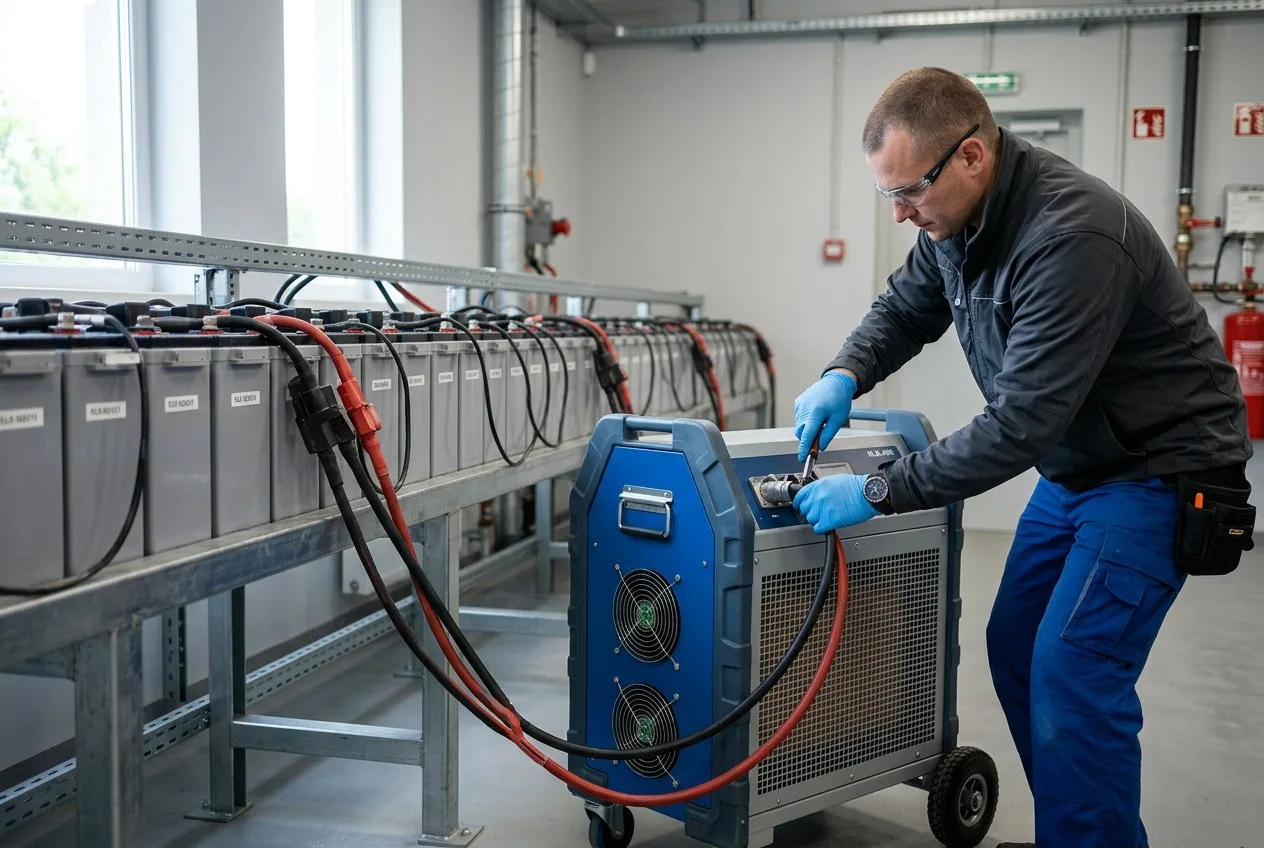
How to perform capacity testing on lead acid batteries?
The method for stationary lead acid batteries is defined in the IEEE 450 (flooded type) and IEEE 1188 (VRLA) application recommendations. The basic steps are as follows:
- Pre-charge and standby: The battery must be fully charged and stabilized in the float as recommended by the manufacturer.
- Temperature record: Cell temperatures are measured prior to testing; the result is corrected to a 25 °C reference.
- Constant current or constant power discharge: It is made with the current or power corresponding to the manufacturer's label value. The discharge is applied with a constant current or constant power load equal to the manufacturer's respective rating.
- End Voltage: In VRLA tests, the common practice is to operate at up to 1.75 V per cell, with discharge times of 1-8 hours and a specific temperature range.
- Cell/block tracking: Individual cell or block voltages are recorded throughout the test; weak units are detected even before the test is finished.
The result is calculated as a percentage: the realized discharge time is divided by the reference time and corrected by the temperature factor. For tests longer than one hour, this method is preferred; The formula is in the form C = ta / (ts × KT) × 100 . Here, ta is the actual time, ts is the expected time, and KT is the correction factor according to the initial temperature. The effect of temperature should not be underestimated: a cold battery gives less Ah than a hot battery .
"Replenishment threshold" and test frequency in lead-acid
The most well-known benchmark within the framework of IEEE 450 and 1188 is 80 percent. Both recommendations suggest replacing the battery when the capacity falls below 80 percent of the manufacturer's rating. This is due to the "knee of the curve" behavior: The decline progresses slowly up to about 80 percent, then increases rapidly. Continuing to use the battery after this point runs the risk of seeing a much lower value than expected in the next test. It is also common practice to increase the test interval when the capacity drops by more than 10 percent from the previous test or drops to around 90 percent.
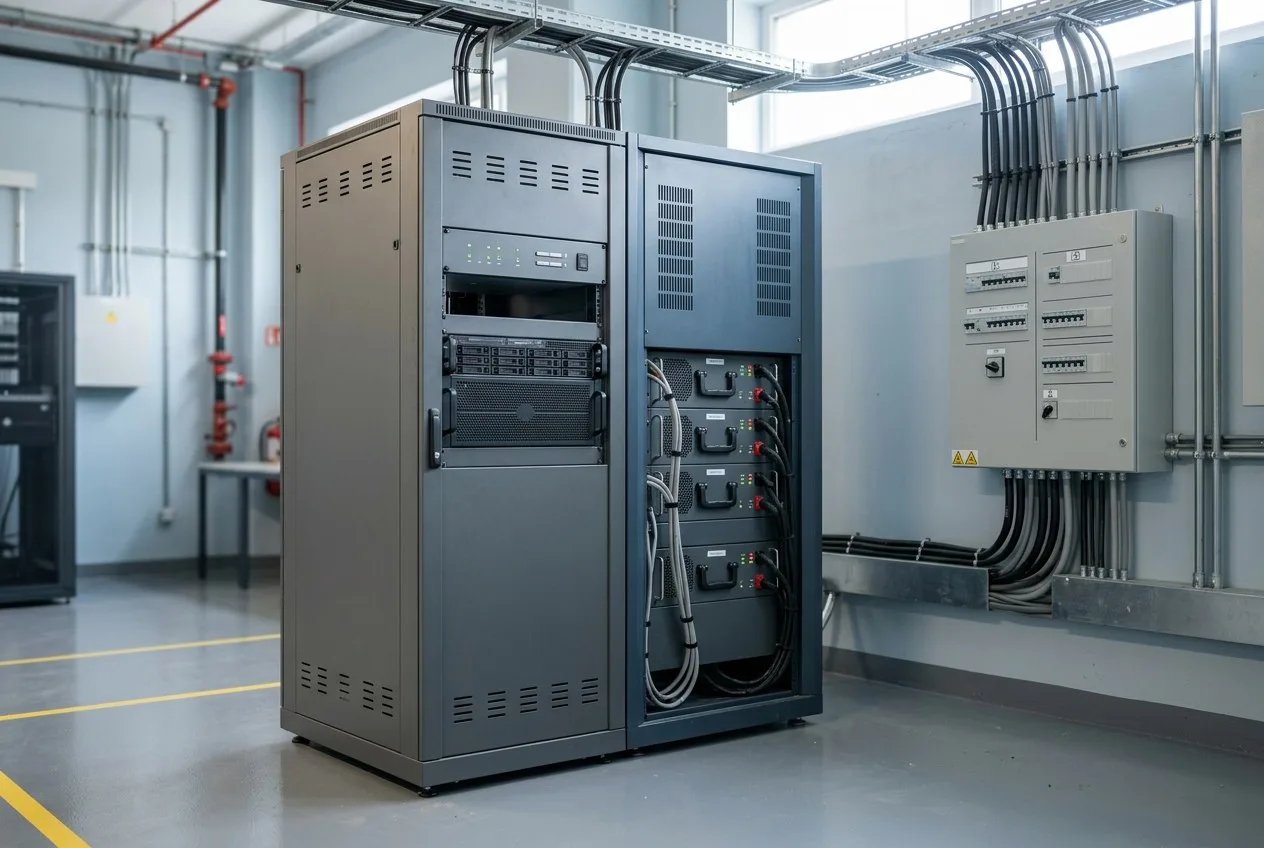
Why is capacity testing different in lithium battery?
The lithium battery contains a BMS (battery management system) next to the cells. BMS; It monitors cell voltage, current and temperature, and disables the battery if the limits are exceeded. Operation of BMS What is a BMS and what does it do in lithium batteries We explained it in our article. The most important conclusion in terms of testing is this: you cannot push the lithium battery outside the cell boundaries; the BMS prevents this and can end the test at its own protection limit, not at the point you set.
End point: BMS and cell boundary instead of 1.75 V/cell
In lead acid, the end voltage is clear in the standard and manufacturer's table. In lithium, it varies according to the cell type. For example For LFP, values such as nominal 3.2 V per cell, maximum charge of 3.65 V and end of discharge of approximately 2.5 V are given ; however, devices may terminate at a value above this to protect the user. The actual test limit is what is written in the manufacturer data sheet and BMS settings. In the field, the "let's take it up to 2.5 V" approach can break the warranty and be risky.
Flat tension curve: you can't track progress with tension
In the lead-acid test, a voltage drop indicates that you are nearing the end of the test. In LiFePO4, the voltage remains almost constant for a long time, then drops sharply towards the end. Practical result: It is difficult to predict the result during the test and the BMS interrupt may be sudden. Therefore, the current and time recording (Ah/Wh integral) is the main source of measurement in lithium.
Cell balance: the weakest cell determines capacity
For series-connected lithium cells, usable capacity is limited to the cell that reaches the earliest limit. If the inter-cell imbalance is large, the test may underestimate the battery. In this case, the problem may not be a loss of capacity, but a lack of balancing. For balancing What is Battery Balancing? You can take a look at the article. Before the test, balancing must be completed and cell voltages must be recorded.
Float charging and preconditioning
The lead acid battery is kept in standby mode with continuous float voltage. For LFP, the table indicates no float charge; prolonged float may shorten LFP life (footnote to the relevant table). For this reason, the "complete charge, wait a while, test" pattern for lithium varies by product. Reaching the point where the current drops (taper) at the end of the charge profile is the way to make sure that the test starts at 100% charge.
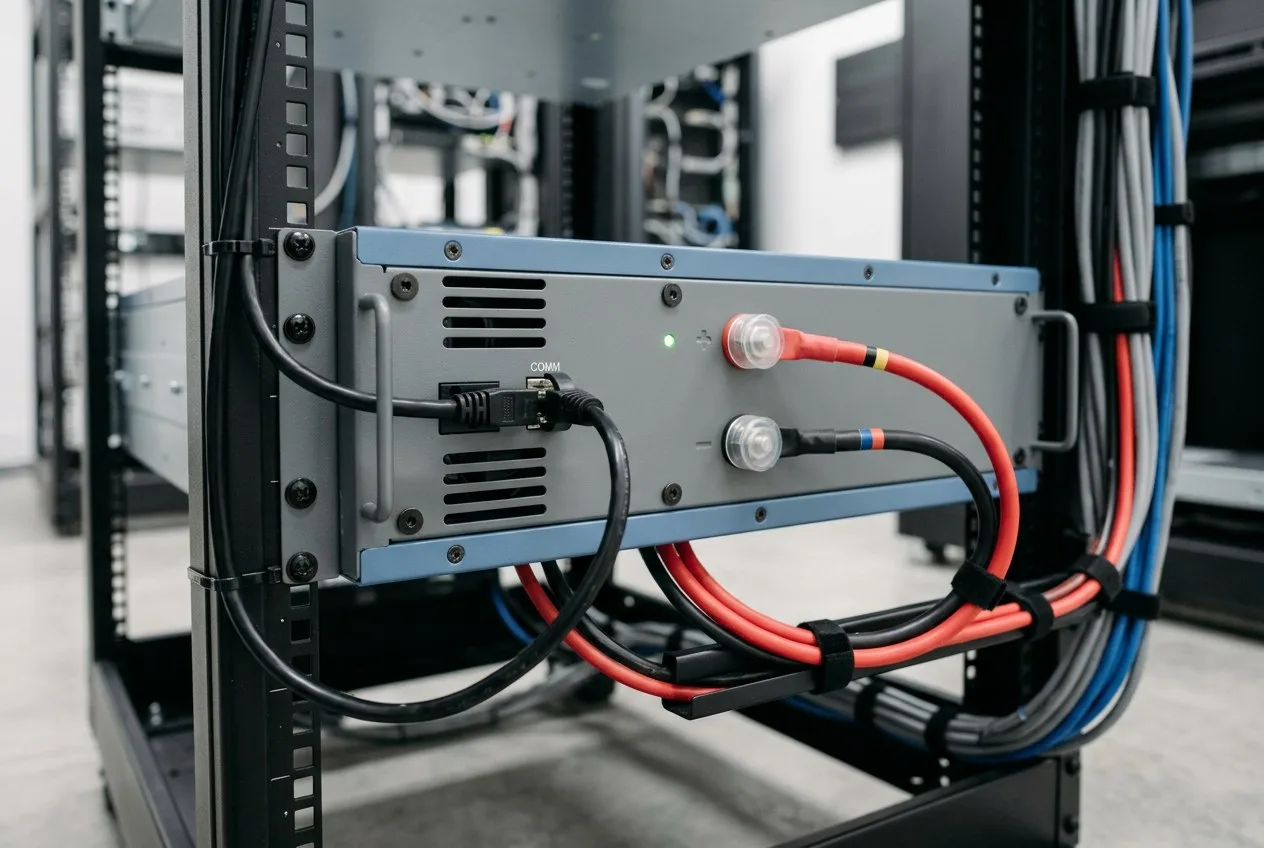
Lead-acid vs. lithium capacity testing
| Subject | Lead-acid (VLA/VRLA) | Lithium (e.g., LiFePO4) |
|---|---|---|
| Reference method | Built-in implementation recommendations such as IEEE 450 / IEEE 1188 | There is no single universal field procedure; based on manufacturer procedure and product standards |
| Endpoint | End voltage per cell (e.g. 1.75 V/cell, depending on product) | Manufacturer's end-of-discharge voltage or BMS cut-off limit |
| Reading occupancy from voltage | Reasonable estimate for a rested battery | Weak due to flat curve |
| Temperature correction | Defined by KT / Kc factors in the standard | In general, according to manufacturer curves; The test is done within temperature limits |
| Identifying the weak link | Cell/block tension and monitoring during testing | Cell voltage difference and BMS records |
| End-of-life criterion | Usually about 80% of the label | Varies by manufacturer and warranty (commonly given a range of 70-80%) |
| Preliminary preparation | Float-stabilized, fully charged battery | Full charging and balancing; BMS status and alarm records checked |
| Additional measurement source | Internal resistance/conductivity, float current | BMS's SOH, cycle count, cell temperature data |
The expression "common 70-80%" in the table is a generalization and differs from manufacturer to manufacturer; the data sheet and warranty certificate of the relevant product apply to the exact threshold.
How does lithium battery capacity testing proceed step by step?
The following flow is to illustrate the logic of the process. Installation and connection works must be carried out by authorized electrical personnel and technical service in accordance with the manufacturer's procedure.
- Documentation and threshold setting: Label capacity (Ah/kWh), rated voltage, maximum allowable discharge current, operating temperature and warranty criteria are obtained from the manufacturer.
- Condition check: BMS alarm/event records, cell voltage differentials, and temperatures are examined. If there is an active alarm, the test is postponed.
- Full charge: The battery is charged according to the manufacturer's charging profile; it is waited after the charging current reaches the drop point and the BMS gives the full information.
- Environment and temperature: The test is carried out within the manufacturer's temperature range. The initial temperature is recorded.
- Discharge with constant current or constant power: In a critical system, it is preferable to disconnect the battery from the circuit and use a load bank in terms of risk. Subject Load Bank Test It is explained in our article.
- Registration: Current, total voltage, cell voltages and temperature are recorded at regular intervals. The sum of Ah and Wh is integrated.
- Finish: The test stops when the manufacturer's end-of-discharge voltage or BMS cutoff is reached. Forcing the cutoff or bypassing the BMS is not acceptable.
- Recharging and reporting: The battery is recharged at full discharge without waiting for a long time; the result is reported along with the conditions and BMS data.
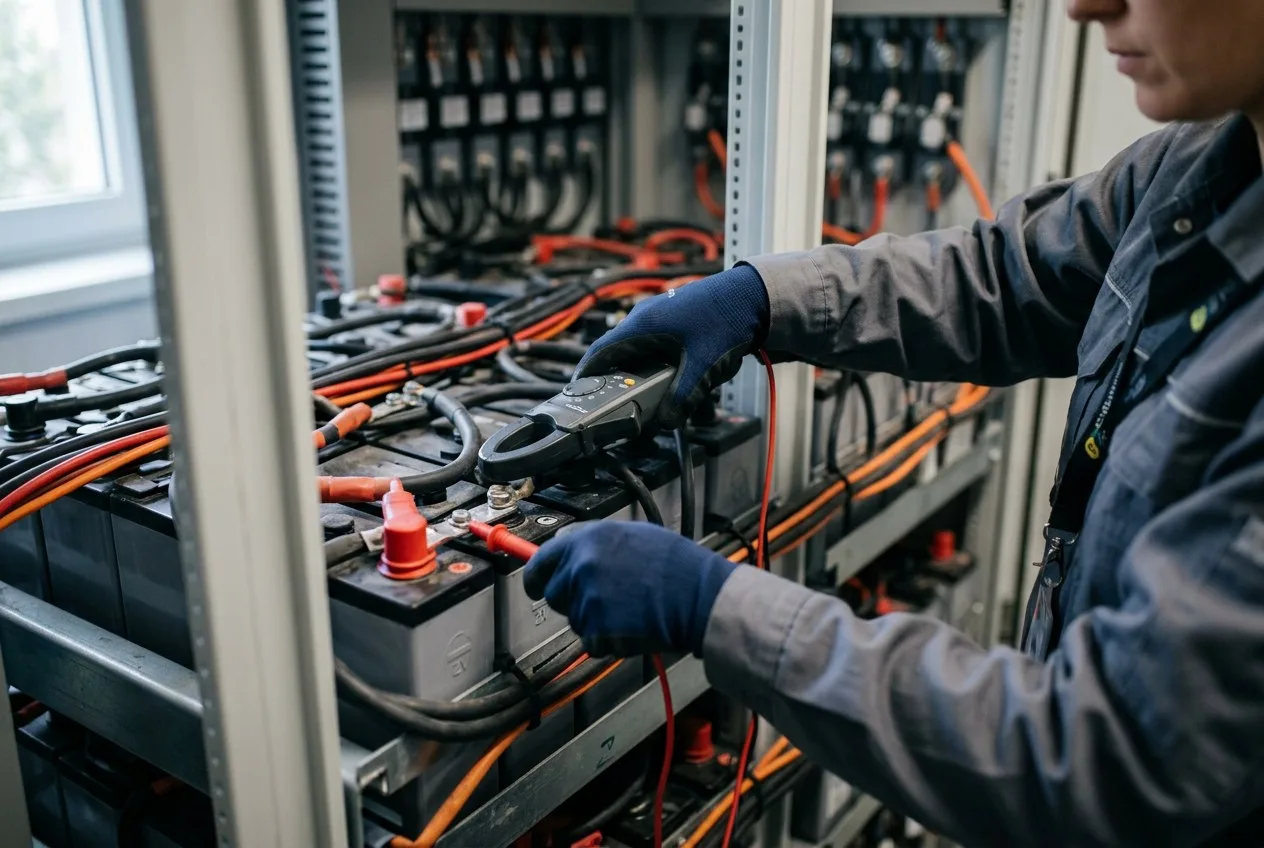
For the general logic of the discharge test on the lead acid side How to perform a battery discharge test for the distinction between the types of the test Difference between capacity testing and status testing will be useful.
Calculation examples: Percentage of capacity in lead-acid and lithium
Example 1: Time-based calculation in VRLA battery group
Assumptions: According to the manufacturer's data, the group should reach the end voltage in 180 minutes with the determined constant power (ts = 180 min). The test temperature is around 25 °C, i.e. KT is considered to be approximately 1.00. The actual time is 153 minutes.
- Capacity = 153 / (180 × 1.00) × 100 = 85%
If the same test started at 20 °C and KT = 0.97 from the manufacturer/standard table (hypothetical value):
- Capacity = 153 / (180 × 0.97) × 100 ≈ 87.6%, which is about 88%
Temperature correction can change the result by several points; therefore, the starting temperature must be recorded. The actual KT values are taken from the standard tables and the manufacturer's data. This battery is above the 80% threshold; however, the rate of decline compared to the previous test must be monitored.
Example 2: Wh-based calculation on a 48 V lithium battery
Assumptions: Nominal 51.2 V (16 cells × 3.2 V), label capacity 100 Ah, i.e. approx. 5.12 kWh. The test is carried out with a constant power of 2 kW on the DC side. The time from full charge to BMS cut-off is 132 minutes (2.2 hours).
- Energy Drawn = 2 kW × 2.2 hours = 4.4 kWh
- Capacity percentage = 4.4 / 5.12 × 100 ≈ 86%
- When the average voltage is approximately 51 V, the equivalent of Ah = 4400 Wh / 51 V ≈ 86 Ah
Important points: The measurement must be made at the battery terminal; if inverter and cable losses are mixed with the measurement on the AC side, the result will be low. In addition, different discharge rates give different results; the same current/power condition should be used when comparing the results. For details of this effect, see C-ratio and the Peukert effect can be looked at.
| Data | Example 1 (VRLA) | Example 2 (LiFePO4) |
|---|---|---|
| Tag / expected | 180 min (manufacturer's data) | 5.12 kWh (51.2 V × 100 Ah) |
| Measured | 153 min | 4.4 kWh (2 kW × 2.2 hours) |
| Fix | KT (according to temperature) | No additional correction; temperature is kept within the limit |
| Conclusion | ≈ 85% (for KT=1.00) | ≈ %86 |
Is the SOH value of BMS a substitute for capacity testing?
Most lithium batteries report a SOH (state of health) percentage through the BMS. SOH is the ratio of the full available capacity to the initial capacity. This value is mostly based on coulomb counting, i.e., the integration of the load entering and exiting the battery. Academic studies have shown that this method is useful for lithium batteries, full capacity can be updated during the charging or discharging phase of regular calibration shows. Sandia's BMS study also estimates capacity coulomb count and resistance-corrected voltage calculations uses.
However, this is an estimate. In the words of Battery University, the readings are instantaneous in lithium battery but Occasional calibration is required to correct the tracking error created by random use . In a backup system that is used with partial cycles and rarely sees a full charge or full discharge, the SOH value of the BMS may actually deviate. Practical tip:
- Use the BMS SOH value for daily monitoring and trend tracking.
- Verify with controlled discharge testing at specific intervals at critical loads.
- If there is obvious difference between the test result and the BMS value, ask for BMS calibration according to the manufacturer's procedure.
For the general framework of the maintenance approach in lithium UPSs Different controls in lithium battery UPS maintenance You can also read the article.

Does internal resistance and conductivity measurement replace capacity testing in lithium?
Internal resistance or conductivity measurement in lead acid batteries is a common tool to find the weak block in between when capacity testing cannot be performed. In IEEE tables, these measurements are also included as a monitoring method between full capacity tests. Measurement method Battery internal resistance and conductivity test You can find it in our article.
In lithium, internal resistance is a valuable indicator for aging and connection quality; however, its relationship with capacity does not fit into a correlation table as established as in lead-acid. In addition, since most lithium modules are closed, classical conductivity measurement cannot be made on a cell basis; the data comes from the BMS. Therefore, internal resistance should not be considered as a substitute for the capacity test, but as a clue that complements it. Which device measures what Battery Testing Equipment We compared it in the article.
How are test results interpreted? Which threshold is accepted?
Three questions are asked in the result interpretation: What percentage of the capacity label? What is the rate of decline compared to the previous test? Does the system still meet the actual load and autonomy time requirement? For general interpretation principles How to interpret and report battery test results Our article is detailed; here two technology-specific points stand out:
- Lead-acid: The 80 percent refresh threshold is common in standard practice. However, the main criterion is the load requirement; if the system is enlarged or the load is increased, it may fall short before 80 percent. IEEE 450 that renewal may sometimes be required before reaching 80 percent. specifies.
- Lithium: The threshold is printed in the manufacturer's warranty terms and datasheet. Cell imbalance, temperature history, and BMS event records should be reported with the result.
- Trend: The curve of successive tests rather than a single test is more informative. The acceptance test constitutes the initial reference value.
| Finding | Possible cause | Recommended step |
|---|---|---|
| Capacity is low, cell voltages are balanced | General aging | Watch the trend; if it's approaching the threshold, schedule a renovation |
| Capacity is low, one cell/block is significantly weak | Single cell malfunction or imbalance | Balancing and retesting; consult manufacturer for module replacement if necessary |
| BMS SOH high, test result low | Deviation in SOH forecast | BMS calibration by manufacturer procedure, followed by revalidation |
| The test ended earlier than expected, there is an alarm recording | BMS protection cut-off (temperature, current, cell limit) | Examine the cause of the alarm; correct the conditions and reschedule the test |
| The result was low when the temperature was low | Cold environment reduces capacity | Repeat at the appropriate temperature range or evaluate with manufacturer curve |
Common mistakes in testing and ways to avoid them
- Applying lead acid finish voltage to lithium: A value of 1.75 V per cell is meaningless for lithium. Manufacturer limits apply to lithium.
- Disabling the BMS: Pushing the limits of protection to extract more "capacity" is both a safety risk and can break the warranty. For lithium safety Thermal runaway Read the article.
- Starting Without a Full Charge: If the test starts from low occupancy, the result does not show the actual capacity.
- Not recording temperature: If the two tests are not performed under the same conditions, the comparison is misleading.
- Taking the measurement in the wrong spot: A measurement made from the AC output of an inverter with an efficiency of 90-95% underestimates the battery capacity.
- Risking critical payload: Performing the test via the live UPS output can result in the load being unprotected if the grid is interrupted during the test. For planning Battery pack test scheduling and downtime risk See the article.
- Looking at an odd number: Not only the percentage; cell distribution, temperature and BMS events should also be included in the report.
Security: Why do you need authorized personnel?
The DC voltage of the battery banks is high and the short-circuit current can be very large; there is a risk of arcing, burns and fire. Lead acid batteries can emit gas during charging/discharging. In the case of a lithium battery, there is a risk of thermal runaway in case of overcurrent, overcharging or physical damage. Therefore, for lithium products Standards such as IEC 62619 define safety tests such as overcharge, external short circuit, and forced discharge ; It is essential that these protections remain functional in field testing.
Testing requires insulated hand tools, appropriate PPE (gloves, goggles, workwear), adequate ventilation, and a fire response plan. For details Occupational safety in UPS and battery work Check out the article. For specific aspects of testing in solar energy storage systems Capacity and health test on solar battery bank will be useful.
Test frequency and scheduling: Lead-acid or lithium?
Standards for lead-acid recommend acceptance testing, periodic testing in the first two years or a percentage of life intervals, and more frequent testing in aging batteries; summaries show ranges such as "25 percent of life or two years, whichever is shorter" ( Related notes in Megger's table includes such examples). The criticality of the system and age are decisive when choosing a range.
Lithium, on the other hand, does not have a fixed standard range. A reasonable plan can be established with the following logic:
- Record the initial value with acceptance testing during deployment (Commissioning tests after battery replacement).
- Determine the periodic test interval based on the manufacturer's recommendation and warranty terms.
- If you see a sudden change in BMS data (capacity drop, cell drift, frequent alarms), bring forward the scheduled test.
- Perform the test during the maintenance window, along with the bypass and backup resource plan.
For the general framework of which test should be performed on which battery and how often, What is a UPS battery test You can also look at the article.
Lithium vs. lead-acid: What to choose in terms of testing?
The choice of technology is not solely based on ease of testing; lifespan, weight, initial investment, safety, and placement are also decisive. From a testing perspective, the advantage of lead-acid is the prevalence of additional diagnostic methods, such as decades of standard and field experience, internal resistance, and conductivity. The advantage of lithium, on the other hand, is that the BMS continuously collects data and facilitates trend monitoring; in return, the testing procedure is manufacturer-dependent and requires compliance with the protection system. For a general comparison of the two technologies lithium-ion UPS batteries can be a guide.
In the investment decision, the test plan should also be included in the cost: the equipment required for capacity testing, the downtime window, the technical service period and reporting. Detailed framework in this regard UPS efficiency and total cost of ownership It is in the article.
Capacity testing and battery health planning with Bempower
If you want to clarify the actual capacity and renewal time of your battery group, Bempower; It offers exploration, installation, periodic maintenance and technical service for lead acid and lithium battery UPS systems in Istanbul and surrounding provinces. The type of your system, battery age and critical load information from the contact page If you share, our technical team can discuss with you for test scope and planning.
- How to Evaluate Time-Adjusted Battery Capacity Results — Vertiv (BattCon), 2018. https://www.vertiv.com/4afc8f/globalassets/documents/battcon-static-assets/2018/how-to-evaluate-time-adjusted-battery-capacity-results.pdf
- BU-903: How to Measure State-of-charge — Battery University, 2025. https://www.batteryuniversity.com/article/bu-903-how-to-measure-state-of-charge/
- BU-409b: Charging Lithium Iron Phosphate — Battery University, 2023. https://www.batteryuniversity.com/article/bu-409b-charging-lithium-iron-phosphate/
- Battery Testing Guide (IEEE 450 and IEEE 1188 capacity testing summary) — Megavar, 2026. https://megavar.com.au/technical-insights/battery-testing-guide/
- VRLA Battery Capacity/Discharge Testing — Exponential Power, 2024. https://www.exponentialpower.com/wp-content/uploads/2024/04/VRLA-Battery-Testing-3.pdf
Resources
