


Battery Testers: Which Device Measures What?

It is often not possible to tell whether a battery group is "good" or not with a single device. A battery that looks normal at float voltage may not be able to carry the load when the power is cut off; a battery with increased internal resistance may give enough time for a while. There are many devices on the market, from multimeters to hydrometers, from internal resistance meters to load banks, and each one looks at a different feature of the battery. Expecting the wrong result from the wrong device leads to both unnecessary battery replacement and the collapse of a system that is thought to be safe during an outage.
In this article, we divide battery testers according to what they measure, explain the strengths and weaknesses of each, which type of battery can be used and which question to answer with which device. We show how to interpret the results with sample calculations and discuss common mistakes when choosing a device and testing.
Article; It was prepared for technical officers operating UPS and battery systems, business owners, purchasing units and home users who want to better understand their own device. The aim is not to instruct you to get tested; It is to ensure that you read the report and offer from the service correctly.
What does a battery tester measure? Separate three different questions
The easiest way to understand battery tests is to separate the questions that the devices answer. There are three basic questions:
- How full is it right now? (state of charge) Measurements of voltage and electrolyte density approximate this question.
- Is it healthy inside? (internal health) Internal resistance, impedance and conductivity measurements give clues to the degradation inside the cell.
- How much energy does it actually give? (capacity) Only a controlled discharge indicates this.
For a stationary battery, the answers to these three questions may be independent of each other. A fully charged battery with reduced capacity reads high voltage; a battery with good capacity but half full shows low voltage. Therefore, instead of making a decision with a single measurement, it is necessary to use the measurements in a way that complements each other. Common application guidelines in the industry also reflect this: for flooded (vented) lead-acid batteries Interpreting Test Results In terms of IEEE 450, IEEE 1188 provides a combination of maintenance, testing, and replacement recommendations for valve-controlled (VRLA) batteries. IEEE 450-2020 provides maintenance and testing schedules and procedures for flooded lead-acid batteries, as well as guidance on when the battery should be replaced.
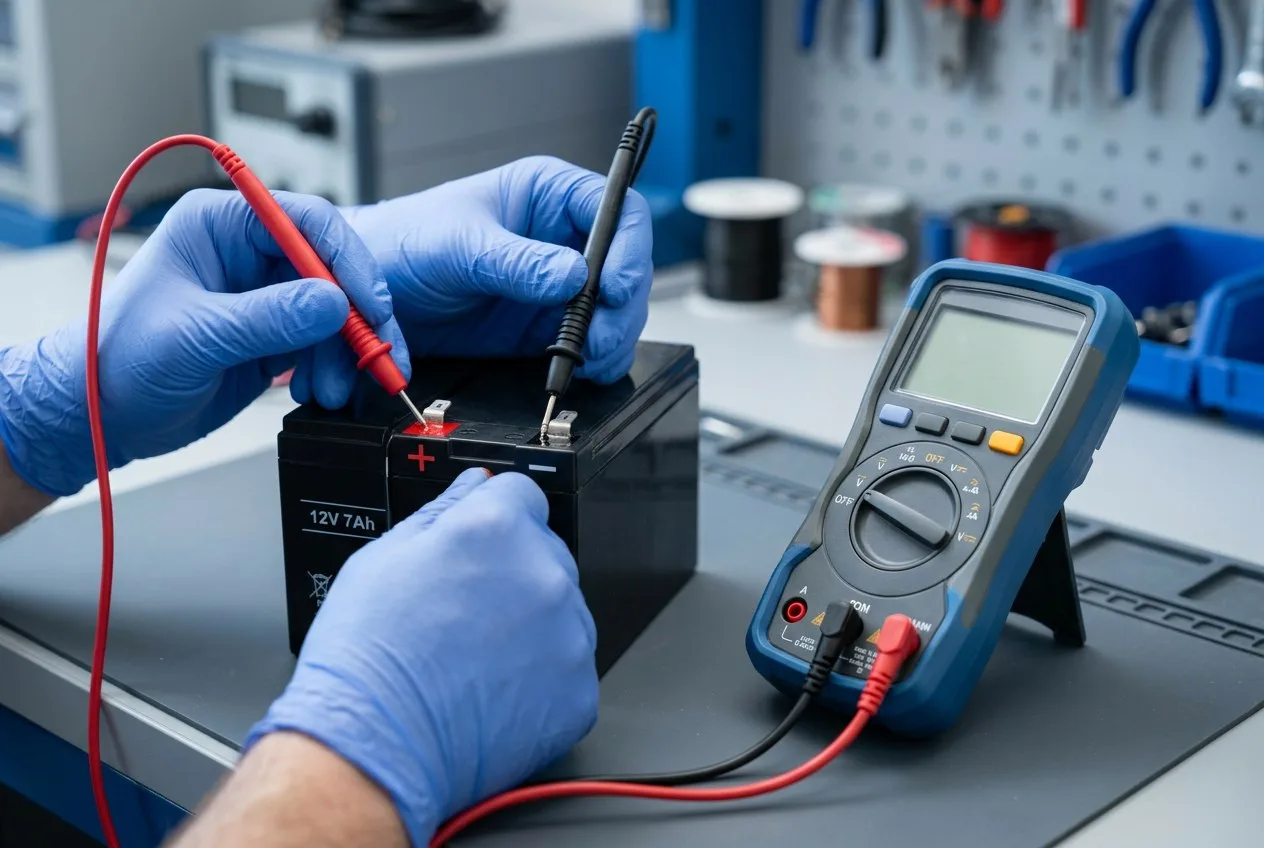
Multimeter and battery voltmeter: what does voltage indicate and what does not?
The multimeter is the most basic device for battery testing. In the direct current (DC) voltage position, it reads the voltage between the battery or cell terminals. What the reading means depends on the condition under which the measurement is made; for the detailed method How to measure and interpret battery voltage You can check our article.
When a multimeter is useful
- To see if the float voltage is applied correctly by the charger.
- To capture the voltage unbalance of individual blocks in the series connected group.
- Noticing a completely discharged, short-circuited or disconnected battery.
- Monitoring the downward trend of voltage during discharge.
Situations where the multimeter is not enough
Voltage does not tell you how the battery will behave under load. An aged VRLA battery appears normal at float voltage thanks to the charger; when the load is connected, its voltage collapses quickly. In addition, problems such as drying out or connection looseness inside the cell only become apparent when current passes. Therefore, a multimeter is a good pre-screening tool, but it is not enough to decide "the battery is intact" on its own.
Practical tips: Always take the measurement at the same points (terminal heads, not connecting bolts); record the measuring interval and temperature; measure the batteries with insulated probes that will not short-circuit them and with gloves. In high-voltage groups involving more than one block, the measurement must be carried out by authorized personnel.
Hydrometer and refractometer: electrolyte density in flooded batteries
The hydrometer measures the density (specific gravity) of the electrolyte in flooded type (open cell) lead-acid batteries. Readings are made from the sinking depth of the float in the glass tube. Since the electrolyte contains sulfuric acid, the density of the battery increases considerably as the battery is charged and decreases as it discharges. For this reason, it is considered one of the most reliable indicators of the state of charge in flooded batteries. Manufacturer support pages state that the specific gravity of a fully charged flooded battery can be in the range of approximately 1.255-1.275, while hydrometers read with an accuracy of approximately 0.005± at best (values vary by manufacturer).
Limits
- Cannot be used on sealed batteries: Since the hydrometer requires free electrolyte, it cannot be applied to electrode-free or closed, maintenance-free lead-acid batteries. VRLA, AGM, and gel batteries do not have this measurement.
- Temperature sensitive: The reading must be corrected to the reference temperature as the intensity changes with temperature.
- Electrolyte contact requires: There is a risk of acid splashes; goggles, gloves and aprons are essential.
- It does not give the capacity: Density indicates state of charge; it does not indicate loss of capacity due to wear of plates.
The refractometer does the same job optimatically; it provides readings with a few drops of sample. Again, it is only valid for batteries with exposed electrolytes and does not provide capacity information in the same way. Since the majority of battery groups in UPS rooms are VRLA, these devices are rare in the field; in DC power systems (substations, telecom, some industrial facilities) that use flooded batteries, they are still part of routine control.

What do internal resistance, impedance, and conductivity testers measure?
These devices measure the "ohmic" state inside the battery. Three magnitudes are interdependent: DC internal resistance, AC impedance, and conductivity. As impedance and resistance increase, conductivity decreases; that is, all three are inversely proportional. IEEE 1188 defines these measurements together as "internal ohmic measurements". For a detailed explanation before moving on to device selection How to perform the battery internal resistance and conductivity test You can check our article on the
Working logic
- AC impedance/conductivity method: The device applies a small AC current or voltage and reads the response. It provides measurements within seconds without disconnecting the battery from the charge. Since large stationary batteries have a very low internal resistance value (milliohm level), the voltage produced by the applied signal remains in the order of millivolts; therefore, it is important how devices take precautions against charger ripple.
- DC method (short-term load): A current step is applied to the terminals of the battery for a very short time; internal resistance is calculated from the voltage drop. The internal resistance calculation in the IEC 60896 series is also based on the voltage difference in two different currents.
When does it work, where does it mislead?
Ohmic measurement is very useful for catching problems such as drying out, plate degradation, loose connection, and weak cell early. However, the results alone do not yield capacity. An IEEE-sourced field evaluation reports that conductivity and impedance are partially related to capacity, but there are several variables that significantly affect measurement accuracy; nevertheless, it is a useful aid in distinguishing between good and bad batteries. A field guide also emphasizes that ohmic values mark weak cells but do not measure capacity.
Therefore, the values are used as follows:
- When the battery is new or in good condition Baseline is taken.
- Regular measurements are made with the same device, the same procedure and, if possible, at the same temperature.
- Cells that deviate significantly from the baseline value are marked; these cells are also examined or taken to the discharge test.
A field guide (referring to the IEEE 1188 supplement) classifies an increase in impedance of approximately 30-50 percent or a decrease in conductivity of approximately 23-33 percent as a significant change. Always evaluate the threshold values in conjunction with the battery manufacturer's datasheet and the device manufacturer's recommendations; no direct comparisons are made between different battery types and devices.
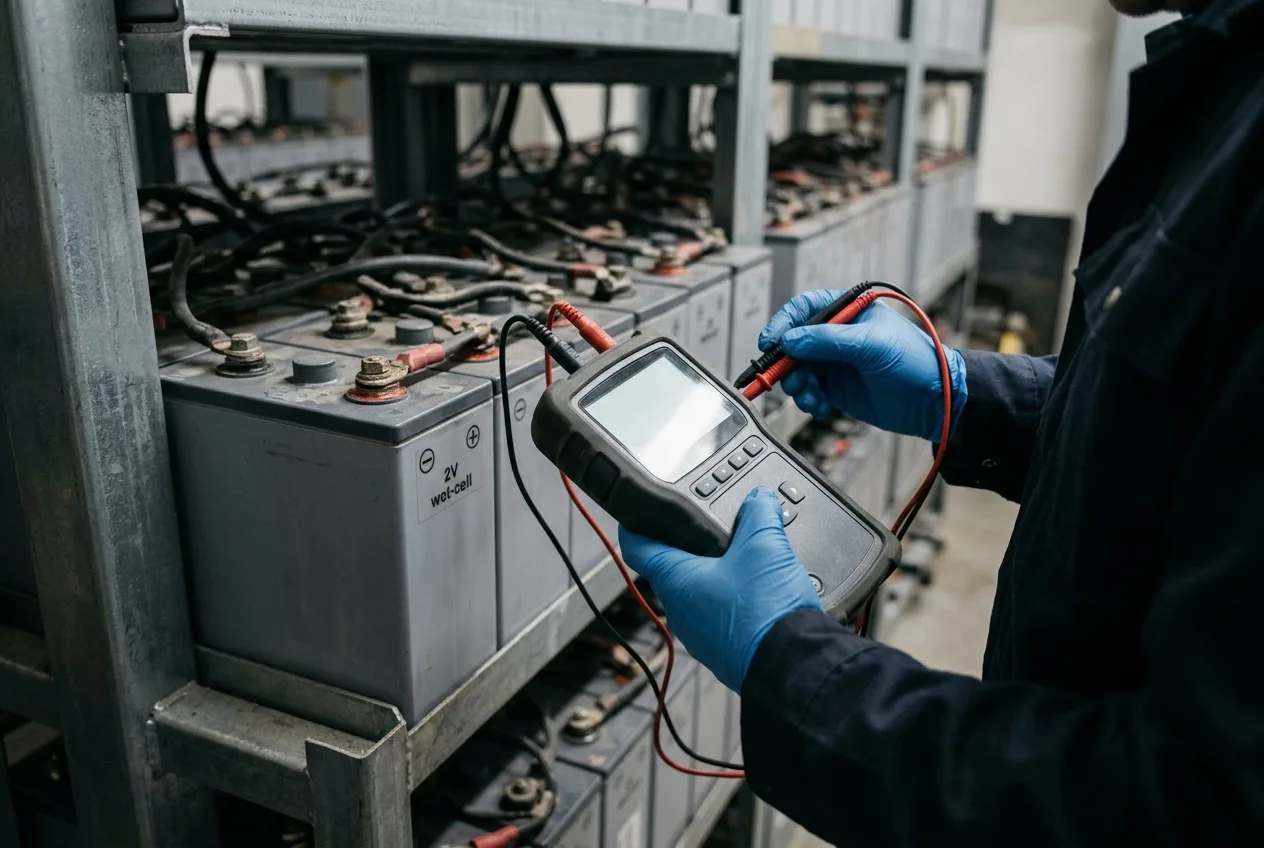
Load tester and carbon battery: short-term under-load control
The load tester draws high current from the battery for a short time and looks at how much the voltage drops during this time. "Carbon battery" type devices in the automotive world and modern electronic load testers are in this group. The logic is simple: a healthy battery keeps its voltage above a certain level under load; a weak battery collapses quickly.
The advantage is that it quickly reveals the "underload behavior" that the multimeter does not show. Disadvantages:
- The result is usually pass/fail; it does not give a percentage of capacity.
- Since it draws high current, there is a risk of heating and gas release even in small batteries; direct use may not be suitable in large UPS groups.
- Since there will be no energy left in the battery after the test, the test should be planned in critical systems.
The short load test should not be confused with the test that measures the actual backup time. The difference between the two is that Difference between battery load test and UPS load test It is also discussed in our article.
Discharge (capacity) tester and load bank: the only test that verifies capacity
The method that measures the actual capacity of the battery is the controlled discharge test. A field guide defines it as: The charger is deactivated, a load bank draws constant current or power, and the total voltage lasts until the number of cells times the minimum voltage per cell. The measured time is corrected for the temperature and proportioned to the manufacturer's nominal value. A Vertiv white paper also emphasizes that the discharge test (load or capacity test) is the only test that can accurately measure the actual capacity of the battery.
Components of the device
- Load bank: Load consisting of high-power resistors that draw constant current from the battery. In large groups, multiple units are used in parallel. For details What is Load Bank Test You can check our article.
- Control unit / data logger: It keeps the current constant; it records the group voltage, and in some systems, the cell or block voltages over time.
- Connecting cables and protection: High current carrying, appropriately cross-section and insulated cables, suitable fuse and emergency cut-off device.
How to schedule the test?
Since the capacity test discharges the battery severely, the state of charge and ambient temperature are checked beforehand, the test current is determined from the manufacturer's discharge table and how the critical load is supplied during the test is planned (e.g. bypass or backup source). After the test, the battery must be recharged. For planning and risk of downtime Planning a battery pack test guide, for the steps Battery discharge test You can check the article. This test should be performed by authorized technical personnel.
A word of caution: A field guide states that the capacitance test does not prove short-term high-current duty, and that a separate service or modified performance test is required for the duty cycle.
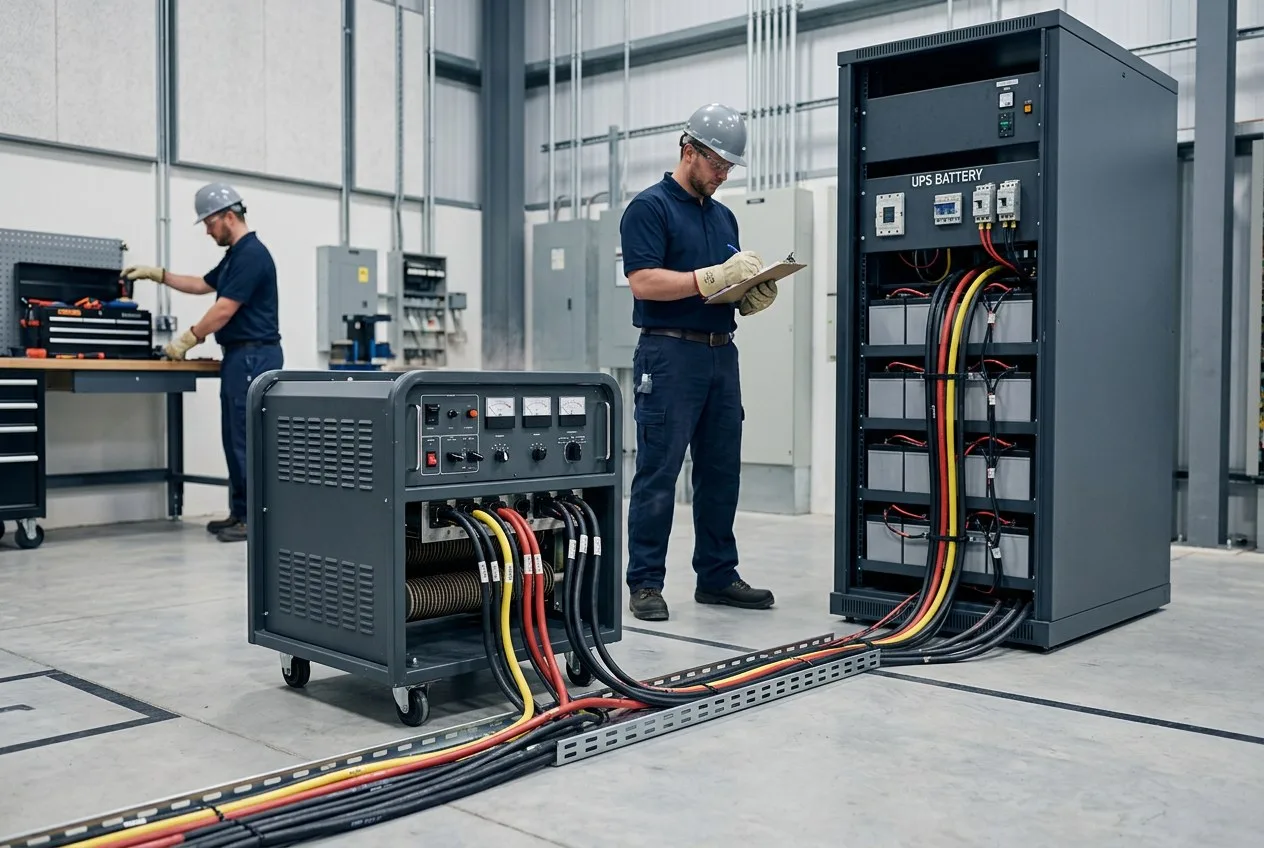
Clamp ammeter, microohmmeter and thermal imager: auxiliary devices
Auxiliary devices that do not directly "measure" the battery, but indicate the cause of the malfunction, are also part of the test set.
- DC clamp ammeter: It measures charge and discharge current, float current, and current distribution in parallel arrays without opening the connection. If the float current rises well above normal, it may be a sign of drying or internal short circuit in VRLA. A field source refers to a float current greater than three times normal as such a warning.
- Microohmmeter (joint resistance meter): It measures intercellular connection and terminal resistance at the micro-ohm level. Loose or oxidized connection causes heating and voltage drop at discharge; the problem may be with the connection, not the battery itself. For terminal problems Unbalanced voltage and corrosion in the battery bank The text is also useful.
- Thermal camera / infrared thermometer: Indicates hot spots under load; catches linkage, fuse or cell heats early.
- Temperature probe: Records battery surface and ambient temperature; required for both interpretation and capacity correction.
These devices alone do not tell the state of the battery; however, they often play a key role in explaining the discrepancy between ohmic and capacity measurements (e.g., in the case of "cells are good but the group is weak").
Measurement on a lithium battery: BMS and different rules
Lithium-ion and LiFePO4 batteries do not comply with most of the methods developed for lead-acid. Electrolyte density is not measured; cell voltages, current, and temperature are monitored by the battery management system (BMS) inside the battery and are often read over communication. The voltage curve is flatter than lead-acid; therefore, it becomes difficult to estimate the state of charge from the voltage. Capacity testing is still done by discharge, but the cut-off voltage, current limit, and test temperature are determined by the manufacturer. For differences How the lithium battery capacity test differs from the lead-acid test For battery groups in solar energy systems, Capacity and health test on battery bank You can review the article.
Which device answers which question? Comparison table
| Device | What does it measure? | What does it not show? | Suitable battery type |
|---|---|---|---|
| Multimeter | Terminal/block voltage | Capacity, internal health, underburdened behavior | All (with BMS in lithium) |
| Hydrometer / refractometer | Electrolyte density (state of charge) | Capacity, plate wear | Aqueous (open-cell) lead-acid only |
| Internal resistance/conductivity meter | Ohmic value, poor cell tendency | Exact capacity percentage | VRLA, aqueous lead-acid, some Ni-Cd |
| Load tester | Short subload voltage collapse | Actual backup time | Small and medium batteries |
| Discharge tester / load bank | Actual capacity, duration, cell behavior | Cause of failure alone | All (with manufacturer parameters) |
| Clamp ammeter | Charge, discharge and float current | Intracellular state | All |
| Microohmmeter | Connection and terminal resistance | Cell capacity | All |
| Thermal camera | Hot spots, heated connections | Voltage and capacity | All |
It also explains the distinction between capacity and state tests, the difference in methods between them, and when to choose which Difference between capacity testing and status testing You can find it in the article.

How often are tests performed? The calendar that determines the choice of device
In real life, devices are not used once, but to complement each other within a calendar. Guidelines such as IEEE 450 and IEEE 1188 recommend voltage and visual checks at frequent intervals, ohmic measurements at less frequent intervals, and capacity testing at regular intervals. For example, a publication reported that IEEE 450-2010 recommends performance testing for flooded batteries within the first two years and at intervals not exceeding 25 percent of the expected service life. On the VRLA side, a summary compiled from the field mentions a schedule of monthly voltage checks, quarterly ohmic measurements, and capacity tests at intervals not exceeding two years; it is also stated that these intervals can be increased in critical facilities. For exact intervals and thresholds, the current standard text and the battery manufacturer's data sheet should be consulted; these are guiding examples.
| Control | Typical purpose | Frequency (directional) |
|---|---|---|
| Visual control and temperature | Swelling, leakage, corrosion, room temperature | Monthly |
| Group and block tension | Float tension, imbalance | Monthly |
| Internal resistance/conductivity | Weak cell tendency, baseline comparison | Intervals such as quarterly in VRLA and annual in flooded batteries (according to manufacturer) |
| Junction resistance and thermal scanning | Loose connection, hot spot | Annually or during the maintenance period |
| Capacity (discharge) test | Actual capacity, replacement decision | Once in the first years, then every few years, or in case of doubt |
For a general UPS battery test and maintenance framework What is a UPS battery test, which test should be done and how often? You can also read the article.
Sample calculations: how to interpret the measurement result?
The following examples are for illustrating logic only; For your own batteries, the manufacturer's data and the evaluation of authorised personnel should be taken as basis.
Example 1: Time-based capacity calculation
Assumptions: According to the manufacturer data sheet, at a certain constant current and a certain terminal voltage, the battery is expected to last for 60 minutes. We neglect temperature correction because the test temperature is close to the reference temperature.
- Actual discharge time: 48 minutes.
- Capacity (%) = actual time ÷ expected time × 100 = 48 ÷ 60 × 100 = about 80%.
This ratio is the basic formula for the time-based method. In sources, this approach is described by dividing the actual discharge time by the rated time. Many application guidelines state that when the capacity is below about 80 percent, aging accelerates and replacement should be planned. Still, the decision should be made in conjunction with the load requirement and criticality level. How the results are presented in the report Interpreting Battery Test Results You can see it in the article.
Example 2: Impedance change relative to the base value
Assumption: The baseline impedance of a VRLA block was recorded as 4.0 mΩ. The new measurement made with the same device and the same method is 5.6 mΩ.
- Increase = 5.6 − 4.0 = 1.6 mΩ.
- Percentage increase = 1.6 ÷ 4.0 × 100 = %40.
This change falls within the "significant change" range of 30-50 percent mentioned above; the block is placed on the list of weak candidates, and a discharge test or change plan is considered. If the same block had increased by only 5%, this could be considered a natural measurement fluctuation.
Example 3: Float tension check
Assumption: Series group of 20 blocks of 12 V (240 V nominal). Suppose the manufacturer's float voltage per cell is approximately 2.27 V; there are 6 cells in the 12 V block.
- Expected float voltage per block = 6 × 2.27 = 13.62 V.
- Group expected tension = 20 × 13.62 ≈ 272 V.
If the multimeter shows 262 V in the group, the difference is about 10 V, which corresponds to an average of 0.5 V per block. This is not a stand-alone fault; it could be charger adjustment, a short circuit of a block, or temperature compensation. The next step is to look at the individual block voltages and ohmic measurement. Note: The float voltage varies depending on the battery type and temperature; the value to use is always taken from the manufacturer's data sheet.
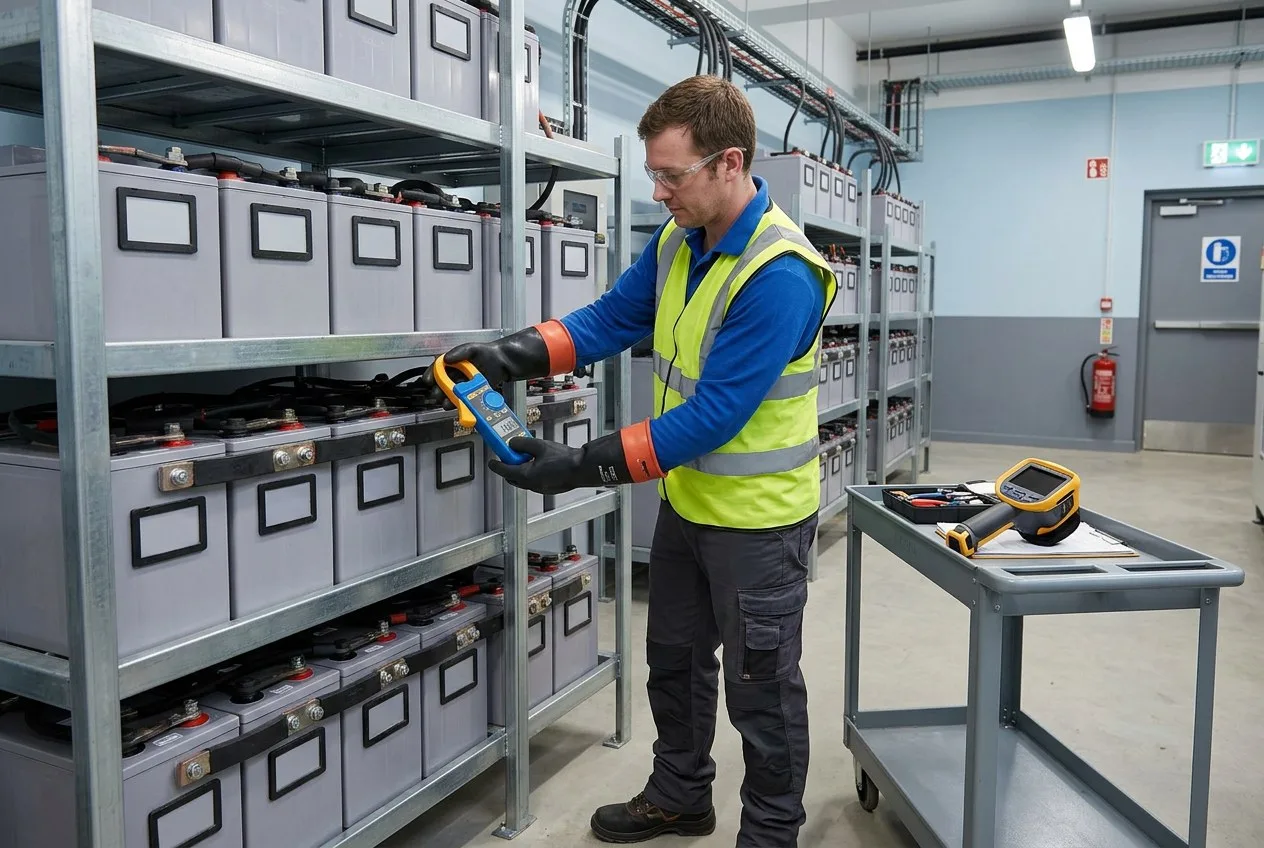
What to look for when choosing a device?
When purchasing a battery tester or getting service, evaluate the following criteria:
- Battery type and voltage range: The device must be designed for your batteries (flooded, VRLA, Ni-Cd, lithium) and for the expected voltage and current level.
- Measurement accuracy and resolution: Resolution and repeatability are important in milliohm-level measurements.
- Base and trend record: Devices that can record and compare measurements with previous values make interpretation easier.
- Calibration: The device must have a valid calibration certificate; the authorized service report must include the device and calibration information.
- Safety class: Devices and probes used in high DC voltage must be in the appropriate measurement category and insulated.
- Relationship of the method with the standard: The capacity test procedure must comply with guidelines such as IEEE 450 or IEEE 1188 and the requirements of the IEC 60896 series applicable to the battery type. For example, IEC 60896-22 defines the requirements for VRLA batteries, and IEC 60896-21 gives the test methods.
Common mistakes in battery testing
| Error | Why the problem? | What should be done? |
|---|---|---|
| Deciding only by looking at the tension | Old battery looks normal in the float | Add ohmic measurement to voltage and capacity test if necessary |
| Comparing the values of different devices | Devices use different frequency and method | Base and trend with the same device and the same procedure |
| Replacing the battery with a single ohmic result | Ohmic value is not capacity; deviations can be misleading | Verify suspicious cells with discharge testing |
| Not recording the temperature | Capacity and ohmic values change with temperature | Note the ambient and battery temperature in each measurement |
| Testing an undercharged battery | Capacity is lower than it is | Check the charging status and float time before testing |
| Not taking a base measurement | There is no reference for the next change | Record the first ohmic and capacity data when the new battery is commissioned |
| Mistaking a loose connection for a battery failure | Unnecessary battery replacement is done | Check connection resistance and thermal image |
For recommissioning tests if the batteries have been reconditioned or individual blocks have been replaced after the test Commissioning after battery replacement Check out the article.
Safety during battery testing: why authorised personnel are required?
UPS battery banks often operate at voltages of hundreds of volts DC. In the event of a short circuit, very high current and arcing can occur; batteries can emit hydrogen-containing gas during charging; incorrect connection or compression can damage the cell. The load bank generates significant heat during discharge and requires ventilation. Therefore:
- Insulated tool, appropriate gloves and eye protection should be used; jewelry should be removed.
- Discharge test, connection change and wiring should be done by authorized electrical personnel or technical service.
- The test room should be ventilated, fire and first aid measures should be available.
- The effect of the test on the critical load (bypass of the UPS, backup resource plan) should be written down in advance.
For the general framework Occupational safety in UPS and battery work You can read the article. A note for home users: Looking up the voltage of a small UPS battery block with a multimeter is relatively simple, but it is not recommended to unplug, open, or attempt to discharge the battery from the UPS.
Get support from Bempower for battery testing
It takes time and expertise to decide which measurement to make in your battery groups and how often, to obtain the devices and to interpret the results. Bempower; provides on-site exploration, battery testing, installation, periodic maintenance and technical service for all brands of UPS and battery groups; It offers on-site support in Istanbul and surrounding provinces. For your test plan, report or battery replacement needs from the contact page You can contact us.
- IEEE 450-2020: Recommended Practice for Maintenance, Testing, and Replacement of Vented Lead-Acid Batteries for Stationary Applications — Swedish Institute for Standards (SIS) / IEEE, 2021. https://www.sis.se/en/produkter/electrical-engineering/galvanic-cells-and-batteries/acid-secondary-cells-and-batteries/ieee-450-2020/
- Evaluation of conductance and impedance testing on VRLA batteries for the Stenter Operating Companies — IEEE Xplore (INTELEC), 1995. https://ieeexplore.ieee.org/document/396644
- IEC 60896-22:2004 VRLA Stationary Lead-Acid Battery Requirements — IEC/iTeh Standards, 2004. https://standards.iteh.ai/catalog/standards/iec/86139155-649c-4c69-bd8a-416cf1477cdf/iec-60896-22-2004
- Draft Storage/Stationary Batteries Standards List — Sandia National Laboratories / UL Standards, 2014. https://www.sandia.gov/ess-ssl/docs/Stationary_Batteries_Standards_List_UL_4-1-14.pdf
- Battery Discharge Testing: Implementing NERC Standards and Field Experiences — Vertiv (BATTCON), 2014. https://www.vertiv.com/48dd30/globalassets/documents/battcon-static-assets/2014/battery-discharge-testing--implementing-nerc-standards-and-field-experiences.pdf
- Performance Testing Lead-Acid Stationary Batteries: Myths, Misunderstandings and Mistakes — Vertiv (BATTCON), 2016. https://www.vertiv.com/48dea9/globalassets/documents/battcon-static-assets/2016/performance-testing-lead-acid-stationary-batteries-myths-misunderstandings-and-mistakes.pdf
- Battery Testing: A Field Guide to Discharge and Capacity Testing of Substation Batteries — Megavar, 2026. https://megavar.com.au/technical-insights/battery-testing-guide/
- White Paper: Differing Maintenance Requirements of IEEE 450 and PRC-005-6 for Vented Lead-Acid (VLA) Batteries — Eagle Eye Power Solutions, 2026. https://eepowersolutions.com/resources/white-papers/differing-maintenance-requirements-of-ieee-450-and-prc-005-6-for-vented-lead-acid-vla-batteries/
Resources
