UPS Design for Data Centers: Redundancy, Batteries, and Monitoring

The power infrastructure for a data center is designed on a different scale and with a different logic than that of an office or server room. Here, the UPS is not merely a backup that kicks in only when the power goes out; it is an integral part of the infrastructure that carries the load until the generator starts up and ensures power quality at all times. For a small-scale server room: Selecting a UPS for a server room You can check out our article; in it, we discuss the key decisions that come into play as the scale increases.
The Role of UPS in the Data Center
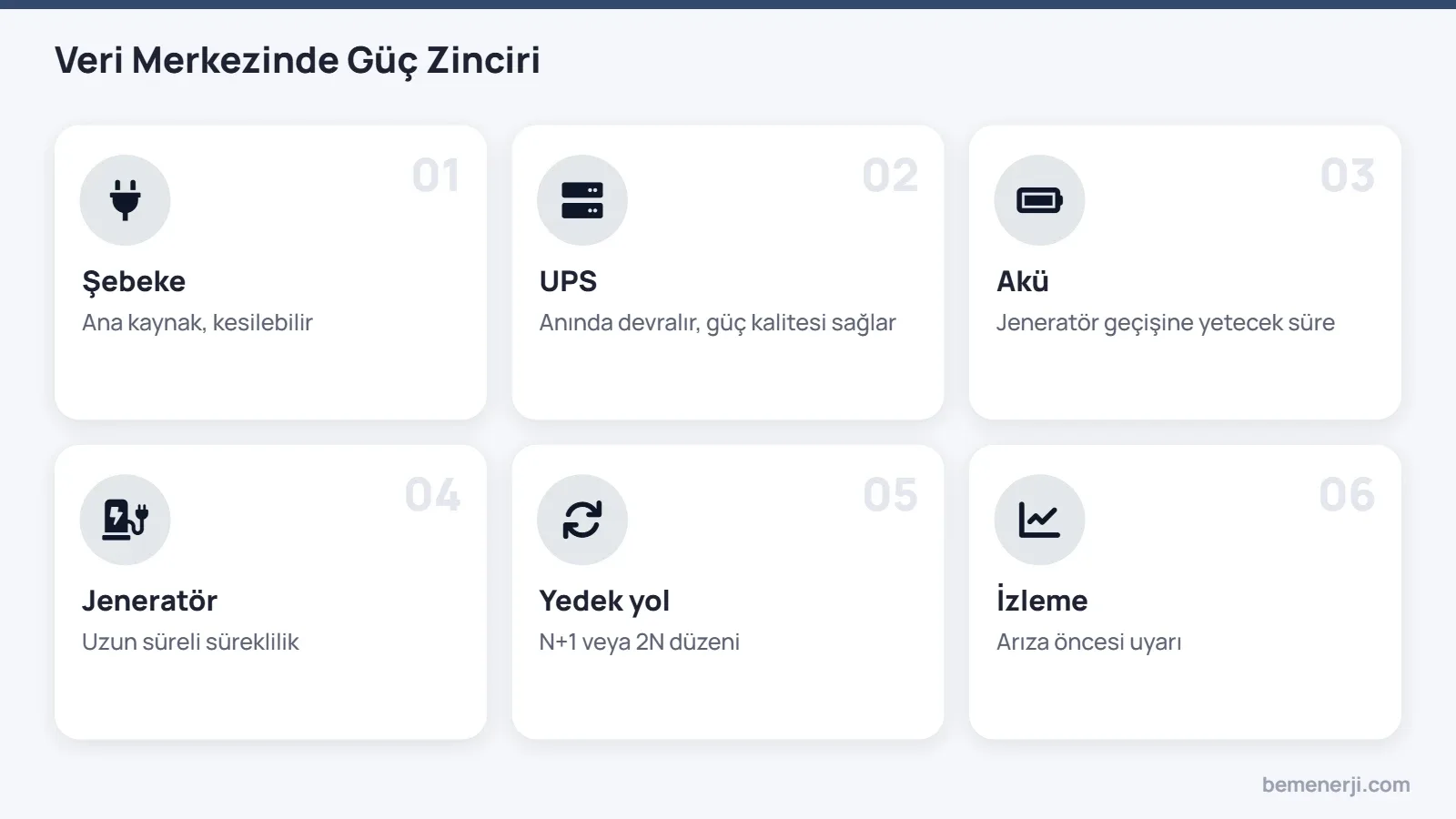
During a power outage, the system works as follows: the utility power goes out, the UPS immediately takes over the load using its batteries, the generator kicks in and stabilizes its speed and voltage, and the UPS transfers the load back to the generator. The battery runtime must be sufficient for this transition. For this reason, batteries in data centers are typically sized to provide backup in the order of minutes, not hours; long-term continuity comes primarily from the generator. This design approach integrates with the business continuity plan; on this subject UPS in business continuity planning You can check our article.
Redundancy Scheme
The data center should not shut down if a single UPS fails or is taken offline for maintenance. Redundancy is used for this purpose:
- N+1: In addition to the N UPS units required to handle the load, a spare is added. If one fails, the load is maintained by the remaining units.
- 2N: Two fully independent power paths are established; dual-powered servers are supplied by both paths. The system continues to operate even if one path is completely shut down.
- Parallel UPS: Multiple UPS units share the load.
For the differences in advantages and costs between these plans Redundancy in a UPS You can refer to our article. The Tier classification system (Uptime Institute), which classifies the resilience levels of data centers, and standards such as TIA-942 and EN 50600 serve as reference sources that define the level of redundancy required for such decisions.
The Benefits of a Modular Structure
Data centers grow over time. A modular UPS allows you to increase capacity as the load grows by adding power modules and enables module replacement without interrupting service. For more details, What is a modular UPS? You can check out our article. This flexibility allows you to scale up as needed, rather than setting up a system that’s too large for your initial investment.
Battery Design
- Battery runtime is determined by the time required for the generator to start up and take over the load, plus an additional safety margin.
- Battery banks are kept in separate rooms with good ventilation; temperature directly affects their service life (Battery Room Ventilation and Safety).
- VRLA and lithium options are evaluated in terms of cost, lifespan, and space (The Difference Between VRLA, AGM, and Gel Batteries; lithium-ion UPS batteries).
- The battery monitoring and periodic testing program is designed from scratch; a single weak cell affects the entire bank.
Monitoring and Maintenance
The status of UPS units in the data center is continuously monitored: load percentage, input and output values, battery temperature, and alarms are collected in a centralized system. The key is being able to perform maintenance without shutting down the system; this approach is called concurrent maintenance and is a benefit of the redundant design. During the maintenance window, the backup path is first verified, and then the component requiring maintenance is taken offline. Power quality is also important; the topic What is power quality? We explained this in our article.
| Decision | Question | Effect |
|---|---|---|
| Redundancy | Should service continue even if there is a single malfunction? | N+1 / 2N selection |
| Battery life | Is that enough for the generator switchover? | Battery capacity |
| Modularity | Is there a growth plan? | Flexible capacity |
| Monitoring | Can a malfunction be detected in advance? | Response time |
| Maintenance | Can this be done without interrupting the service? | Concurrent maintenance |
Projects on the scale of a data center require site surveys and project-based planning; for this purpose, UPS Installation and Setup You can check out our page, maintenance contract You can evaluate your options.
Rethinking Growth
The most common mistake made in data centers is designing the system based on the initial day’s load without accounting for growth. Racks added later push the UPS to its capacity limit; redundancy is lost without anyone noticing. This is because, in an N+1 configuration, if the total load increases enough to require the standby module to come online, redundancy effectively disappears. For this reason, the load is monitored regularly, and expansion is planned before the capacity limit is reached.
- Uptime Institute — Tier classification system (data center reliability levels; named after the organization).
- ANSI/TIA-942 — Standard for telecommunications infrastructure for data centers; EN 50600 series — Information technology data center facilities and infrastructure (as per the standard title).
- IEC 62040-3 — Uninterruptible power systems (UPS) — Performance and test requirements (standard title).
Sources
A UPS Is a Bridge; Continuity Is a Chain
In the data center, the UPS takes over the load during a power outage, bridges the gap until the generator is ready, and ensures power quality.

If the redundancy system, battery life, and monitoring are designed together, a single failure will not interrupt service.
Frequently Asked Questions
01How many minutes should the UPS batteries last in a data center?
02What is the fundamental difference between N+1 and 2N?
03Why is a modular UPS suitable for a data center?
04Is selecting a tier class required?
05Is this setup necessary even in a small server room?
Let's Plan Your Power Infrastructure Together
We can assess the redundancy, battery life, and maintenance schedule of the current or planned system on-site. UPS Installation and Setup Check out our page and Contact Us.