UPS, Rectifier, and Battery Systems in Telecommunications Facilities

In telecommunications facilities—that is, in switching centers, base stations, and data collection points—the uninterrupted operation of communication equipment is essential. The power infrastructure in these facilities is not typically limited to just a UPS, as is often the case in an office: most of the equipment operates on direct current (DC), and power is supplied by a DC system in which a rectifier and a battery bank work together. In this article, we explain how the power infrastructure in telecom facilities is set up.
Why a DC Power System?
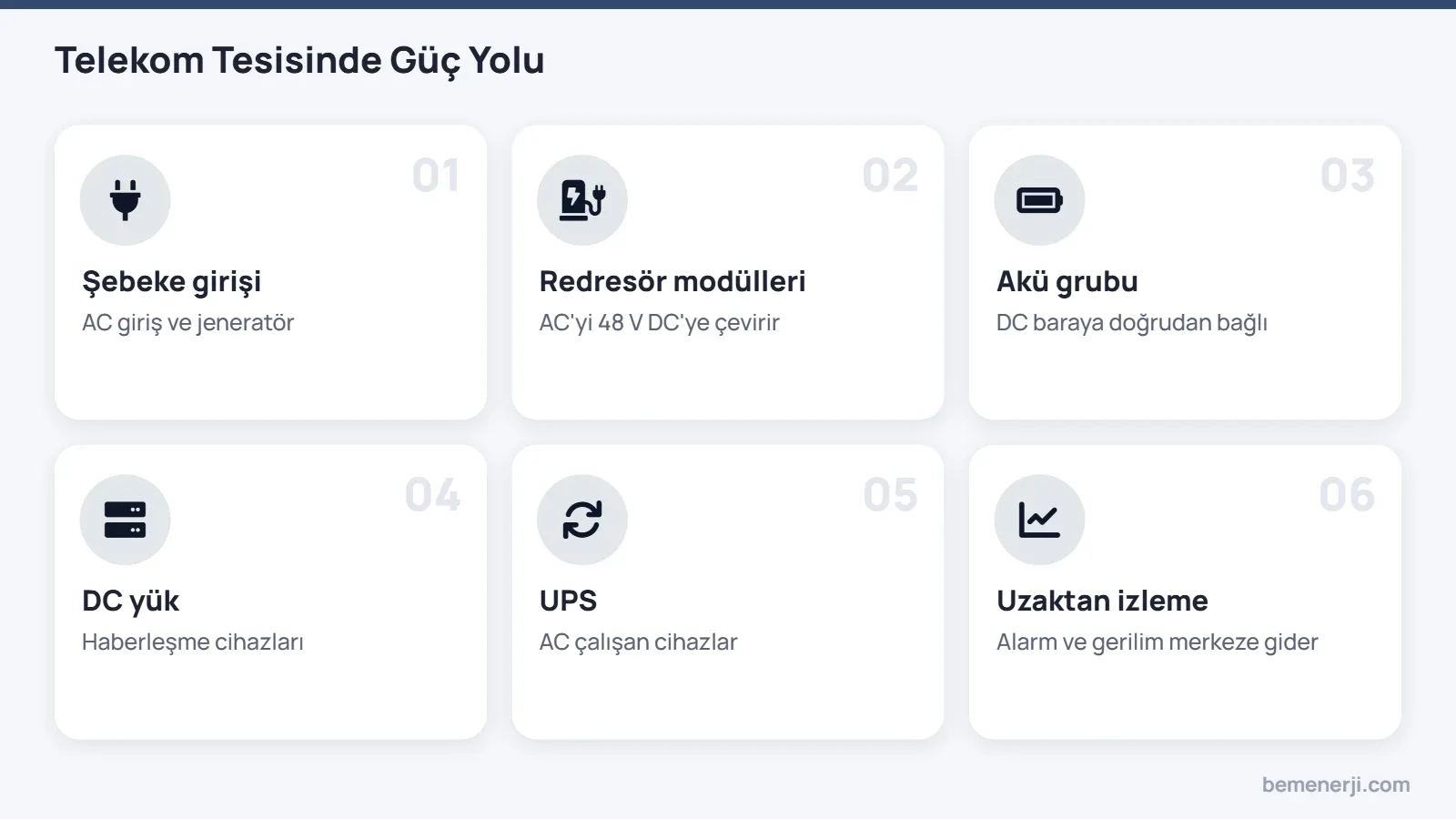
For many years, the standard input voltage for communication devices has been 48 V DC. In this configuration, the alternating current from the utility grid is converted to 48 V DC by rectifiers. The batteries are connected directly to the DC bus; when the utility power fails, the load continues to be powered by the batteries without any interruption. A significant advantage of the DC system is the reduced number of conversion stages: unlike in a UPS, there is no need to convert the battery output back to AC. The typical voltage range of the DC output and the interface requirements are defined in the ETSI EN 300 132-2 standard.
Task Sharing Between the Rectifier and the UPS
Not all devices at the telecom facility operate on DC power; management computers, some servers, and office equipment operate on AC power. For this reason, both systems coexist:
- Rectifier system: It supplies power to the DC-operated communication devices and the battery bank.
- UPS: The AC-powered server supplies power to computers and office equipment.
The main difference between a rectifier and a UPS is whether the output is DC or AC. The operating principle of a UPS How Does a UPS Work?, its inverter function What is an inverter? You can find it in our article.
Modular Rectifier and Redundancy
DC power systems typically consist of modular rectifiers. Each module provides a specific current capacity, and the number of modules is determined based on the load. A spare module is added (N+1) so that if a single module fails, the load can still be supported by the remaining modules. Modules can be replaced while the system is running. For redundancy configurations: Redundancy in a UPS Our article explains the same concept.
Battery Life and Installation Conditions
In the telecommunications sector, battery runtime is planned based on the importance of the facility and the availability of a generator. At a remote base station that is difficult to access and lacks a generator, a crew response can take hours; therefore, batteries are selected to provide backup power for a longer period. At sites with generators, the battery runtime may be sufficient to cover the time it takes for the generator to come online.
- The equipment cabinet is often not air-conditioned; as the temperature rises, battery life decreases. As a general rule, battery life decreases as the ambient temperature increases (Factors Affecting Battery Life).
- Lead-acid VRLA and lithium battery types are used; their differences are VRLA, AGM, gel and lithium-ion We explained this in our articles.
- The charging voltage is adjusted according to temperature, thereby preventing overcharging and undercharging.
Maintenance and Monitoring
Numerous facilities spread across a wide geographic area cannot be managed without remote monitoring. The rectifier controller transmits battery voltage, current, and alarms to the central system. However, on-site maintenance is still required: battery connections, terminal maintenance, and periodic discharge testing are part of this maintenance. Approach as listed on the maintenance checklist is largely the same. As for the logic behind the test, battery discharge test, for the maintenance plan Maintenance Frequency and Schedule You can check out our articles.
| System | Exit | Typical load |
|---|---|---|
| Rectifier (DC) | 48 V direct current | Communication devices |
| UPS (AC) | Alternating current | Server, computer, office |
| Batteries | DC busbar | Spare parts for both |
DC power systems contain hazardous energy; adjustment and maintenance tasks must be performed by authorized technical personnel. For periodic maintenance, Periodic Battery and UPS Maintenance You can check out our page.
Common Problems Encountered in the Field
Among the most common problems encountered in telecommunications facilities are aging battery banks, loose connections, and inadequate ventilation. While part of a battery bank may appear to be in good condition, a single weak block can significantly shorten the runtime when the power goes out. For this reason, periodic measurements include a block-by-block assessment to detect weak blocks early. Since the number of visits to remote locations is limited, creating a list of tasks to be performed during each visit reduces both time and cost.
- ETSI EN 300 132-2 — Power interface at the input of telecommunications and data communications equipment; Part 2: DC-powered (as defined in the standard).
- EUROBAT — European Battery Manufacturers Association (Guidance publications on the relationship between temperature and service life of VRLA batteries).
Sources
DC Systems and UPS Work Together
Communication devices are powered by 48 V DC from the rectifier system, while AC devices are powered by the UPS. The batteries provide backup power for both systems.

A modular rectifier, remote monitoring, and regular battery maintenance are the three cornerstones of the facility’s uninterrupted operation.
Frequently Asked Questions
01Why is 48 V DC used in telecommunications?
02Can a rectifier be used instead of a UPS?
03Why do cell tower batteries wear out so quickly?
04Are lithium batteries preferred in the telecommunications industry?
05Who should perform maintenance on the DC power system?
For Your DC and AC Power Systems
The maintenance and testing of battery banks are the backbone of a telecommunications facility’s continuity. Periodic Battery and UPS Maintenance Check out our page and Contact Plan with us through this platform.