UPS in Business Continuity Planning: Power Outage Scenario

A business continuity plan is a set of preparations that enables an organization to maintain its critical operations at an acceptable level in the event of an incident. A power outage is an essential scenario in any such plan, as electricity is the source of nearly everything—from IT to manufacturing. In this article, we explain how a power outage fits into the plan and where the UPS fits into it.
Start with a Business Impact Analysis
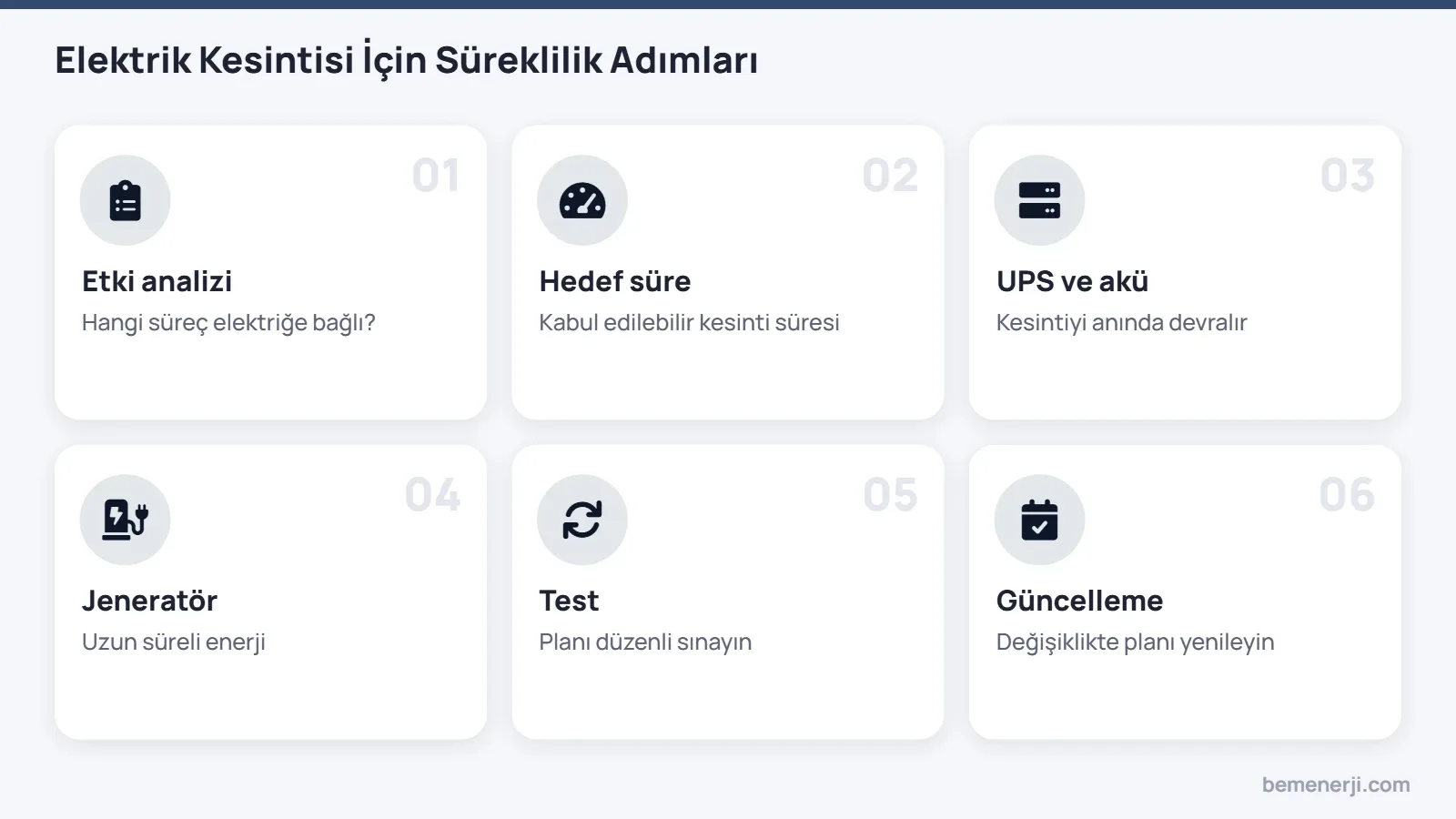
The plan begins by determining how critical each activity is. A business impact analysis answers the following questions: Which processes depend on electricity? How long can an outage last before the damage becomes unacceptable? Which devices do these processes rely on? This analysis provides the key data used to determine what the UPS will protect. What constitutes a critical load? What is a critical load? We explained this in our article.
Target Timeframes
There are two concepts frequently used in business continuity plans:
- Maximum acceptable downtime: The maximum duration for which an interruption in an activity can be tolerated.
- Target recovery time: The target time for restoring the system to operational status after an outage.
In IT, an acceptable level of data loss is also defined. From an electrical perspective, these targets directly shape decisions regarding battery runtime, generators, and redundancy. For example, if the target outage time is zero, a UPS and a redundant power path are required; if a few minutes can be tolerated, a simpler design may suffice.
Layered Power Protection
Electrical continuity is not provided by a single device; it is layered:
| Layer | Duties | Time scale |
|---|---|---|
| UPS and battery | It takes over immediately in the event of an outage, and the load remains unaffected | Minutes |
| Generator | Provides long-lasting energy | Hours, days |
| Backup line / secondary source | Eliminates a single point of failure | Continuous |
| Controlled shutdown | It preserves data integrity even if the source runs out | Last resort |
The UPS is the first link in this chain. For redundancy configurations, Redundancy in a UPS, to ensure the servers are shut down safely Automatically Shut Down Servers During a Power Outage You can check out our articles. How a UPS differs from a generator The Difference Between a UPS and a Generator This is explained in our article.
A Plan Shouldn't Just Stay on Paper
The most common mistake made with a plan is that it is prepared but never tested. In a power outage scenario, the following should be tested regularly:
- The UPS's actual backup time (Autonomy Duration Test).
- The generator coming online and the load being transferred back.
- Controlled shutdown scenario and responsible parties.
- Service and replacement parts available for maintenance and repair.
Test results are documented, and the plan is updated whenever changes are made to the system. Since batteries degrade over time, the backup duration also decreases over time; therefore, the plan should include a battery replacement schedule (When should a UPS battery be replaced?).
The Maintenance Agreement Is Part of the Plan
The plan covers not only the hardware but also the human and service components. Service access, response time, and periodic maintenance are part of this component; the way to ensure this is It is a maintenance contract. Our maintenance plans Maintenance Plans You can check it out on the page.
A Concrete Power Outage Scenario
For the plan to work, the scenario must be described in concrete terms. For example, one morning the power goes out: the UPS takes over the load, “battery mode” and the remaining time appear on the screen, and the person on duty receives an alarm. The first step is to determine whether the outage will be short or long; if it’s short, the UPS is sufficient. If it is long, the generator kicks in and the load is transferred to it. If the generator also fails, critical systems are shut down sequentially and in a controlled manner within the remaining battery runtime. Who does what, which phone number to contact, and who has decision-making authority are all specified in writing for each step.
Responsibility and Education
A plan lives not as a document, but as a habit. On-duty staff must be able to read the UPS screen, recognize the alarm, and know whom to notify. A brief drill conducted once a year reveals whether the plan on paper is truly feasible. Any shortcomings identified during the drill are incorporated into the plan: details such as a missing phone number, a malfunctioning switch, or an incorrect label only come to light during the drill. This feedback saves time during an actual outage.
- ISO 22301 — Security and resilience — Business continuity management systems (also published under the standard title TS EN ISO 22301).
- IEC 62040-3 — Uninterruptible power systems (UPS) — Performance and test requirements (standard title).
Sources
A Power Outage Is Part of the Plan
A business impact analysis determines how much downtime each activity can tolerate. UPS systems, generators, and redundant power paths are selected based on this objective.

If a plan isn't tested, it remains just a plan on paper. Battery life, generator switchover, and shutdown scenarios must be tested regularly.
Frequently Asked Questions
01Is a business continuity plan required?
02Does a UPS alone ensure continuity?
03Which devices should be connected to the UPS?
04How often should we test the plan?
05Is it necessary for small businesses as well?
Strengthen Your Power Continuity Plan
We can work together to assess whether your UPS and battery system are in line with the plan. Maintenance Plans Check out our page and Contact Us.