


UPS Mode, EPS and Transfer Time in Hybrid Inverters: Are They Enough for a Computer and Server?

When you buy a hybrid inverter for your home or workplace, you see phrases such as "UPS mode", "EPS output" and "millisecond transfer time" on the box and in the brochure. These phrases can give the impression that your computer will not shut down when the grid fails. In reality, the meaning of these terms varies from manufacturer to manufacturer. Working "like a UPS" is not the same as the protection offered by a true uninterruptible power supply.
In this article, we look at what UPS mode does in a hybrid inverter, how the EPS output works, how to read the transfer time, and how long computers and servers can withstand it. We then work through a sample battery runtime calculation and discuss which loads should be connected directly to the EPS and which should be connected behind a separate UPS.
This article is written for home users installing solar and storage systems, people working from home, small business owners, technical managers and purchasing departments. If you are not familiar with the basic principle of a hybrid inverter, you may first want to read our article on what a hybrid inverter is and how it works during a power outage .
What does "UPS mode" really mean in a hybrid inverter?
A hybrid inverter is an inverter that manages the DC energy from the solar panels, the battery and the grid in a single device. These devices usually have several operating modes: self-consumption priority, peak shaving, off-grid operation, and a "UPS" or "backup priority" mode. The names of the modes vary from brand to brand.
The critical point here is this: in most products, UPS mode is a battery management strategy, not a new power conversion topology. In UPS mode, the battery is always kept full and reserved solely as an emergency source. When an outage occurs, the inverter disconnects from the grid and starts supplying the load from the battery. Some models instead offer an intermediate option that allows the battery to cycle normally while keeping a minimum charge level (for example 30-50 percent) in reserve for emergencies.
The practical result works in two ways:
- Pro: When an outage occurs, the battery is most likely full, so the backup time is assured.
- Con: Because the battery waits at a high state of charge all the time, the share of solar energy going to household consumption or to grid export decreases; in addition, with some battery chemistries, staying at a high state of charge continuously can affect lifespan. See the battery manufacturer's recommendations for details.
- Limit: UPS mode alone does not determine how fast and how clean the transfer will be. That is determined by the inverter's hardware and the architecture of the load output.
We covered the general structure of a hybrid system and the distinction between on-grid, off-grid and hybrid in a separate article, with their differences and selection criteria . Here we focus only on transfer behavior.
What is the EPS output, and how does it differ from UPS mode?
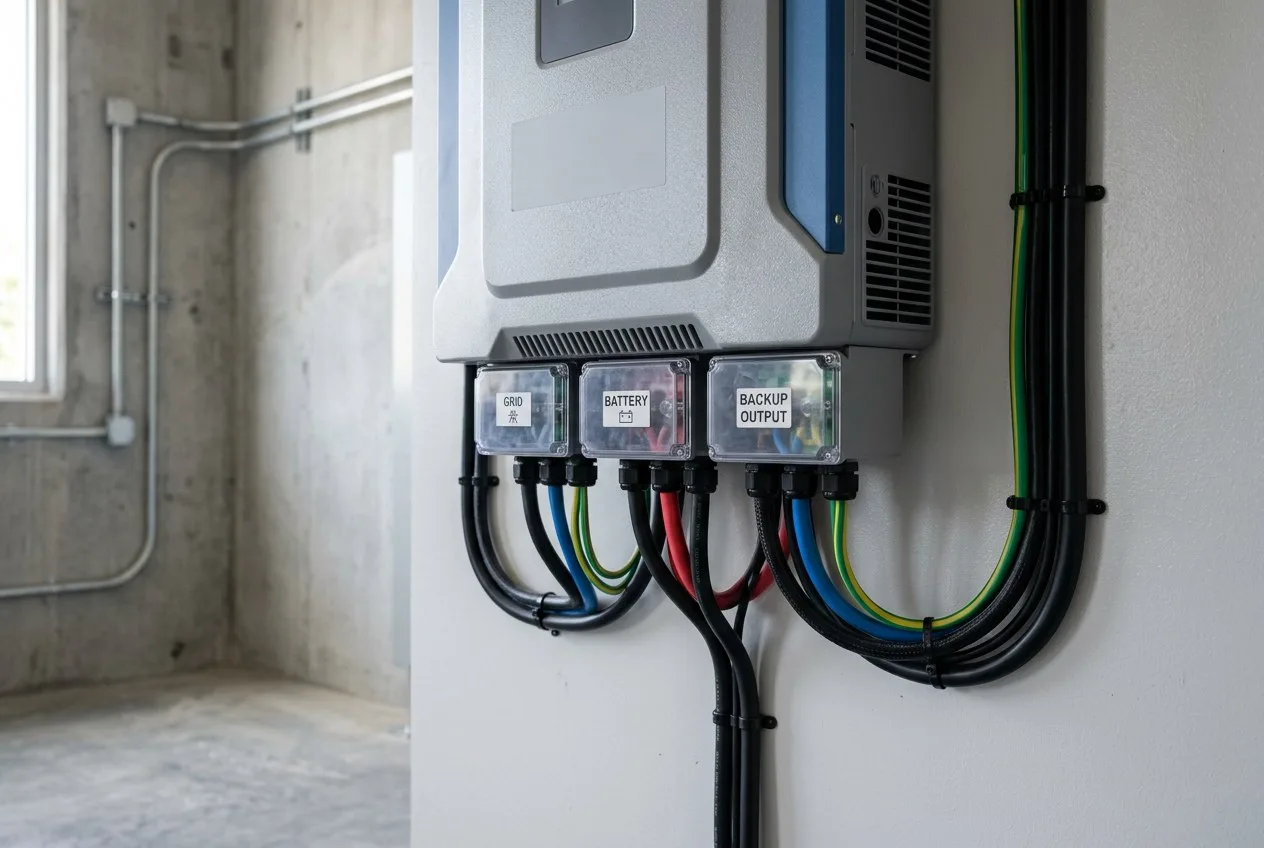
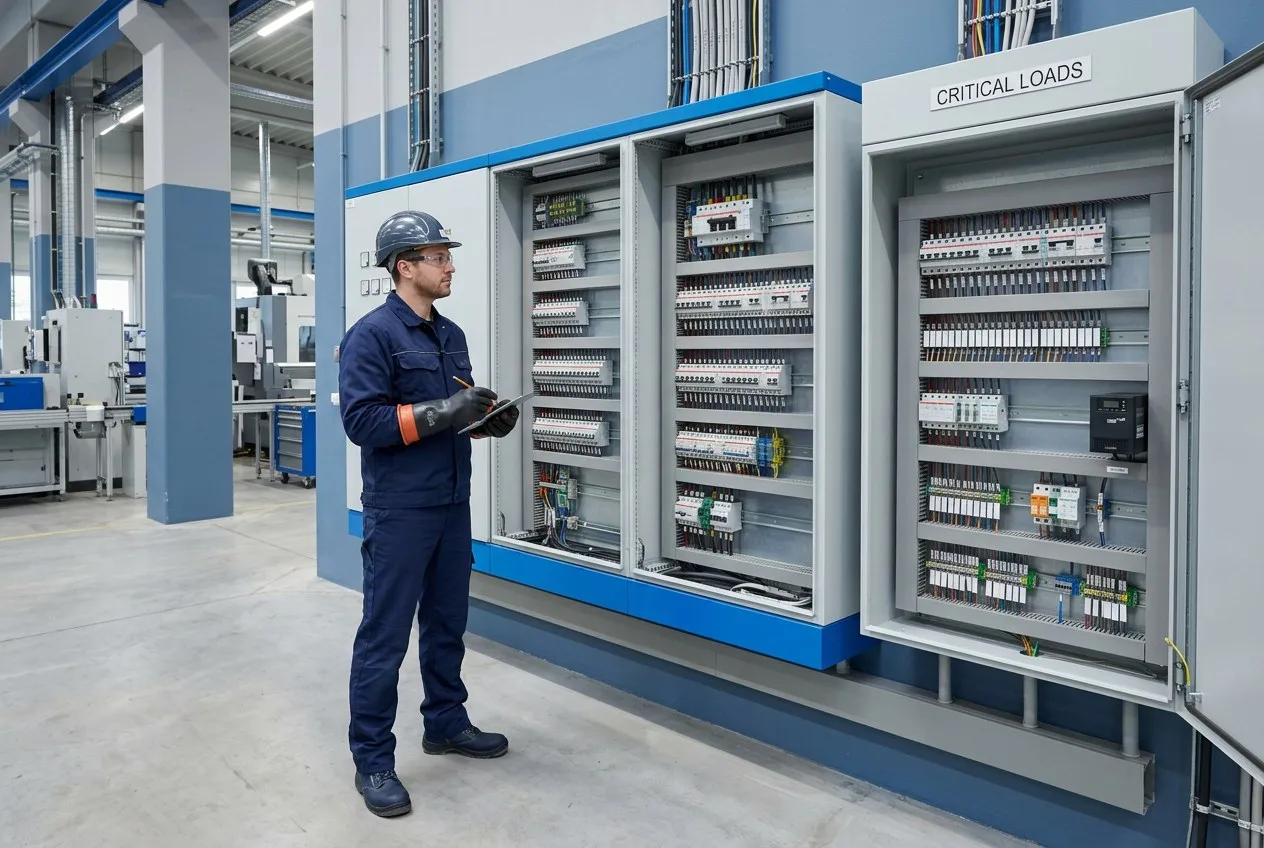
EPS (Emergency Power Supply) is the name given to the separate AC output of hybrid inverters that supplies selected circuits when the grid fails. This output is usually connected to a small "critical load panel" separated from the main panel. This way, the inverter carries not the entire home or business, but only selected loads such as the refrigerator, lighting, modem and computer.
We can summarize the difference briefly as follows:
| Concept | What does it mean? | What does it determine? |
|---|---|---|
| UPS mode | An operating strategy that keeps the battery full for backup | How full the battery will be at the moment of an outage |
| EPS output | A backup AC output that supplies selected circuits when there is no grid | Which loads are protected and the output power |
| Transfer time | The gap between the grid dropping out and the backup output delivering stable voltage again | Whether a sensitive device will shut down |
| Off-grid mode | Continuous operation with panels and battery, without the grid | Load supply at sites without a grid |
Some manufacturers use "UPS mode" and "EPS" almost synonymously; for others, EPS is a separate terminal and UPS is a software setting. Some sources distinguish UPS mode as transferring in under 10 ms and EPS as transferring in the 10-20 ms range. However, this distinction is not a universal standard; which term means what should be checked in the device's manual and datasheet.
How is transfer time measured and how should it be read?
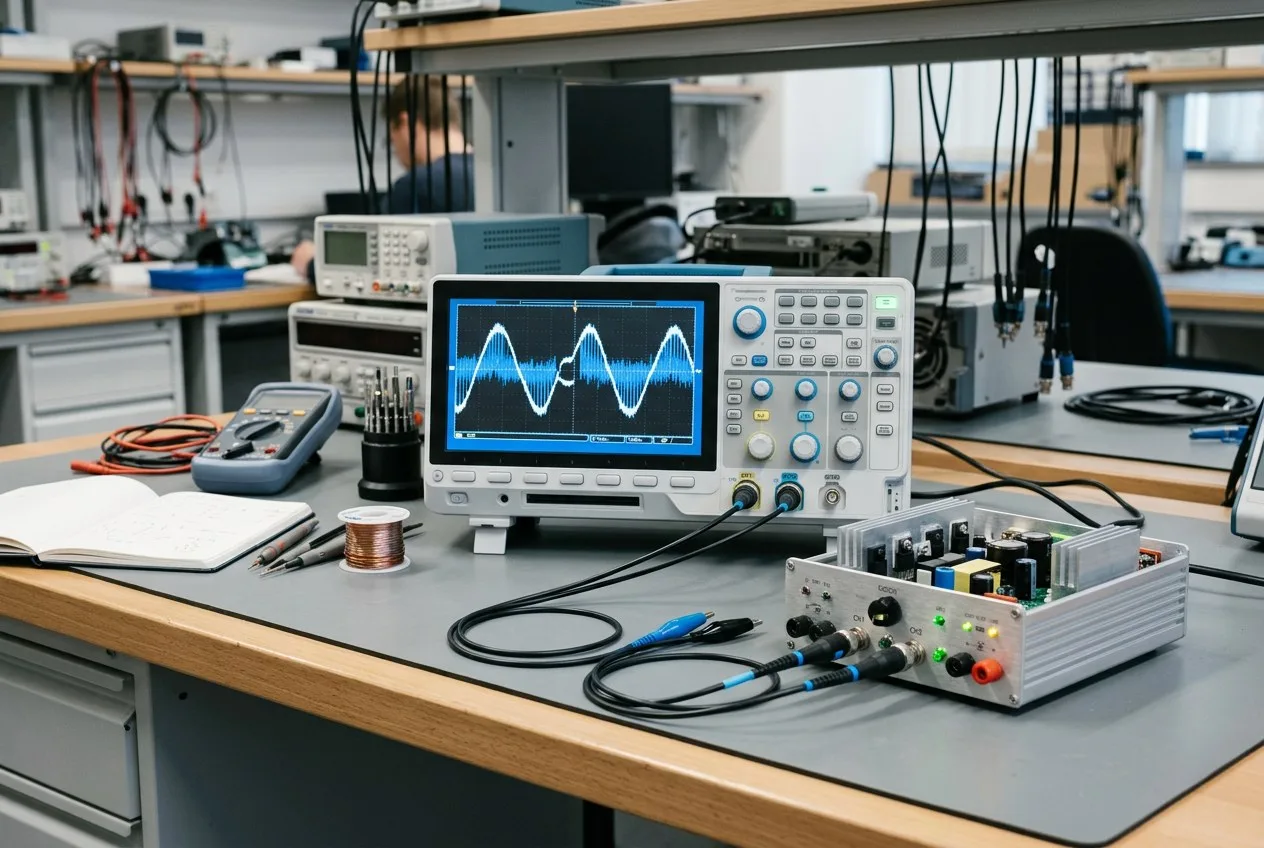
EPS transfer time is the gap between the grid being cut and the inverter's backup output becoming stable again. During this time, the load may be without voltage or may see a distorted voltage. Transfer time should be read not as an "average" but as an upper limit: the value on the datasheet is often one measured under specific test conditions with a specific load.
Understanding the architecture makes it easier to understand the time. The EPS output of a hybrid inverter is fundamentally based on a "bypass, then switch" architecture (passing the grid through first and stepping in when an outage occurs). In other words, in normal operation the load is supplied through the grid; when an outage is detected, a relay or solid-state switch disconnects the grid and the inverter output takes over. Detection, disconnection (anti-islanding safety), the rise of the inverter output and the settling of the voltage all take time.
When reading datasheet values, pay attention to the following:
- Which output is it given for? There may be separate values for the EPS output, the UPS output or the "backup port".
- Single unit or parallel? Some manufacturers specify a shorter time for a single unit.
- In which unit? The difference between milliseconds and seconds is huge. For example, for one model from one manufacturer, the transfer time to EPS mode is stated as under 1.5 seconds. That time is definitely long for a computer, but may not be a problem for a refrigerator.
- Load condition: The time may not be the same at no load and at full load.
- "UPS-level" claim: A claim of "UPS-level" given without stating which UPS class it is compared with can be misleading.
As a general idea, it is said that hybrid inverter EPS transfers are generally under 20 ms, and under 10 ms in well-defined units. This range is a typical value; it is not binding for any single model. For the real value, refer to the manufacturer's datasheet and, if possible, have it measured on site.
How many milliseconds of interruption can a computer and a server tolerate?
A computer's power supply unit (PSU) tolerates a brief grid interruption thanks to the large capacitors inside it. This is called "hold-up time". The reference used in the IT industry for this tolerance is The ITIC (formerly CBEMA) curveThis curve shows the voltage deviations IT equipment can withstand, together with their duration. Following the zero-voltage line, you can see that a power supply can keep running for about 20 ms after the mains drops to zero, so source transfers completed in less than 20 ms will not affect the IT equipment.
Three caveats apply to this reference:
- The curve is published for 120 V / 60 Hz. The official ITIC document applies to 120 V nominal systems at 60 Hz. It is also used for 230 V / 50 Hz because one cycle at 50 Hz is 20 ms. Since the percentage limits depend on physical time, this use is widely accepted.
- The curve is not an acceptance test. It is noted that the ITIC curve is not an actual test standard and that computers are not required to be tested against it. In other words, not every power supply guarantees 20 ms.
- Hold-up time varies with load and age. High load, aged capacitors and low input voltage shorten this time.
For this reason, the 20 ms of the ITIC curve is not a "safe limit" but a practical design reference. If the transfer time is half of that, i.e. below 10 ms, the safety margin increases. Also, the voltage settling during the transfer (overshoot, sag, distorted waveform) is part of this time and is not always visible when measuring the duration.
Desktop and laptop computers
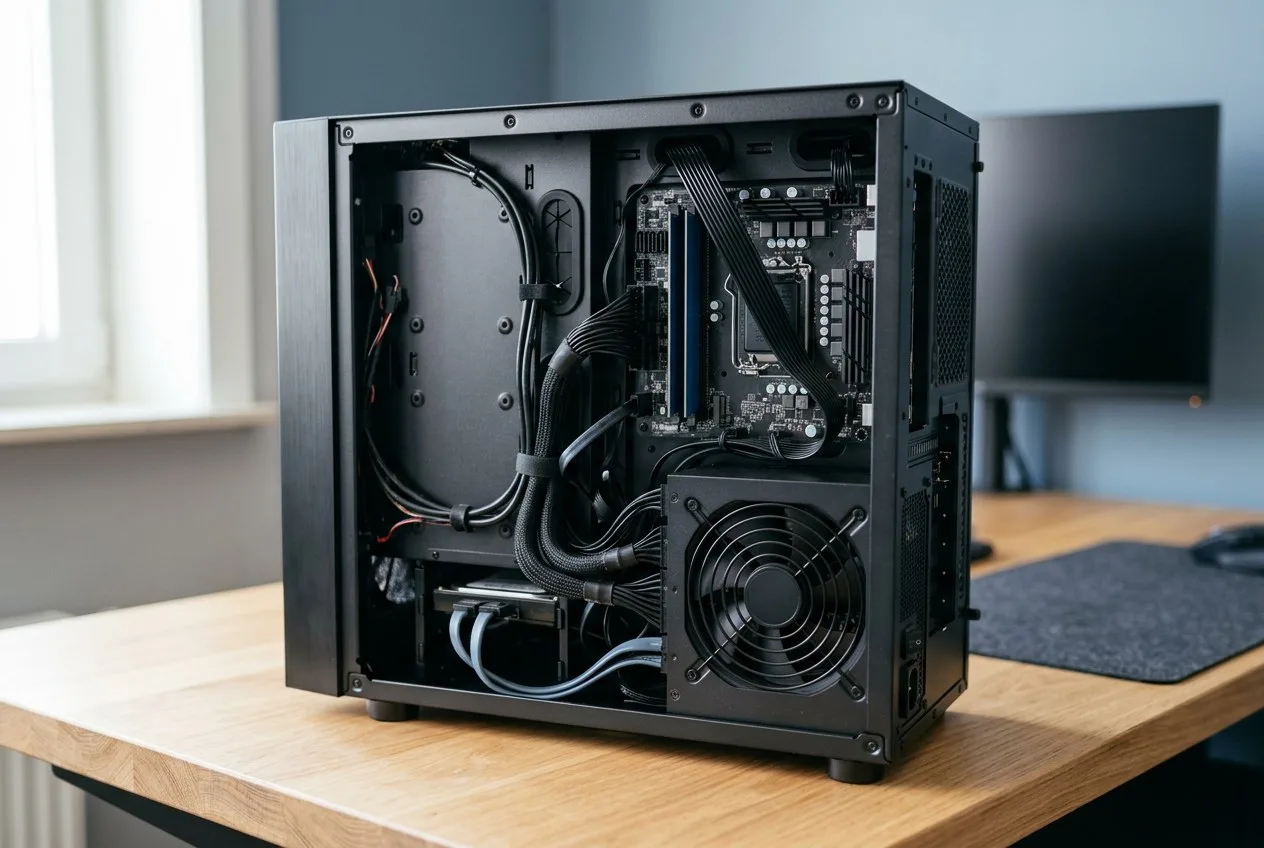
Since a laptop has its own battery, a mains interruption is not a major problem. However, operation may be affected if the charging adapter sees an overvoltage or a distorted waveform during the transfer. In a desktop computer, the PSU hold-up time is the deciding factor. A new, high-quality, high-efficiency PSU usually has a hold-up time close to 20 ms at half load; however, this value depends on the product and decreases with age. A fast-transfer hybrid inverter may be sufficient for most desktops; still, testing in the real environment is essential. For home and office computers, the load-list approach in the article UPS for home and small office is also helpful.
Servers, NAS and network devices
For a server, the issue is not just whether it "shuts down or not". Disk write operations, database consistency and the RAID controller are important. Even if a server rides through a 20 ms interruption, the voltage deviating from a clean sine wave, a sudden voltage spike during the transfer, or repeated transfers after the interruption (while the mains goes on and off) create risk. In addition, the EPS output of a hybrid inverter does not come with a network card or software that signals the server to perform a graceful shutdown . We have covered this topic separately in our article on automatically shutting down servers .
Comparison with UPS topologies: where does a hybrid inverter fit?
In the UPS world, transfer behavior is classified in the IEC 62040-3 standard. The standard defines the VFI, VI and VFD classes according to dependence on the input. VFI is the most independent class (double-conversion online); VFD is the voltage and frequency dependent (offline/standby) class. You can find this classification in detail for UPS systems in the article on online, line-interactive and offline UPS types .
| Solution | Typical transfer time | Where is the load normally supplied from? | Interpretation for computer / server |
|---|---|---|---|
| Offline (VFD) UPS | Approx. 4-20 ms | Mains | Acceptable for a home computer; limited for critical loads |
| Line-interactive (VI) UPS | Approx. 2-6 ms | Mains (with voltage regulation) | Considered sufficient for most server power supplies |
| Online (VFI) UPS | 0 ms | Continuous inverter | The safest option for critical servers and the network backbone |
| Hybrid inverter EPS output | Depending on the model: from tens of ms to a second; under 10 ms for good models | Generally mains transfer (bypass) | Behaves close to the offline UPS class; should be verified from the datasheet |
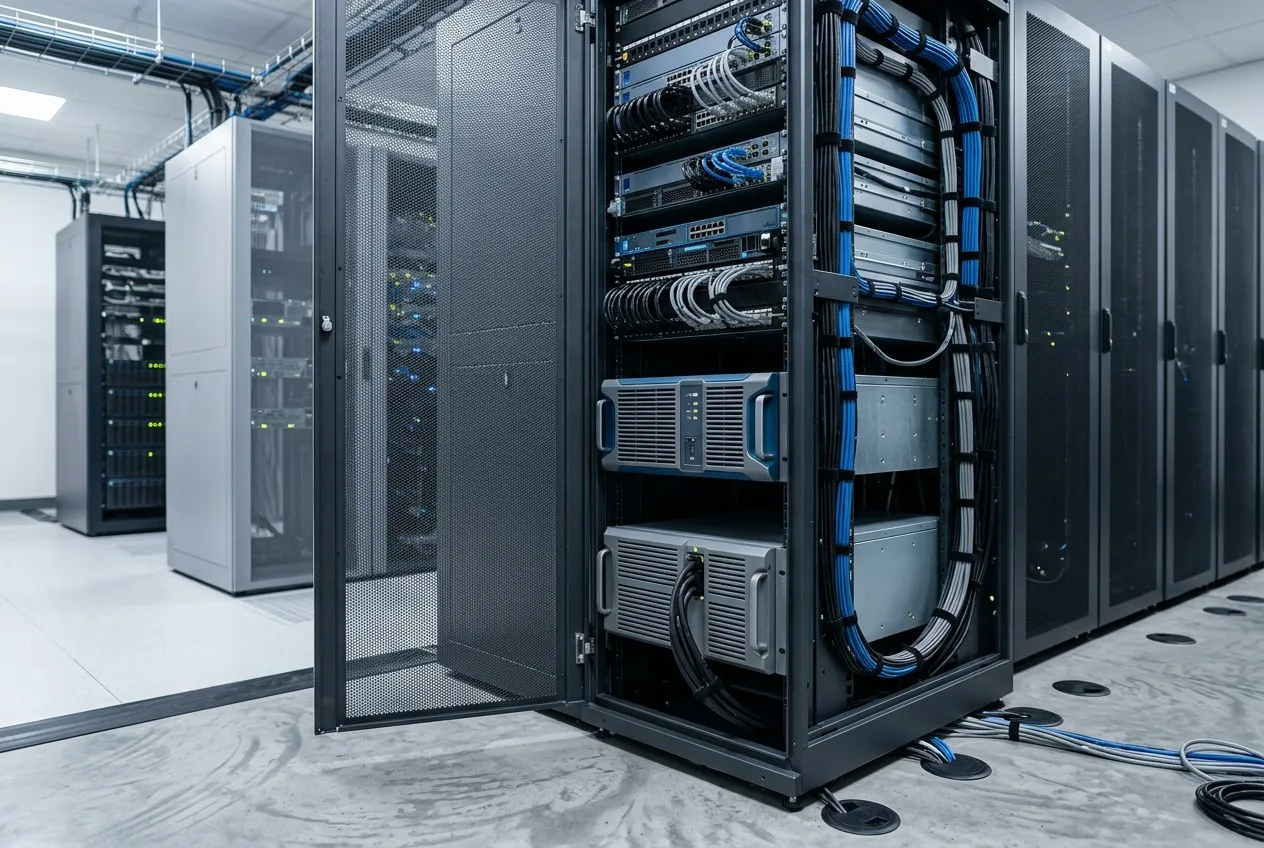
As stated in one source, critical racks or clinical endpoints deserve a separate online UPS, no matter how fast the hybrid inverter's EPS is. The reason is not just time; a double-conversion online UPS also continuously isolates the load from disturbances on the mains such as voltage sags, fluctuations and frequency deviations. In the IEC classes, VFI is the double-conversion type, the only design that can provide this independence.
Therefore, the most accurate mental model for the EPS output of a hybrid inverter is: a battery-backed backup output with a fast transfer switch. It is more than adequate for most household loads; however, it does not offer the continuous protection guarantee that a double-conversion UPS provides.
Which loads should be connected directly to the EPS and which to a separate UPS?
Dividing loads into three groups by their "tolerance to interruption" and "cost of interruption" makes the decision easier:
| Load group | Examples | Recommended connection |
|---|---|---|
| Interruption-tolerant | Lighting, refrigerator, TV, chargers, heat pump control | Direct EPS output |
| Sensitive to short interruptions | Desktop computer, router, modem, NAS, camera recorder | May have a fast-transfer EPS output; preferably together with a small UPS |
| Critical / requiring data integrity | Server, storage unit, patient records, financial transactions | Separate online UPS; the hybrid inverter feeds the input of the UPS |
| High inrush current | Air conditioner compressor, pump, laser printer, workshop motor | Evaluate separately according to EPS capacity; often kept off the EPS |
Inrush current is often overlooked. A motor or compressor can draw several times its rated current at startup. Some hybrid inverters state that they accept a short-term overload on the EPS output (for example, up to twice the rated power for 10 seconds ). This is again a model-dependent value. We explained how these devices affect UPS units and inverters in our article on the inrush current problem with motors, air conditioners and laser printers
Example calculation: How long does a computer run on a hybrid inverter and battery?
Even if the transfer time is sufficient, there is also the question of "for how long?" The calculation below shows an estimation method you can apply to your own system. The figures are assumptions; actual values vary depending on your device and battery.
Assumptions:
- Battery: LiFePO4, nominal 51.2 V, 100 Ah, i.e. approximately 5,120 Wh of nominal energy
- Depth of discharge used for backup: 80 percent (varies according to the manufacturer's datasheet and settings)
- Total efficiency of the battery-inverter-AC chain: 90 percent
- Load: desktop computer + monitor + modem, approximately 250 W in total
- Standby consumption of the backup output itself: approximately 40 W (the power the inverter draws in backup mode, varies by model)
Steps:
- Usable energy = 5,120 Wh × 0.80 = 4,096 Wh
- Energy reaching the AC side after efficiency losses = 4,096 Wh × 0.90 ≈ 3,686 Wh
- Total power drawn = 250 W + 40 W = 290 W
- Runtime = 3,686 Wh ÷ 290 W ≈ 12.7 hours; rounded down, about 12 hours
If the same battery also powers not just the computer but also a refrigerator (on average around 80-120 W), lighting and a TV, the load can rise to 600 W and the runtime drops to about 6 hours. With a load that runs 24 hours a day and draws high power, such as a server, this energy is depleted quickly. The logic of the calculation is explained in our article on battery runtime calculation while the details on the solar system side are covered in calculating solar energy battery capacity
There are two additional points to keep in mind:
- Power factor: Server PSUs may have different VA and W ratings. A hybrid inverter's EPS power is usually given in W, while UPS power is given in VA. Power factor Do not verify capacity without calculating the
- Battery management: As the battery nears depletion, BMS protection may shut the inverter down abruptly. For a server, this means an outage with no chance for a graceful shutdown.
Hybrid inverter + separate UPS: When and how to use them together
The most common practical solution for critical computers and servers is two-stage protection. The hybrid inverter provides long-term power continuity, while a double-conversion UPS provides fast, clean protection right in front of the load.
The operating sequence is as follows:
- When the grid is normal, the UPS input is fed from the hybrid inverter's backup output (or from the grid-assisted output), and the UPS supplies the load through double conversion.
- When the grid fails, the UPS switches to its own battery for a moment. The load sees no interruption during this time.
- The hybrid inverter's backup output kicks in and supplies voltage to the UPS input again. The UPS exits battery mode and recharges its own battery.
- The hybrid inverter's battery and solar energy continue to power the UPS during a long outage.
In this setup, the UPS absorbs the hybrid inverter's transfer time and short deviations in the backup output voltage emer. In addition, the UPS's remote monitoring and shutdown software ensures the server is shut down properly. For planning a rooftop solar power plant (GES) and a UPS together on the business side, you can read the article rooftop solar and UPS in businesses .
Technical points to consider in this installation:
- Compatibility: The waveform (pure sine), frequency and voltage of the hybrid inverter's backup output must be within the UPS input tolerance. The UPS's mains/generator input must be checked for compatibility.
- Power margin: The sum of the UPS charging current, inverter efficiency and inrush current must remain below the EPS power.
- Selectivity and protection: Fuse and residual current protection selection, short-circuit selectivity and earthing must be done correctly. UPS earthing is important in this respect.
- Authorization: Panel, battery and inverter connections carry the risk of high DC voltage, arcing and short circuits. Installation, commissioning and modifications must be carried out only by authorized electrical personnel.
What to look at besides transfer time? Selection criteria
Deciding by looking only at the millisecond value is not enough. The table below lists the criteria to check when evaluating whether a hybrid inverter is suitable for a computer or server load.
| Criterion | Why is it important? | Where to check? |
|---|---|---|
| Transfer time (ms) | Must be shorter than the PSU hold-up time | Datasheet, measurement if possible |
| Output waveform | PSUs with active PFC prefer a pure sine wave | Datasheet; see the difference between pure sine and modified sine waves |
| EPS continuous power and peak power | The load and inrush current must be met | Datasheet (together with duration information) |
| Unbalanced load acceptance | In three-phase systems, can the EPS output take different loads across phases? | Manual |
| Battery and BMS compatibility | The battery's discharge current and low-voltage limit affect backup time | Battery and inverter compatibility list; see what is a BMS |
| Reserve charge level setting | Ensures the battery has a minimum charge level for an outage | Settings menu |
| Automatic return behavior | Does a second transfer affect the load when the grid returns? | Manual and field test |
| Monitoring and alerts | A signal is needed to shut down the server properly | Communication interfaces, network card option |
| Documents and standards | CE and related test reports are for safety and compliance | See which documents and standards should be checked |
Transfer time is the first row of the table, but it is not the only one. A hybrid inverter may claim an 8 ms transfer and still feed the load with a distorted waveform. This can cause the device to restart even though the transfer time is short.
Common mistakes
- Assuming it is a UPS because it says "UPS mode". The mode name does not change the topology. Unless a double-conversion architecture is clearly stated in the datasheet, consider the EPS output a bypass-type (line-interactive/offline) backup.
- Connecting the whole house to the EPS. The power of the backup output is usually low compared with the total power of the house. Critical circuits need to be separated out.
- Trusting it without testing. The manufacturer's measurement conditions differ from your load. While the computer is running, the main grid switch should be turned off in a controlled way and the load behavior observed. This test should be carried out under the supervision of a qualified electrician.
- Not making a shutdown plan for the server. When the battery limit is reached, the hybrid inverter may stop suddenly. The server should first shut down through its own UPS and software.
- Forgetting the reserve level. If the battery is drained on sunny days, there may be no backup left when an evening outage occurs. The backup-priority setting and the minimum charge level should be chosen deliberately.
- Choosing a battery that is too small. If the load, discharge current and BMS limit are not taken into account, the battery cuts off early under load. It is important to learn how much of the battery capacity (Ah) is actually usable.
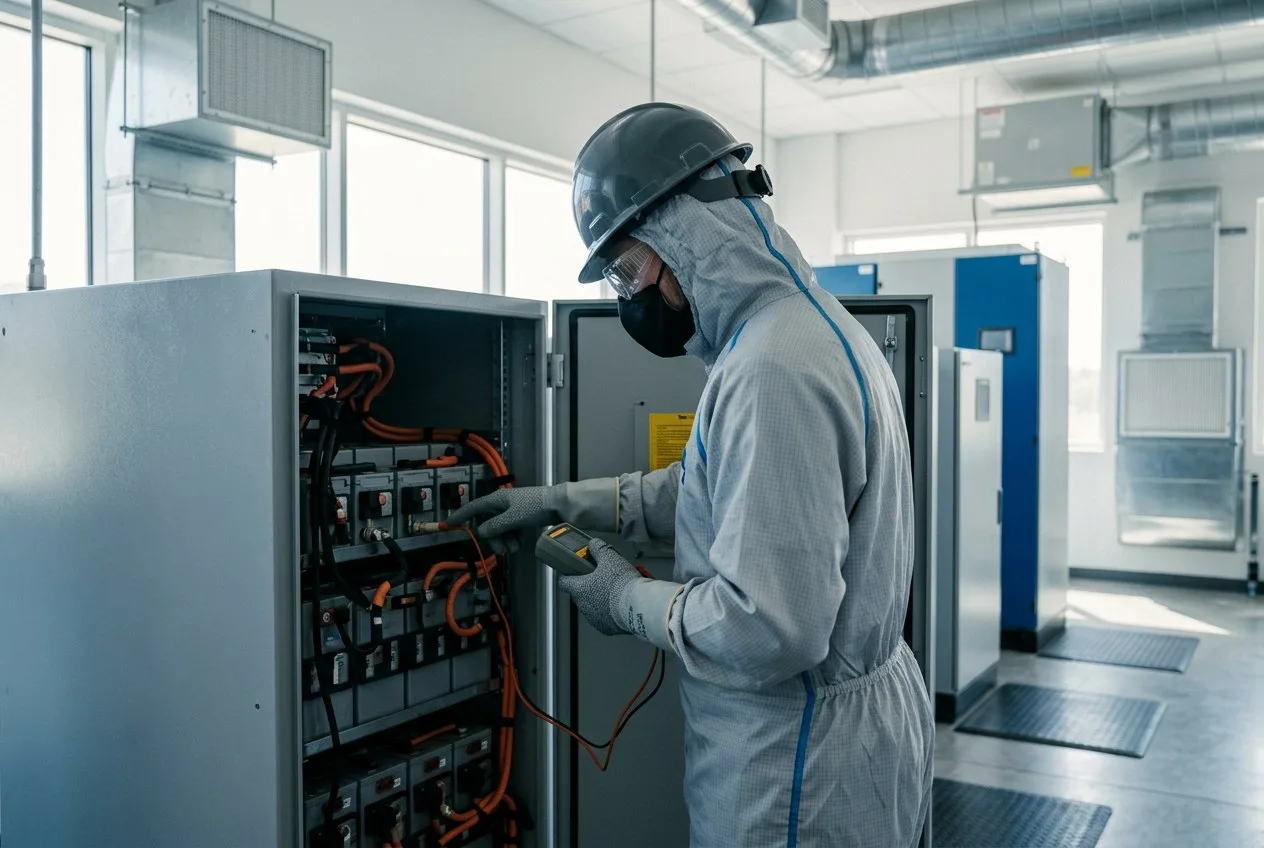
- Neglecting safety and ventilation. The placement, ventilation and fire safety of the lithium battery and inverter cabinet must be planned separately.
What is recommended in which scenario? Quick decision guide
| Scenario | Recommendation |
|---|---|
| Laptop, modem, lighting and refrigerator at home | A hybrid inverter's EPS output is often sufficient; a small DC UPS can be considered for the modem. |
| Working from home with a desktop computer and NAS | A pure sine wave model with a transfer time under 10 ms, or a small line-interactive UPS in front of the computer. |
| Small office, a few servers, network devices | An online or line-interactive UPS; a hybrid inverter as the source that covers longer durations. |
| Business where data integrity is critical | A double-conversion online UPS, proper shutdown software and, if necessary, a redundant setup. |
| Motor, air conditioner, pump-heavy load | Separate planning that accommodates inrush current; separate high-capacity supplies instead of EPS. |
If you would like to see the general picture, our article that compares UPS, inverter, generator and solar energy options for home power outages may also be helpful.
How can Bempower help?
Although hybrid inverter or solar system installation is the topic of this article, protecting critical computer and server loads falls within Bempower's field on the UPS, battery and inverter side. To have the transfer behavior of your existing backup setup and the condition of your UPS and batteries inspected on site, to have a suitable UPS and battery bank selected, and to have periodic maintenance carried out, you can reach us via our contact page . For your survey, installation, periodic maintenance and technical service needs, we provide on-site service in Istanbul and surrounding provinces.
- Hybrid Inverter EPS Transfer Time: How Fast Is It? — EPEVER, 2026. https://www.epever.com/articles/hybrid-inverter-eps-transfer-time-how-fast-is-it/
- Validating UPS Transfer Time According to IEC 62040-3 — Yokogawa Test & Measurement, 2025. https://tmi.yokogawa.com/us/library/resources/application-notes/validating-ups-transfer-time-according-to-iec-62040-3/
- A new International UPS Classification by IEC 62040-3 — 24th International Telecommunications Energy Conference (INTELEC) / W. Solter, 2002. https://scispace.com/pdf/a-new-international-ups-classification-by-iec-62040-3-22joo437gy.pdf
- Voltage Thresholds for Distribution Planning — EPRI, 2024. https://restservice.epri.com/publicdownload/000000003002010996/0/Product
- CBEMA/ITIC Curve for 50Hz Systems: Application Guide — Industrial Monitor Direct, 2026. https://industrialmonitordirect.com/blogs/knowledgebase/cbemaitic-curve-50hz-vs-60hz-applicability-guide
- UPS Topologies: Offline, Line-Interactive and Online UPS Compared — Industry Electronics, 2025. https://industry-electronics.com/knowhow/ups-topologies
- What Are the 4 Operating Modes of A Hybrid Inverter? — BSLBATT, 2024. https://www.bsl-battery.com/news/what-are-the-4-operating-modes-of-a-hybrid-inverter
- What is the switchover time to EPS mode during a grid failure for X3-Hybrid G2 inverter? — SolaX Power Service, 2025. https://solaxpowerservice.zendesk.com/hc/en-001/articles/12893447619343-What-is-the-switchover-time-to-EPS-mode-during-a-grid-failure-for-X3-Hybrid-G2-inverter
Sources
