


How Much Solar Energy Does It Produce in Winter? Battery and System Plan in Winter Conditions

Many people who have installed or are considering installing a solar energy system ask the same question: "Everything is fine in summer, but what about winter?" Production really drops in winter. However, understanding the reason for the decline correctly makes it easier to set the expectation correctly and to plan the battery, inverter and charge controller according to winter conditions. Knowing that cold weather does not damage the panel and affects the battery in a very different way is half the battle.
This guide; It was written for home users, vineyard house and summer house owners, small businesses and technical officers. We discuss how much the December-January radiation in Turkey decreases compared to the summer month, how the cold changes the panel voltage and battery capacity, the effect of snow and frost, how lithium and lead acid batteries behave in winter, and the system sizing according to the winter with numerical examples.
The figures in the article are typical values. Actual production; varies according to location, panel slope, shading and equipment. Electrical connection, battery and DC circuit works should be done by authorized electrical personnel; what is described here is for planning and informational purposes.
Does the solar panel work in winter, how much does the production decrease?
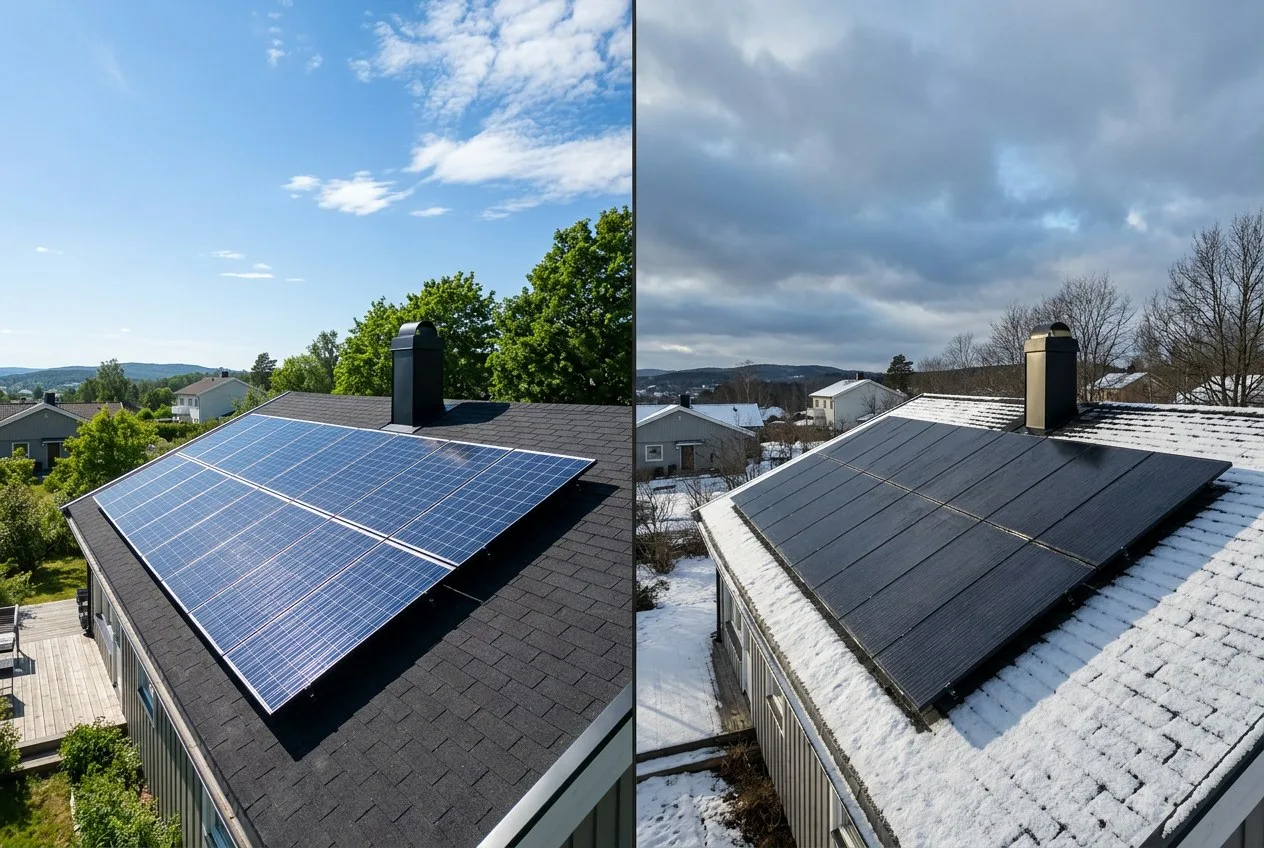
The panel generates electricity with light, not temperature. There are three main factors that reduce production in winter: shorter day, lower angle of the sun to the horizon, and increased number of cloudy days. The cold itself slightly increases panel efficiency; it is not the cause of production loss.
According to the data of the General Directorate of Meteorology based on 55 major climate stations In the 2011-2024 period, Turkey's average annual global solar radiation is 1581.1 kWh/m² level. Although the annual total seems high, the distribution is not equal. In a study conducted by MGM with satellite data the lowest in December with a monthly average of 1926 Wh/m², and the highest in June with 6726 Wh/m² calculated. These figures are daily averages and correspond to approximately 29 percent of December and June (1926 ÷ 6726 ≈ 0.29).
The old EIE monthly table gives the same table: Monthly total of approximately 51.75 kWh/m² in January, 46.87 kWh/m² in December It is shown as. In other words, the middle of winter is significantly below the annual average. There is also a difference between regions; for example, a radiation site for Istanbul The most productive month is July, the lowest month is December It shows as. For precise planning, it is necessary to look at the data of the province you are in and, if possible, the district.
A simple winter production calculation
The calculation below is to see the approximate size. Assumptions: 3 kWp (kilowatt-peak, peak power of the panel under standard conditions) installed power, system performance ratio 0.75 (general coefficient covering cable, inverter, temperature and dirt losses), December horizontal irradiance of 1.9 kWh/m²/day (country average approximation), approximately 1.3 times more radiation of the curved panel compared to the horizontal surface compared to winter.
- Winter radiation on a slope: 1.9 × 1.3 ≈ 2.5 kWh/m²/day
- Daily energy: 3 kWp × 2.5 × 0.75 ≈ 5.6 kWh/day
- Cloudy day (assuming about 20 percent of the clear day): approx. 1.1 kWh/day
- Summer comparison (June, 6.7 kWh/m²/day, slope gain approx. 1.0): 3 × 6.7 × 0.75 ≈ 15 kWh/day
In this example, a clear winter day produces about one-third as much as a summer day; a heavily cloudy winter day can go down to one-tenth. What disrupts the system is not the average, but the successive bad days.
Is cold weather good or bad for a solar panel?
Crystalline silicon panels lose strength with temperature. The maximum power temperature coefficient in crystal cells is around −0.5%/°C is specified; in modern panels, this value is often slightly lower and is written in the data sheet of each panel. As the panel goes below 25 °C, the efficiency increases slightly. So the cold is an advantage for the panel; the reason why you produce less in winter is not the cold.
The more important result of this effect in system design is voltage. The open circuit voltage (Voc) on the module's label is measured at 25 °C, and as the temperature drops below it, the voltage rises . In the series connected panel array, this increase is summed up. The voltage applied to the input of the charge controller and inverter must not exceed the maximum allowed by the device.
| Size | Value (example assumption) | Description |
|---|---|---|
| Panel Voc (25 °C) | 49 V | Tag value |
| Voc temperature coefficient | −0.28%/°C | Taken from the datasheet |
| Lowest expected cell temperature | −15 °C | Temperature difference: 40°C |
| Pros | 40 × 0,28 = %11,2 | 49 × 1,112 ≈ 54.5 V |
| 4 panel serial array | 4 × 54.5 ≈ 218 V | Suitable if the controller input is, for example, 250 V, and exceeds the limit if it is 5 panels (≈272 V) |
This account prevents the error of "the TV series that works properly in the summer breaks the device on the first cold morning". Discussing the compatibility of the series and the device in detail Panel array, current and voltage compatibility in charge controller selection You can look at the article. The person who will make the design should be based on the lowest recorded temperature of your location.
How do snow, hoarfrost and pollution affect production?
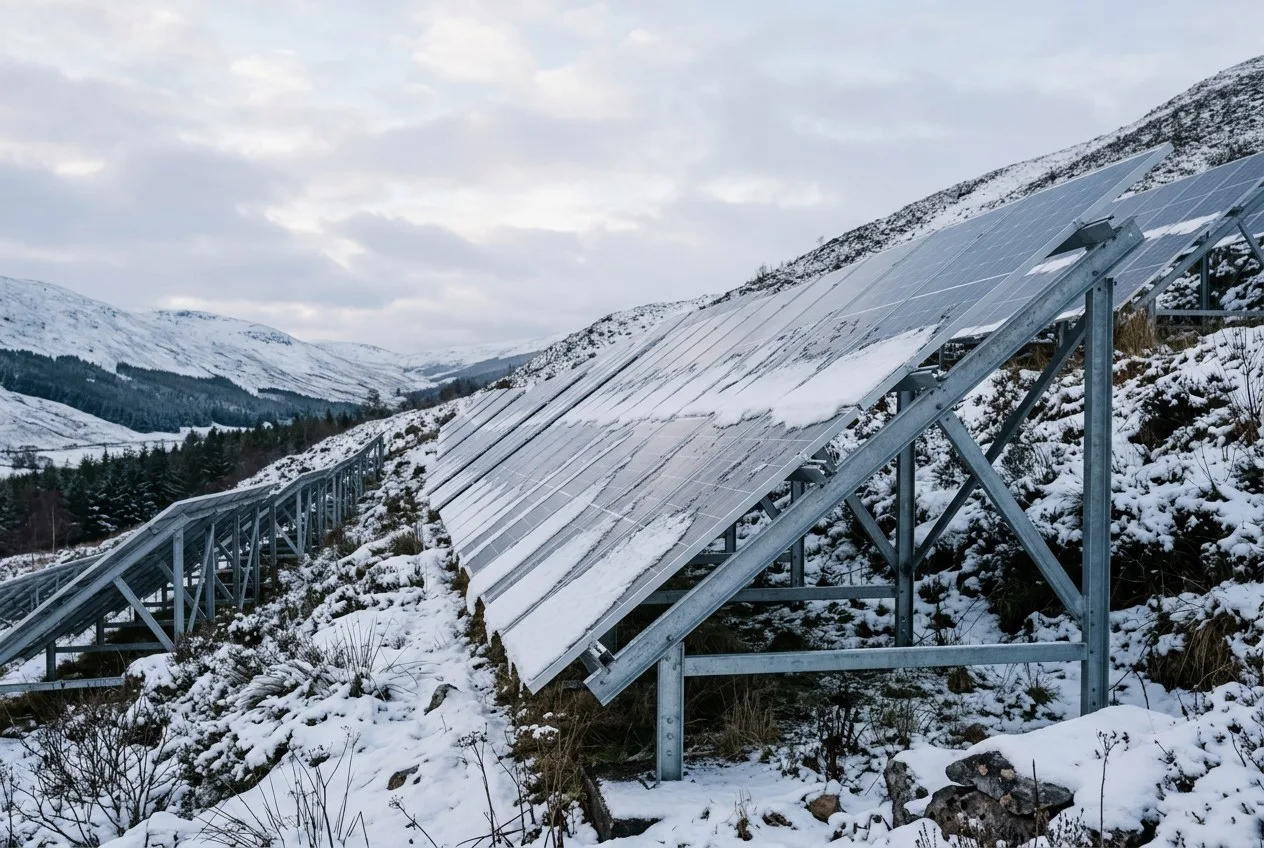
The snow-covered panel transmits less light and production decreases or even stops. However, its impact on the annual total may be limited depending on the amount of snowfall and the angle of the panel. According to published estimates compiled by Sandia National Laboratory Annual energy losses range from 1 to 12 percent, while monthly losses can be up to 100 percent, depending on local conditions . Another compilation, Annual losses generally remain in the range of 1 to 12 percent. declares.
The factors that determine how long the snow stays on the panel are as follows:
- Slope: Steeply placed panels leave snow more easily. The steeped slope for winter helps both snow sliding and receiving more radiation from the low sun.
- Proximity to the ground: Snow cannot slide if it is blocked by ground snow deposited on the bottom edge of the panel; shading of cells in the bottom row can affect the entire array.
- Panel surface and frame: The bottom edge of the frame can delay the snow from slipping.
- Bifacial panels: They can have an advantage on snowy ground because they can pick up the light reflected from the ground with the backside; however, this depends on the installation height and ground reflection.
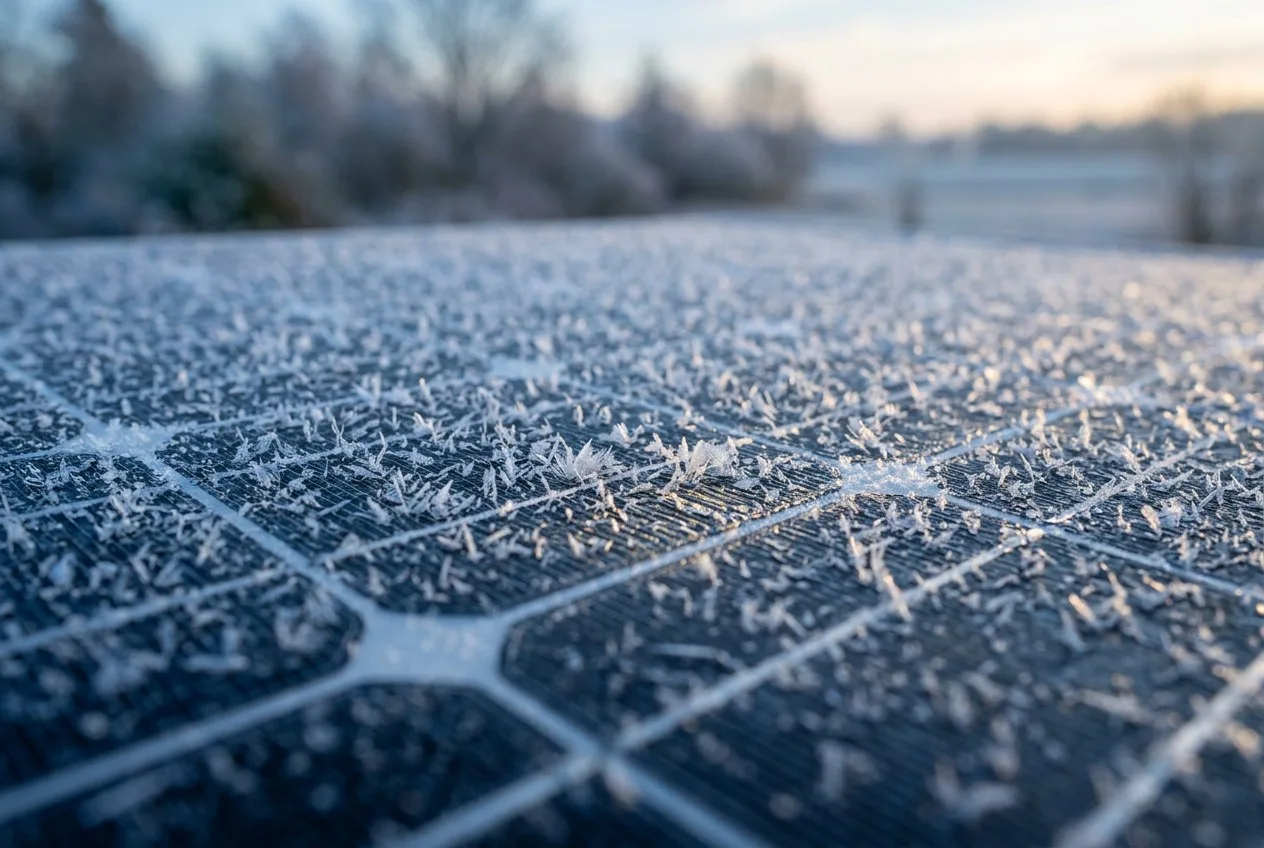
Another factor affecting production in winter is hoarfrost. In the early morning, the thin layer on the panel surface melts in a short time with the sun and its effect is mostly limited to a few hours. In dry and dusty periods without rain, contamination comes to the fore. For safe cleaning and timing Solar Panel Cleaning and Maintenance You can take a look at the article.
Safety note: Climbing on the roof and clearing snow in winter conditions is not recommended due to the risk of slips and falls. If cleaning or snow removal is required for roof panels, authorized teams with appropriate access and equipment should be consulted. If you notice broken glass, frame damage or cable damage, do not touch the system; report it to the authorized service.
Winter angle and direction: Does it work to steep the panel?
Since the sun comes at a lower angle to the horizon in winter, a panel with a horizontal slope compared to summer receives less radiation. Steepening the panel increases winter radiation but reduces summer production. The best fixed angle for annual energy is usually a value slightly below latitude; in a system that prioritizes winter, this angle can be chosen close to latitude or slightly more.
In systems where the winter month is decisive, such as an off-grid vineyard house, the angle selection is made according to the production of the critical month rather than the annual yield. In a grid-connected system, the annual total production is more important. For details of settlement in Turkey Solar panel angle and orientation can be seen in the article. In addition to all these, winter shading is also important: the shadow of a chimney, tree or neighboring building, which does not cause problems in summer, falls much longer on the panel in low sun in winter. The consequences of this effect on the array Ghosting and Bypass Diode It is explained in the article.
How does the battery behave in cold weather?
The main component of the solar energy system that struggles in winter is usually the battery. In the cold, the chemical reactions inside the battery slow down, the internal resistance increases and the usable capacity decreases. Two common battery classes are affected differently.
| Feature | Lead acid (AGM, gel, OPzV) | Lithium (LiFePO4) |
|---|---|---|
| Discharge in the cold | Capacity drops significantly; usable energy decreases at low temperature | Discharge is less affected, but at low temperature, capacity and power are reduced again |
| Charging in the cold | Charging is possible; charging voltage is compensated by temperature | Charging is restricted around and below freezing; BMS interrupts or limits charging |
| Main winter risk | Freezing of electrolyte at low charge, permanent damage | Lithium plating and capacity loss |
| Protective measure | Keeping the charge level high is not suitable for a heated or insulated environment. | Heated cell, low temperature charge cut-off, heated technical room |
The statements in the table show the general principles; the limit values of each product are different and should be consulted in the manufacturer's data sheet.
Risk of freezing in a lead acid battery
Freezing in a lead acid battery is more about the level of charge than the temperature. According to Battery University a frozen lead acid battery is permanently damaged; the electrolyte with a specific gravity of 1.15 freezes at −15 °C . The electrolyte of a fully charged battery withstands very low temperatures, while as the discharge increases, the electrolyte approaches the water and the freezing point rises. A discharged battery is at risk even at temperatures close to zero degrees. Therefore, keeping the battery at a low charge for a long time in winter increases both sulfation and the risk of freezing.
On the charging side, the charging voltage needs to be raised slightly in the cold. Battery University says that the charging voltage that it is set high in cold and low in hot specifies. Therefore, chargers with temperature sensors are beneficial for battery life in winter. For general factors affecting the life of lead acid batteries Factors Affecting Battery Life You can look at the article.
Cold charge limit on lithium battery
LiFePO4 batteries discharge better in the cold than lead acid, but require attention when it comes to charging. According to a statement from a battery retailer Sub-freezing charging can lead to lithium plating; this reduces capacity and can create a risk of short circuits . Therefore, the battery's BMS (battery management system) cuts off the charge according to the cell temperature. The cut-off threshold varies between approximately 0 and 5 °C depending on the product; this limit is defined in the battery and inverter settings.
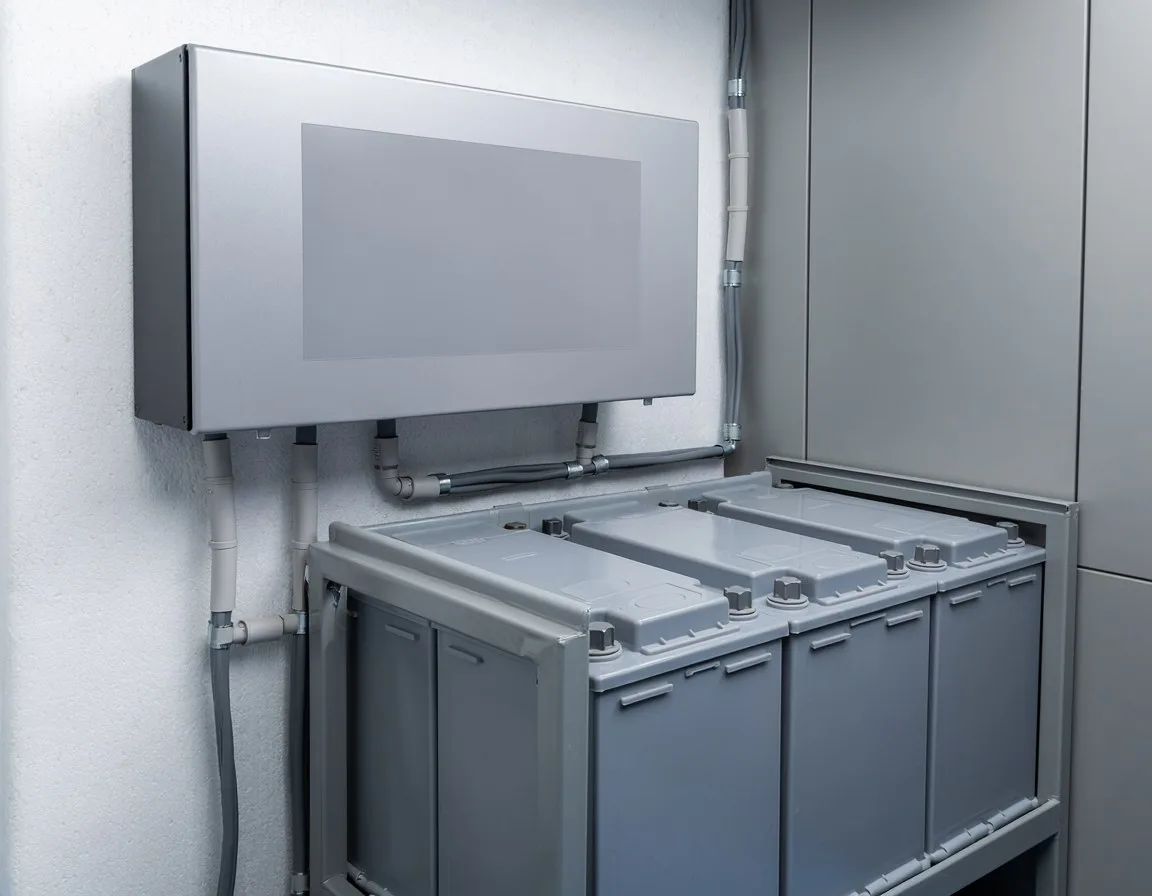
The practical conclusion is that in a cold storage, the lithium battery may not receive a charge when the sun first rises in the morning; charging resumes when the environment warms up. Models with heated cells reduce this problem. The location of the battery is decisive in winter performance: an insulated, frost-free and ventilated technical room is much safer than an exposed cabinet. For the role of the BMS What is BMS article, general features of LiFePO4 LiFePO4 battery You can take a look at the article.
How to calculate battery capacity based on winter condition?
Battery capacity determines how long you can carry the load on consecutive cloudy days in winter. The main concept is the day of autonomy: the number of days the battery will supply the load, even if there is no charge from the panel. The calculation takes into account the depth of discharge (DoD, how much of the battery will be used) and the conversion efficiency. General logic of the calculation from daily consumption to battery Ah value It is given in detail in the article; here we adapt it with winter assumptions.
Example assumptions: daily consumption 4 kWh, autonomy 2 days, system voltage 48 V, inverter and cable throughput approx. 0,90 (in lead acid calculation) and 0,95 (in lithium calculation).
- Required energy: 4 kWh × 2 days = 8 kWh
- Lithium (DoD about 80%, yield 0.95): 8 ÷ 0.80 ÷ 0.95 ≈ 10.5 kWh. That means 10,500 Wh ÷ 48 V ≈ 220 Ah.
- Lead-acid (DoD about 50%, yield 0.90): 8 ÷ 0.50 ÷ 0.90 ≈ 17.8 kWh. This means 17.800 Wh ÷ 48 V ≈ 370 Ah.
- Cold share: If the battery is in an unheated environment, it is assumed that the usable capacity is reduced. Assuming a reduction of about 20 percent for lead-acid at typical values, 17.8 ÷ 0.80 ≈ 22 kWh (approx. 460 Ah) are required.
The capacity-temperature relationship varies by manufacturer; the manufacturer capacity-temperature curve should be taken as a basis. For the effect of depth of discharge on battery life Depth of discharge and cycle life for battery type selection gel, AGM, OPzV and lithium comparison You can look at it.
The large battery is not the only solution to the winter problem. No matter how big the battery is, if the daily production is below the daily consumption, it will gradually discharge during the winter. So the panel power should also be checked according to the winter month.
How to size panel power for winter?
An off-grid system is sized according to the weakest month of the year; the calculation made according to the annual average is insufficient in winter. In the grid-connected system, the clear difference is drawn from the grid and the sizing is made according to the annual consumption and annual production balance. For the general approach How many solar panels do you need can be looked at.
Example: daily consumption 4 kWh, system efficiency 0.70, average irradiance of the year on the sloping surface 4.5 kWh/m²/day (approximately 4.5 peak sun hours), 2.5 kWh/m²/day in winter.
| Sizing by | Account | Required panel power |
|---|---|---|
| According to the annual average | 4 ÷ (4,5 × 0,70) | ≈ 1.3 kWp |
| According to winter (2.5 hours) | 4 ÷ (2,5 × 0,70) | ≈ 2.3 kWp |
| With a share of cloudy winter (+20%) | 2,3 × 1,2 | ≈ 2.7 kWp |
In this example, the winter criterion requires about twice the panel power of the average annual calculation. During the summer months, some of this excess capacity will not be used; this is a typical balance of off-grid systems. Alternatively, generator support can be planned for the winter months. This way can reduce both the cost of the panel and the battery, and In scenarios where solar, battery and generator work together It is explained in detail.
The heating load must also be taken into account. An electric heater, air conditioner or combi pump increases consumption in winter; solar production is lowest during the same period. Which device draws how much energy and what should not be connected to the solar system refrigerator, combi boiler and air conditioner in load calculation is being discussed.
Winter preparation checklist
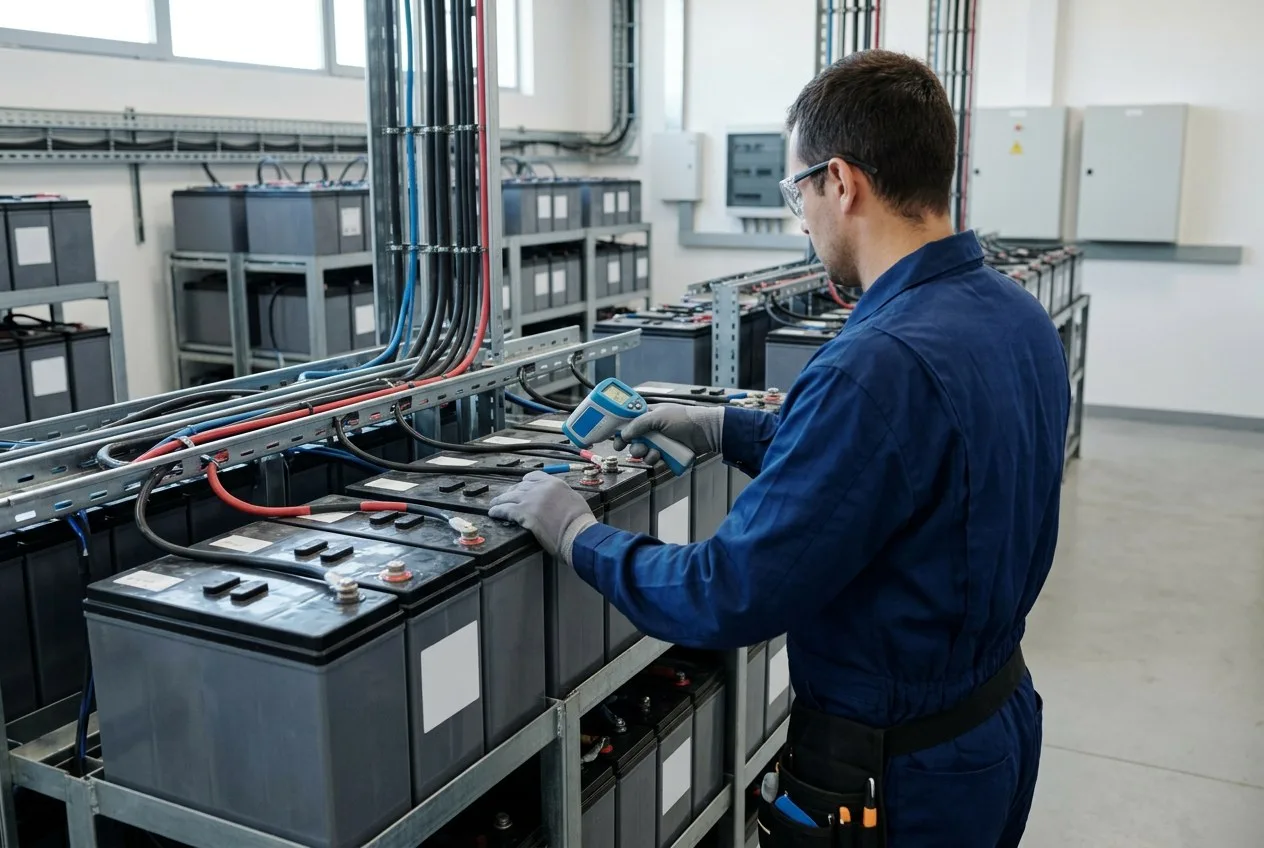
Checks that can be made before winter arrives prevent most of the problems that may arise in the cold. The list below is a general framework; DC circuit, battery and panel interventions should be carried out by authorized personnel.
| Control | Why is it important? | Who should do it? |
|---|---|---|
| Cold Voc calculation | String voltage do not exceed the input limit of the controller and inverter | Authorized electrical personnel / designer |
| Battery charge level | Reduces the risk of freezing and sulfation in a lead-acid battery | From the user monitoring screen; measurement by technical staff |
| Battery ambient temperature | The charge limit of lithium battery and the capacity of lead-acid depend on temperature | User observation; insulation and heating technical service |
| Charging settings and temperature sensor | Let the charging voltage compensation work correctly in the cold | Technical service |
| Connection and terminal | In the cold, the loose and oxidized connection heats up more and creates resistance | Competent technical personnel |
| Ghosting scan | Seeing new shadowed spots in the low winter sun | User observation; solution designer |
| Backup energy plan | Generator or grid support for consecutive cloudy days | User and technical service together |
For all periodic control steps Periodic maintenance checklist for solar energy systems and for the battery side Battery Maintenance and Life You can look at the article.
Which type of system is more advantageous in winter?
Since winter production is low, whether the system is connected to the grid or not changes the plan.
- On-grid: In winter, the missing energy is taken from the grid. There is no battery, so there is no battery winter problem. However, when the grid is cut off, the system does not give energy. For details On-grid, off-grid and hybrid system differences See the article.
- Hybrid: It both receives support from the grid and remains active in case of interruption with the battery. In winter, the battery does not cause problems on completely cloudy days as it balances with the grid. Working logic Hybrid inverter It is explained in the article.
- Off-grid: Winter is the most challenging period. The panel, battery and, if necessary, the generator as a whole should be planned for the winter month. For installation heads To the off-grid system guide can be looked at.
The winter plan in enterprises focuses on the protection of critical loads with batteries. How this is set up rooftop SPP and UPS relationship It is discussed in the article.
Common mistakes in winter
- Sizing according to the annual average: The system that seems sufficient in the summer will be insufficient in December. Make the calculation according to the weakest month or plan the backup resource.
- Not accounting for cold Voc: The array selected based on the summer measurement may exceed the device input limit on the first cold morning.
- Placing the battery in an unheated, humid environment: Lead acid has a risk of freezing, lithium has a charging interruption and capacity loss.
- Leaving the battery at a low charge during the winter: A battery that has been discharged for a long time can both freeze and become sulfated. Consequences of this Battery sulfation It is explained in the article.
- Force-charging a lithium battery in a cold environment: Disabling BMS protection or using an unprotected battery can cause permanent damage to the cells.
- Risky intervention to get rid of snow: Climbing on the roof or scraping the panel with hard tools causes safety and warranty problems.
- Not monitoring production: When winter performance is lower than normal, data is needed to distinguish whether the problem is weather or failure. Fault detection if the system produces less will help you make this distinction.
Monitoring production and expectation management in winter
When evaluating winter performance, it is misleading to look at the data of a single day. For the same month, the previous year's data, the cloudiness of the weather and the production of the period when the system was first installed should be read together. It is an accurate measure to compare the kWh value shown by the monitoring system with the monthly irradiance data of your location (e.g. daily production per kWp).
When calculating the return on investment, the winter decline should also be taken into account; the return period is calculated based on annual production, looking only at the summer months gives an exaggerated result. How to make this calculation Return time on solar energy investment It is explained in the article. According to the analysis published in DergiPark for general information on Turkey's annual potential According to GEPA, total incoming solar energy is 1,527 kWh/m²-year, with an average of 4.18 kWh/m² per day level. This average is a combination of low values in winter and high values in summer.
Bempower's place in the winter plan
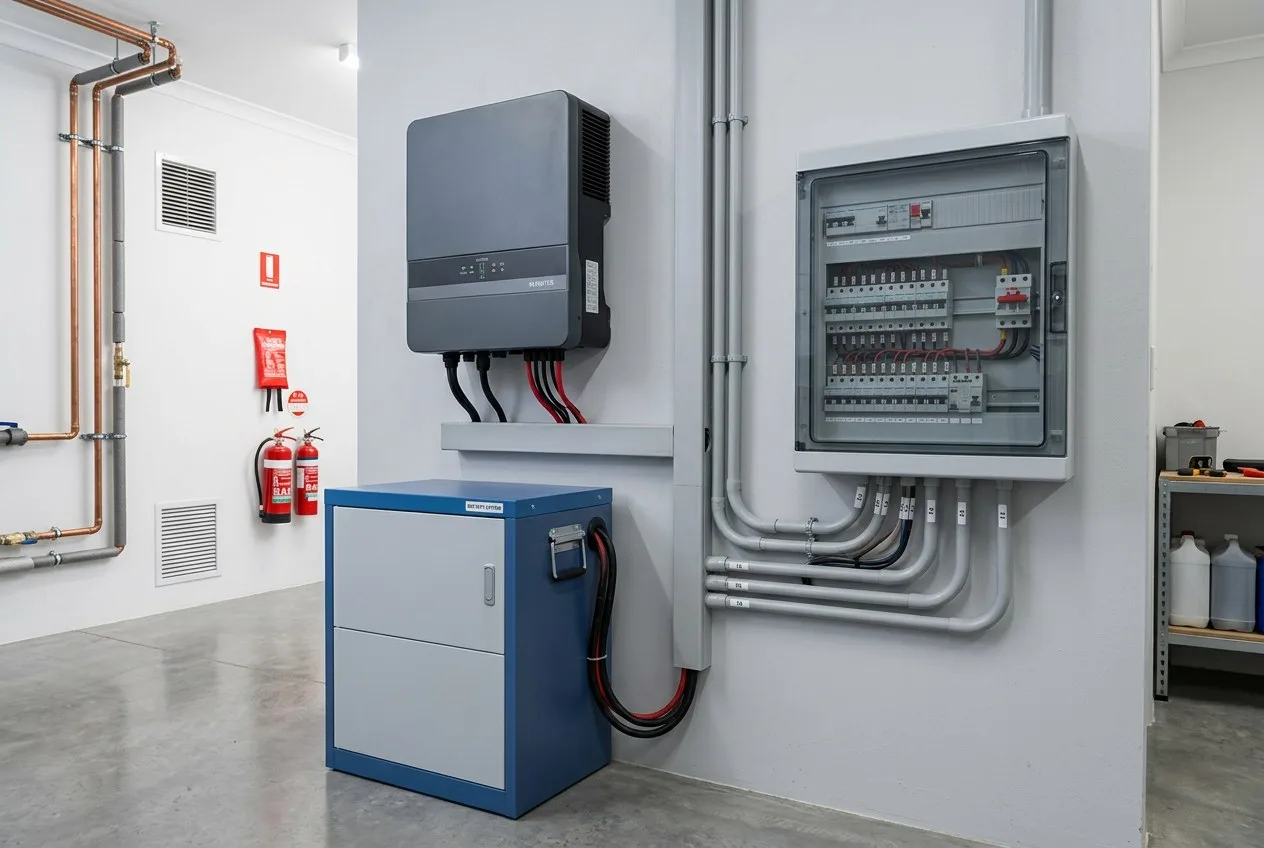
Winter performance of solar energy systems; It depends on the correct setup of panel, battery, inverter and charging management together. Bempower does not provide solar panel installation or SPP application services; however, it provides on-site support in Istanbul and surrounding provinces for discovery, installation, periodic maintenance and technical service on the battery, UPS and inverter side of your system. For questions such as whether your batteries are ready for winter, whether they discharge faster than expected in the cold or whether the inverter fails during the winter months From our contact page You can contact us.
- Turkey Annual Global Solar Radiation (2011-2024) — General Directorate of Meteorology (MGM), 2025. https://www.mgm.gov.tr/FILES/resmi-istatistikler/parametreAnalizi/2024-gunes-radyasyonu.pdf
- Determination of the Distribution of Global Solar Radiation in Turkey Using Satellite Data — General Directorate of Meteorology (MGM), 2010. https://www.mgm.gov.tr/FILES/arastirma/modeller/bildiriler/MSG_UYDU_GLOBAL_GUNES_RADYASYONU.pdf
- Analysis of Turkey's Solar Energy Potential with PVSyst — DergiPark, 2024. https://dergipark.org.tr/tr/download/article-file/3906370
- The Impact of Snow on PV Performance — Sandia National Laboratories, 2025. https://energy.sandia.gov/programs/renewable-energy/photovoltaic-solar-energy/projects/the-impact-of-snow-on-pv-performance/
- BU-410: Charging at High and Low Temperatures — Battery University, 2025. https://www.batteryuniversity.com/article/bu-410-charging-at-high-and-low-temperatures/
- PV Math (cold module open circuit voltage) — IAEI Magazine, 2009. https://iaeimagazine.org/2009/january2009/pv-math/
Resources
