


UPS for Aquarium and Terrarium: Air Motor, Filter and Heater

Aquariums and terrariums are one of the most sensitive home systems to power outages. When the computer shuts down, the files disappear. In the aquarium, when the air motor and filter stop, the oxygen starts to drop, and when the heater stops, the water starts to cool. When the heat source and thermostat turn off in the terrarium, the temperature balance for reptiles and insects is disturbed. If the outage lasts for a few minutes, there is no problem. The risk increases with outages that last for hours.
In this article, we first discuss what happens in the tank during an outage, and then how to supply the air motor, filter and heater with UPS (uninterruptible power supply). There is also a separate section for step-by-step Wh and Ah calculations, UPS type selection, safety in environments where water and electricity are together, and terrarium. Article; It is aimed at hobbyists who have an aquarium or terrarium at home, those who run a pet store, incubator and production area, and technical officers who support these users.
Our goal is not to recommend connecting every tank to the UPS, but to ensure that you spend your resources in the right place. In most cases, a small load of 20-30 W can be maintained for hours with a properly selected UPS. A heater load above 100 W requires a completely different battery calculation.
What happens in the aquarium when the power goes out?
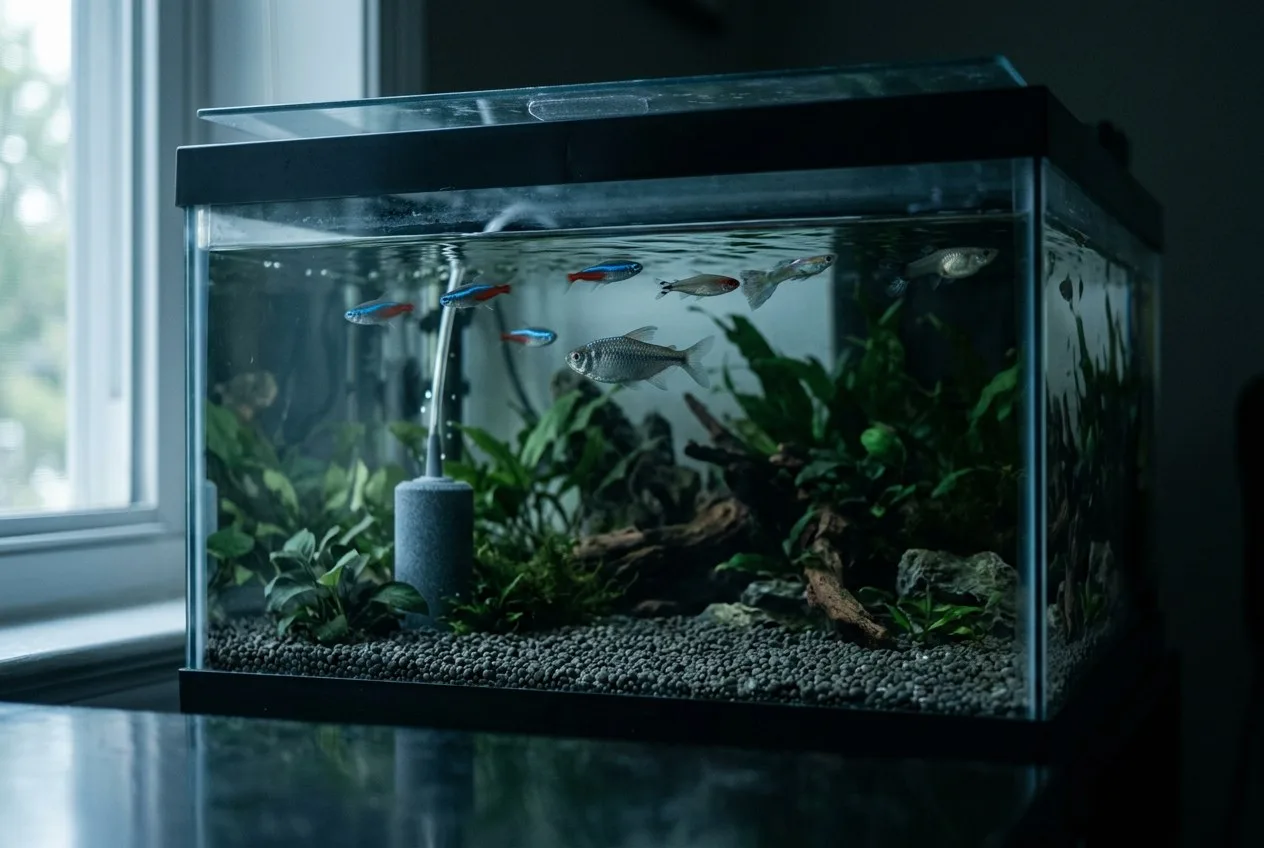
At the time of an outage, three things start in the aquarium at once: gas exchange decreases, water flow stops, and heating is interrupted.
Oxygen drops
Fish breathe dissolved oxygen (DO) in water. Oxygen in water increases only by direct diffusion on the surface and by surface agitation. Oxygen passes into the water by direct diffusion and the movement of surface water. When the air motor and filter stop, this agitation decreases. Fish, plants, and bacteria continue to consume oxygen. The University of Florida extension bulletin recommends that about 5 mg/L dissolved oxygen is recommended and reminds us that sensitivity varies by species.
Temperature is also important. Hot water holds less dissolved oxygen gas than cold water. Texas State University lecture notes show that water at 31 °C It can hold about half as much oxygen as water at 1 °C. shows. A tropical aquarium will compress faster during the summer outage because of this.
The filter stops, the biological balance is challenged
Beneficial bacteria in the filter material depend on the flow of oxygenated water. When the flow is interrupted, the water stagnates inside the canister filter. According to the guide prepared by Petco Most aquarium fish can survive an outage of up to three hours with low risk. Over a longer period of time, oxygen depletion, temperature fluctuations, and ammonia buildup begin to threaten health. This period varies according to type, stock density, tank size and room temperature. It should not be read as a definitive guarantee.
The temperature drops slowly but steadily
When the heater stops, the temperature drops gradually, not instantaneously. A 100 liter tank contains about 100 kg of water. The specific heat of water is 4.18 kJ/kg· K, heating or cooling this mass by 1 °C is about 418 kJ, or about 116 Wh of energy. How quickly the tank cools depends on the room temperature, glass thickness and insulation. Therefore, supplying the heater with a battery is often a more expensive and more difficult solution than covering the tank and conserving oxygen.
Which device has priority? Air motor, filter, heater and others
If you have a limited battery, you must first decide what to protect. The table below summarizes typical power ranges and order of priority. Wattages vary greatly by manufacturer and model; check the actual consumption with the label or the outlet-type watt meter.
| Device | Typical power | Importance in interruption | Should it be connected to UPS? |
|---|---|---|---|
| Air motor | 2-10 W (more on large pumps) | Very high; directly supports oxygen | Yes, first priority |
| Inner/sponge filter, small circulation pump | 3-15 W | High; provides flow and surface agitation | Yes, if the battery is enough |
| Canister filter | 10-40 W | Medium-high; important for biological filter | Depending on the situation; Departure current should be checked |
| Heater | 25-300 W | Medium; the temperature drops slowly | Usually not; separate account required |
| Lighting | 10-100 W | Low; negligible in short downtime | Nope |
| CO₂ system, dosing pump, cooler | Variable; heatsink hundreds of W | Varies by type | No for refrigerated and compressor appliances |
A practical sequence is as follows: first the air motor, then the filter or circulation pump, then the thermostat and temperature gauge. The heater is only added if your battery capacity is sufficient. EcoFlow's blog post emphasizes the same logic: The air motor must work, and you can spend hours or even several days without filters and heaters. As this is such a broad generalization, caution should be exercised with sensitive species and heavily stocked tanks.
UPS for air motor: most protection with the least energy
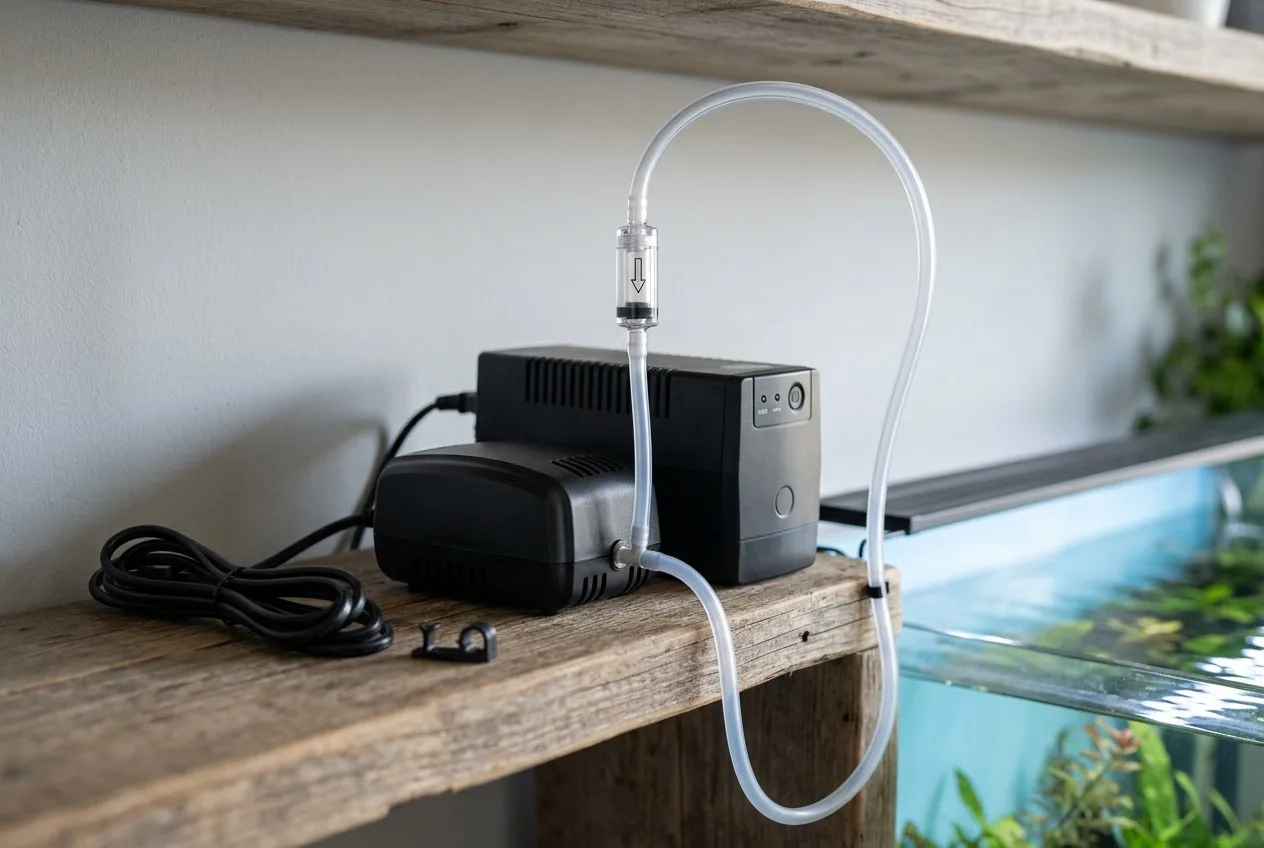
The air motor (air pump) delivers air to the tank through the hose and air stone or sponge filter. This load is small, constant and low current. This is the most efficient load to be maintained with a UPS. The internal battery of many small UPS can carry this load of several watts for hours.
Things to consider in selection and use:
- Vibrator (diaphragm) air motors: It is low power and simple in structure. In UPS battery mode, it may hum slightly depending on the output waveform. Try beforehand if it works.
- Check valve (non-return valve): When the air motor stops during an outage, water can flow back through the hose and reach the motor. Place the air motor above the water level or use a non-return valve.
- Multiple air motors: Measure the total power with the watt meter. The sum of all devices to be connected to the same UPS must not exceed approximately 80 percent of the wattage capacity of the UPS.
- Power saving mode: Some battery air motors extend the battery life by turning them on and off at regular intervals. Aquarium Co-Op, It can be used to operate with a 15-second on, 15-second off cycle, which can extend battery life up to 40 hours. specify. This is a strategy that can also be applied in the UPS: an air motor with a power-saving mode or a timer can be selected.
If you want to compare the alternatives to power outages in your home in general, UPS, inverter, generator and solar energy options against power outages at home You can take a look at our article about it.
Does aquarium filter connect to UPS?
A filter is a device that contains an electric motor. In terms of UPS, the main issue is the current when this motor starts working. Motors can draw several times their rated current for a short time. This situation is called inrush and its details are Inrush current for motors, air conditioners and laser printers processed. The effect is generally limited in small internal filters and circulation pumps. Care is required in more powerful canister filters and UPSs with sensitive output waveform.
Schneider Electric's technical support page gives a general warning about this: Some inductive loads can create very high inrush current, in which case the UPS series in question may not be suitable. It also counts the same sheet heaters and large motor loads among the non-IT loads.
Checklist for filter
- Note the filter's label power (W) and, if possible, its current (A).
- Know the output waveform (including battery mode) and capacity from the UPS datasheet.
- Start the filter from the mains first, then try to disconnect the mains and restart it in battery mode, depending on the UPS. In an unexpected situation, the UPS may give an overload alarm.
- If the filter does not lift again on its own after an outage, check the impeller and hoses when the power is restored.
- If the battery time is limited, choose not to connect the canister filter to the UPS and only protect the air motor.
Can the heater be powered by UPS?
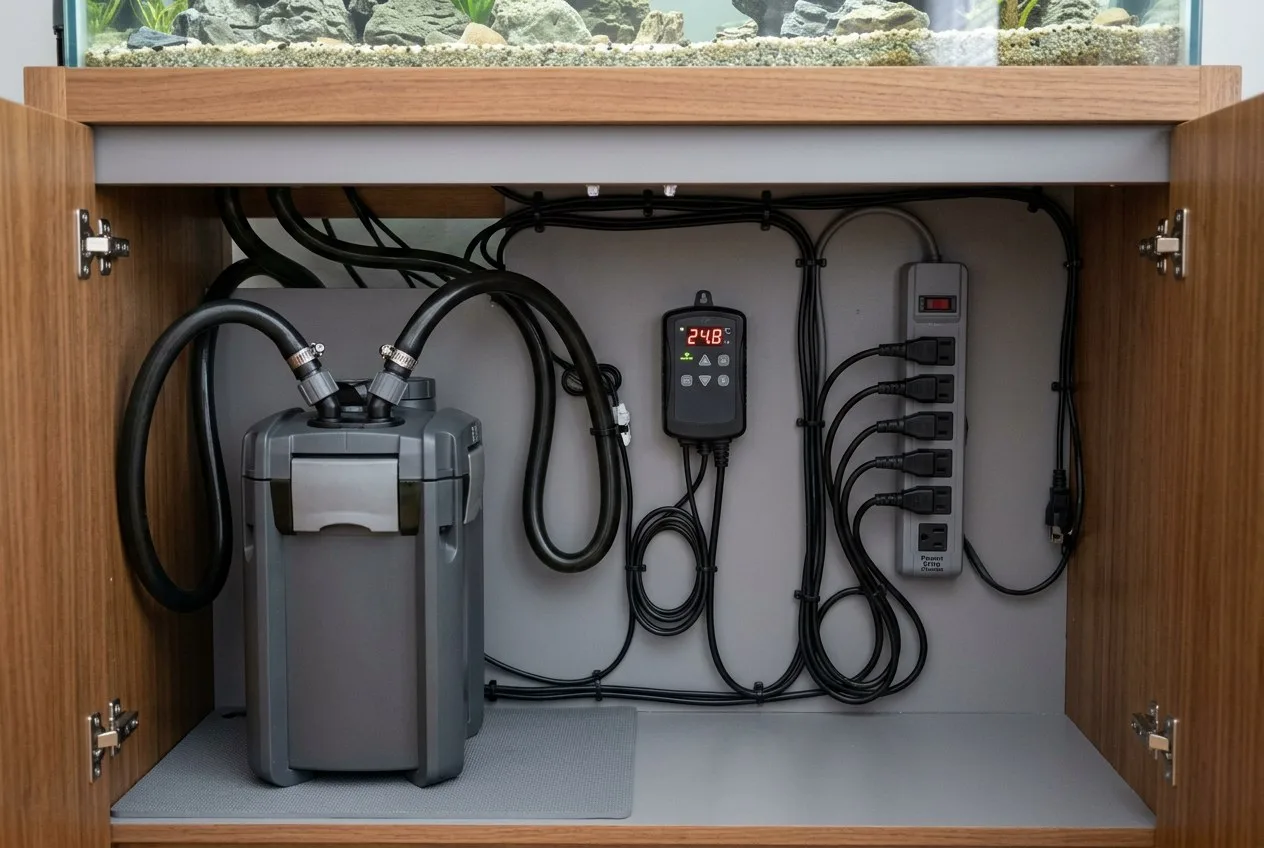
Technically yes, but often it doesn't make sense. The heater directly converts electrical energy into heat, and its power demand is 10-50 times higher than that of the air motor. The internal battery of a small UPS cannot carry this load for hours. The UPS must also not exceed its own output power. Schneider Electric also believes that the UPS to operate at approximately 80 percent of its capacity according to the connected load recommends.
If you want to protect the heater, think about it with these steps:
- Is it really necessary? Type, room temperature, and downtime are taken into account. Heating is not critical in non-tropical tanks that are kept close to room temperature.
- Insulation first: Reduce heat loss by covering the side and top surfaces of the tank with blankets or foam. The closed top reduces heat loss while surface agitation lasts.
- Enough energy for a short time: Take into account that the heater will operate intermittently through the thermostat during an outage (assuming a 50 percent operating rate in the calculation example below).
- Risk of dry running: The heater should not operate out of the water when the water level drops. Check the tank during an outage.
Where this work can translate into a detailed continuous power account and large battery bank, you can directly use the UPS instead of the DC UPS for 12V and 24V DC devices or a separate battery system can be evaluated. This decision should be made together with the load analysis.
How to calculate reserve time? Step by step examples of Wh and Ah
Reserve time is found by dividing the usable energy in the battery by the load. The essence of the formula is simple: battery capacity (Ah) × battery voltage (V) = stored energy (Wh). This value; It is reduced by the depth of discharge, inverter efficiency and aging status of the battery. A general calculation guide says: Multiply Ah by voltage to find Wh, multiply by inverter efficiency (usually 85-95 percent) and divide by the load. For small loads, it is realistic to get lower efficiency because the UPS's own consumption and constant losses carry larger weight. For detailed method Battery time calculation in UPS and battery inverter and To our article explaining the difference between VA, kVA and watt You can look at it.
Example 1: Air motor and small filter, ready small UPS
Assumptions: A UPS with a 12 V 9 Ah internal battery; air motor 4 W, internal filter 10 W, small circulation pump 6 W; total load 20 W. Only 60 percent of the lead-acid battery is planned to be used; at a small load, the total efficiency is 75 percent, including internal losses.
- Stored energy: 12 V × 9 Ah = 108 Wh
- Usable energy: 108 × 0.60 × 0.75 ≈ 49 Wh
- Duration: 49 Wh ÷ 20 W ≈ 2.4 hours (approx. 2 hours 25 minutes)
If only the 4W air motor is connected, the time approaches about 12 hours; however, the actual time may be shorter due to the UPS's own internal consumption and battery age. So verify with the actual test without expecting a high value.
Example 2: 12-hour target for the same load
Let's calculate the external battery capacity to carry the same 20 W load for 12 hours:
- Energy required: 20 W × 12 hours = 240 Wh
- Rated battery energy required: 240 ÷ (0.60 × 0.75) ≈ 533 Wh
- in a 12 V system: 533 ÷ 12 ≈ 44 Ah; 12 V 50 Ah class battery with aging allowance
What battery capacity (Ah) alone means and how much energy can actually be extracted Battery capacity in our article You can find it. The decision to connect an external battery depends on the UPS's support for that function and manufacturer approval. Batteries cannot be added to every UPS; this must be done by an authorized service center.
Example 3: If heater is added
Assumption: The 100 W heater works for 50 percent due to the thermostat in an outage; the target is 12 hours; the same 60 percent depth of discharge and 75 percent efficiency.
- Average load: 100 W × 0.50 = 50 W
- Energy required: 50 W × 12 hours = 600 Wh
- Rated battery energy required: 600 ÷ 0.45 ≈ 1,333 Wh
- In a 12 V system: approx. 111 Ah
This means that adding the heater increases the battery requirement by more than 2.5 times. The table below compares the three scenarios.
| Scenario | Average load | Rated battery energy for 12 hours | About Ah at 12 V |
|---|---|---|---|
| Air motor only (4W) | 4 W | ≈ 107 Wh | ≈ 9 Ah |
| Air motor + filter + pump | 20 W | ≈ 533 Wh | ≈ 44 Ah |
| The above + 100 W heater (50 percent operation) | 70 W | ≈ 1,867 Wh | ≈ 156 Ah |
The values in the table are round values calculated with the above assumptions. Actual battery capacity varies with discharge rate, temperature, and age; refer to the discharge curves in the manufacturer data sheet.
UPS for terrarium: maintaining temperature and humidity control
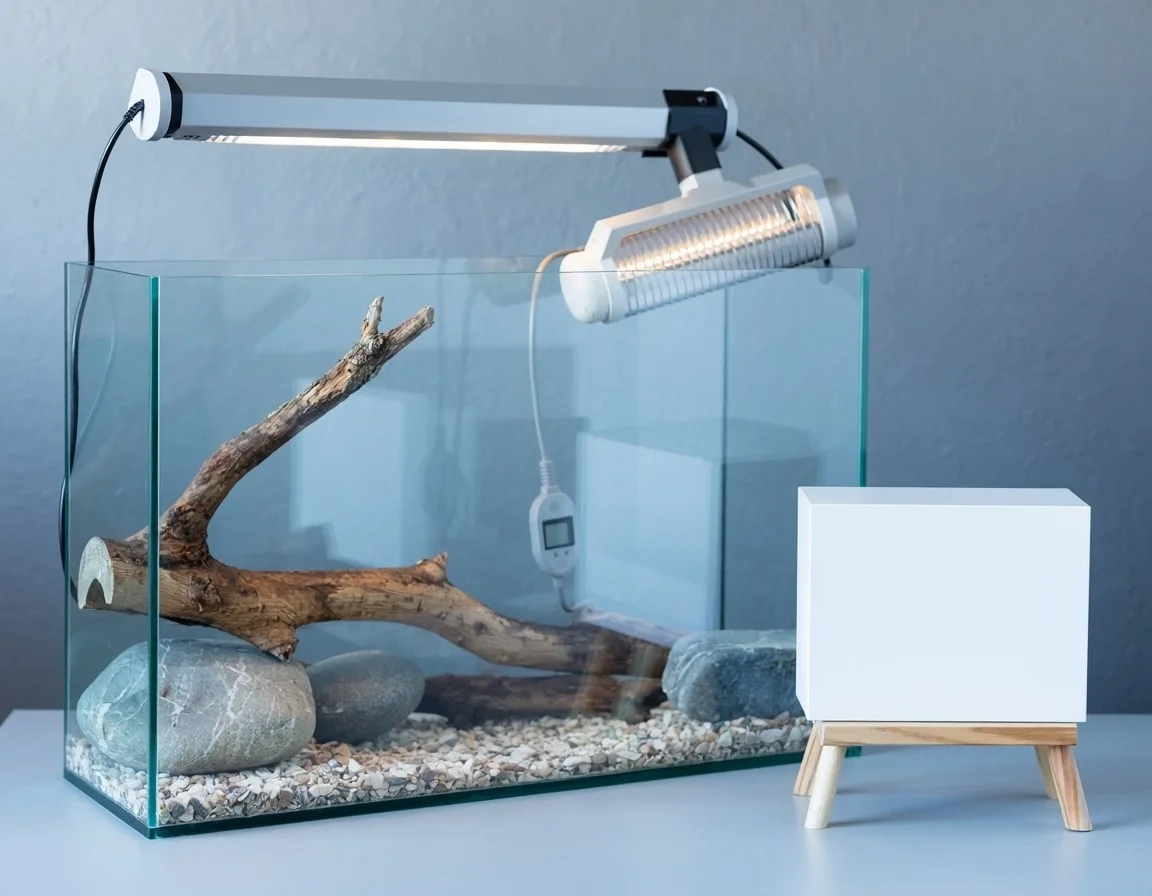
In a terrarium, it's more about heat and humidity than oxygen. Reptiles depend on external heat; the heat source, thermostat and monitoring device are all part of the same chain. Pets.co.uk's winter reptile guide is on the backup power plan Instead of trying to run the entire room, priority should be given to monitoring devices with controlled heat supply. recommends. The same source also emphasizes that every heat source should be controlled with a compatible thermostat.
You can roughly list terrarium devices as follows:
- Thermostat and temperature/humidity display: It's low-power and is your first source of information in an outage. Also check if it retains its setting after the outage.
- Primary heat source: Sources that do not emit light, such as a ceramic heater, heating mat, or heating cable, are common for nighttime. These devices can be in the range of 25-150 W; do the calculation as in Example 3.
- Fogging pump, fan: May be needed for moisture management; its importance is low in short downtime.
- Light and UVB lamp: It can often be delayed in a few hours of downtime. Consult the veterinarian for the species requirement.
An example calculation: If a 75 W heat source operates at 50 percent due to the thermostat, it draws an average of 37.5 W. The energy required for 6 hours is approximately 225 Wh, and on the battery side, with the same 45 percent overall coefficient, approximately 500 Wh of nominal energy is required. This means about 42 Ah in a 12 V system. Since it is not possible to cover the heating load with a small UPS, heat packs, insulation and a type-specific lower temperature limit plan must be considered together. The UPS to which the thermostat is connected must be strong enough to cover the heater and the output must not be overloaded.
Regarding safety regarding heat packs and other methods, the recommendation of a veterinarian is essential according to the type of your animal. Pets.co.uk source is no heater, thermostat or backup battery. that it is not suitable for every reptile specifies.
Which type of UPS is suitable? Line-interactive, online and offline
For small aquarium and terrarium loads, a household, single-phase, line-interactive UPS is often sufficient. The difference between UPS types online, line-interactive and offline UPS in our article You can find it. Let's give a brief summary in terms of aquarium here:
| By | Offline (standby) | Line-interactive | Online (double rotation) |
|---|---|---|---|
| Migration | There is a very short interruption moment | Very short transition | No migration |
| Voltage surge | Limited protection | Medium protection with voltage regulation | The output is continuously generated |
| Cost/complexity | Lowest | Medium | Highest |
| Aquarium suitability | It may be enough for the air motor | Balanced choice for most home tanks | For precision and commercial installations |
When choosing, look for:
- Battery mode output waveform: The manufacturer's data sheet says whether it is pure sine or cascading approximate sine in battery mode. For motorized devices, pure sine is quieter and safer.
- Wattage Capacity: The VA rating on the label alone is not enough; check the wattage (W).
- Battery expansion option: If long periods are required, find out if external battery pack support is available.
- Cold start: The ability to turn on the UPS when there is no mains (DC start) works well in some scenarios.
- Alarm and warning: A model that reports the outage by voice or over the network makes a difference when you are not at home.
Water and electricity combined: safety rules
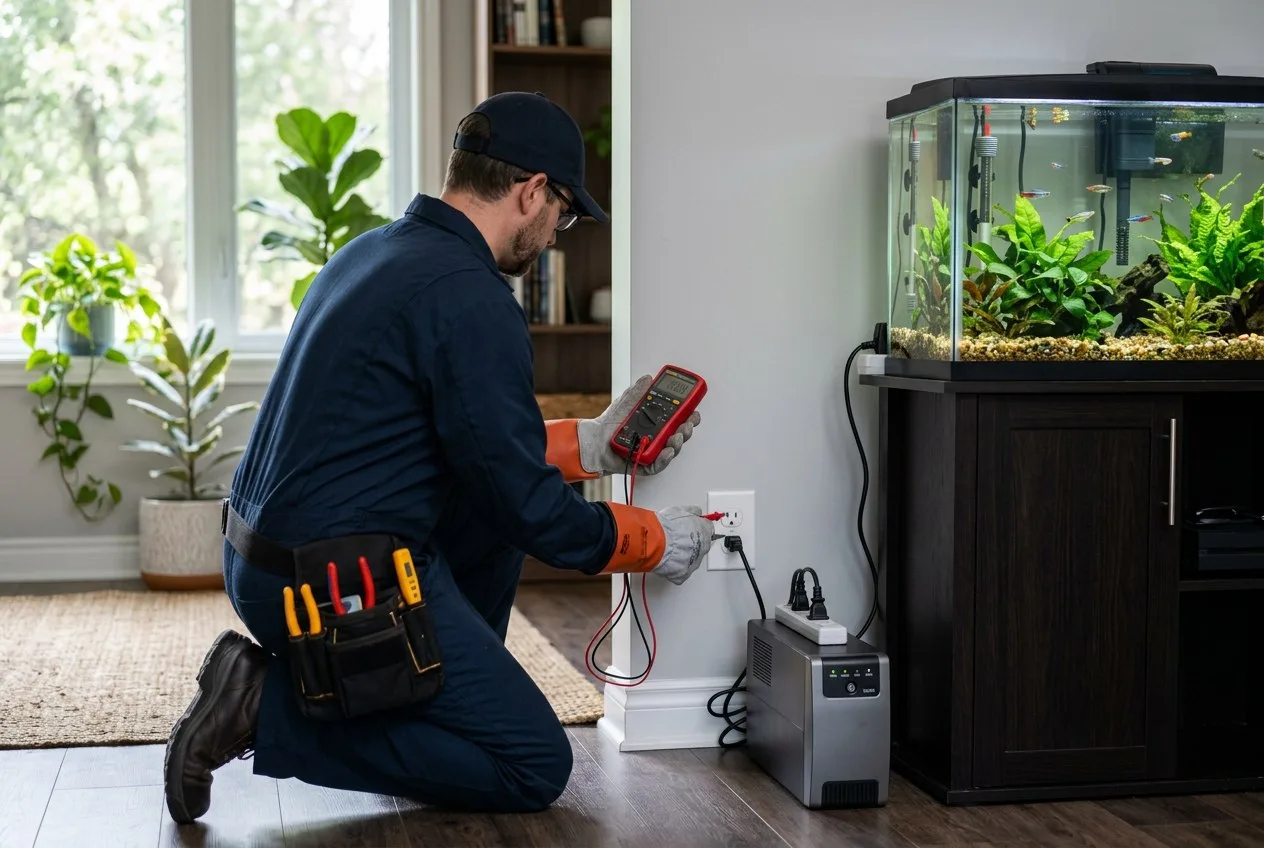
The use of electricity around the aquarium and terrarium requires additional precaution due to water dripping, evaporation and wet hands. A UPS is also an electrical appliance. The following rules are general safety principles. Have the installation and connection work carried out by authorized electrical personnel.
- Do not place the UPS under or near water. Do not place it under the tank cabinet, where there is a risk of water overflow and dripping. Choose a shelf that is above the water level, dry and ventilated.
- Leave drip ring. The cables make a downward hanging ring at the tank outlet, preventing dripping water from reaching the outlet.
- Use grounded and residual current protected line. If your installation does not have grounding, the protection function of the UPS is limited. UPS grounding in our article We explained the importance and symptoms of this issue.
- Do not open the UPS enclosure. The UPS contains mains voltage and battery energy; it can be dangerous even when it is turned off. Battery and internal component operations should be left to the technical service.
- Do not overload the extension cord and multiple sockets. For continuous loads, such as heaters, use heat-resistant, appropriately cross-sectioned cables.
- Do not cover the vent. The UPS and battery generate heat; heating in a closed cabinet shortens battery life.
When to consider a UPS solution?
A UPS may not be the right tool in all situations. In some scenarios, alternatives are more suitable:
| Status | More convenient solution | Cause |
|---|---|---|
| Interruptions are rare and short; one air motor is enough | Battery (rechargeable) air motor | Cheap and easy; automatically activated when the network goes |
| A few hours, a few devices | Small UPS | Feeds devices simultaneously and without interruption |
| Temporary, portable need | Portable power station | Flexible, but changeover time and continuous engagement vary by product |
| Long Term Outage, High Power | Generator or large battery system | Small UPS battery time is not enough |
| Commercial or multi-tank facility | System-level backup power | Requires load, redundancy, and maintenance plan |
Whether portable power stations can be used in place of a UPS is another matter; portable power station vs UPS You can decide by reading. Petco's guide is also in short interruption that using a spare battery air motor can reduce problems states. In general, a backup air motor is much better than no backup plan at all.
What to do and what not to do during the outage
Even with a UPS or backup air motor, some simple steps reduce risk during an outage:
- Stop feeding. Food increases waste and oxygen consumption. Petco's timeline also recommends that fish not feed during the extended outage.
- Cover the tank. Insulate the surface with a blanket or foam, leaving an opening to breathe, not completely covering it.
- Do not overmix the tank. Unnecessary intervention can put fish under stress. Aquarium Co-Op says that experienced hobbyists prefer not to intervene much in the first hours; nevertheless, the availability of oxygen support provides comfort.
- Start in order after the outage. First the air motor, then the filter; Before starting the filter, see if the impeller rotates freely. Test the water for ammonia and nitrite.
- Record the battery status. Note the downtime and how many minutes the UPS has given backups; useful for subsequent planning.
UPS and battery maintenance: what you need to know for continuity
Battery health is critical because the UPS installed for the aquarium is plugged in 24 hours a day. A typical sealed lead-acid UPS battery will serve for several years; the hot and humid environment shortens this period. Refer to the life ratings and temperature curve in the manufacturer data sheet. The hot and humid interior volume of the tank cabinet is not a suitable place for the battery.
- Perform regular testing: Every few months, disconnect the mains (safely) and see if the UPS is carrying the load. If the device has its own test function, use it as well.
- Take battery warnings seriously: If the time is shortened, it does not charge or it gives an alarm, the battery may be weakened. When to replace a UPS battery Our article explains the symptoms.
- Recalculate the load: When you add a new filter, heater, or pump, check the Wh calculation and the UPS load percentage again.
- Follow manufacturer guidelines: Battery replacement and maintenance should be left to authorized technical personnel as they involve high-energy components.
Common mistakes
| Error | Conclusion | The truth |
|---|---|---|
| Connecting the heater to the small UPS | Overload alarm, very short backup time | Calculate the load first; evaluate the heater separately |
| Looking at VA Only | Exceeding the actual wattage capacity of the UPS | Check the wattage and load percentage |
| Assuming the duration from the label | Shorter-than-expected backup | Test with actual load and battery age |
| Putting the UPS under the tank cabinet | Risk of water and moisture, loss of battery life | Place in a dry, ventilated, elevated place |
| Not using a check valve | Water backflow into the air motor | Move the air motor above the water level or install a check valve |
| Relying on the system without testing | The surprise of not working at the time of interruption | Perform periodic downtime testing |
| Ignoring grounding | Residual current and protection issues | Use grounded and protected line |
Planning with Bempower
The right UPS and battery plan for small but critical loads such as aquariums and terrariums; load measurement requires evaluating the time target and environmental conditions together. Bempower offers discovery, installation, periodic maintenance and technical service for all brands of UPS, battery packs and inverters in Istanbul and surrounding provinces. To discuss whether an existing UPS is suitable for your load, the health of the battery or a new backup power solution from the contact page You can contact us.
- 4. Dissolved oxygen — FAO, n.d. https://www.fao.org/4/ac175e/AC175E04.htm
- Dissolved Oxygen (lecture notes) — Texas State University, n.d. https://docs.gato.txst.edu/311332/1DissolvedOxygen.pdf
- How to Care for Your Aquarium Fish During a Power Outage — Aquarium Co-Op, 2023. https://www.aquariumcoop.com/blogs/aquarium/power-outage
- Reptile Vivarium Temperature in Winter: Heating, Thermostats and Power Cut Safety — Pets.co.uk, 2026. https://www.pets.co.uk/blog/reptile-vivarium-temperature-in-winter-heating-thermostats-and-power-cut-safety
Resources
