


How Long Does a 6 kVA UPS Work? Duration Table and Calculation

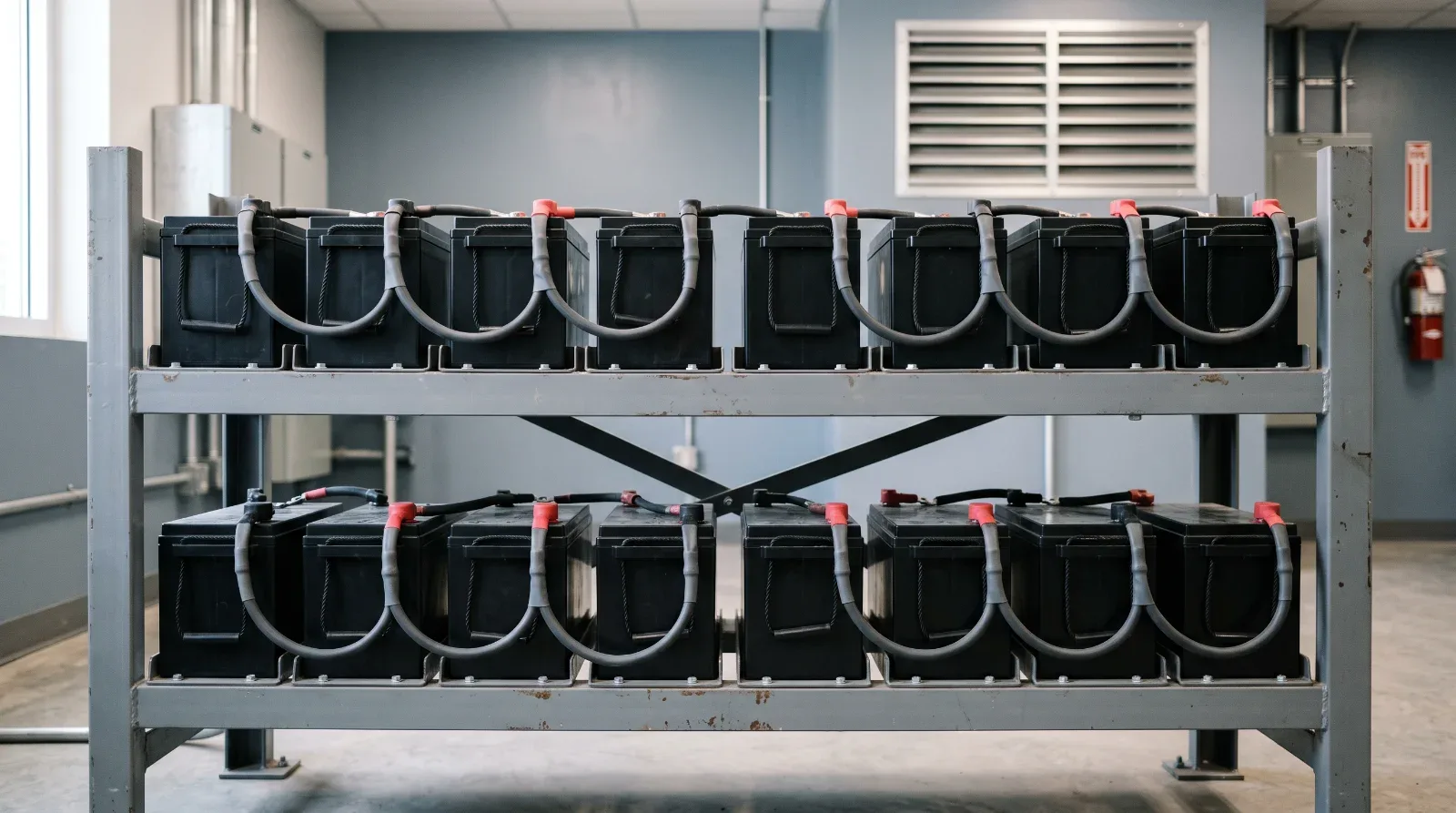
A 6 kVA UPS is used to protect a single floor office, a business with several servers, or the control systems of a small workshop. At this power, the battery pack is now a crowded array of 16 and the duration is very sensitive to the Ah value of the battery. In this article, we explained the time table, calculation method and the maximum amount of battery that can be connected to the UPS.
Short answer
In most 6 kVA online UPSs, 16 12 V batteries are connected in series (192 V DC). With 9 Ah batteries, you can expect approx.:
- At full load (approx. 5400 W): 4-6 minutes
- At half load (approx. 2700 W): 12-14 minutes
- At a quarter load (approx. 1350 W): 30-35 minutes
Most often at this power, the UPS is sold without a battery (without a battery), and the battery cabinet is selected separately. The duration then depends entirely on the battery you choose.
How many watts does a 6 kVA UPS carry?
- 6 kVA on online UPS with power factor 0.9 approx. 5400 W does.
- In the model with a power factor of 0.8 4800 W does.
- In the new generation models with a power factor of 1,0 6000 W can do.
Check the power factor on the label or datasheet. See What is Power Factor? and How to Calculate UPS Power?.
Time table for 6 kVA UPS (16 x 12 V batteries, 192 V DC)
Durations for new VRLA/AGM battery, 25 °C and 0.9 power factor and 90% UPS efficiency They are rough calculations. The actual time may deviate by 20-30% ± depending on the model.
| Ah on each battery | Full load (5400 W) | 75% load (4050 W) | Half load (2700 W) | 25% load (1350 W) |
|---|---|---|---|---|
| 9 Ah | 5 min | 8 min | 13 min | 33 min |
| 17 Ah | 12 min | 18 min | 31 min | 1 hr 15 min |
| 26 Ah | 22 min | 32 min | 54 min | 2 hr 10 min |
| 40 Ah | 38 min | 55 min | 1 hr 35 min | 3 hr 45 min |
| 65 Ah | 1 hr 10 min | 1 hr 45 min | 2 hr 55 min | 6 hr 35 min |
| 100 Ah | 2 hr 5 min | 3 h | 4 hr 50 min | 10 hr 40 min |
Periods, 3 kVA UPS It turns out to be the same as . Because there are 8 batteries in 3 kVA and 16 batteries in 6 kVA and the load on each battery is the same. In periods above 12 hours, the calculation loses its reliability.

Example calculation: 3000 W load on the office floor
On an office floor, the server, network devices, computers and lighting control draw a total of 3000 W. The UPS is 192 V, the batteries are all 9 Ah.
- Battery energy: 16 × 12 V × 9 Ah = 1728 Wh.
- Current: 3000 ÷ (0.9 × 16 × 11.5 V) = approximately 18.1 A.
- C-rate: 18.1 ÷ 9 = approximately 2.
- Available rate: Since the C-ratio is about 2, 0.40 (for the ratio table 1 kVA inscription see).
- Duration: 1728 × 0.40 ÷ 3000 = 0.23 hours, so about 14 min.
If the business wants 30 minutes, repeat the calculation with 26 Ah batteries: Wh = 4992, C-rate approx. 0.7, ratio 0.50. Duration = 4992 × 0.50 ÷ 3000 = approx 50 minutes. 17 Ah, on the other hand, gives about 26 minutes, so it's not enough for 30 minutes. That's why 26 Ah is the safer choice.

What is the maximum amount of battery connected to a 6 kVA UPS?
The number of batteries is fixed
The DC voltage of a 6 kVA UPS can be 192 V (16 batteries) or 240 V (20 batteries), depending on the model. There are two ways to extend the time without changing this number: using the same number of batteries with a larger Ah, or adding one more parallel from the same battery string. For series-parallel rules What is a Battery String? See the article.
Charging current is the most important limit
In UPSs of this power, the charging current is usually a few amperes in the standard model, and can reach 10 A and above in the long-run model. The exact value is in the data sheet.
Rule: Ah = charging current × 10 (comfortable) to 20 × (limit).
| UPS charging current | Recommended maximum battery (Ah) | Full charge time (roughly) |
|---|---|---|
| 2 A | 20-40 Ah | 12-24 hours |
| 4 A | 40-80 Ah | 12-24 hours |
| 8 A | 80-160 Ah | 12-24 hours |
| 12 A | 120-240 Ah | 12-24 hours |
Coarse charging time: Ah × 1.2 ÷ charging current (hours). For 26 Ah in the office example above, 2-3 A is sufficient.
DC current and protection
At full load, the DC current is approximately 33 A (approximately 26 A in the 240 V model). The cable, fuse and switch between the battery cabinet and the UPS must carry this current easily. If the cable cross-section is insufficient, both time is lost and there is a risk of heating.
Highest Ah battery
For single block 12 V batteries, the practical upper limit is around 200 Ah. For 6 kVA, most projects are between 26-100 Ah. If longer is required, it is usually more economical to add a generator. See. Differences Between UPS and Generator.
Security: 192-240 V DC voltage is risky for life safety. Battery addition, cabin connection and insurance works are the job of authorized personnel. All batteries must be of the same brand, the same Ah and the same age. See. Can Every Battery Be Installed in Every UPS?.
Phases in a 6 kVA UPS
6 kVA UPS is mostly available as single phase input and single phase output (1/1). Some models may be 3 phase input, 1 phase output (3/1). To choose the structure suitable for your building's network Differences Between Three-Phase and Single-Phase UPS See the article.
Summary for all kVA classes on one page: How Long Does a UPS Work? kVA Guide
Frequently Asked Questions
01Does a 6 kVA UPS run for 1 hour?
02How much space do the batteries of a 6 kVA UPS take up?
03Can lithium be used instead of batteries?
04How do I verify duration?
Let's Choose the Right UPS Together
Tell us your load and the time you want, and we'll determine the UPS power and battery capacity together. Our single-phase online UPS models or You can contact us.
