How Does a UPS Work? Rectifier, Battery and Inverter

From the outside, a UPS is a box that is connected to a socket or panel and chirps when the power is cut off. Inside, there are sections that carry the energy to the load by changing form several times, each with a different job. What does a UPS do? What is UPS We summarized it in our article; In this article, we follow the power path inside an online (double conversion) UPS section by section.
Power Path: Input to Load
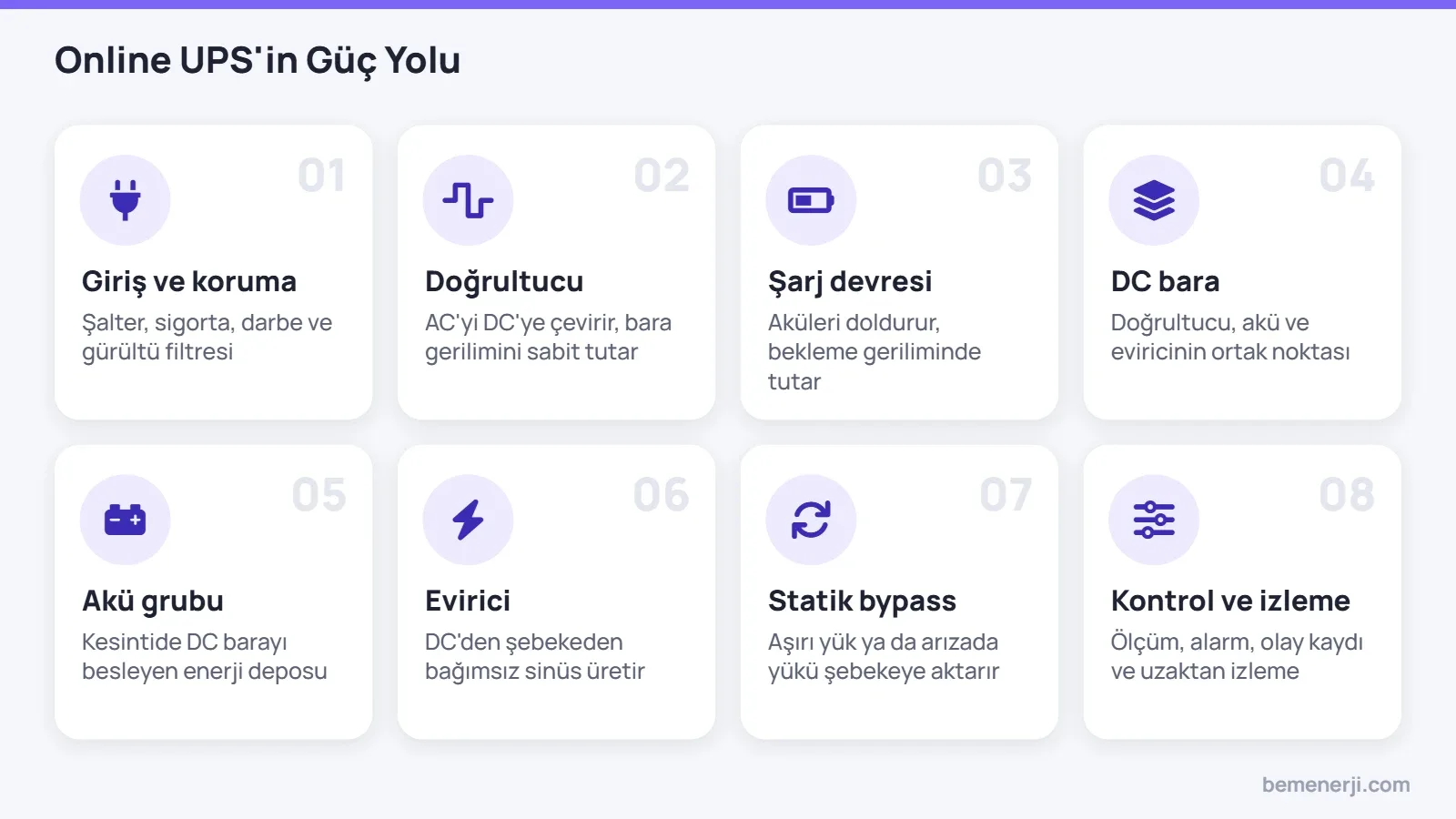
In an online UPS, energy travels in normal operation in the following order: input → rectifier → DC bus → inverter → output. The battery pack is connected to the DC bus, either directly or via a converter; static bypass is a second path that bypasses the rectifier and inverter. This structure is installed in the same way in every online UPS; the details vary depending on the power and manufacturer.
Introduction and Rectifier
On the ground floor, there is a switch or fuse, a filter against sudden shocks and electrical noise. What follows Rectifier (rectifier) converts the alternating current (AC) of the network into direct current (DC).
In many online UPSs today, the rectifier is controlled by fast-switching semiconductors. Such a rectifier keeps the DC bus voltage constant even if the network fluctuates and draws low-harmonic current from the mains close to the sine; the harmonics may be higher in older type rectifiers. The effect of this behavior of the input on cable and generator selection What is the power factor We discussed it in the article.
Charging circuit
The work that keeps the batteries full is given to the rectifier itself in some UPSs, and to a separate charging circuit in others. The charging circuit first fills the batteries with a limited current, then a constant charge that keeps them full at float voltage waits. This voltage is adjusted according to the battery manufacturer's value; in many systems, it is also corrected according to the battery temperature. Incorrectly adjusted charging voltage is one of the reasons that silently shorten battery life.
DC Busbar and Battery Assembly
DC busbaris the common point where the output of the rectifier, the connection of the batteries and the input of the inverter meet. The battery group consists of one or more strings installed from batteries connected in series; the voltage of the array is determined according to the model of the UPS. In some models, the battery voltage is lower than the bus voltage and a DC-DC converter intervenes. String layout Battery Array and Series-to-Parallel Connection We explained it in the article.
Inverter and Output
Inverter (inverter) converts the DC bus voltage back into alternating current by switching it at high speed; the output filter converts these pulses into a smooth sine. The inverter generates the output voltage and frequency itself and constantly monitors it. Therefore, the output of the online UPS is not affected by voltage fluctuations and frequency deviations in the network.
Some UPSs also have a transformer at the output; transformerless designs are lighter and smaller. Which one is suitable is evaluated by the neutral-ground layout of the installation and the type of load.
Static Bypass and Control
In the event of an overload, inverter failure or overheating Static bypass it automatically transfers the load directly to the grid. To ensure this transition is seamless, the inverter keeps its output synchronous with the voltage, frequency and phase of the bypass line: it slowly monitors the grid frequency when it is inside a certain window, and continues to operate at its own frequency when it is outside the window. For the difference between static bypass and maintenance bypass: What is UPS bypass.
A control card manages all these parts: it takes measurements, generates alarms, keeps event logs, and informs the monitoring software or network card.
Four Simultaneous UPS Behavior
| Status | What happens? |
|---|---|
| Normal operation | The rectifier both feeds the inverter and keeps the batteries full; the load is fed from the inverter. |
| Power outage | The rectifier stops, the DC bus is supplied by the batteries. Since the inverter is already running, the transition to the load is not reflected. |
| Return of the grid | The rectifier gradually restores the load, spreading it over an adjustable period of time in many models; the batteries are recharged. This gradual take-up is especially important to avoid straining the generator. |
| Battery drain | The battery voltage drops to the warning threshold and then to the shutdown threshold. The UPS shuts down the outlet to protect the batteries from deep discharge; if monitoring software is installed, the servers are properly shut down before the shutdown threshold is reached. |
Battery capacity and load determine how long the UPS will last in an outage; logic of calculation How to calculate UPS power in the guide titled.
The Road is Different at Line-Interactive UPS
In line-interactive and offline UPSs, the load is normally supplied from the mains, if necessary via voltage corrective (AVR) stages; the inverter is on standby or only works to charge the battery. In the event of an interruption, a relay transfers the load to the inverter and a transition of a few milliseconds occurs. Comparison of the three types Types of UPS We collected it in the article.
How Do Departments Wear Out?
- Batteries: It loses capacity with temperature, charge setting and number of discharges; Detail Factors Affecting Battery Life in his article.
- Capacitors: DC bus and filter capacitors depreciate over time; this aging accelerates as the temperature increases.
- Fans: Cooling must continue uninterruptedly as the rectifier and inverter heat up; dusty or slowing fan affects all sections.
- Links: The loosened connection heats up under load.
These wear and tears are often not visible from the outside; they are noticed by measurements in periodic maintenance and thermal control. The inside of the UPS carries dangerous voltage from the batteries even when the device is closed; opening the covers and every work related to the internal parts Authorized Technical Personnel It should be done by.
Sections Inside the UPS
In an online UPS, the energy from the grid passes through the following sections until it reaches the load.

When the power is cut off, only the source supplying the DC bus changes; the load does not feel the interruption because the inverter continues to operate.
Frequently Asked Questions
01Are UPS batteries used when there is electricity?
02Why is there no transition period in the event of an outage in online UPS?
03How does a UPS know when batteries are dead?
04How long does it take for the batteries to fill up when the grid turns?
05Can I tell for myself which part of the UPS is faulty?
Control Every Part of Your UPS
We perform periodic maintenance of UPS of all brands and models throughout Istanbul and in the surrounding provinces; we monitor the condition of the sections from batteries to fans with measurements and reports. Maintenance scope Periodic Battery and UPS Maintenance On our page, visit frequencies Care Plans page. In case of malfunction Fault Detection and Technical Service or Contact Us.