What Is a UPS Battery? Types of Batteries and Where They Are Used

The most obvious function of a UPS is to keep connected devices running when the power goes out. The component that makes this possible is the battery: it charges while the mains power is available, and during an outage, it supplies the energy it has stored to the UPS’s inverter. No matter how high a UPS’s power rating is, if the battery is weak, it cannot support the load during an outage. This article provides a brief introduction to UPS batteries; details on each topic can be found in our related articles.
What Is a UPS Battery Used For?
The batteries located inside the UPS or in an adjacent cabinet store energy as direct current (DC). When the utility power is normal, the UPS’s charging circuit keeps the batteries fully charged. When the power goes out or the utility voltage falls outside acceptable limits, the UPS switches to supplying power to the load from the batteries. The duration the battery can last backup (autonomy) duration ...; this duration depends on the load size, the battery's capacity, its age, and the ambient temperature. For the operating principle of a UPS, How Does a UPS Work? You can check out his article.
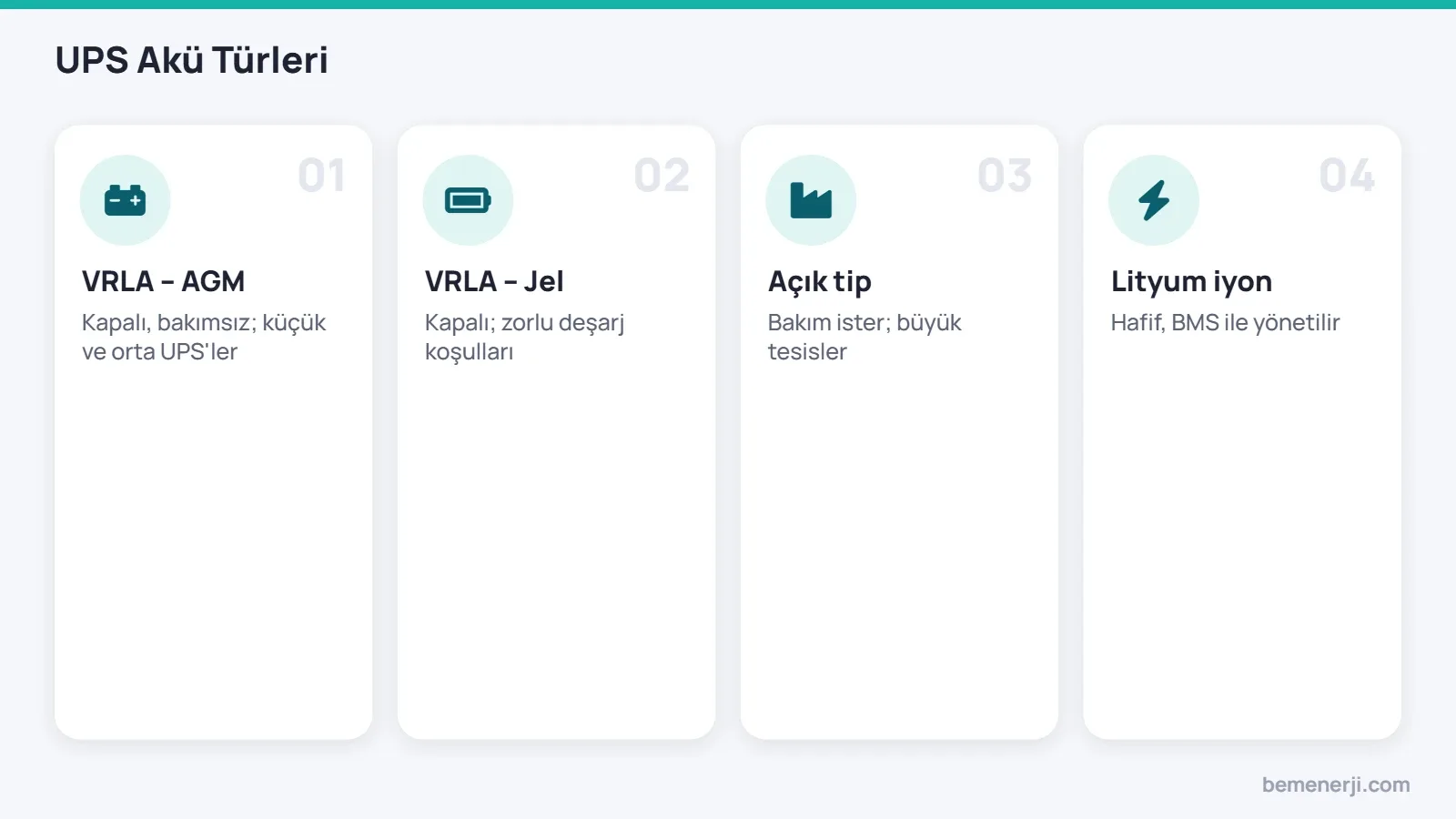
Types of Batteries Used in UPS Systems
| Type | In short | Typical use |
|---|---|---|
| VRLA – AGM | Sealed, maintenance-free lead-acid; electrolyte impregnated into glass fiber | The vast majority of small and medium-power UPSs |
| VRLA – Gel | Sealed lead-acid; gel-like electrolyte | Applications where deep discharge and high temperatures pose greater challenges |
| Open-type (flooded) lead-acid | Battery requiring maintenance with monitored electrolyte level | Large power plants, energy and industrial facilities |
| Lithium-ion | A lighter battery with its own battery management system (BMS) | Next-generation systems where space and weight matter |
Batteries commonly referred to in everyday language as "maintenance-free batteries" or "sealed batteries" are mostly VRLA batteries. The difference between AGM and gel batteries The Difference Between VRLA, AGM, and Gel Batteries, the pros and cons of lithium-ion batteries lithium-ion UPS batteries We explained this in detail in our article.
In small UPS units, the batteries are housed inside the unit; in medium- and high-power systems, however, they are located in separate battery cabinets or battery rooms. The type of battery also determines the UPS’s charging settings: the float voltage, current limit, and temperature compensation must be adjusted according to the battery type and manufacturer. Therefore, changing the battery type should not be done without first reviewing the UPS’s settings.
Key Concepts You Need to Know
- Voltage: Most UPS batteries are 12-volt cells; they are connected in series according to the DC voltage required by the UPS.
- Capacity (Ah): It is the amount of current a battery can deliver over a specific discharge period; it does not refer to duration alone.
- Battery series: A group of batteries connected in series. The strings can be connected in parallel to extend the runtime.
- Design life: The period specified by the manufacturer for ideal conditions; the actual service life is usually shorter.
Each of these concepts is covered in our separate articles: What is battery capacity (Ah)?, battery bank and series-parallel connection, Factors Affecting Battery Life.
What Factors Affect Battery Life?
EUROBAT, the European battery manufacturers’ association, classifies sealed lead-acid batteries according to their expected service life: 3–5 years, 6–9 years, 10–12 years, and over 12 years. The class with the shortest expected lifespan is most commonly used in small UPS systems. The most important factor determining actual lifespan is ambient temperature; high temperatures significantly accelerate battery aging. Charging settings, discharge frequency, and the condition of the connections also affect lifespan.
It is normal for batteries to lose capacity over time; the problem is that this is not noticeable from the outside. Even while the UPS appears to be functioning normally, the batteries may have lost a significant portion of their capacity. For this reason, the batteries must be monitored through measurements; how to determine when they need to be replaced When should a UPS battery be replaced? We explained this in our article.
What Should You Look for When Choosing a Battery?
The correct battery must be compatible with the type and voltage specified by the UPS manufacturer. Capacity is calculated based on the desired backup time and load; batteries in the same string must be of the same type, same capacity, and, if possible, from the same production batch. It is also important to consider how long the batteries have been in storage. For more details, How to Choose a UPS Battery and battery shelf life You can check out his articles.
Security Note
UPS batteries retain a charge even when the UPS is turned off and can deliver very high currents in the event of a short circuit. Touching battery terminals, opening the cover, or replacing batteries should only be done by authorized technical personnel. To have the condition of your batteries checked or to schedule a replacement, Battery Replacement and Refurbishment You can check out our page.
- EUROBAT — Guide to VRLA Stationary Batteries (2022) (calendar life classes; the effect of temperature on service life)
- Product manuals and data sheets from UPS and battery manufacturers (specifications vary by manufacturer)
Sources
The Component That Bears the Load During a Shutdown
The most common type of battery used in UPS systems is the sealed lead-acid (VRLA) battery; open-type batteries are used in large facilities, and lithium-ion batteries are also used in newer systems.

Regardless of the type, a battery loses capacity over time; it should be monitored through regular testing.
Frequently Asked Questions
01Are UPS batteries and car batteries the same?
02What does "dry battery" mean?
03How long does a UPS battery last?
04Can a lithium battery be installed in any UPS?
05How can I check the condition of my batteries?
Have Your Batteries Tested
For information on the condition of your UPS batteries and when to replace them Battery Replacement and Refurbishment Check out our page, Contact Contact us through this link.