Rectifier and DC Power System Faults and Maintenance

Rectifiers operate silently for days or even months; when the power goes out, the battery takes over the load, and most of the time, no one even notices. That’s why a hidden fault in the rectifier or battery bank may only become apparent when it’s actually needed. Regular inspections prevent this surprise. To understand what a rectifier does, What is a rectifier?, for battery compatibility Battery and Rectifier Compatibility You can check out his articles.
Common Symptoms
- The output (DC bus) voltage is lower or higher than expected
- The battery charging current remains consistently high or is not detected at all
- Alarm: power failure, low battery voltage, rectifier module failure, high temperature
- Fan noise, overheating, or the fan not spinning
- The failure of one of the modules and the disruption of load sharing
- Swelling, overheating, or leakage in battery packs
Possible Causes
| Symptom | Possible cause |
|---|---|
| Low output voltage | Module failure, insufficient capacity, setting drift |
| High output voltage | Regulation circuit malfunction, incorrect float adjustment |
| The battery isn't charging | Current limit, fuse, battery connection, or low battery |
| Overheating | Fan malfunction, clogged filter, insufficient ventilation |
| Frequent alarms | Loose connection, aging capacitor, sensor malfunction |
For problems with the battery The battery isn't charging or is draining quickly You can read his article. Reasons related to warming Overheating and fan failure This is explained in the article regarding UPS systems; the same principle applies to a large extent to rectifiers as well.
First Steps in Case of a Malfunction
When the rectifier or DC power system triggers an alarm, the first step is to determine whether the load is still receiving power and how long the batteries will last. The alarm log, the values displayed on the screen, and the time of the incident should be noted; do not attempt to replace a fuse or module without first obtaining information about the device.
In redundant modular systems, a faulty module can often be removed without shutting down the system; however, this procedure must be performed in accordance with the manufacturer’s instructions and by authorized personnel. Post-failure inspections and replaced parts must be documented in the service report, and the system must be monitored to determine whether a similar failure recurs.
Inspections Performed During Maintenance
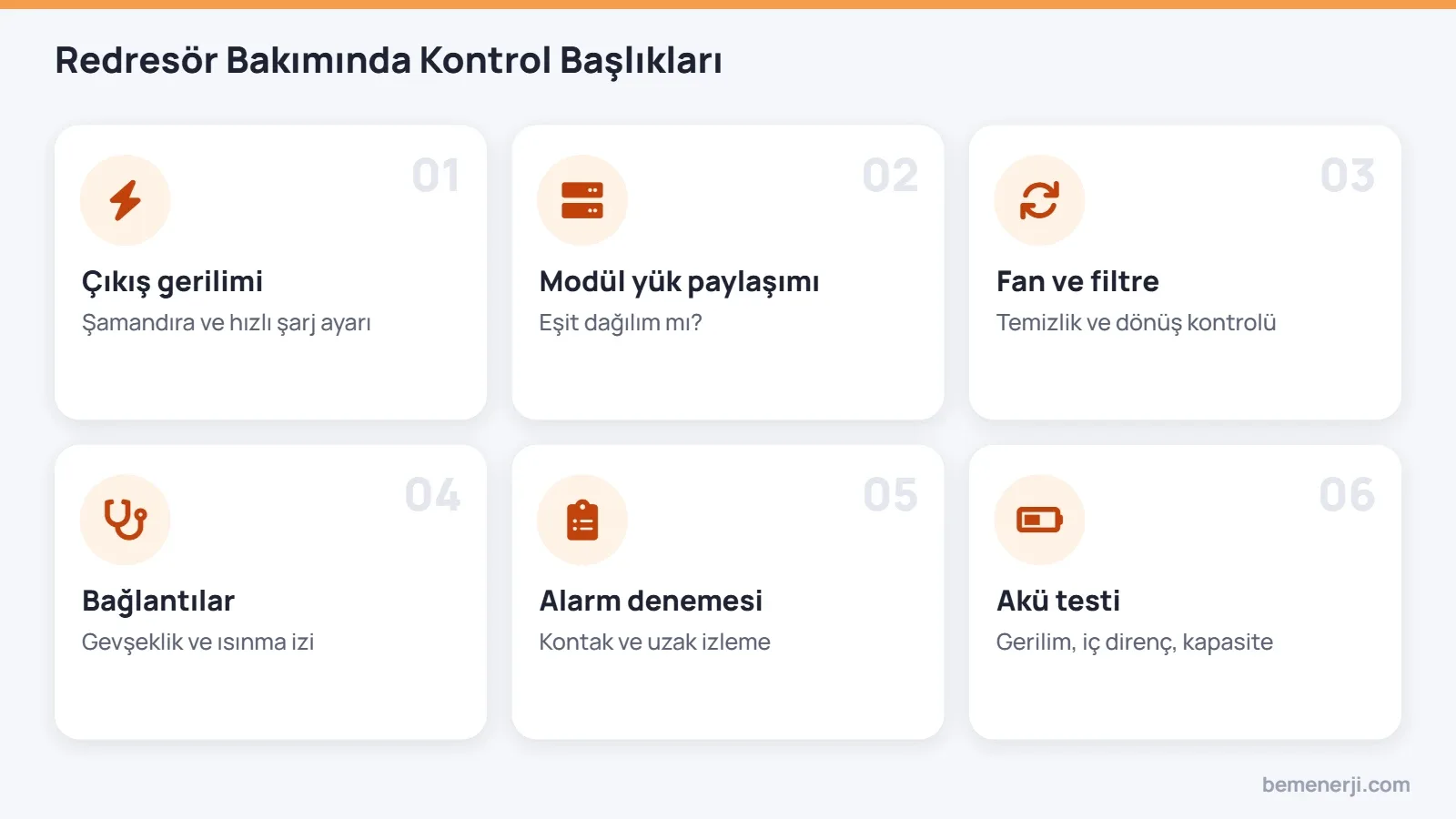
- Measuring the output voltage, float charge, and fast-charge values and comparing them to the set points
- Control of load sharing between modules
- Cleaning and inspection of fans, filters, and ventilation ducts
- Check connection points for signs of overheating and loose connections; inspect with a thermal camera if necessary
- Testing of alarm and contact outputs (including remote monitoring)
- Battery pack testing: voltage, internal resistance, and, if necessary, capacity
How inspections are conducted using a thermal camera Thermal Camera Inspection During UPS Maintenance This is explained in the article; the same approach is also used in rectifier panels.
Aging Parts
Electrolytic capacitors and fans in the rectifier also have a limited service life. This service life is shortened in hot environments. The safest approach is to replace parts that have reached the end of their service life before they fail. How to address component aging Replacement of the capacitor and fan In his article: The Logic of Scheduled Maintenance Preventive and predictive maintenance It is described in the article.
Security and Remote Monitoring
Although DC power systems may appear to operate at low voltages, battery banks can carry very high short-circuit currents. Work must be performed using insulated tools and by authorized personnel; Workplace Safety in UPS and Battery Operations You can read the article. Remote monitoring and alarm management are especially important for detecting malfunctions early, particularly at unmanned facilities; for more details, UPS Remote Monitoring and Alarm Management Check out his article.
For the inspection and repair of your rectifier and battery systems Troubleshooting and Technical Support You can check out our page.
- IEEE Std 450 and IEEE Std 1188 — Recommended Practices for Battery Maintenance and Testing (as per the standard titles).
- Rectifier manufacturer's user and maintenance manual — the authoritative source for alarm codes and setting values.
Sources
Regular Inspection of a Quietly Operating System
A rectifier malfunction may not be detected until the moment of an outage. Scheduled inspections and battery tests reduce this risk.

Aging fans and capacitors are replaced before they fail.
Frequently Asked Questions
01How often should a rectifier be serviced?
02The charger is working, but the battery isn't charging. Why?
03If a module fails, will the system shut down?
04What should you do when the alarm goes off?
05Is remote monitoring necessary?
For Alternator and Battery Service
We provide support for troubleshooting, maintenance, and repair of your DC power systems. Troubleshooting and Technical Support Check out our page, Contact Please contact us through this channel.