


What Are Microinverters and Optimizers? How They Differ from String Inverters

Anyone considering solar panels for their roof will quickly run into this question when they get quotes: "Should I choose a string inverter, a microinverter, or per-panel optimizers?" All three options aim to do the same job: converting the direct current (DC) produced by the panels into usable alternating current (AC). The difference is where this conversion and the per-panel adjustment take place. That difference changes many outcomes, from shading and fault management to monitoring and installation cost.
This guide is written for homeowners, small business owners, and purchasing or technical managers. You will find how each architecture works, which situations favor which one, the effect of shading illustrated with simple calculation examples, the safety and monitoring aspects, and selection criteria. There are no brand or model recommendations; the goal is to help you ask the right questions.
If you are not yet familiar with the general logic of a solar energy system, you may first want to read our article explaining how a solar energy system works . This article builds on that foundation.
The basics first: What does an inverter do, and what is MPPT?
Solar panels produce DC; household appliances and the grid run on AC. The inverter is the device that performs this conversion. There is also MPPT (maximum power point tracking): a panel's voltage and current change constantly with temperature, irradiance, and shade, and the MPPT algorithm searches for the operating point that captures the highest power the panel can deliver at that moment. We also covered MPPT in the context of charge controllers in our article MPPT vs. PWM comparison .
The key question that distinguishes the three architectures has two parts:
- Where does the DC-to-AC conversion take place? In a single central device, or at each panel?
- At how many points is MPPT performed? One MPPT for the whole string, or a separate one for each panel?
What is a string inverter and how does it work?
In a string inverter system, panels are connected in series to form a "string", and the strings feed into the inputs of a single central inverter. The central inverter is usually located somewhere easy to access, such as a garage, utility room, or exterior wall. In a series connection, the same current flows through all the panels. For this reason, as noted in the academic literature, when a single panel is shaded its maximum power point drops, and the power of the series-connected string is limited toward that of the weakest panel.
The practical meaning is this: a string inverter gives the best results on the assumption that all panels in a string operate under similar conditions. For panels that face the same direction, are unshaded, and are of the same type and age, it is a simple, economical, and easy-to-maintain solution. If some panels are shaded during the day, if the roof has surfaces facing different directions, or if different panel types are mixed, losses occur.
What is a microinverter?
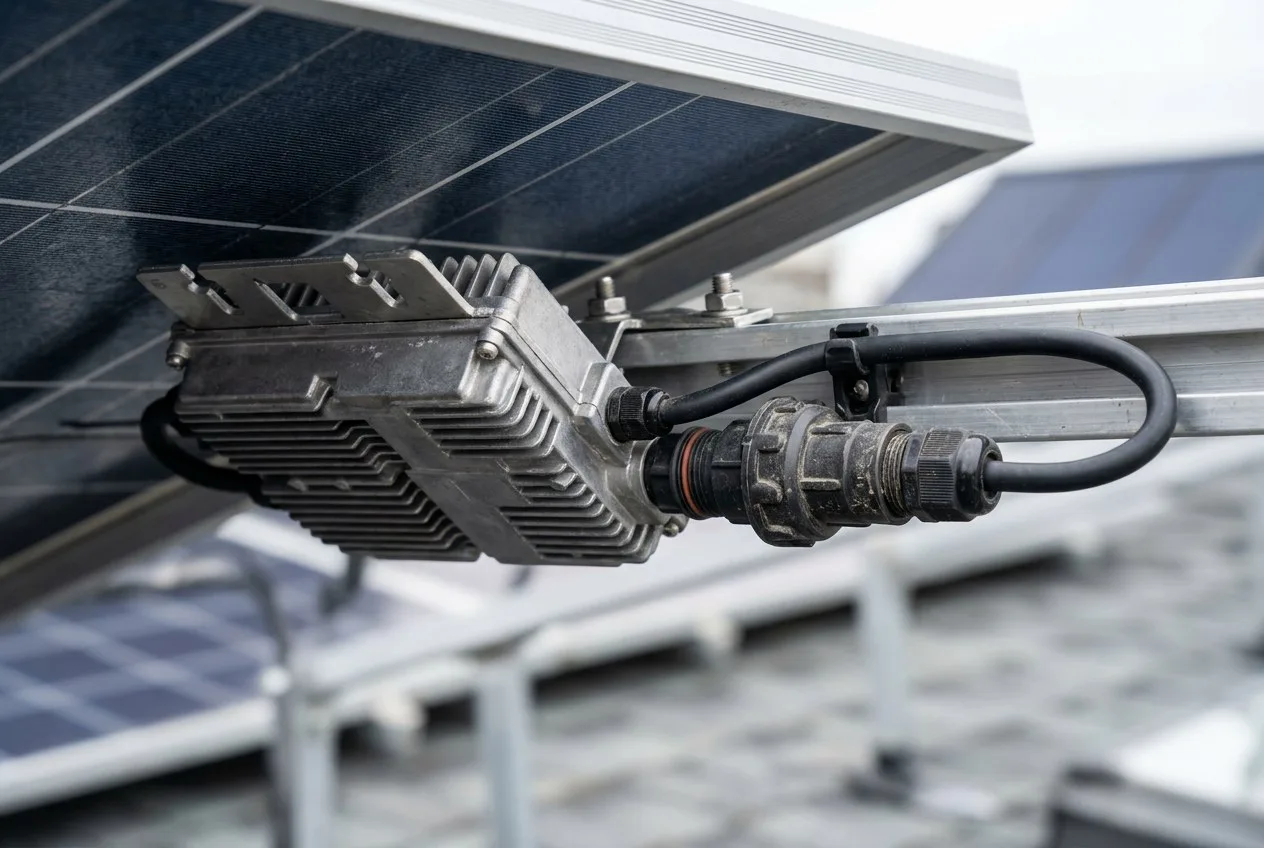
A microinverter is a configuration in which a small inverter is mounted behind each panel. The DC power produced by the panel is converted to AC right there, and AC cables run down from the roof. Each microinverter performs independent MPPT on its own panel; that is, shading or failure of one panel does not affect its neighbors. Because each panel has its own inverter in this setup, control flexibility and fault tolerance increase.
Key features of microinverters:
- Panel independence: On roof surfaces facing different directions or tilts, each panel operates at its own optimum point.
- No single point of failure: If one microinverter fails, usually only that panel's production is lost.
- Panel-level monitoring: Because each device can report its data separately, an underperforming panel is easy to find.
- No high DC voltage on the roof: Since the panel output is converted to AC on the roof, there is no long run of high-voltage DC cable. Even so, the AC side also carries electrical risk; work must be carried out by qualified personnel.
There are disadvantages too: you buy as many electronic devices as there are panels, which generally increases the initial investment per unit of power. The devices operate on the roof in a hot, sun-exposed environment, and replacing one in case of failure requires going up on the roof. With a string inverter, troubleshooting focuses on a single accessible device.
What is a power optimizer (DC optimizer)?
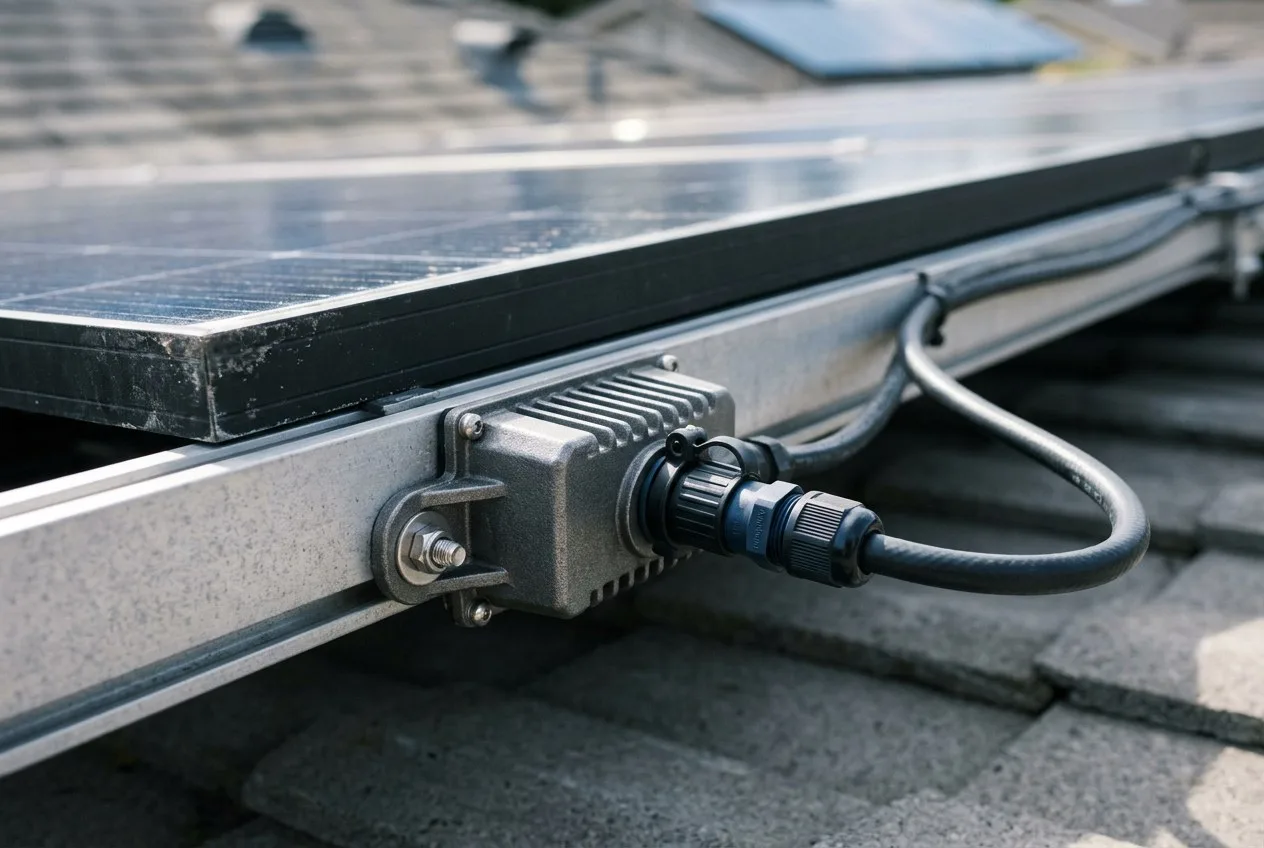
An optimizer is an electronic device attached behind each panel that works only on the DC side. It performs the panel's MPPT at the panel itself, adjusts the output voltage to the needs of the string, and sends the conditioned DC power to a common string inverter. In other words, an optimizer is "half" of a microinverter: MPPT is distributed, but the AC conversion is still performed in a single central inverter. One source summarizes it this way: a microinverter combines an optimizer and a small inverter in one box, whereas an optimizer system keeps the inverter separate and uses a single inverter for the entire system.
When a shaded panel's voltage drops, the central inverter slightly raises the output voltage of the other optimizers so that the string voltage stays constant; the shaded panel's low current affects only its own power. This way of operating also shows how important it is which inverter each optimizer is compatible with: many optimizers are designed to communicate only with the inverter family of the same manufacturer.
An optimizer system has two separate maintenance points: panel-level electronics on the roof and the central inverter below; the inverter also remains a single point of failure.
Side-by-side comparison of the three architectures
| Criterion | String inverter | Microinverter | Optimizer + string inverter |
|---|---|---|---|
| DC → AC conversion | In the central device | At each panel | In the central device |
| MPPT point | Per string (or MPPT input) | Per panel | Per panel (in the optimizer) |
| Shading sensitivity | High; the entire string may be affected | Low; each panel operates separately | Low; each panel operates separately |
| Single point of failure | Yes (inverter) | No (failure is per panel) | Yes (central inverter) |
| Electronics on the roof | None | As many as the number of panels | As many as the number of panels (may be optional) |
| DC voltage on the roof | String voltage (high) | Low DC; AC on the roof | Can drop to a safe low-voltage mode (depending on the product) |
| Panel-level monitoring | Usually none | Available | Available |
| Initial investment | Usually lowest | Usually higher | In between |
| Fault response | Single unit, easy access | Per panel on the roof | Both on the roof and at a central location |
Note: The table shows typical trends. It may vary depending on the product, scale, and manufacturer design; refer to the relevant datasheets for exact values.
How much difference does it really make under shading? A simple calculation
NREL has reported that partial shading can raise annual performance loss in residential systems to 10-20 percent or more, and that module-level power electronics recover part of this loss; such findings are often summarized as "30-40 percent is recovered." This range varies greatly from site to site. To understand the mechanism, let's use the rough model below.
Example 1: A string with a single shaded panel
Assumptions: 10 panels, each 450 W, all connected in series in a single string. Half of one panel is in shade at that hour, and this panel can produce only 225 W. We build a simplified model representing the worst case, deliberately ignoring the effect of bypass diodes and the inverter's additional MPPT strategies.
- String inverter, bad case: Since the current is limited by the weakest panel, the string delivers approximately 10 × 225 W = 2,250 W.
- Panel-level MPPT (microinverter or optimizer): 9 × 450 W + 225 W = 4,275 W, that is, it reaches approximately 4.3 kW (without accounting for conversion losses).
In reality, bypass diodes limit the loss by disabling the shaded section of the panel, and modern string inverters have multiple MPPT inputs; therefore the difference is smaller than in the worst-case scenario above. We explained how the diode works in detail in our article on shading and bypass diodes in solar panels . Still, the example shows why shade can be a problem of "the whole string, not just one panel."
Example 2: Converting it to annual energy
Assumptions: 10 × 450 W = 4.5 kWp; annual specific yield 1,400 kWh/kWp; let the additional loss due to shading and mismatch be 4 percent with a string inverter and 1 percent with panel-level electronics (varies by location).
- Base production: 4.5 kWp × 1,400 kWh/kWp = 6,300 kWh/year
- String inverter: 6,300 × 0.96 ≈ 6,050 kWh
- Panel-level electronics: 6,300 × 0.99 ≈ 6,240 kWh
- Difference: approximately 190 kWh/year
You decide whether this difference covers the cost of the extra devices and the possible maintenance burden. On an unshaded roof, the loss difference approaches zero; the picture reverses. To calculate the payback, you can use the method in the article on payback period of a solar energy investment . Vendor quotes should be used for current device prices; no prices are given here.
Mismatch and panel aging
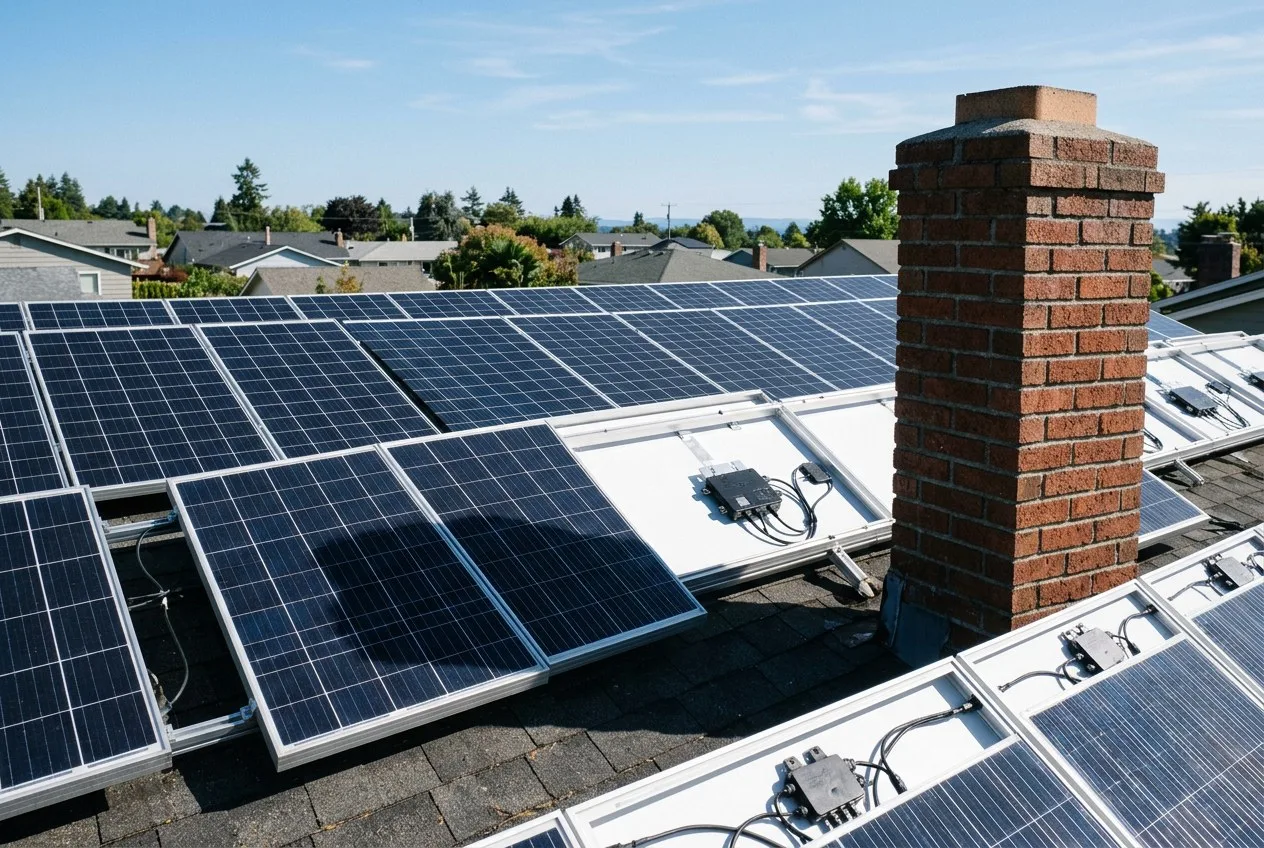
Shade is not the only cause. Manufacturing tolerances, differences in soiling, different temperatures, and panels aging at different rates over time also create "mismatch" loss. NREL's PVWatts modeling report notes that module-level power electronics are solutions expected to eliminate mismatch losses and may also mitigate age-related mismatch. The same report recommends treating system losses and inverter efficiency parameters separately when calculating with these solutions; in other words, designers should reflect this advantage correctly in their calculations.
Even if there is no shade on the roof, factors such as panel soiling and tilt angle also determine performance. You can find them in the article on factors that reduce panel efficiency .
String voltage and inverter window: A design constraint not present with microinverters
With a string inverter, the number of panels cannot be chosen arbitrarily; the string voltage must stay within the inverter's MPPT operating range. The most critical check is the open-circuit voltage (Voc) in cold weather, because voltage rises as temperature falls.
Example 3: String voltage in cold weather
Assumptions (hypothetical datasheet): Panel Voc = 41 V (25 °C); Voc temperature coefficient = -0.27 %/°C; 10 panels in the string; lowest expected cell temperature -10 °C; inverter maximum DC input voltage 600 V.
- Temperature difference: 25 - (-10) = 35 °C
- Voc increase: 35 × 0.27% ≈ 9.5%
- Panel Voc in the cold: 41 × 1.095 ≈ 44.9 V
- String Voc: 10 × 44.9 ≈ 449 V
Since 449 V is below the 600 V limit, there is a safety margin in this calculation. In a real design, the relevant datasheet and local winter temperatures must be used. With microinverters there is no such series string calculation; each panel connects to its own unit, but the panel's maximum current and power input must still be compatible with the limits in the microinverter's datasheet. For string voltage design, DC cable cross-sections, and protection topics, see the article on DC fuse, switch, and surge protection .
Example 4: Microinverter-to-panel power ratio
Assumption: A 450 W panel and a microinverter with 400 W AC output. The DC/AC ratio is 450 / 400 = 1.125. In real conditions where the panel rarely reaches nominal power, clipping remains small; however, the loss increases in a place with continuously high irradiance. The right ratio is determined according to the recommended panel power range in the microinverter's datasheet.
Safety and rapid shutdown
Series-connected panels on the roof produce voltage as long as there is light; switching off the grid or the inverter does not bring the panel itself to zero voltage. This poses a risk for firefighters and rescue crews. For this reason, Article 690.12 of the US National Electrical Code (NEC) requires the conductors on the roof to drop to a low voltage within a short time after the command. Under the NEC 2017 implementation, the goal is for conductors inside the array boundary to fall to 80 V or below within 30 seconds. The same source states that microinverters come rapid-shutdown compliant and require no additional components. In string inverter systems, optimizers or separate rapid shutdown devices can provide this function.
The NEC is a US standard and is not directly binding in Turkey; it is given here only to show how the architecture affects safety design. For current obligations in Turkey, the relevant regulations and distribution company requirements, consult your designer and the official pages of the relevant institutions (Ministry of Energy and Natural Resources, EPDK, the distribution company). For document and standard checks, the article which documents and standards should be checked will serve as a guide.
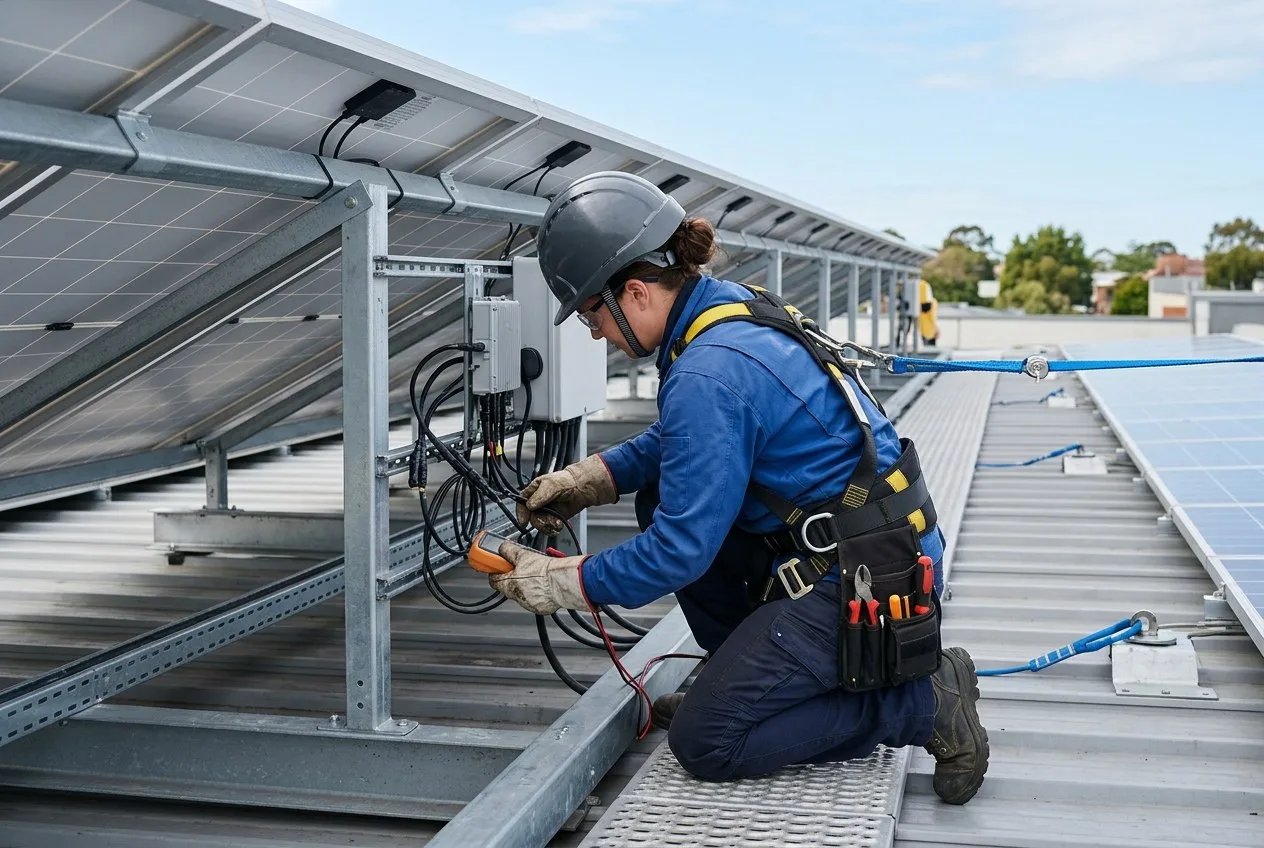
Safety note: There is a risk of high DC voltage, arcing and fire in panel cables and string inputs. Connection, measurement and repair work must be carried out by authorized electrical personnel, with working-at-height precautions. You can also find why this work requires an expert in the article occupational safety in UPS and battery work ; the principles are similar.
Differences in monitoring, fault finding and maintenance
A string inverter has a single measurement point: the total power of the string. Even if one panel underperforms, it is hard to notice. With panel-level electronics, however, the output of each panel can be reported separately; this speeds up finding a dirty, shaded or faulty panel. One of the design goals of optimizers and microinverters is also to improve monitoring and energy yield. For monitoring details, see the article solar energy monitoring systems and for step-by-step checks when production drops, see fault detection and checklist
| Symptom | Possible cause | In which architecture is it easier to find? |
|---|---|---|
| Total production suddenly drops to zero | String inverter failure, grid loss, main switch | String inverter: only one device needs to be checked |
| One panel is consistently low | Shade, dirt, panel damage, device failure | Microinverter / optimizer: panel-level data |
| Regular drop in the afternoon | Shade from a nearby structure or tree | Panel-level monitoring shows the shading hours |
| No panel data coming in at all | Communication / network problem, power line noise | In the communication network of microinverters and optimizers |
| Voltage of one string is low | Loose connector, damaged cable | String inverter: string-level measurement; intervention by authorized personnel |
Relationship with battery systems and hybrid inverters
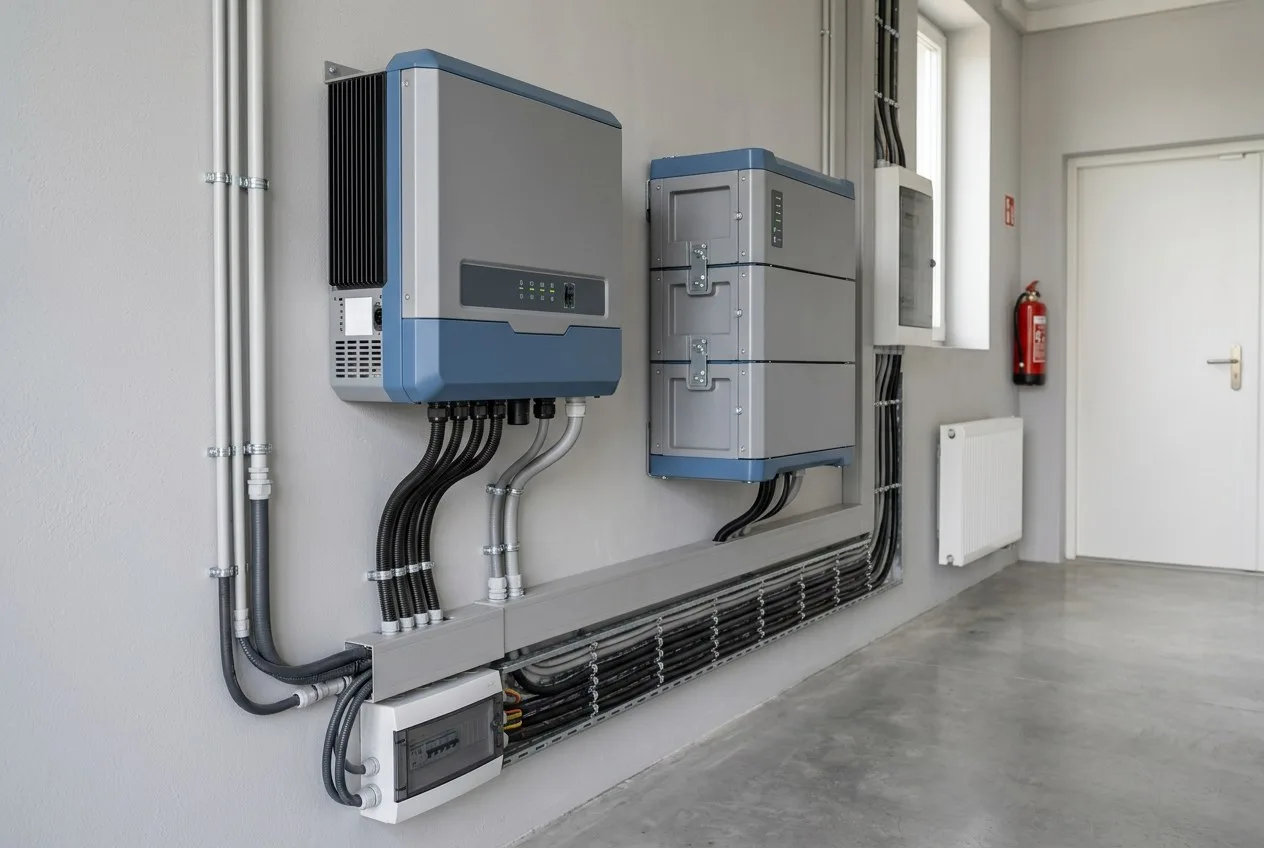
Those who want the system to work during a power outage and carry energy into the night should consider the architecture choice together with the battery plan. For safety reasons, most grid-connected systems stop producing when the grid goes down; to operate during an outage, a battery and a suitable inverter (hybrid or with backup output) are required. A hybrid inverteris a unit that combines panels, battery and grid in a single device; for the distinction between grid-tied, off-grid and hybrid systems, see the article on-grid, off-grid and hybrid systems .
- String inverter + battery: There is a natural fit with DC-coupled hybrid inverters; the DC energy from the panels can go directly to the battery.
- Optimizer + hybrid inverter: Some manufacturers offer hybrid inverter families compatible with optimizers; compatibility is brand-specific and should be verified from the datasheet.
- Microinverter + battery: Because the output of a microinverter is AC, the battery is usually added with an AC-coupled storage unit. Whether microinverters operate during an outage depends on that unit creating a grid reference; whether such a setup exists and how it is managed should be clarified in the manufacturer's documentation.
To decide whether you should have a battery, read the comparison of systems with and without batteries . Bempower can help with survey, installation, periodic maintenance and technical service for batteries, inverters and UPS systems; panel installation and project services are a separate area of expertise.

Which one in which situation? Decision criteria
| Situation | More suitable approach | Rationale |
|---|---|---|
| Flat, unshaded, single-orientation roof | String inverter | The contribution of panel-level electronics is small; cost and maintenance stay simple |
| Shade from a chimney, tree or neighboring building | Optimizer or microinverter (only on the affected panels if necessary) | Panel-level MPPT limits shading losses |
| Roof surfaces facing multiple directions | Microinverter; or a string inverter with multiple MPPT inputs | Different irradiance profiles are managed separately |
| Panel-level monitoring is required | Microinverter or optimizer | The data of each panel is visible separately |
| Gradual addition of panels in the future | Microinverter | Adding panels does not depend on the central inverter's capacity |
| Building where roof access is difficult | String inverter (worth considering) | Reduces the need to go up on the roof in case of a fault |
| Battery and operation during outages are the priority | Hybrid inverter-based architecture | Panel, battery and load management in one place |
Do not base your decision on a single manufacturer's brochure; base it on the roof and shading analysis, the budget and the maintenance options. NREL's approach points the same way: the gain from module-level power electronics should be modeled according to the system's shading and mismatch conditions.
Common mistakes
- Choosing without a shading analysis: If there is no shading, the return on an expensive panel-level solution stays low; if shading is heavy, a string inverter will disappoint.
- Mismatched optimizer and inverter pairing: Most optimizers communicate only with certain inverters; changing them later is difficult.
- Not reading the datasheet for a microinverter: The panel current and power must not exceed the device's input limits.
- Looking only at efficiency: Not the catalog efficiency, but the total energy on the roof, monitoring, warranty and service access should be evaluated together.
- Not asking about the warranty and service period: The warranty period of the electronics on the roof, and whether it covers replacement labor, should be obtained in writing.
- Neglecting grounding and surge protection: Whichever architecture is chosen, lightning and overvoltage protection is necessary. See grounding and lightning protection.
- "DIY" connection: Because of the high DC voltage and arc risk, connection, commissioning and repair are work for authorized personnel.
Questions to ask before buying
- Is there an area of the roof that gets shaded during the day? What are the shading hours and seasons?
- How many different directions and tilts do the panels face?
- Will panel-level monitoring really be used, or is total production enough?
- In case of a fault, who will come up on the roof, and within how long? Is replacement labor included in the warranty?
- Will a battery be added later? Does the chosen architecture make that easier?
- Is the device's and installation's compliance with the relevant standards and the distribution company's requirements documented?
- How many years is the device warranty and what does it cover? Are the manufacturer and service network long-established?
When comparing quotes, not only the device name but also the number of panels, total installed power, DC/AC ratio, cabling and protection equipment should be of equal scope. To determine how much production to target and with how many panels, you can use the sizing steps in the article how many solar panels are needed
To consult Bempower
If you are planning the battery, hybrid or battery inverter, the critical loads that must keep running during an outage, and the UPS side of your solar energy system, Bempower provides survey, installation, periodic maintenance and technical service for batteries, UPS and inverters. Solar panel installation and solar power plant (GES) project processes are outside our scope of services. To have the battery and inverter side of your existing system evaluated, you can reach us via our contact page .
- An Overview of Microinverter Design Characteristics and MPPT Control — arXiv, 2020. https://arxiv.org/pdf/2009.06055
- High-resolution hierarchical PV system performance modeling in urban environments — arXiv, 2025. https://arxiv.org/pdf/2511.13424
- How to meet NEC 2017 rapid shutdown requirements in solar — Solar Power World, 2018. https://www.solarpowerworldonline.com/2018/04/how-to-meet-nec-2017-rapid-shutdown-requirements/
- String Inverter vs Microinverter vs Power Optimizer: How the Architecture Changes — Portlandia Electric Supply, 2026. https://www.portlandiaelectric.supply/blogs/news/string-inverter-vs-microinverter-vs-power-optimizer-how-the-architecture-changes
Sources
