


UPS and Battery Capacity Projecting: From Load Analysis to Proposal

In a UPS project, the most expensive errors are made at the beginning of the account, not in the device catalog. If the load is undercollected, the UPS remains small. If the power factor is assumed to be incorrect, the kVA appears sufficient, but the kW is not. If the battery calculation is based on the label capacity, the specified backup time does not hold up in the actual power outage. These errors often occur not at commissioning, but at the first long outage.
This guide goes step-by-step from load analysis to how to determine UPS power, battery capacity, redundancy, and offer scope. The assumptions are clearly written in the numerical examples. So you can adapt it to your own system.
Article; It has been prepared for business owners, technical officers, purchasing units and anyone who wants to evaluate incoming offers. The calculations given are for preliminary sizing purposes. The final selection should be verified with measurement and manufacturer data sheets, and installation and connection works should be carried out by authorized electrical personnel or technical service.
Project Flow: What steps are followed from load analysis to quotation?
A healthy UPS project follows the same sequence. The output of each step is the input of the next; skipping the sequence yields an erroneous result.
- Freight inventory: The devices to be protected, their power and criticality are listed.
- Power Conversion: Watt values are converted to VA by power factor and distributed to phases.
- Margins: Allowance is added for growth, inrush flow and occupancy rate.
- Architecture: A single UPS, parallel, modular or redundant structure is selected.
- Battery calculation: It is calculated with the power per cell, temperature, and aging allowance for the desired time.
- Installation fit: Layout, ventilation, wiring, protection and generator compatibility are checked.
- Proposal and acceptance criteria: Assumptions, coverage and commissioning tests are put in writing.
Once the calculation is completed on paper, on-site exploration compares these assumptions with the reality on the ground. For details of the discovery Technical discovery before UPS installation You can look at the article.

Load analysis: What data is collected and how?
Load analysis is to reveal the actual consumption and operation of each device to be connected to the UPS. Label power is often the worst-case value. Actual consumption is generally lower, but inrush currents and instantaneous peak loads should not be left out of the calculation.
Device inventory and criticality ranking
First, decide which devices will be powered from the UPS. Connecting everything to the UPS increases both power and battery needs unnecessarily. Critical loads such as servers, network equipment, safes and recording systems and loads that can be excluded from the UPS, such as lights, air conditioners, heaters, should be separated. Which load is considered critical What is critical load The article guides the way.
Measurement or label?
If possible, measure phase currents at the panel outlet during normal and peak operating hours. If measurements are not available, use the label or datasheet values of the devices and mark them as estimates. The following table summarizes the data that needs to be collected.
| Data | Why is it necessary? | How to get it? |
|---|---|---|
| Device power (W) | The basis of UPS kW rating and battery power | Measurement, datasheet, label |
| Power factor | Determines the conversion of W to VA | Measuring device or manufacturer information |
| Phase distribution | In a three-phase UPS, the most charged phase is the determinant | Current measurement per phase |
| Inrush | Loads such as motor, compressor, laser printer can overload the UPS | Manufacturer data, inrush current measurement |
| Desired backup time | The main input of battery capacity | Business continuity requirement, generator presence |
| Growth plan | Influences margin and architecture decision | Management and IT planning |
| Ambient temperature | Correction for battery capacity and life | Installation space measurement |
Motorized loads and devices that draw inrush currents, such as laser printers, are a separate issue. This topic connecting motors, air conditioners and laser printers to the UPS You can find it in detail in the article.

Wattage, VA, and power factor: How to get UPS power out?
Power factoris the ratio of actual power (W) to apparent power (VA). A source has to carry not only watts but also VA to the load. Therefore, choosing a UPS with only the sum of watts is an incomplete approach. For basic concepts What is the power factor and How to calculate UPS power You can take a look at his articles.
The power factor of the load and the output power factor of the UPS are separate concepts. The kW equivalent of the rated kVA in modern UPSs depends on the power factor of the device itself and is typically between 0.9 and 1.0. Older UPSs were commonly rated with an output power factor of 0.9; a 100 kVA device carried a maximum of 90 kW. Many current models have a unit power factor. You should check both in the calculation: the kVA value of the load should be below the UPS kVA value, and the kW value of the load should be below the UPS kW value.
On the load side, typical values also vary. In modern IT loads with power factor correction (PFC), the power factor can be about 0.95-0.98; in ancillary equipment such as air conditioning motors, it can drop to 0.7-0.85, in which case additional allowance is required. The impact of the low power factor is great: A facility with older equipment with a power factor of 0.7 requires approximately 40 percent larger UPS in kVA than a facility operating at the same kW load of 0.95.
Example calculation 1: Small server room (single phase)
Assumptions: The load was verified by measurement, the power factor was taken as 0.9. The growth share is 25 percent.
| Step | Process | Conclusion |
|---|---|---|
| 1. Load sum | 2 servers × 350W + NAS 120W + network devices 180W + other 50W | 1,050 W |
| 2. VA with power factor | 1,050 W ÷ 0.9 | ≈ 1,167 VA |
| 3. Growth share | 1,050 W × 1.25 = 1,313 W; 1,313 ÷ 0.9 | ≈ 1,458 VA |
| 4. Rounding to standard value | A 2,000 VA / 1,800 W class UPS | Today's occupancy ≈ is 58%, ≈ after growth is 73% |
Here, the 1,800W UPS covers the design load of 1,313W. It is also in line with the approach mentioned in the sources, which recommends keeping the normal occupancy around 70-80 percent; For headroom, growth and temporary loads, the UPS is targeted to be loaded to approximately 70-80 percent.
Phase equilibrium in a three-phase system
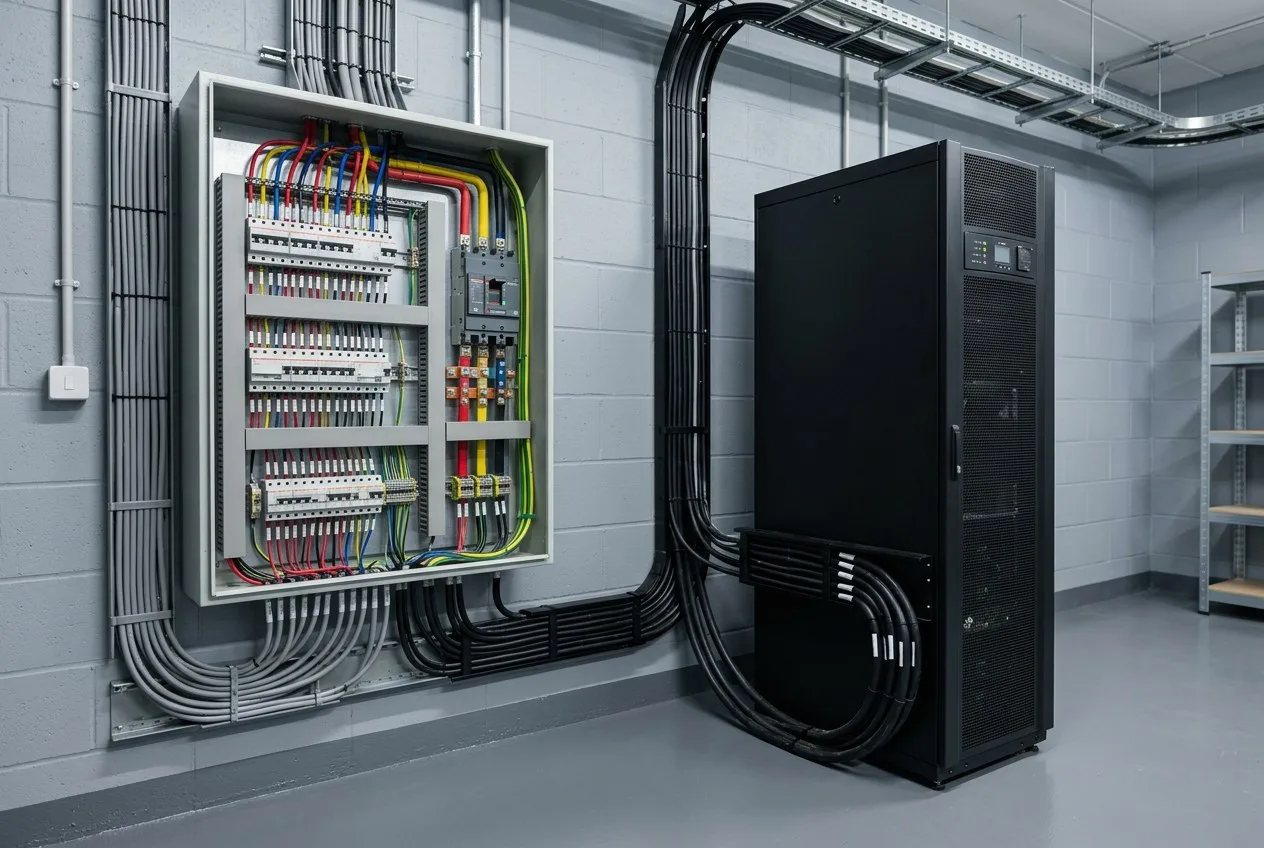
In a three-phase UPS, it is not enough to divide the total kVA by three. The load is calculated per phase and the maximum value is multiplied by three to find the required UPS power. For example, if the most loaded phase has 10 kVA, the UPS is sized as 3×10 = 30 kVA. Although the phase loads are L1 = 6 kVA, L2 = 4.5 kVA, L3 = 5 kVA for a total of 15.5 kVA, the pre-dimension is around 18 kVA due to the unbalanced load. If the phases are balanced, the pre-dimension can decrease to 16-17 kVA. For the differences between single-phase and three-phase three-phase and single-phase UPS The article is useful.
The formula for three-phase power is used to control the voltage and current relationship: kVA = 1,732 × 400 V × 20 A ÷ 1,000 ≈ 13.86 kVA. This calculation gives a quick apparent power estimate from the line current measurement.
Growth share, inrush and fill rate: How much margin is enough?
Margin moves the account away from the "just fit" point and makes it operable. There are three separate margins and should not be confused with each other.
- Growth share: If the load is constant, a growth margin may not be required; if expansion is expected, it is recommended to add 20-25 percent. The basic method of some producers is to multiply the collected load by 1.2, to take more if rapid growth is expected; the plan should cover three to five years.
- Instantaneous current allowance: A separate multiplier is required for loads such as motor, compressor and transformer energization. If there is no manufacturer data, it is often healthier to take these loads out of the UPS.
- Occupancy limit: Not approaching the full load of the UPS in normal operation is also beneficial in terms of DC current and heating, which increases as the battery ages.
There are also sources that combine these three margins into a rough formula: kVA ≈ (kW ÷ PF) × inrush current multiplier × (1 + growth) ÷ occupancy target. When margins are multiplied and piled up, UPS can grow unnecessarily. So justify each margin in the proposal. The "let's make it all 25 percent" approach can be expensive for non-critical load and insufficient for critical load.
| Margin type | Typical approach | Point to note |
|---|---|---|
| Growth | About 20-25%; plan 3-5 years | If uncertain, modular architecture is considered |
| Inrush current | With manufacturer data on a device basis | Motorized loads can be taken out of the UPS |
| Occupancy | Normal load ≈ 70-80% | Controlled for both kW and kVA |
| Redundancy | Architectural decision such as N+1, 2N | It should not be confused with margin, it is a separate step |
Single UPS, parallel or modular? Redundancy decision
Power calculation is not independent of the architecture decision. A single UPS leaves the load unprotected in the event of failure or maintenance. If the cost of the outage is high, redundancy is required. Basic logic of redundant structures Redundancy in UPS: N+1, 2N and parallel UPS It is explained in the article. Let's only look at the effect on the account here.
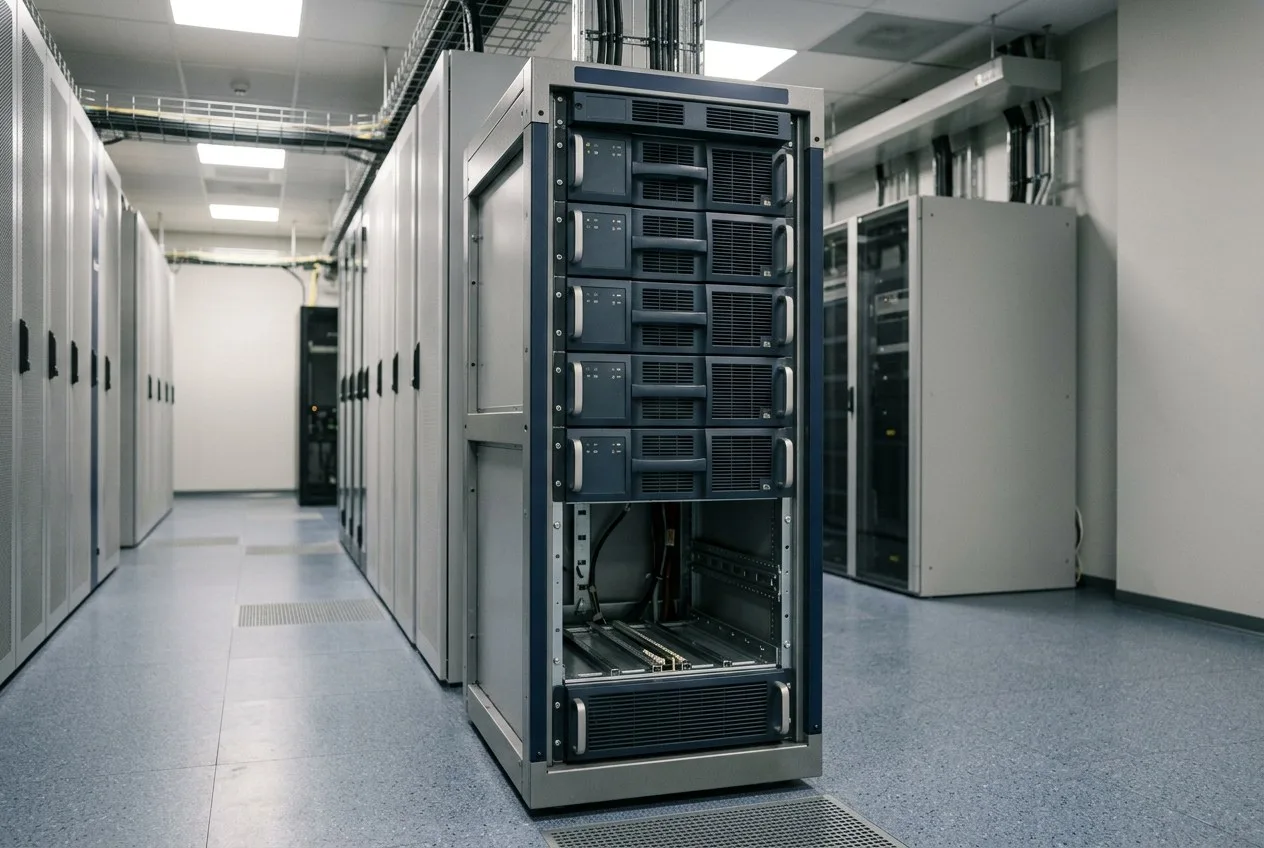
For example, if the load is 20 kVA and the module power is 10 kVA, the number of N modules is 2. In an N+1 structure, 3 modules are installed; even if one module fails, two modules carry the load. If there are two 20 kVA UPSs with parallel redundant for the same load, each of them must be able to carry the load alone. Redundancy comes at an additional cost but also ensures that the load is protected during maintenance.
Where growth is uncertain, modular construction can be appealing: If the load can increase significantly, a modular UPS can be considered, which allows adding a capacity module without changing the entire system. For the installation side modular UPS installation and retrofitting for parallel operation and load sharing parallel UPS setup You can see the article. Not every UPS can be connected in parallel to each other; the ability to work in parallel depends on the manufacturer's approved structure.
How to project battery capacity?
UPS power is the ability to carry the load instantaneously. The battery, on the other hand, determines how long it will carry this load. UPS capacity defines the instantaneous kVA support; battery sizing determines how long this load can be sustained. The two accounts are related, but not the same.
Battery load: Don't forget about inverter efficiency
The battery provides DC power, which covers the inverter's efficiency loss, not the load at the UPS output. Battery load; UPS kVA is calculated by power factor and UPS efficiency, and efficiency losses within the UPS must be taken into account. The yield value varies with the load and should be taken from the producer data.
Why isn't just Ah × V enough?
The label capacity of a battery is given for a certain discharge time and end-discharge voltage. UPS discharge, on the other hand, is usually short and high-current, such as 5-30 minutes. As the current increases, the energy available decreases; this effect battery discharge rate and the Peukert effect You can find it in detail in the article. For the meaning of the values on the label How to read the battery label guide helps. The basic concept of Ah is What is battery capacity (Ah) It is explained in the article.
Therefore, the method used in short-term UPS discharge is watts per cell (W/cell) tables. Sizing in UPS applications is done in watts/cell, and in long-term discharge batteries, it is done in amperes/cell. The standard approach takes into account the number of cells, temperature correction factor, aging factor to secure lifetime capacity, and design allowance. IEEE 485 is an implementation guide prepared for this purpose; Its scope is the identification of the DC load and the sizing of the battery for lead acid batteries operating in float service. Other technologies that are out of scope, such as lithium, are based on the producer method.
Example calculation 2: 20 kVA three-phase UPS, 15 minutes
Assumptions: Load 14 kW. Inverter efficiency is 94 percent. There are 20 12 V VRLA blocks in the DC bus; this means 120 cells (240 V nominal). The end of discharge voltage is accepted as 1.75 V per cell. The environment is 25 °C. The aging factor is 1.25 and the design margin is 1.10. These values are examples; the actual project should be based on the specification and manufacturer data.
| Step | Process | Conclusion |
|---|---|---|
| 1. Battery DC power | 14 kW ÷ 0.94 | ≈ 14.9 kW |
| 2. Power per cell | 120 cells ÷ 14,900 W | ≈ 124 W/cell |
| 3. Aging and allowance | 124 × 1,25 × 1,10 | ≈ 170 W/cell |
| 4. Manufacturer table | For 15 min, 1.75 V/cell, select the battery that delivers ≥ 170 W/cell | Verified by datasheet |
| 5. Control current | 14,900 W ÷ (120 × 1.75 V = 210 V) | ≈ 71 A (end of discharge) |
The striking point in the calculation is that the current increases as the end-of-discharge voltage decreases. In the selection of cables and fuses, the higher current at the end of discharge should be taken as a basis, not the current at the nominal voltage. The calculated value is verified by a load test to be carried out in the field afterwards. For this purpose UPS autonomy time test The article is useful.
For the reverse direction of the time calculation How to calculate battery time gives an example. For the logic of serial-parallel sequence Battery Array and Series-to-Parallel Connection text can be used. Current balance and cable length are important in parallel battery strings.
How do temperature, ageing and battery technology affect the account?
The multipliers added to the battery account are not arbitrary; they represent three separate phenomena.
- Temperature Correction: The standard rated temperature is 25 °C, and the capacity decreases at low temperature. If the electrolyte temperature is to fall below 25 °C, the determined capacity is multiplied by a correction factor. For example, winter conditions should be taken into account in an unheated space.
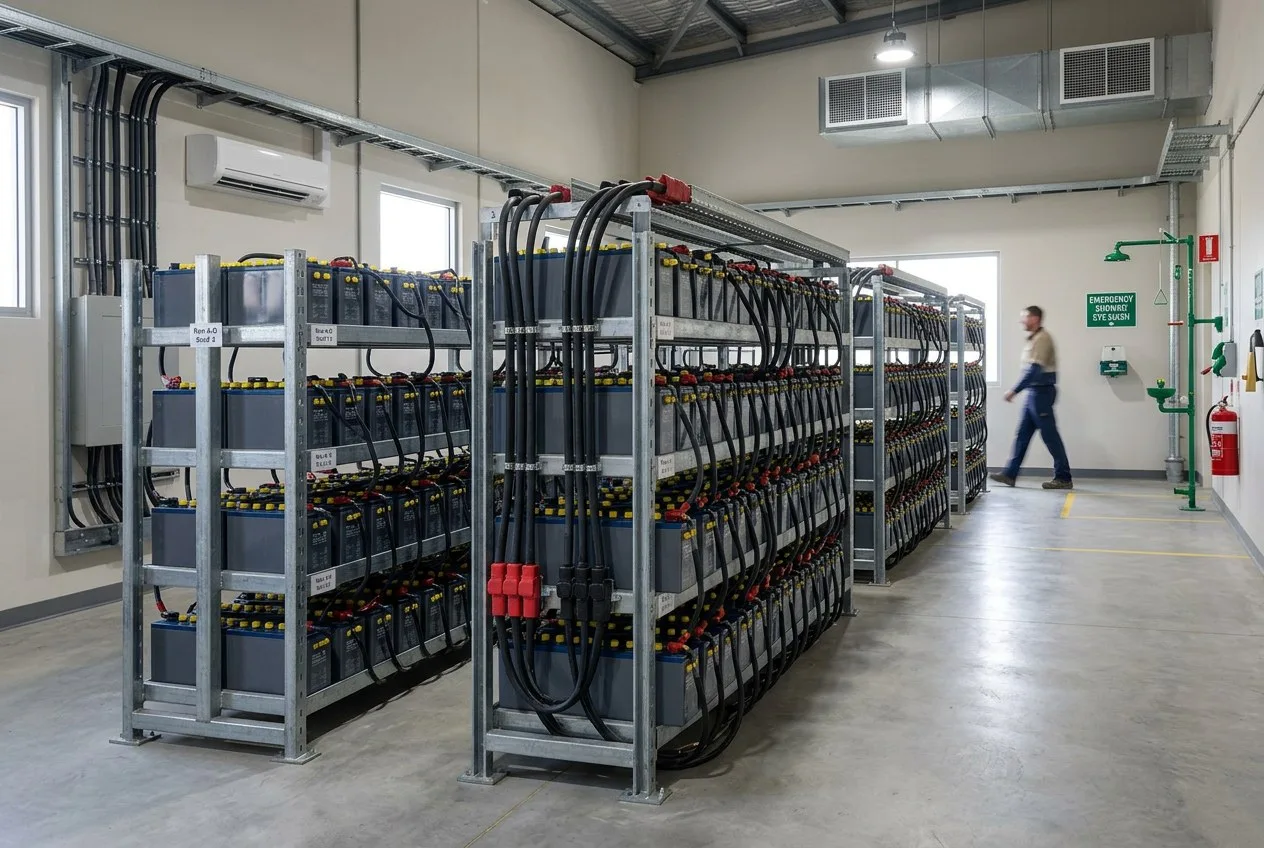
- Effect of high temperature on life: According to IEEE 484 information, if lead acid batteries operate at high temperatures continuously, the life is approximately halved for every 8 °C increase above 25 °C. Therefore, even if the battery calculation is correct in a hot room, the life plan does not work. For battery room conditions Battery Room Ventilation and Safety See the article.
- Aging allowance: It must still provide the required time at the end of the battery life. This allowance also determines the replacement time. Manufacturer data for battery life expectations and Factors Affecting Battery Life text can be used.
The choice of technology also changes the calculation. VRLA and lead acid batteries are a common, economical and well-known solution. Lithium-ion batteries, on the other hand, offer a different profile in terms of weight, cycle and usable energy. However, the calculation method and BMS integration for lithium should be done with the manufacturer's knowledge; cabin layout and safety distances should be evaluated separately. For details lithium-ion UPS batteries and Lithium Battery Cabinet Installation You can read the articles. For the differences between lead acid types VRLA, AGM and gel battery is sufficient.
The relationship between depth of discharge (DoD) and cycle life is critical, especially in backup applications with frequent discharges. Topic Depth of discharge and cycle life It is discussed in the article.
Standard vs. performance class: Which UPS to write into the specification?
The quotation and specification should state the standard to which the UPS is tested. IEC 62040-3 specifies the performance and test requirements for UPSs that are powered from the mains not exceeding 1,000 V AC, output the same level of AC and whose primary function is to ensure load continuity. This standard defines the characteristics of the UPS, such as its independence from mains voltage and frequency variations, with a classification code. In the current edition, the performance classification code has been reduced from 8 characters to 7 characters. Standards and certifications UPS standards and certifications You can find it in more detail in the article.
Efficiency is also measured in the standard; Efficiency is evaluated at 25, 50, 75, and 100 percent of the reference test load. For this reason, the operating cost of a system operating at partial load should not be evaluated by looking at a single full load efficiency value. For total cost view UPS efficiency and total cost of ownership can be looked at.
How to check input, output, protection and generator compatibility?
If the calculated UPS does not comply with the electrical installation it is in, the project design is not considered complete. The list below summarizes the compliance checks to be made after the calculation. These works should be carried out by authorized electrical personnel according to the relevant standards and manufacturer's instructions.
- Input supply line: The UPS input current also includes the battery charging power. The charging current is added to the load; the cable and fuse are evaluated by this sum.
- Bypass and exit protection: In the event of a short circuit on the output side, it is important which protection element will open. Topic Short circuit, overcurrent and selectivity in UPS output It is explained in the article.
- Generator: If the UPS and the generator are to work together, the compatibility of the generator with the UPS input characteristics must be verified with the manufacturer's data. For details Differences between a UPS and a generator and Frequency problems with generator powered UPS See his articles.
- Harmonics: The rectifier input produces harmonics; source impedance and generator power should be evaluated in this respect. See What is harmonic.
- Grounding: The grounding of the UPS and battery system is part of the project. See UPS grounding.
- Physical Layout: Space is planned for weight, ventilation and service access. In rack type solutions rack type UPS mount, for wiring Wiring and panel preparation in UPS installation His writings guide the way.
What information should be included in a good UPS and battery quote?
The offer is not just a price and brand-model line. If the assumptions on which the offer is based are not written, it is not possible to compare the two offers. Since prices change over time and exchange rates, price information is not given in this article; it is correct to get the terms of the offer in writing in any case.
| Proposal title | What should be written? | Risk if missing |
|---|---|---|
| Load assumption | Accepted kW, kVA, power factor, phase distribution | Incompatibility with the actual load |
| UPS power | kVA and kW rated values, output power factor | Overlooked kW limit |
| Margins | Growth, occupancy target, inrush flow share, if any | Unnecessary large or small system |
| Redundancy | N, N+1, parallel; load carried in case of failure | The system that is thought to be redundant is without backup |
| Battery type and calculation | Technology, number of cells, time, end-of-discharge voltage, temperature, aging allowance | Meaninglessness of the time commitment |
| Scope | Wiring, panel, battery cabinet, handling, installation, grounding | Additional cost later |
| Commissioning and acceptance | Which tests, at what load, with which reports | Failure to prove performance on delivery |
| Maintenance and service | Periodic maintenance, response time, warranty coverage | Uncertainty of warranty and liability |
Acceptance tests should not be considered separately from the offer. Which tests should be requested UPS initial commissioning and acceptance tests It is explained in the article. In particular, to verify the actual backup time and UPS performance Load Bank Test appropriate method. For the maintenance contract party UPS maintenance agreement Check out the article. Those who prepare specifications for public or corporate procurement UPS and battery specification in public tenders can also benefit from the article.

Common mistakes in project design
| Error | Conclusion | The right approach |
|---|---|---|
| Choice only with the sum of watts | kVA insufficiency, overload alarm | Converting to VA with power factor and controlling kW and kVA together |
| Mistaking label power for real burden | Unnecessarily large or incorrect UPS | To measure if possible, to mark estimates |
| Not accounting for growth | UPS becoming inadequate in a few years | Justified growth share or modular architecture |
| Calculating battery time in Ah × V | Time is short in real downtime | W/cell table, end-discharge voltage, aging and temperature allowance |
| Skipping inverter efficiency | Underestimation of battery load | Finding battery power divided by UPS efficiency |
| Loading phases unevenly | UPS or overload that is too large for the most loaded phase | Distributing the load evenly to the phases |
| Getting motorized loads into the UPS | Overload with inrush current and unnecessarily large device | Calculate inrush current or exclude load from UPS |
| Not thinking about the battery environment | Shortened life, temperature-related problems | Incorporating battery room temperature and ventilation into the project |
For the criteria to be considered in battery selection How to choose a UPS battery and for match matching Is every battery installed in every UPS? are complementary. For a general framework of industry-specific critical time and power needs UPS selection by sectors You can take a look at the article. If you want to evaluate the cost of deduction numerically before making a decision, The cost of a power outage to the business The article helps.
From account to field: Discovery and verification
The desk calculation remains an assumption unless completed with field exploration. In the discovery; the actual load measurement, the condition of the phases, the existing panel and cable capacity, the transport and placement paths, the ambient temperature, the ventilation and the area allocated for the battery are checked. After installation, the calculated time and load carrying ability should be verified by testing. Otherwise, the difference between the calculation and the actual is only visible at the first interruption.
There is a risk of high DC voltage, arcing and short circuits in battery work. For this reason, measurement, connection and commissioning work must be carried out by authorised personnel. For safety reasons Occupational safety in UPS and battery work You can look at the article.
Get support for your UPS and battery project
Bempower provides on-site exploration, installation, periodic maintenance and technical service for all brands of UPS, battery packs and inverters; It works in the field in Istanbul and surrounding provinces. For load analysis, capacity calculation or evaluation of an offer you have from the contact page You can contact us.
- How To Size UPS Systems — Server Room Environments, 2020. https://www.serverroomenvironments.co.uk/ups-sizing-calculations
- How to Calculate UPS Capacity in kVA (Formula & Guide) — Instrumentation Blog, 2026. https://www.instrumentationblog.in/ups-capacity-kva-calculation/
- How to Size a UPS: kVA, kW, Power Factor and Growth — Data Center UPS, 2026. https://datacenterups.ca/guides/ups-sizing/
- IEEE 485 Battery Sizing for Stationary Use — Scribd (IEEE 485 digest), 2020. https://www.scribd.com/document/465625699/IEEE-485-Lead-Acid-Batteries-for-Stationary-Applications
- IEC 62040-3:2021 Uninterruptible power systems (UPS) – Performance and test requirements — IEC / IECEE, 2021. https://www.iecee.org/certification/iec-standards/iec-62040-32021
- A Comprehensive Review: Impacts of Extreme Temperatures due to Climate Change on Power Grid Infrastructure and Operation — arXiv, 2024. https://arxiv.org/pdf/2410.08425
- Battery Sizing (IEEE 485 method) — myElectrical, 2012. https://myelectrical.com/notes/entryid/163/battery-sizing
- UPS Sizing Calculator — MEP Base, 2025. https://tools.mepbase.com/ups-sizing-calculator
- How to size a UPS: the kVA, power factor and runtime calculation nobody explains — Noxtel, 2026. https://noxtel.mx/how-to-size-a-ups-the-kva-power-factor-and-runtime-calculation-nobody-explains/
Resources
