


UPS for Veterinary Clinics: Anesthesia, Imaging, and Patient Monitoring

A power outage in a veterinary clinic means something different than most offices. The computer on the table may shut down, but at the same time, there may be an anesthetized patient on the operating table, a ventilator running, and a heart rhythm being monitored. The vaccine cabinet, laboratory device, X-ray computer, and appointment system are also connected to the same line. Therefore, UPS (uninterruptible power supply) is more of a measure of patient safety and continuity than an investment in comfort in the clinic.
This guide; It was written for veterinarians, hospital managers, technical officers and purchasing units. We discuss step by step which device should be protected with a UPS, which should not, how to calculate power and battery time, how to consider it together with a generator, and what to look for in maintenance.
An important note: The actual needs of your clinic vary depending on the device models, electrical infrastructure and working order. The examples given here are to illustrate the concept; precise selection requires on-site exploration and technical data from device manufacturers.
Why is a Power Outage More Critical in a Veterinary Clinic?
Downtime creates four different problems in the clinic at once: patient safety, device damage, data loss, and cold chain loss. Sources writing on veterinary emergency planning, that a power outage can put the lives of animals at risk, especially during a complex surgery emphasizes. Another source also that the outage could stop lab instruments, disrupt vaccines, and disable monitoring devices he says.
The key is to see that the outage isn't just "lights out." Short-term voltage drops and sudden surges can also restart sensitive devices. Detailing the types of grid disturbances to our power quality guide You can take a look.
Four risk areas in the clinic
- Patient safety: Anesthesia device, ventilator, monitor, infusion and syringe pumps, heater systems.
- Continuity of diagnosis: X-ray, ultrasound, laboratory analyzers; unfinished shots and lost calibration states.
- Registration and contact: Clinic software, PACS (image archiving) server, telephone exchange, internet.
- Cold Chain: Vaccine and medicine cabinets, sample cabinets. This title In our cold chain monitoring article We also processed it.
Generator with UPS: What Do the Two Do in the Clinic?
The UPS continues to feed the load through the battery as soon as the mains is cut off; but it does this for a limited time. The generator, on the other hand, gives energy for a long time, but it takes a few seconds to activate. These two devices are not alternatives to each other, but complementary. A source That the UPS responds very quickly, but can only provide power for a short time, even with large battery banks specifies. The difference is generally In our UPS vs generator comparison You can find it.
| Scenario | UPS's mission | Backup time objective |
|---|---|---|
| There is a generator, it is activated automatically | Closing the passage gap, not restarting the sensitive device | A few minutes (adding margin to the actual start-up time of the generator) |
| There is a generator, it is operated by hand | Giving staff enough time to start the generator and transfer | Longer; determined by the duration of the procedure |
| No generator | Safely ending the process that has started, shutting down the servers | Depending on the processing time, the interval of 20-60 minutes is frequently considered; Real account is a must |
The times in the table are for guidance. Which procedure takes how long in the clinic and how to safely complete the longest procedure should be defined together by physicians and technical service.
UPS for Anesthesia Device and Operating Room
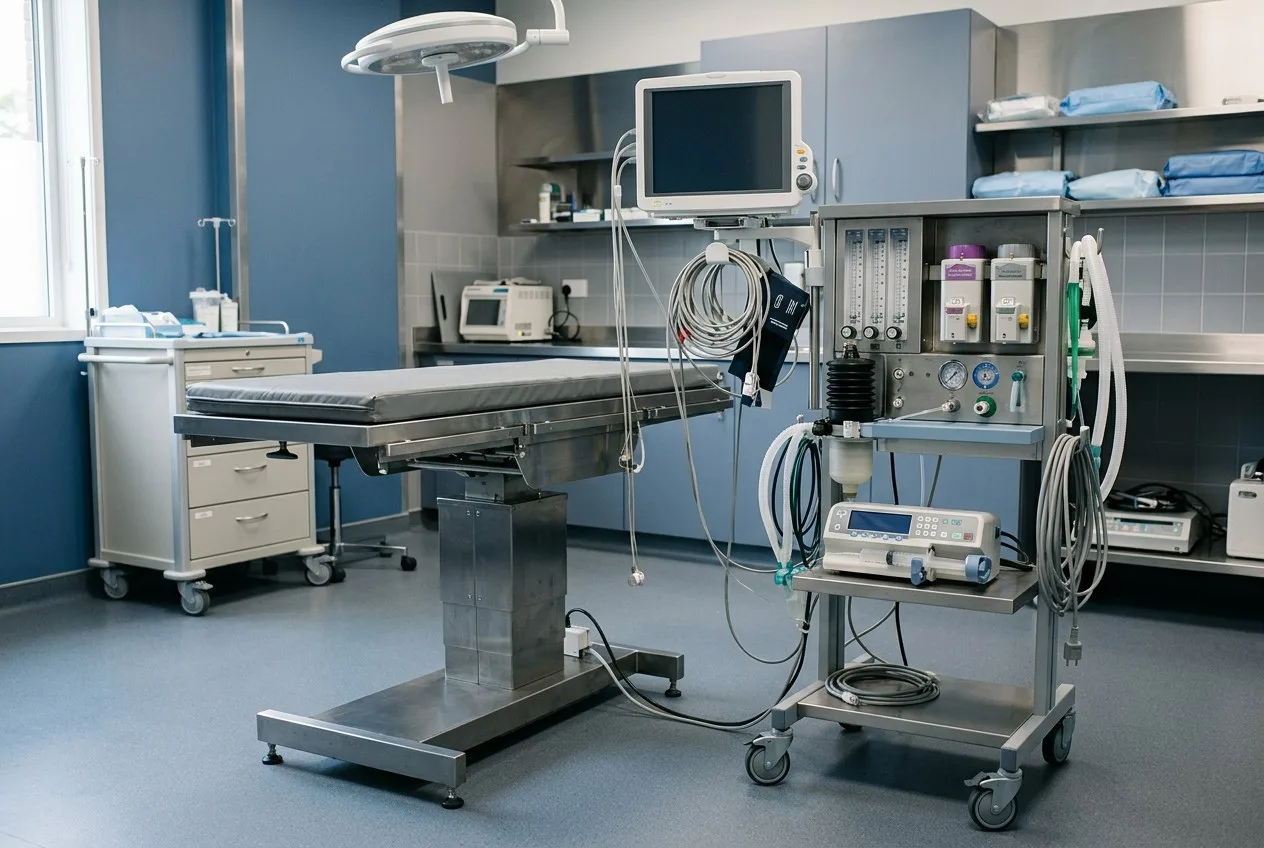
The anesthesia device is one of the most critical loads in the clinic. Many models have a built-in backup battery; but which parts this battery feeds, how long it lasts, and what happens when it wears out vary from device to device. A study on this subject, that providers mostly do not know the battery capacity and runtime of local devices reveals. In the same study, Some monitors connected to the device do not have a battery backup. It is stated that it creates a disadvantage at the time of outage.
In an operating room outage case in the NIH archive, the anesthesia device and monitor, with a source that operates independently of the room's grid The process could be continued because it was fed. The conclusion of the same article, the physician needs to know exactly which parts of the machine are connected to backup power. emphasizes its importance.
Basic approach for anaesthesia line
- A separate and marked line: The anesthesia device, monitor and infusion pumps should be fed from the same UPS circuit; these sockets should be separated by color or label. This approach is based on Connecting the anesthesia machine with all monitors and pumps to a UPS-protected circuit It is in line with the recommendation.
- The internal battery is the second layer: Even when the UPS is running, the device's own battery should be kept ready; these batteries should also be tested.
- Not mixing loads: High-power devices such as heating pads, autoclaves, and brooms should not be installed on this line.
- Manual attendance plan: For electronic flow-controlled devices, it may be possible to switch to manual mode in the event of a power loss; this information should be within the team. The device manual is taken as a basis.
Which type of UPS is suitable?
In places where interruption and voltage distortion cannot be tolerated, such as the operating room, online (double conversion) UPS is generally preferred; because the load is fed through the inverter at any time and no passage gap occurs. Difference between types UPS types in our article You can find it in detail. Medical devices are designed according to safety standards such as IEC 60601-1; This standard covers basic safety and basic performance requirements for medical electrical devices . The UPS itself is not evaluated by this standard, but by the IEC 62040 series. Within the scope of this series IEC 62040-3 specifies the performance and testing requirements of UPSs . It is important for the clinic to evaluate the device manufacturer's recommendation on the UPS connection and the ground/insulation conditions on the same line. Regarding grounding Our UPS grounding article guides.
Patient Monitor, Pump and Heating Systems
Monitors, pulse oximeters, capnographs, blood pressure monitors, infusion and syringe pumps are low-power, but they are the most commonly looked at devices in case of outage. Some have an internal battery, some do not. Therefore, the question "What happens when the network is cut off?" should be written down one by one for each device.
| Device | Risk in outage | The UPS strategy |
|---|---|---|
| Anesthesia device / ventilator | Loss of ventilation and gas flow | Separate UPS line + internal battery |
| Patient monitor | Discontinuation of vital sign monitoring | Line with UPS; high priority if it does not have an internal battery |
| Infusion/syringe pump | Cessation of drug administration | Built-in battery + line with UPS |
| Heating pad / air heater | Risk of hypothermia | Not powered by UPS; generator or alternative plan |
| Surgical lighting | Loss of vision | LED is low power, it can be taken to the line with UPS; emergency flashlight backup is a must |
Since the heating elements are resistant, they draw high power and consume battery time quickly. Instead of adding them to the UPS line, alternative plans such as cloth covers and hot water bottles are more suitable for the patient to warm up.
X-ray, Ultrasound and Other Imaging Devices
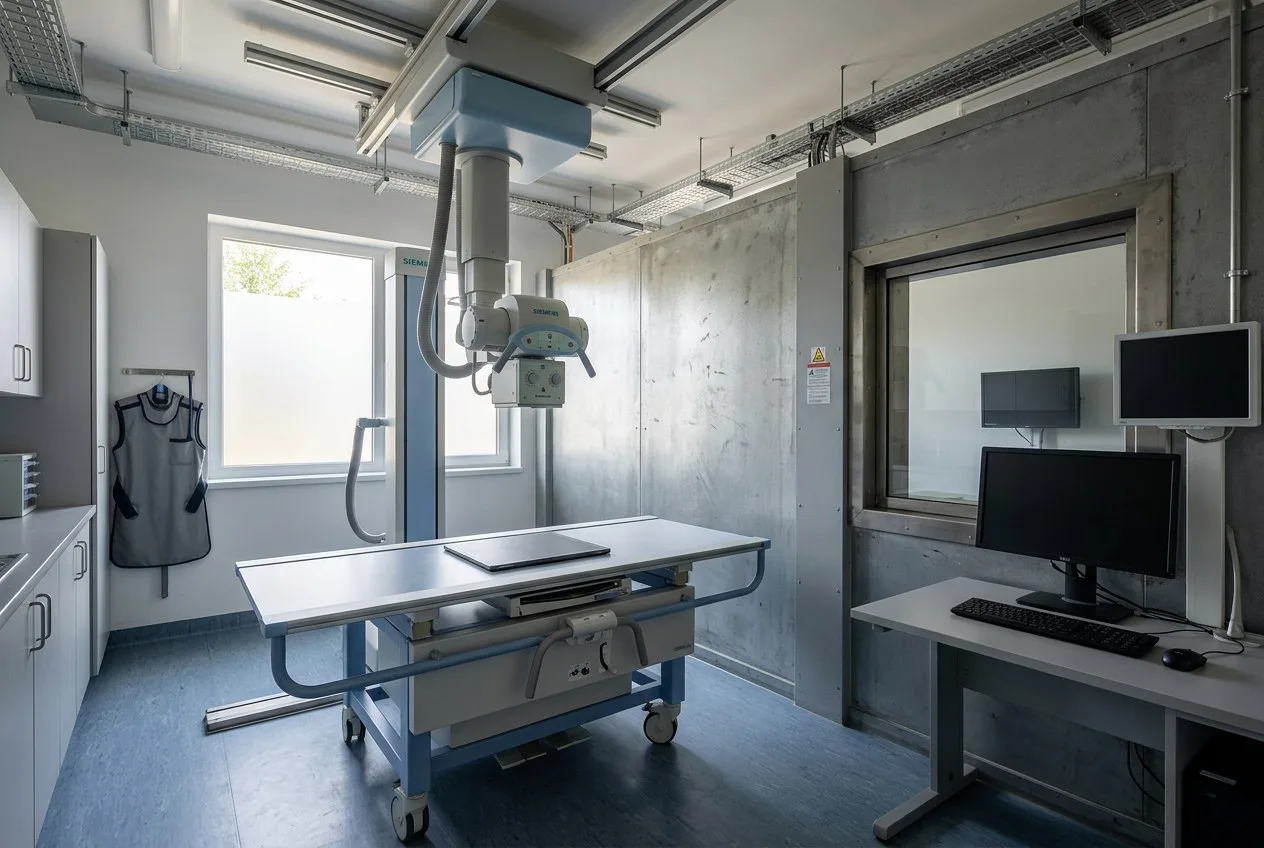
On the imaging side, the most important distinction is whether you want to protect the device itself or the connected computer and archive system. X-ray units have short-term high-current pulses at the time of shooting. A UPS manufacturer uses that medical scanners can request 3-4 times the rated load inrush current, and that the voltage must remain constant at this time. The same source states that that many scanners expect a very low impedance feed for a clear image also reminds us. For this reason, it is not right to commission a computer-type UPS without seeing the conditions of the x-ray manufacturer.
In practice, three approaches stand out for clinics:
- Leaving the device unprotected and only taking the image workstation to the UPS: If there is an interruption during shooting, the shot is repeated, but the computer and image files remain safe.
- Using a special UPS or conditioner approved by the device manufacturer: Required in large and high-power devices. For details UPS for medical imaging devices Look.
- Automatic transfer with generator: The main protection for X-ray and similar loads can be the generator; UPS only supports the control and data side.
Ultrasound devices are usually low-power and can be conveniently powered online or with a high-quality line-interactive UPS. However, the manufacturer's connection recommendation and total power rating should be checked for each model. To avoid confusing power units To our article explaining the difference between VA, kVA and watt You can look at it.
Vaccine Cabinet, Laboratory and Cold Chain
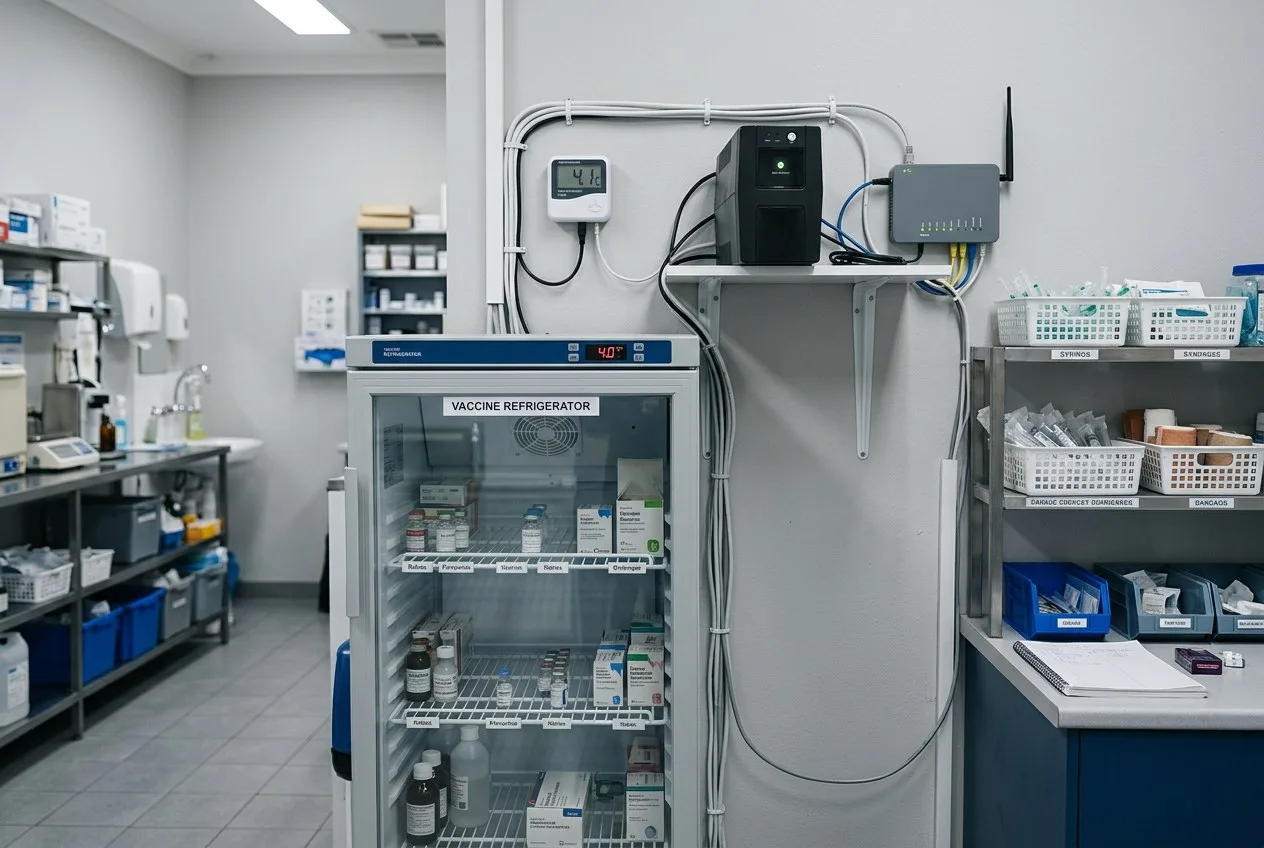
Vaccine and medicine cabinets are devices with compressors; they draw high current at the time of take-off and are generally not economical to connect to the UPS. What needs to be protected in these devices is the continuous monitoring of the temperature and the timely transmission of the alarm. A resource on temperature monitoring systems in healthcare facilities, That the UPS can help keep monitoring components afloat during short outages or generator changeovers and that the monitoring system should not be tried for the first time in real outage. emphasizes.
If there is an interruption during operation in laboratory devices (blood count, biochemistry analyzer, centrifuge), the test is repeated, and some devices require recalibration. If the analyzer's computer and itself are low power, they can be taken to the UPS line; load analysis should be performed for motorized devices such as centrifuges. Note that there is a general limitation on connecting loads that draw inrush currents such as motors, air conditioners and printers to the UPS.
Clinic Software, PACS and Network Infrastructure
Patient cards, appointments, treatment notes, billing, and image archive; all connected to a server, a network switch, and an internet connection. Unexpected shutdown can corrupt this data. A veterinary software provider may use the server and switch to a UPS of at least 1500 VA and server UPS is usually enough to run for 20-30 minutes. recommends. These figures may not be applicable per clinic as they come from the manual of a particular software; nevertheless, they are a good reference for considering the target time and power level for the server.
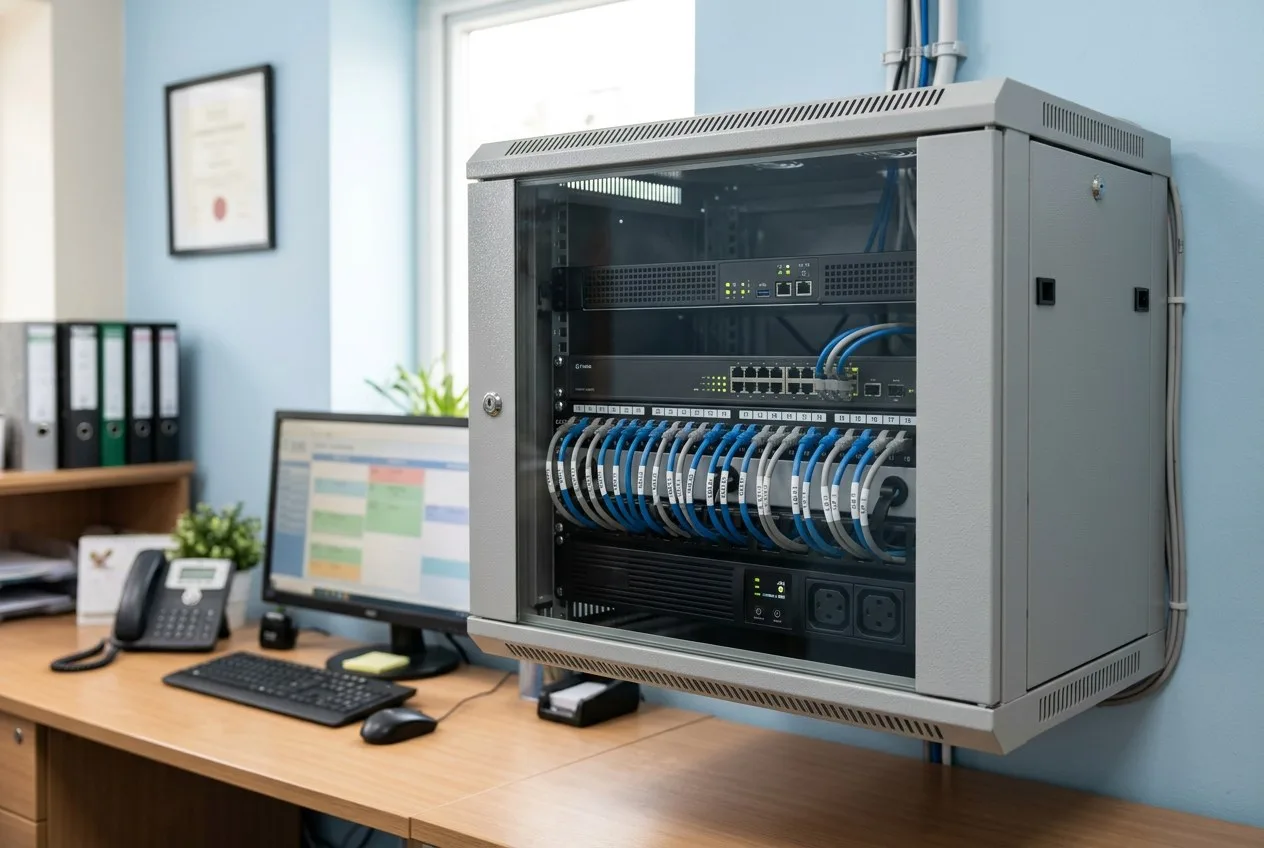
- Automatic shutdown: The UPS network card and monitoring software can safely shut down the server when the battery is low. For installation details Our guide to automatically shutting down servers Look.
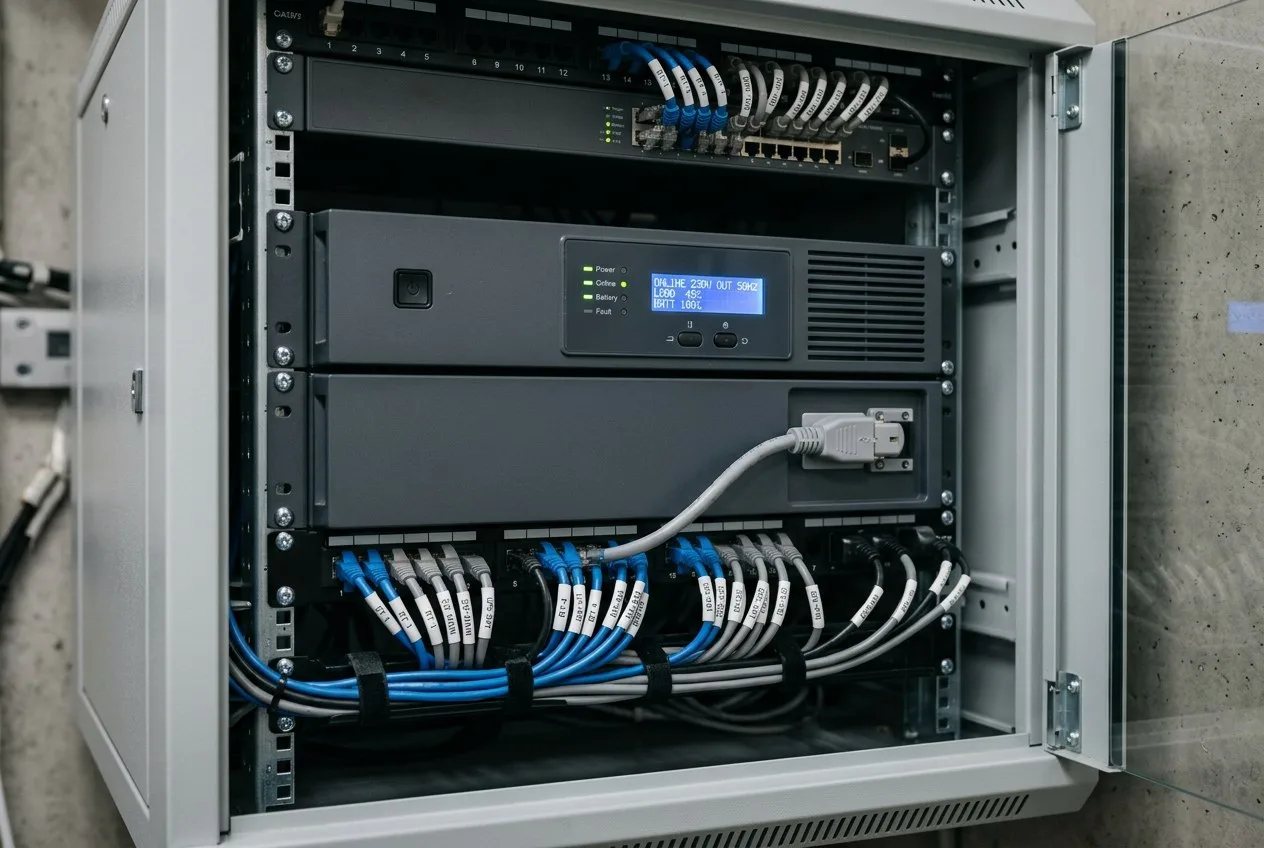
- Network devices: The switch, router and modem must be connected to the same UPS; otherwise, access will be lost even if the server is running.
- Laser printers: It should not be in UPS sockets as they draw high inrush current.
- Camera and alarm: A separate approach for security cameras and recorder security camera UPS in our article is explained.
Example Calculation: UPS and Battery Sizing for the Operating Room Line
The following calculation is a conceptual example; the actual device powers must be taken from the labels and measurement.
Assumptions
- Loads to be protected: anesthesia device and ventilator 150 W, patient monitor 60 W, syringe pump 30 W, LED surgical lamp 100 W, clinical laptop 60 W.
- UPS output power factor 0.9; inverter efficiency 90%.
- Target backup time: 30 minutes. Battery depth of discharge (usable capacity rate) 80%. Battery aging allowance 20%.
- Battery system 24 V (two 12 V battery series).
Step-by-step calculation
| Step | Process | Conclusion |
|---|---|---|
| 1. Total load | 150 + 60 + 30 + 100 + 60 | 400 W |
| 2. Apparent power | 400 W / 0.9 | approx. 445 VA |
| 3. Safety margin | 445 VA x 1.25 | approx. 560 VA; in practice, an online UPS of 1000 VA class is evaluated |
| 4. Required energy | 400 W x 0.5 hours | 200 Wh |
| 5. Battery output (efficiency) | 200 Wh / 0.9 | approx. 222 Wh |
| 6. Nominal capacity (DoD) | 222 Wh / 0.8 | approx. 278 Wh |
| 7. Aging allowance | 278 Wh x 1.2 | approx. 333 Wh |
| 8. Oh counterpart | 333 Wh / 24 V | approx. 14 Ah (at 24 V) |
Conclusion: With these assumptions, a load of about 560 VA and a battery capacity of about 14 Ah (24 V) for 30 minutes are required. Since chemistry, discharge rate and temperature affect the actual capacity, it is necessary to refer to the manufacturer's discharge tables for product selection. Explaining the logic of the calculation more broadly Check out our battery time calculation guide You can examine it. The sudden operation character of the anesthesia device and monitor may differ from the continuous operation value; therefore, get the power values from the device manual and measurement.
UPS Selection Criteria for Your Clinic
| By | What to look for? | Common mistake |
|---|---|---|
| UPS type | Online for bedside devices; quality line-interactive may also be sufficient for office and network | Getting a single, cheap UPS for the entire clinic |
| Power (VA/W) | Actual load measurement + 20-30% margin + growth share | Guessing without summing the maximums on the device tag |
| Backup time | Generator presence and longest critical operation | Mistaking the "full load" time in the catalog for real time |
| Output waveform | Pure sine output for sensitive devices | Connecting a cascading sine output UPS to a medical device |
| Inrush current capability | Manufacturer requirement for x-ray, compressor, engine loads | Installing these loads in the computer UPS |
| Battery technology | Sealed lead-acid or lithium; ambient temperature and maintenance availability | Just looking at the initial purchase price |
| Monitoring | Network card, SNMP, email/SMS alarm | The alarm does not reach anyone |
| Standard and document | Compliance with IEC 62040 series, CE; for details UPS standards article | Buying undocumented products |
To see the general election process step by step Our guide to choosing a UPS will also be useful. For small clinics at the practice scale Our Polyclinic and Practice Article It offers a simpler framework.
Installation, Layout and Occupational Safety
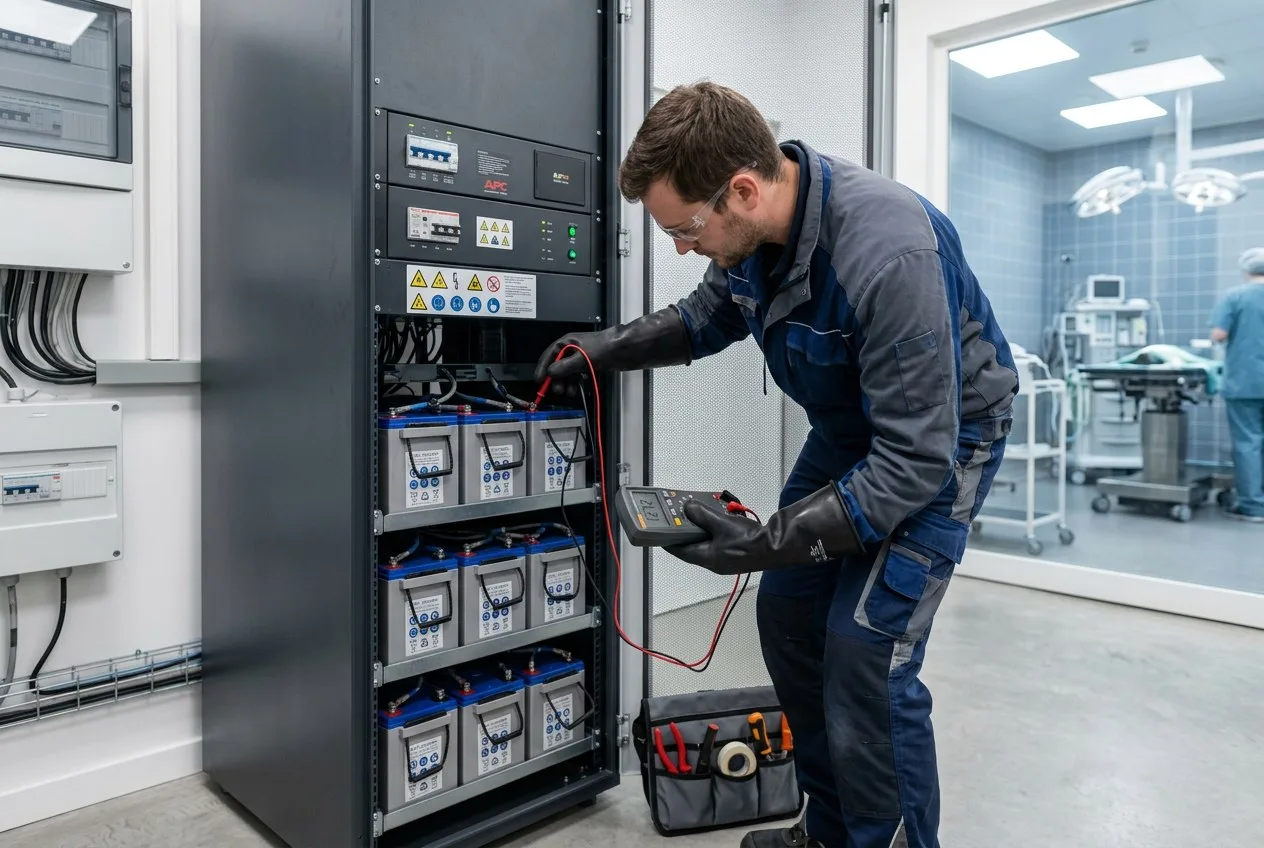
UPS and battery installation must be done correctly as they are part of a critical medical line. Wiring, panel preparation, output protection elements and selectivity should be considered separately in places such as operating rooms. UPS and battery works involve high current and DC voltage; these works should be done by authorized electrical personnel or technical service, not with a do-it-yourself approach.
- Layout: The UPS should be in a dry, cool and ventilated area. A hot environment shortens the battery life. A source is also poor thermal management can reduce battery life and UPS capacity states.
- Hygiene and humidity: In areas where washing and disinfection are carried out, the UPS should be positioned away from splashing water; if necessary, it should be taken to a technical room outside the hygienic zone.
- Fire and safety: If lithium batteries are to be used, the cabinet, ventilation and distance conditions are determined by the manufacturer's instructions.
- Labeling: UPS sockets and lines should be clearly marked; personnel should be prevented from accidentally plugging in heaters or vacuum cleaners.
- Discovery before installation: For load list, panel status and space conditions Our technical discovery article It is a checklist.
Maintenance, Testing, and Downtime Procedure
The weakest link in the UPS is the batteries. In most clinics, the UPS operates silently for years; when the first outage comes, it is understood that the battery is dead. Therefore, it is necessary to plan the maintenance and testing of the UPS. A resource written for healthcare facilities, That in places where UPS is trusted, the expected uptime, battery status, maintenance and replacement should be known. he says.
| Control | Frequency (typical) | Who does it? |
|---|---|---|
| Panel and alarm control | Weekly / monthly | Clinical staff (visual only; no intervention) |
| Ambient temperature and cleanliness | Monthly | Clinic staff + technical service |
| Battery voltage and internal resistance measurement | Once a year or more often | Authorized technical service |
| Autonomy / discharge test | Once a year, more often depending on the risk situation | Authorized technical service |
| Fan, capacitor and linkage control | In periodic maintenance | Authorized technical service |
| Deduction rehearsal (procedure) | Every 6-12 months | Team + technical responsible |
Frequencies are typical; they should be determined based on manufacturer recommendation and your risk. To prepare a plan Our Care Plan Guide, for duration verification autonomy time test article you can use it. It is important to manage the risk of interruption during the test; the test should not be done on the days of surgery, and a temporary backup plan should be prepared.
Downtime procedure: what should the team do?
- Verify the patient's airway, ventilation, and vital signs monitoring; remember which device is powered from which source.
- Check the UPS alarm and the remaining time display.
- If there is a generator, verify that it has been activated; if not, follow the plan to end the process at a safe point.
- Use manual ventilation and lighting backup where necessary.
- Shut down servers and computers securely; take note of logs.
- Review the UPS log and temperature logs after the outage.
It is important that this flow is written and repeated regularly. A resource on emergency planning, that plans will not work if they are not remembered by the team or never learned specifies. For a broader view business continuity planning You can look at it.
Common Mistakes and Solutions
| Error | Conclusion | The truth |
|---|---|---|
| Connecting everything to one UPS | Overload, short time, incorrect load priority | Separate line for operating room, network/server and auxiliary loads |
| Plugging the heater and compressor into the UPS | Battery drains in minutes, overload alarm | Leaving these loads to the generator or alternative plan |
| Not testing the battery at all | UPS shutting down in minutes at first real outage | Annual measurement and discharge test |
| No one watches the alarms | Not recognizing the problem | Network card and notification; Definition of responsible person |
| Forgetting the appliance inner battery | False trust with a battery that has weakened over the years | Comply with the manufacturer's maintenance schedule for the internal battery |
| Battery replacement on your own | Arcing, burning, incorrect polarity, loss of warranty | To have it done by an authorized technical service |
The need may be different in large or livestock-oriented enterprises; farm loads such as ventilation, incubation and milking Uninterrupted power for poultry and livestock facilities in our article We discussed.
Getting Support from Bempower
On-site exploration is the healthiest way to clarify which device should be protected with UPS in your clinic, and the actual load and time calculation. Bempower provides sales, installation, periodic maintenance and technical service for all brands of UPS and battery groups; It offers on-site support in Istanbul and surrounding provinces. For discovery request or status check of your existing system From our contact page You can contact us.
- A Case of a Power Failure in the Operating Room — NIH / PubMed Central, 2008. https://pmc.ncbi.nlm.nih.gov/articles/PMC2527046/
- The Anaesthetic Machine - Power supply — anaesthesia.uk.net, 2025. https://www.anaesthesia.uk.net/Trusts/BLT/BLSA/Part1/Machine/electrical.html
- IEC 62040-3:2021 Uninterruptible power systems (UPS) - Part 3: Method of specifying the performance and test requirements — IEC Webstore, 2021. https://webstore.iec.ch/en/publication/60140
- IEC 60601-1:2005+AMD1:2012+AMD2:2020 CSV Medical electrical equipment - General requirements for basic safety and essential performance — IEC Webstore, 2020. https://webstore.iec.ch/en/publication/67497
- The importance of UPS for medical equipment — Power Control Ltd, 2018. https://www.powercontrol.co.uk/news-blog/blog/the-importance-of-ups-for-medical-equipment/
- Veterinary Emergency Preparedness: Creating a Plan — IDEXX, 2025. http://software.idexx.com/resources/blog/veterinary-emergency-preparedness-creating-a-plan
- Why Temperature Monitoring Systems Fail During Power Outages — ICARE Monitoring, 2026. https://icaremonitoring.com/why-temperature-monitoring-systems-fail-during-power-outages-and-how-healthcare-facilities-can-prepare/
Resources
