UPS for Universities and Campuses: Distributed Infrastructure, Laboratory Devices and Computing

A university campus is a small city in terms of electricity. The IT department's data center carries the entire campus's network and student systems; each faculty has its own weak current rooms, computer labs, and servers; research labs have weeks of experiments, expensive analyzers, and freezers; dormitories, dining halls, libraries, sports facilities, and security systems are scattered in separate buildings. The biggest problem with UPS at this scale is administrative, not technical: hundreds of UPSs, dozens of different owners, and batteries that no one knows the full list of. This article explains how UPS is layered on campus, how to manage clutter, and what to look out for in lab devices. For school-scale UPS for schools and training centers You can look at the article.
UPS Tiers on Campus
| Layer | Owner | Typical solution |
|---|---|---|
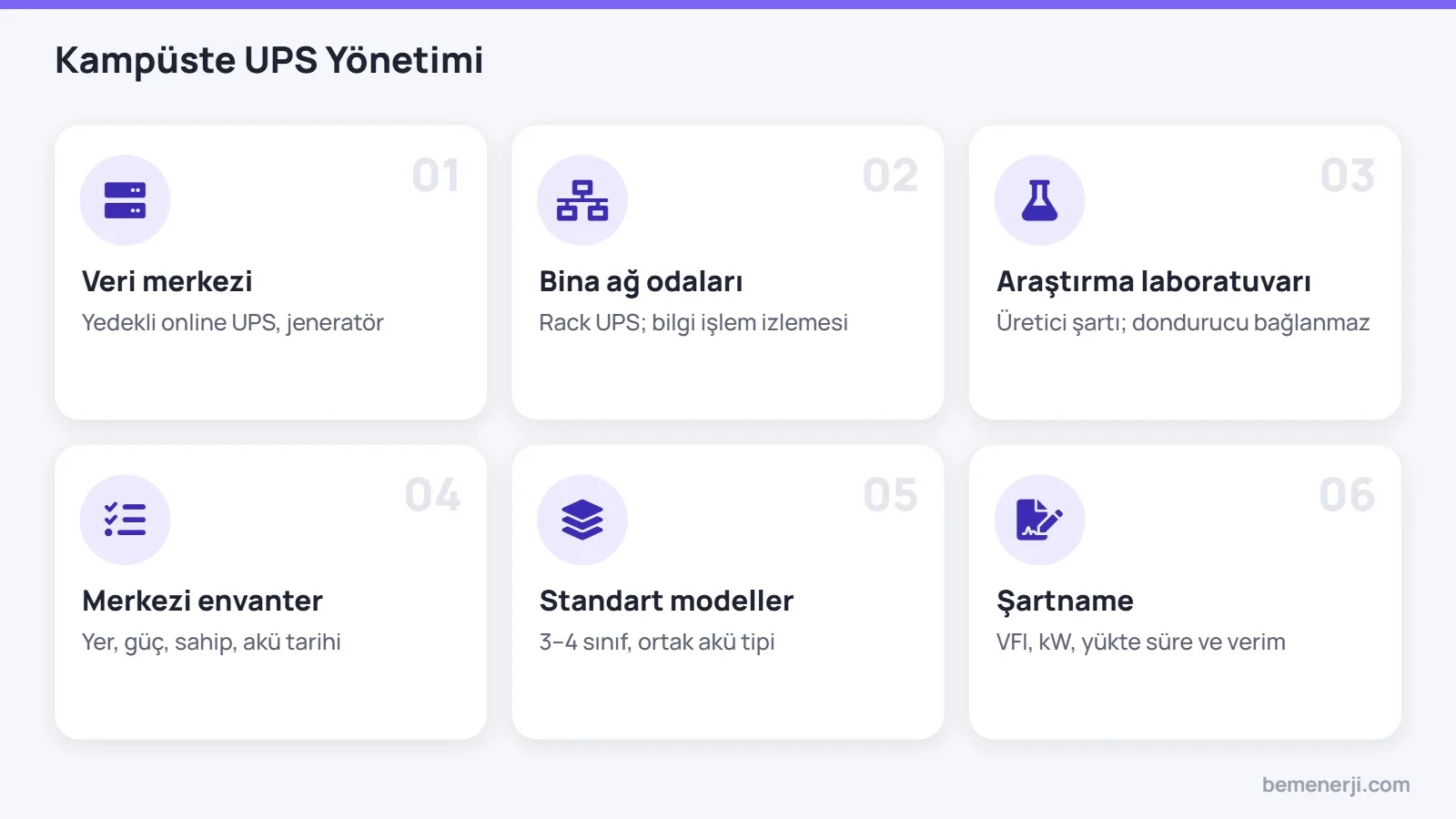
| Data Center | Computing | Redundant online UPS, generator; data center design |
| Building network and weak current chambers | IT or construction works | 1–6 kVA rack UPS |
| Faculty servers and computer labs | Faculty | 3–10 kVA per laboratory |
| Research Instruments | Research group/laboratory | According to the device manufacturer's requirement |
| Security, turnstile, camera | Security unit | UPS in district cabinets |
| Dormitory, dining hall, library | Related unit | Small UPS for cash register, turnstile, automation |
The design of the data center is a separate engineering subject and has its own rules, from redundancy to generator integration; it is UPS design for data center We explained it in the article. The focus of this article is on the scattered layers outside of it, because that's where the problem arises most.
The Real Problem: Ownership and Inventory
UPSs on campuses are purchased by different units in different years, from different budgets. A faculty puts a UPS in its laboratory with its project budget, the IT buys another brand in its cabinets, and the security unit brings a third UPS with a camera system. Five years later, there are hundreds of UPSs on campus and the battery age of none of them is known; in an outage, it is only after the outage that it is understood which ones work. The solution is three-step. The first is a central inventory: the location, power, owner, battery installation date of each UPS are on a list. The second is remote monitoring: UPSs with network cards are connected to the monitoring system of the IT system, battery failure and battery operation alarm fall to the center; this is UPS remote monitoring and alarm management We explained in the article. The third is a single maintenance plan: all UPSs are measured by the same team at least once a year, and battery replacements are scheduled. How to install maintenance in multi-location structures UPS maintenance management in multi-location businesses We discussed it in the article.
Standardization
Reducing UPS models to three or four classes on campus provides the biggest savings in the long run: a rack model for cabinets, a medium power model for laboratories, a large model for buildings, and common battery types. Thus, the stock of spare batteries and parts is reduced, the technical team encounters the same device in every building, and the change accelerates in case of failure. The standard is written by IT or construction works and is also applied to the units' own purchases.
Research Laboratories
In laboratory devices, the UPS decision is made according to the device itself and often the manufacturer has a condition. Some analyzers, chromatography systems and imaging devices require a UPS with their own control computers; some are only under warranty with a certain type and size of UPS. In experiments that last for weeks, interruption means that the experiment is restarted; the time target for these devices is set according to the time when the experiment can be safely stopped or the generator will be activated. Deep freezers, incubators and air conditioning are compressor or heated loads; they are not connected to the UPS and are protected by a generator and temperature alarm. This subject cold chain monitoring and UPS In his article, he explained the details of laboratory devices UPS for laboratories and pharmaceutical companies We discussed it in the article.
What Should Be Written in the Tender Specification?
In public universities, UPS procurement is made with a specification and the language of the specification determines the result. Only a specification that says "10 kVA UPS" brings the cheapest device. A short checklist includes: compliance with the UPS family of standards (TS EN 62040 series), online double conversion (VFI) topology, output power and output power factor in kW, efficiency at certain load rates, battery duration at certain load (such as "15 minutes at 10 kVA"), battery type and design life, maintenance bypass, network card and monitoring, on-site installation and commissioning, warranty and maintenance coverage, availability of spare parts. If the duration and efficiency are not written together with the load ratio, no comparison can be made. Common points about specification in public institutions UPS for municipalities and governments We also discussed it in the article.
Battery Rooms and Large Groups
With the growing need in faculty buildings, the battery pack of the UPS, which was initially placed in a closet, grows over time and overflows into a corridor corner or warehouse. Large battery banks have ventilation, temperature and access conditions; batteries placed in a warehouse without these are both short-lived and pose a safety risk. Guidelines Battery Room Ventilation and Safety We explained it in the article.
Dormitories, Dining Hall and Library
The structures of the campus other than education are also affected by the outage. When the cafeteria turnstiles and card payment system stop, students cannot enter the meal; the library's automation and loan system is closed; access control, cameras and internet are lost in the dormitories. The load of these points is small; a few kVA UPS is sufficient for each, but they all need to be included in the inventory and maintenance plan. How turnstile and card access behave during interruption UPS for access control systems We explained it in the article.
In the delivery-acceptance of new buildings, the recording of UPSs in the inventory and the interruption trial should also be written in the specification.
Common Mistakes
- Each faculty receives a separate brand and model; backup and maintenance are distributed.
- Connecting the precision laboratory instrument to a small desktop UPS; no manufacturer's requirement is required.
- Trying to connect the freezer or incubator to the UPS.
- Placing large battery banks in warehouses without battery room.
- Not keeping a central inventory; battery ages are unknown.
- To write the duration and efficiency in the specification without the load rate.
To inventory and collect scattered UPSs on your campus into a single maintenance plan to our maintenance plans or You can contact us.
The problem on campus is ownership, not device

Frequently Asked Questions
01Centralized or distributed UPS on campus?
02Which UPS for laboratory instruments?
03How often does the battery change?
04What should be written in the specification?
Inventory and Maintenance for Your Campus
Let's inventory and measure the UPSs on your campus, let's set up the change schedule and single maintenance plan together; For on-site projects in Istanbul and surrounding provinces, and for industrial-scale projects in distant cities Contact Us.