UPS for PLC and Industrial Automation Systems: 24 V DC UPS or AC UPS?

When the power goes out on a production line, the first thing to stop is the PLC. The line is left in a confused state at that moment: some product is inside the machine, the valves are half-open, the arrangement on the conveyor is broken, the operator panels are blacked out. Restarting the line when the power is restored often means unloading the machines, referencing them and going step by step; this can be hours, not minutes. In automation, the purpose of the UPS is not to keep the line running, but to ensure that the control system stops regularly, data is recorded and the power is restored quickly. There are two ways to do this: a 24 V DC UPS in the cabinet or an AC UPS in front of the panel. This article compares the two. For the overall power layout of the factory use of UPS in factories You can look at the article.
What Happens in Automation in Downtime?
- PLC stops: The program may not be able to continue from where it left off; some values are lost.
- HMI and SCADA connection is broken: The operator cannot see the status of the line; the alarm history remains incomplete.
- Process data is lost: Batch registration, production counters, quality data.
- The communication network drops: When industrial switches turn off, remote I/Os and drives cannot see the PLC.
- The restart extends: The machines are unloaded, referenced, and operated step by step.
Two Ways: 24 V DC UPS and AC UPS
| 24 V DC UPS / buffer module | AC UPS (at the panel entrance) | |
|---|---|---|
| Where? | Inside the cabinet, on the DIN rail, at the output of the 24 V power supply | In front of the 230 V supply of the cabinet |
| What does it feed? | PLC, I/O, sensors, industrial switch — everything that works with 24V | PLC + HMI + industrial PC + 230 V devices |
| Energy storage | Small battery or supercapacitor | Battery pack of UPS |
| Typical duration | From seconds to a few minutes; its battery is longer | Minutes; by battery group |
| Performance | High; no double conversion | Lower; AC–DC–AC conversion |
| Care | Battery or capacitor replacement in the panel | UPS maintenance and battery replacement |
| Best suited for | 24V control layer only | If you have 230 V industrial PC, HMI, network devices |
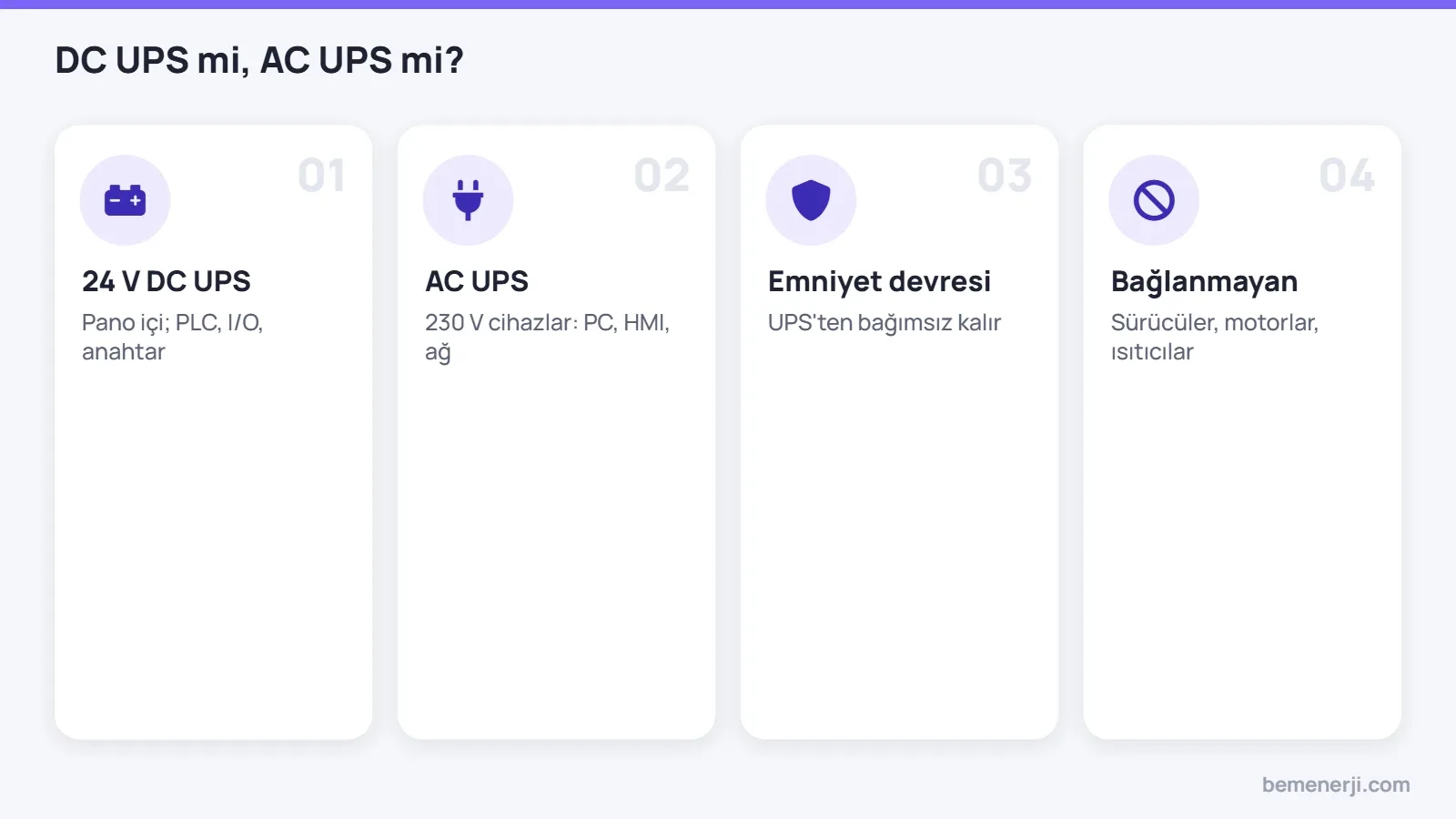
The rule of thumb is simple: if everything to be protected is powered by 24 V DC, a DC UPS is the most efficient and smallest solution; it is connected to the output of the 24 V power supply, and in the event of an outage, the PLC, I/O and switches continue to operate for a few minutes. Models with supercapacitors do not require battery maintenance, but their duration is limited to seconds; just enough for the PLC to record data and shut down properly. If the panel has a 230 V industrial computer, operator panel or SCADA client, AC UPS is required. In large cabinets, both are used together: the control layer with DC UPS, 230 V devices with AC UPS.
What to protect and what not to protect?
The layer to be protected is small: PLC processor and I/O boards, operator panel, industrial switches, sensor supply; 50–500 W total in most cabinets. Motor drives, frequency converters and motors are not connected to the UPS; they either stop safely or are supplied by the plant's generator. Valve and contactor coils require special attention: if the process design provides for the valves to move to a safe position in the event of an interruption (e.g. closing of a spring-return valve), the UPS's continued supply of these coils may disrupt that safety design. Which output is fed from the UPS is determined by the process engineer's design.
Safety circuits are independent of the UPS
The emergency stop, light curtain, door locks and safety PLC are designed according to machine safety standards and guarantee the safe stop of the machine in the event of an outage. The UPS must not alter the behavior of these circuits. Feeding the safety PLC with the UPS and saying "let it work in an outage" can mean circumventing the outage scenario of the safety design. The place of the UPS is in the control layer outside the safety; the safety circuit remains with its own design conditions.
Robotic Lines
In automotive and packaging lines, it is a requirement for the robot manufacturer how the robot controllers behave in an outage; some controllers have their own buffer energy and safe stop function, some require a specific UPS structure. Conveyor PLCs, image processing computers and the line control server are protected by standard rules. Since the cost of restarting a robot line is high, it is aimed that the control layer never closes when switching to the generator. Feeding the line control and monitoring center UPS for control rooms and SCADA We explained it in the article.
AC UPS Inside the Board: The Heat Problem
AC UPSs placed inside the panel most often fail prematurely due to heat. The inside of a closed automation panel can reach 45-50 °C in summer due to the heat of the drives and power supplies; at this temperature, the battery life decreases to one or two years. If an in-panel UPS is to be chosen, a model operating in the industrial temperature range is preferred, considered together with the ventilation or air conditioning of the panel, and the UPS is placed in the coolest area of the panel. Easy access for battery replacement and a bypass switch that will carry the load without disabling the UPS should also be planned. The importance of grounding in the industrial environment UPS grounding, the effect of harmonics What is harmonic We explained it in his articles.
Duration Target
In automation, the time target is determined according to regular downtime: PLC recording data, HMI and SCADA client shutting down properly, communication waiting for the transition to the generator. A few minutes is enough in systems with generators; in systems without generators, the control system is regularly shut down for 10-15 minutes. A buffer module of a few seconds only covers short interruptions and voltage drops; in case of a long interruption, the PLC still shuts down, but records the data.
Each new card or device added to the panel changes the load and time calculation of the DC UPS; the load of the UPS must be kept up-to-date in the document of the panel.
Common Mistakes
- Waiting for 20 minutes from the supercapacitor buffer module.
- Running the AC UPS at 50 °C inside the panel and draining the battery in two years.
- "Circumventing" the safety PLC with the UPS.
- Feeding the valve coils from the UPS and disrupting the safe position design of the process.
- Forgetting industrial switches; PLC works, remote I/Os are not visible.
- No one knows the battery age of the UPSs in the automation panels.
How the battery and rectifier work together in DC power systems Battery and rectifier compatibility in DC power systems We explained in the article. For CNC machines UPS for CNC machines You can check the article. For the UPS layout of your automation panels Contact Us.
DC UPS if everything to be protected is 24 V

Frequently Asked Questions
01DC UPS or AC UPS for PLC?
02How many minutes does a 24 V DC UPS last?
03How to protect HMI and SCADA computer?
04Do motor drives connect to UPS?
05Should the safety PLC be connected to the UPS?
For Your Automation Panels
Let's determine together how to protect the control layer of your panels with DC or AC UPS; For on-site projects in Istanbul and surrounding provinces, and for industrial-scale projects in distant cities Contact Us.