UPS for Metro and Railway Stations: Signaling, Turnstile, Passenger Information and Camera

There are two distinct faces to power outages in rail systems. The first is the signaling and train control systems that manage the movement of trains; these are the most safety-critical systems and have their own redundant feeds, designed to their own standards. The second is the station itself: turnstiles, ticket vending machines, passenger information displays, announcement, cameras, emergency call points, elevators, and the station's monitoring system. In the event of an outage, especially at an underground station, the operation of these systems is vital for safely guiding passengers and evacuating them if necessary. This post deals with the station side; the supply of the signaling is subject to its own safety design, and we do not pass judgment here.
Signaling is kept separate
Signaling and train control systems are designed according to the level of reliability stipulated by railway safety standards; their supplies are also part of this design and usually consist of their own, redundant UPS or DC systems. The UPS of these systems is not confused with the general UPS of the station, it is not fed from the same panel, and the maintenance is carried out by the procedure of the system's own owner. It is important for a technical team working on the station side to know this limit: a change to the station UPS must not affect the signaling.
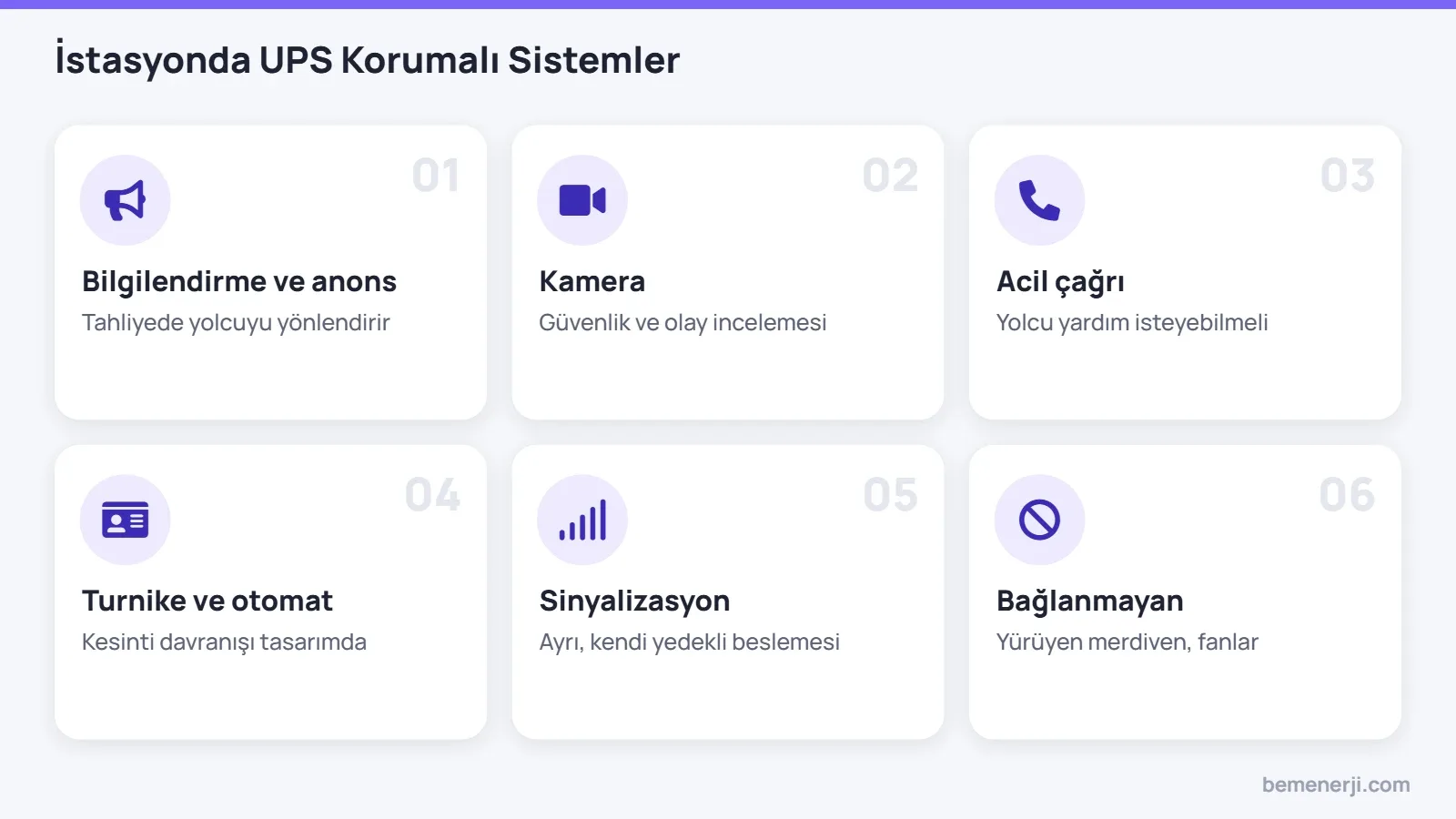
Systems Connected to the UPS at the Station
| System | Importance in interruption | Note |
|---|---|---|
| Passenger information screens and announcement | Guides the passenger in the evacuation | The most critical station system |
| Camera and recording | Security and incident investigation | From the regional cabinets |
| Emergency call points, intercom | Passenger asking for help | |
| Turnstiles and toll collection | Passage and registration; open position on evacuation | Interrupt behavior is determined by design |
| Ticket vending machines | Not leaving the sale and transaction unfinished | |
| Radio and communication | Staff coordination | |
| Station monitoring system | Central's view of the station | |
| Escalators, ventilation fans | — | does not connect to the UPS; recovery in the elevator is separate |
The turnstiles turning open during an outage is often a design requirement for evacuation; UPS does not change this behavior, but only ensures that the turnstiles operate normally throughout the outage and that passages are recorded. This dilemma UPS for access control systems We explained it in the article. The rescue mechanism of the elevators is fed from the elevator's own device, not from the station UPS; detail Elevator Rescue Systems in his article.
Duration Target: Evacuation and Bridge to Generator
The time target of the station UPS is set according to two things. The first is to bridge the passage to the generator or backup supply line; a few minutes is enough for this. The second and decisive one is the time required to evacuate the station if the backup supply does not arrive. During this period, passenger information screens, announcements, cameras, emergency calls and communication should work. The evacuation time is determined in the emergency plan of the enterprise according to the size, depth and passenger density of the station; The battery group of the UPS is sized to meet this period. Emergency lighting often works with its own battery or central emergency lighting system and is included in this calculation separately. Time calculation How to calculate battery time We explained it in the article.
Underground Environment
Underground stations are a challenging environment for UPS. Metal dust from the brakes of trains spreads everywhere and sticks to the fans and cards of the UPS; since it is a conductive dust, it can create leakage current paths and faults on the board. Humidity is high due to the effect of groundwater and ventilation. Vibration loosens the connections over time. Therefore, station UPSs should be kept in dust-free, air-conditioned technical rooms, their filters should be cleaned regularly, and their connections should be tightened during maintenance. Ventilation of underground battery rooms is also planned; Rules Battery Room Ventilation and Safety We explained it in the article. Fan and capacitor maintenance UPS capacitor and fan replacement You can find it in the article.
Standard and Tracking Along the Line
There are dozens of stations on a metro line and there are several UPSs at each station. Choosing a different model for each station makes spare parts and maintenance unmanageable in a short time. The right way is to determine a few standard models along the line, to set up redundant (N+1) order in the station technical rooms and to monitor all UPSs from the central control center. Control center's own supply UPS for control rooms and SCADA In his article, remote monitoring UPS remote monitoring and alarm management We explained it in the article.
Ticket Vending Machines and Fare Collection
Ticket vending machines and card filling machines may leave an unfinished transaction in an outage: the passenger's money may have been received but his card may not have been filled. UPS gives the vending machine time to complete the current transaction and safely stop taking new transactions. The station server and network connection of the fare collection system must also be on the same UPS; even if turnstiles and vending machines can operate offline, the transfer of transactions to the center is done when the connection arrives. The UPS of vending machines is usually located inside the device or on the line with the UPS from the station technical room; the second way is more organized in terms of maintenance.
Station Technical Room
In the technical room of each station, there are communication, network, camera recording and station monitoring systems. This room is the nerve center of the station and the UPS is installed with redundancy; its air conditioning should be on the backup supply line. The UPS of the technical room is also the source of the UPS lines going to the scattered devices in the station; the screens, cameras and emergency call points on the platforms are fed from here. In this order, the failure of a line affects only that area and the failure is monitored from the technical room.
In fact, if the same standard model and the same monitoring pattern are used when the new station is opened, the maintenance team will encounter the same device at each station.
Common Mistakes
- Mixing the station UPS with the signaling supply or feeding it from the same panel.
- Allowing brake dust to coat the UPS fans and boards.
- Not putting the discharge time in UPS longitudinal at all.
- Leaving passenger information and announcements outside of UPS.
- Using different model at each station; spare parts problem.
- Trying to connect an escalator or ventilation fan to a UPS.
For terminal systems of transport facilities UPS for airports You can check the article. Exploration, standard model selection and maintenance plan for your station systems: Contact Us.
Discharge time determines the size of the UPS

Frequently Asked Questions
01Is the signaling fed from the station UPS?
02Which systems should be in the UPS at the station?
03How to maintain a battery underground?
04How many minutes should station UPS last?
For Your Station Systems
Let's work together for the UPS inventory, standard model selection and maintenance plan of your station systems; For on-site projects in Istanbul and surrounding provinces, and for industrial-scale projects in distant cities Contact Us.