UPS For Medical Imaging Devices: Power Protection In Tomography, MRI, X-ray And Ultrasound

Medical imaging devices are the most expensive and electrically complex loads of the hospital. A tomography scans tens of kilowatts for a short time at the time of shooting, much less when it is on standby; the system that cools the magnet of the MRI has to work day and night; in digital x-rays, the generator cabinet requires instantaneous high power. For these devices, the approach of "100 kVA is written on the label of the device, let's buy a 100 kVA UPS" is both very expensive and often unnecessary. The correct method is to know which part of the device is susceptible to outage and what the manufacturer stipulates. This article deals with imaging devices one by one; for the general power system of the hospital UPS and battery systems in hospitals You can look at the article.
Why Is Generator Not Enough?
All hospitals have generators and these devices are in the generator line. But in the seconds until the generator is activated, the computers and control electronics of the imaging system shut down. It can take tens of minutes for a CT or MRI system to restart, perform its own inspections and be ready for use; for the patient who is taking the shot at the time, the scan is taken from the beginning, and in the case of tomography, this means an additional radiation dose to the patient. In the emergency room, these minutes can be vital. This is the main task of the UPS in the imaging device: that the control system never shuts down when the generator passes and that the shooting is not interrupted. The relationship between the generator and the UPS The difference between UPS and generator We explained it in the article.
Device Device: Which Partition is on the UPS?
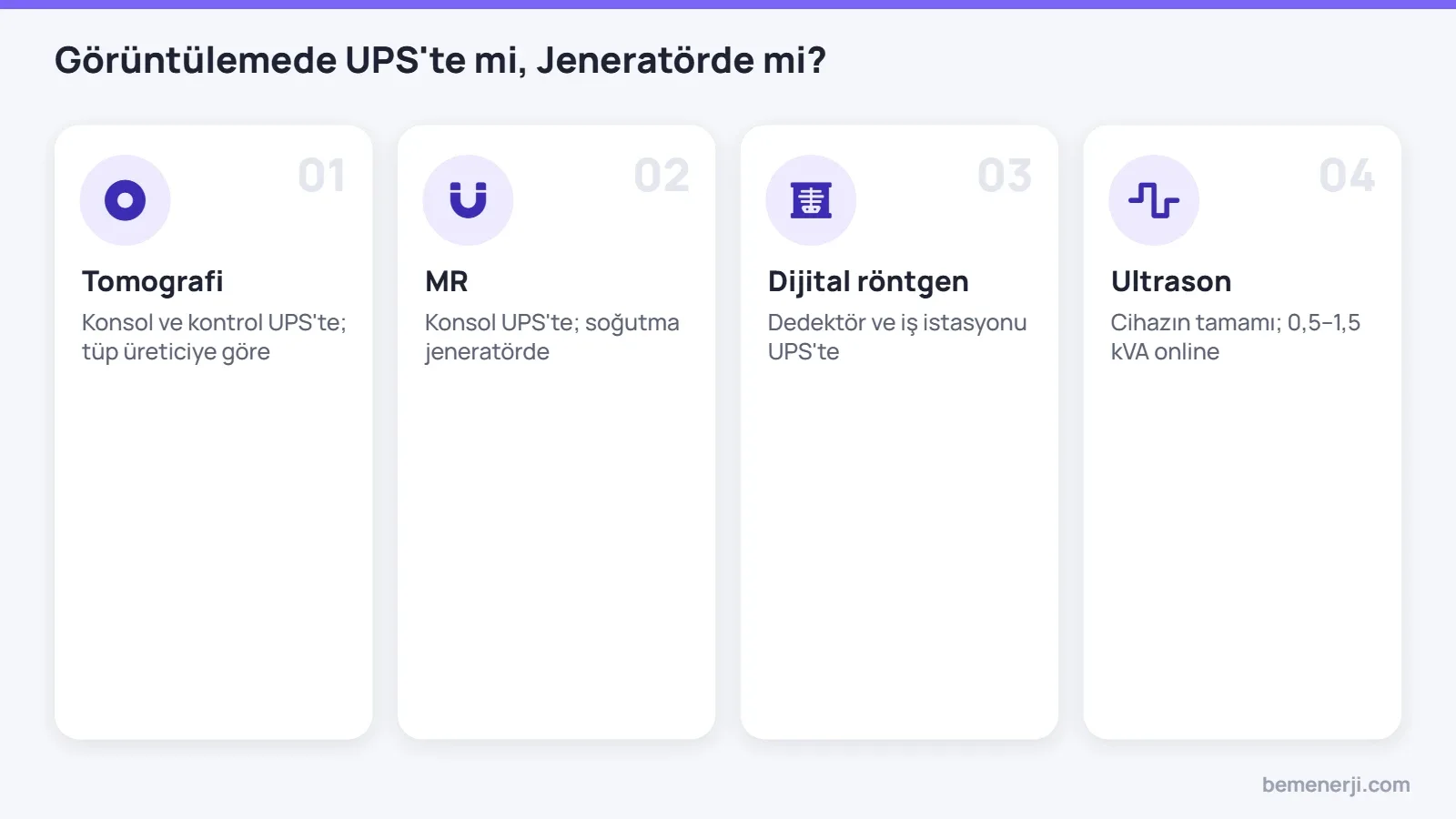
| Device | Connecting to UPS | Remaining in the generator | Note |
|---|---|---|---|
| Tomography | Console, control electronics, image generation computer; tube generator by manufacturer | Refrigeration, room air conditioning | Feeding the entire cylinder from the UPS is a manufacturer's condition and expensive |
| MR | Console, system cabinet; gradient electronics by manufacturer | Magnet refrigeration compressor and chiller | Cooling must continue uninterrupted; risk of helium loss |
| Digital X-ray | Detector, workstation, control | High power part of the generator cabinet (according to manufacturer) | Mobile X-ray is powered by its own battery |
| Ultrasound, mammography, bone density | Entire device | — | 0.5–1.5 kVA online per device |
| PACS, RIS, read workstations | All | — | System room UPS |
This table is a general orientation, not a rule; the manufacturer's document draws the boundary in each device. Particular attention should be paid to magnet cooling in MRI: if the system that cools the superconducting magnet stops for a long time, liquid helium is lost by evaporation, which is both very expensive and cannot be used for a long time. This cooling compressor is connected to the continuous generator line, not to the UPS, and the commissioning of the generator is planned with this load in mind.
Lengthing: Manufacturer's Certificate, Not Label
Manufacturers of imaging devices provide a site preparation or power requirements document before installation. This document states the continuous power of the device, peak power at the time of shooting, inrush current, voltage and frequency tolerances, allowable voltage drop and recommended structure if UPS is to be used. The UPS longitude starts with this document, if possible verified by the measurement made while the device is running, then the power factor and growth margin are added. In short, the method is as follows:
- Ask for the manufacturer's power requirements document; clarify the section to be connected to the UPS in the document.
- Write down the continuous power, shooting moment peak power, and take-off current separately; The short-term overload capacity of the UPS should meet the peak.
- Measure during shooting with a power analyzer on the current device.
- Set a time target: typically a few minutes to 10–15 minutes to transition to the generator and complete the shoot.
- Commissioning with the device manufacturer's service and try out the operation with the UPS.
Effect of power factor on kVA–kW relationship What is the power factor We explained it in the article.
Medical Space Rules
The electrical installations of hospitals are designed according to a standard specific to medical spaces (IEC 60364-7-710, TS HD 60364-7-710). This standard divides the spaces into groups according to the use of devices that come into contact with the patient and classifies how long it takes for the safety supply to be activated: there are time classes such as half a second for some loads and fifteen seconds for others. In areas where vital devices are in direct contact with the patient, isolated (IT) power systems are also used. The group and duration valid for imaging rooms are determined in the electrical project of the hospital; UPS is located within the framework of this project. We only refer to the standard here; the provision is in the project.
Central UPS or Per-Device UPS?
For large devices in the imaging center, the UPS per device ensures that each device is selected according to the manufacturer's requirements, and a malfunction affects only that device. A line from the central UPS of the hospital to the imaging department concentrates maintenance and monitoring in one place. Whichever route is chosen, maintenance bypass is essential: the imaging department also operates at night and it is often not possible to switch off the device for UPS maintenance. How bypass works What is UPS bypass We explained in the article. Large battery groups must comply with battery room rules; the maintenance of the UPS placed in radiation-protected rooms becomes difficult, the UPS must be located outside these rooms, in an accessible technical volume.
Maintenance and Trials
The UPS of the imaging devices is checked in coordination with the manufacturer's service of the device; A change to the UPS is notified to the device manufacturer. Annual load and time trials are scheduled for non-shooting hours; in large UPSs, the load bank trial verifies capacity without risking the device. Load bank testing What is Load Bank Test We explained it in the article.
Common Mistakes
- Saying "The device needs 100 kVA, 100 kVA UPS"; regardless of the manufacturer's certificate.
- Connecting the MR refrigeration compressor to the UPS or forgetting to take it to the generator line.
- Connecting an ordinary UPS to devices that come into contact with the patient without observing the rules of the medical space.
- Putting the UPS in a radiation-shielded room and making it impossible to maintain.
- Forgetting PACS servers and reading workstations; shooting is done, the image cannot be read.
- Failing to notify the device manufacturer of the UPS change.
For clinics using small-scale ultrasound and x-ray UPS for outpatient clinics and practices You can look at the article. For your imaging partition with the device manufacturer's document for discovery and installation Contact Us.
- IEC 60364-7-710 / TS HD 60364-7-710 — Rules for low-voltage electrical installations, special facilities and places: medical premises (with the name of the standard).
- IEC 60601 series — General rules for basic safety and performance of medical electrical equipment (standard name).
- Device manufacturer's site preparation / power requirements document — requested from the manufacturer at each installation.
Resources
The manufacturer's document draws the boundary

Frequently Asked Questions
01Is UPS mandatory for tomography?
02How many kVA UPS is required for tomography?
03Which part of MRI should be in UPS?
04Why do I need a UPS when there is a generator?
05How to choose a UPS for ultrasound?
For Your Imaging Section
Let's determine the sections and time to be connected to the UPS together with the device manufacturer's power certificate, and commission it together with the manufacturer's service; For on-site projects in Istanbul and surrounding provinces, and for industrial-scale projects in distant cities Contact Us.