UPS for Hotels: Reception, Card Encoder, PBX, Camera, and Generator Switching

A power outage at a hotel is a guest experience issue before it is a technical problem. Check-in cannot be processed at the front desk because the reservation system is down; room keys cannot be encoded; the telephone switchboard goes silent, and guests cannot reach the front desk from their rooms; the Wi-Fi goes out, interrupting a presentation in the conference room; and the surveillance camera system restarts. Most hotels have generators, but the 10–30 seconds it takes for the generator to kick in is enough time for all these systems to restart, and some do not recover on their own. This article explains which hotel systems should be protected by a UPS, how to set up the protection layers, and how to maintain the battery in seasonal hotels.
What Is Affected at a Hotel During a Power Outage?
| System | During the outage | Location of the UPS |
|---|---|---|
| Reservation / Hotel Management System | Check-in, check-out, and billing are on hold | Server and reception computers are connected to a UPS |
| Card encoder | The new room key cannot be programmed | At the reception UPS |
| Room door locks | Battery-powered; not affected | It's not necessary |
| Telephone switchboard | Room phones and outside lines go silent | UPS in the server room |
| Wi-Fi and Networking | Guest Wi-Fi, IP TV, payment | UPS in floor-standing cabinets |
| Cameras and Security | The recording ends | UPS in the security room |
| Elevator | The cabin comes to a stop | Separate: rescue system |
| Kitchen, laundry room, boiler room | Stops | Does not connect to a UPS; generator |
The rescue system for elevators elevator rescue systems In his article, the hotel restaurant's cash register and kitchen display UPS for restaurants and cafes We also discussed this in our article.
We Have a Generator—So Why a UPS?
The generator can handle a long power outage but cannot handle an instantaneous power switch. The time it takes for the generator to start up and take over, and for the transfer panel to switch over, is 10–30 seconds; during this time, computers shut down, the server restarts, and network switches begin their startup process. Some devices recover automatically when power is restored, while others will not function until technical personnel arrive. Additionally, the generator’s output is unstable in terms of frequency and voltage during the first few seconds; sensitive devices do not tolerate this well. A UPS bridges this gap: systems switch to the generator without ever shutting down. Even if the generator fails, the UPS’s runtime provides enough time for a controlled shutdown. The division of responsibilities between the two The Difference Between a UPS and a Generator As we explained in our article, why the generator output requires an online UPS harmonic and generator effects You can find it in his article.
UPS Layers in a Hotel
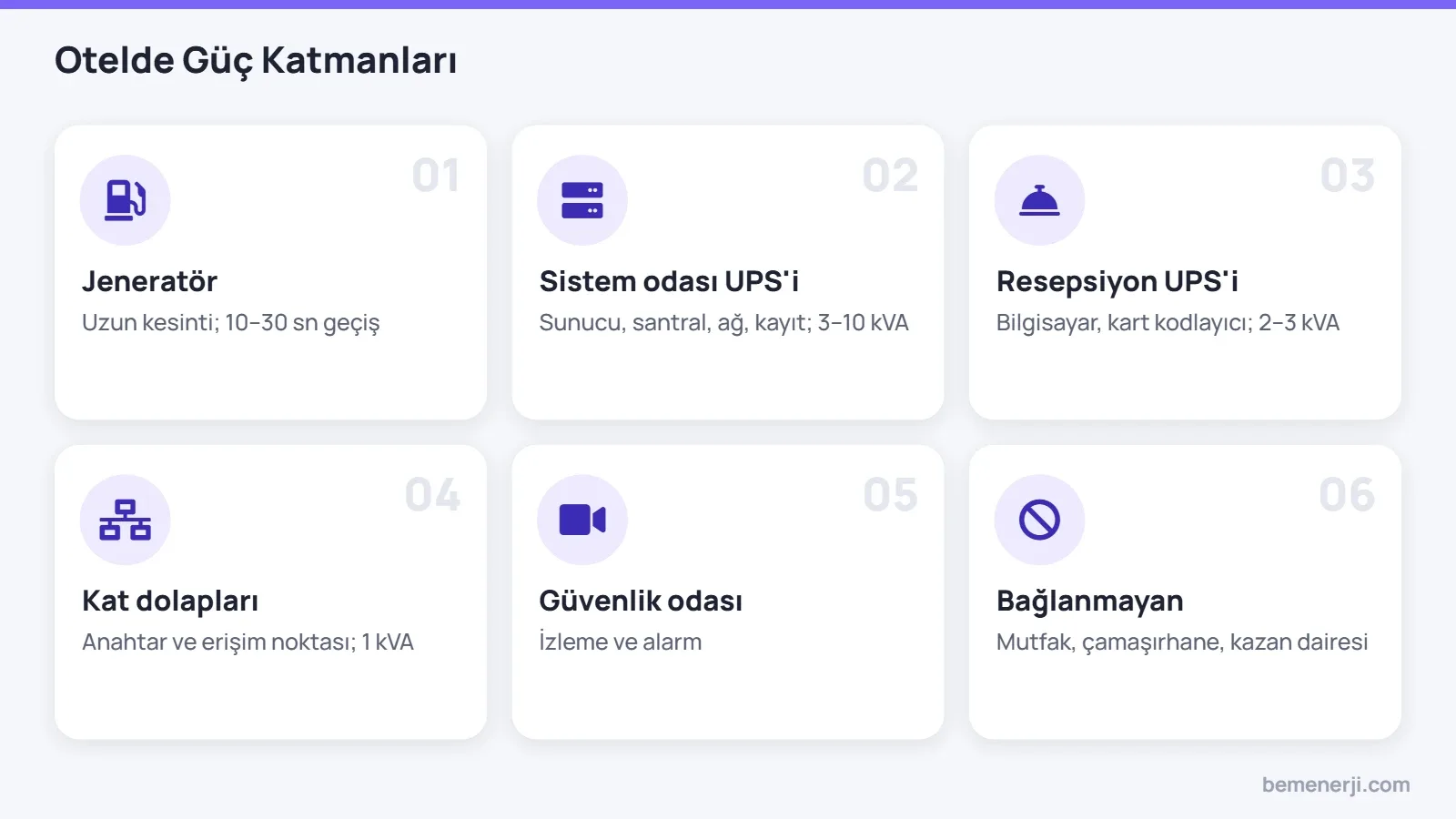
- Server room: The hotel management system server, telephone switchboard, core network switch, firewall, and video recording devices. A 3–10 kVA online rack-mounted UPS is standard here; in large hotels, two redundant UPS units are typically used.
- Reception and back office: Reception computers, card encoder, printer, payment terminals. A 2–3 kVA UPS powers this location.
- Floor cabinets: Network switches and PoE-powered access points on each floor. A 1 kVA rack-mounted UPS is sufficient; if there are a large number of cabinets, a maintenance plan becomes essential.
- Security room: Monitoring screens, camera clients, alarm panels. If not powered by the UPS in the system room, its own UPS.
Powering all floors from a single large UPS seems simple on paper, but it is generally impractical due to long cable runs, a single point of failure, and outdated wiring in the floor cabinets. A layered architecture is both reliable and scalable. How to calculate the PoE load in floor cabinets UPS for network and communication systems We explained this in our article.
Time Target
In a hotel with a generator, the UPS’s role is to bridge the transition and provide enough time for a controlled shutdown if the generator fails; 10–15 minutes is sufficient. In boutique hotels and guesthouses without generators, the target is extended to 30–60 minutes: the front desk and guest internet must remain operational for most of the outage, and security cameras must continue recording during nighttime outages. Since the load on floor panels is low, extending the runtime is cost-effective; however, if the system room is offline, the floor panel’s operation is meaningless—runtimes are adjusted relative to one another.
Seasonal Hotels: Battery During the Off-Season
At beach and ski resorts, where facilities remain closed for months, the biggest problem with UPS systems is not power outages but the batteries left in standby mode. If UPS systems are unplugged at the end of the season, the batteries will discharge on their own, and by the time the season reopens in the spring, the batteries will be deeply discharged and their capacity will have permanently decreased. If security cameras and alarms continue to operate at the facility, the UPS should be left on; if it is to be turned off, the batteries should be left fully charged and recharged once during the middle of the off-season. A brief power outage test should be performed on every UPS before the start of the season. The behavior of a battery left idle battery shelf life We explained this in our article.
Location of the Battery and UPS Room
In hotels, technical rooms are often located in basement spaces adjacent to the laundry room, boiler room, or kitchen; these rooms are hot and humid. A UPS and its battery will reach half their expected lifespan in a room where the temperature exceeds 30 °C. The climate control for the system room must be connected to the generator circuit; otherwise, during a prolonged outage, the UPS will operate, but as the room heats up, the servers will shut themselves down. The ventilation requirements for the battery room Battery Room Ventilation and Safety We explained this in our article.
Conference Room and Events
Meeting and event rooms in city hotels are a significant source of revenue and are the areas most vulnerable to outages: presentations are cut short, interpretation systems go silent, and live streams are interrupted. Since the venue’s projection and sound systems draw a lot of power, it’s usually not necessary to connect the entire system to a UPS; however, the presentation computer, interpretation booths, live stream encoder, and the venue’s network switch can be protected with a small UPS. This ensures that the event continues uninterrupted during a brief power outage; even if the room goes dark while switching to the generator, recording and broadcasting continue. For large events, the event management company brings its own equipment; their UPS requirements should be discussed during the pre-event technical meeting.
Common Mistakes
- Not even thinking about the UPS because "there's a generator"; the reception desk and switchboard restart every time there's a power outage.
- If you leave the card encoder disconnected from the UPS, the reception computer will run, but the card will not be encoded.
- Do not connect the server room's air conditioning to the generator circuit.
- Unplugging the UPS units and leaving them unplugged for months as the season comes to a close.
- No one knows which batteries are in the UPS units in the server racks; half of them won’t work during the first power outage.
- Failing to monitor UPS alarms during generator tests means it is impossible to determine whether the UPS is handling the switchover.
In hotel chains and multi-building resorts, it is necessary to consolidate the maintenance of dozens of UPS units into a single plan; UPS Maintenance Management for Multi-Site Operations We explained this in our article. When conducting a site survey for your hotel’s floor layout, we examine everything from the system room to the floor cabinets: UPS Installation and Setup.
Generator bears long outage, UPS switching

Frequently Asked Questions
01Do I need UPS when I have a generator in the hotel?
02What systems are connected to the UPS at the hotel?
03How many kVA UPS do I need for a hotel?
04What happens when the batteries are off in a seasonal hotel?
05Do room door locks work on outage?
Discovery for Your Hotel
Let's explore the UPS layers of your hotel from the system room to the floor cabinets together; For on-site installation in Istanbul and surrounding provinces, and for industrial-scale installation in distant cities Contact Us.