UPS for Control Rooms and SCADA Hubs: Operator Consoles, Video Wall, and Redundant Supply

Water utility, power distribution, manufacturing plant, traffic, or rail — they all have a control room, and its behavior during an outage is different from any other. In the office, an outage stops work; in a control room, the site doesn't stop. If the operator's screens go black while pumps, valves, lines, and trains are still running, no one can see the site, and no one can intervene. That's why the UPS's job in the control room is not only to protect the computers, but also to keep the operator's eyes and hands on the site. This article describes the control room's loads, redundant supply, time target, and maintenance in a place that runs non-stop.
Loads of the Control Room
| Load | Typical power | Note |
|---|---|---|
| SCADA and data history servers | By load | Mostly dual power supplied |
| Operator consoles (2–4 screens) | 200–400 W per console | Multiplied by the number of consoles |
| Video wall | 50–150 W + controller per display | There may be several kW in total |
| Radio, telephone exchange, recording | 100–500 W | Communication should not be interrupted |
| Network, firewall, field communication devices | By load | Fiber, Radio, GSM |
| Alarm printers, recorders | 50–200 W | |
| Room air conditioning | kW order | Won't connect to UPS — generator |
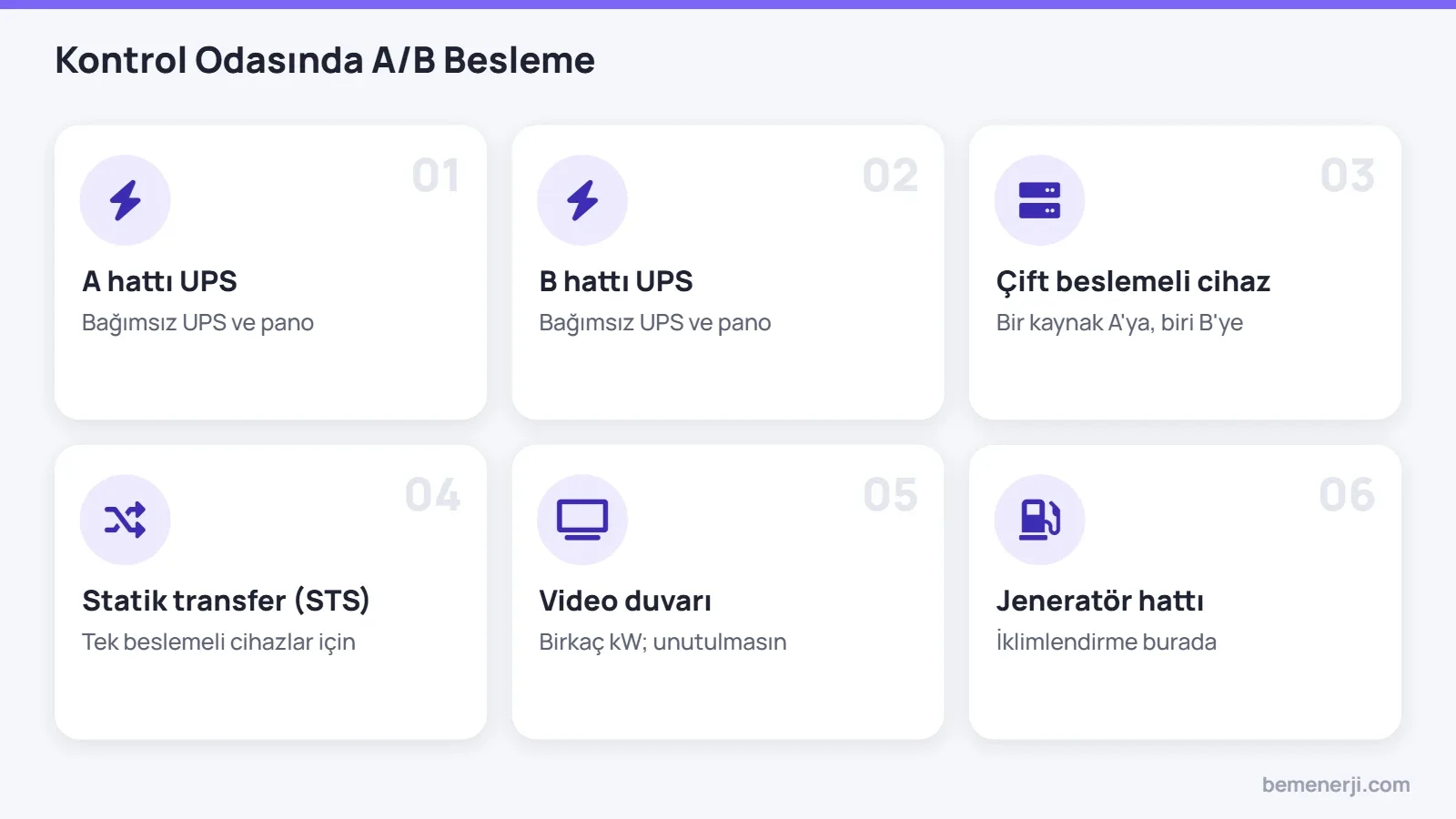
The most overlooked load is the video wall: a wall with twelve screens and its controller can draw several kilowatts, and it is the main screen where the operator has a view of the field. In a control room where the servers are protected but the video wall is outside, the servers work during an outage, but the operator only looks at the small console screens. For details of the server side UPS for server room You can look at the article.
A/B Feed: Two Independent Lines
The failure of a single UPS in the control room is a greater risk than a single outage. That's why in critical control rooms, loads are fed from two independent UPS lines: line A and line B. Dual power supply servers and network devices have one source connected to A and the other to B; if one UPS fails or is serviced, the other carries the load alone. A static transfer switch (STS) is used for single power supply devices — some consoles, video wall controllers, communication devices — that device is powered by one line, and if that line goes down, the switch switches to the other line within milliseconds. A and B need to be truly independent; taking two lines from two outlets of the same UPS or two fuses of the same panel is not redundancy. Options for redundancy UPS redundancy: N+1, 2N, parallel We explained it in the article.
Field Devices Are Considered Separately
The control room's UPS only protects the inside of the room. Remote terminal units, PLCs, and communication modems in the field are supplied in their own cabinets, usually 24 V DC, and have their own DC UPSs or battery power supplies. The communication line between the control room and the field — fiber switches, radio transmitters, GSM modems — needs to be supplied at both ends; otherwise, the room and the field cannot see each other even if they are standing. Supply field devices PLC and UPS for industrial automation We also discussed it in the article.
Duration Target
In plants with generators, the UPS's primary task is to bridge the generator; a few minutes is enough. But in the control room, the time target goes beyond that: if the generator does not start, it takes time for the operator to bring the site to a safe state — stop the pumps in turn, close the valves, bring the lines to safety. This time is determined by the plant's operating instructions and often reaches 30–60 minutes. The goal of a long time increases the battery pack; but the control room is less than a production hall, and this investment is reasonable compared to the value of the plant. Time calculation How to calculate battery time We explained it in the article.
Air Conditioning: The Secret Condition Behind UPS
The control room and the adjacent system room must also be cooled during an outage. The air conditioner is not connected to the UPS, but must be on the generator line; otherwise, the UPS will run during a long outage, the room will heat up, and the servers will shut down to protect themselves. This renders even the most well-designed UPS setup useless. The presence of air conditioning in the generator should be checked at the first commissioning and at each generator attempt.
24/7 On-Site Maintenance
Control rooms cannot be closed; maintenance must be carried out without leaving the load unprotected. In an A/B layout, one line carries the other while it is under maintenance. Maintenance bypass is essential in small control rooms with a single UPS: the load is transferred directly to the grid during maintenance and is taken back without interruption when the job is finished. How bypass works What is UPS bypass We explained in the article. Battery replacement should also be able to be done live; this requires a separate breaker in the battery cabinet and a layout to carry the load during replacement. The alarms of the UPSs should be moved to the control room's own monitoring screen or to the building automation; the operator should see that the UPS is running on the battery on his own screen. Remote monitoring UPS remote monitoring and alarm management We explained it in the article.
Communications: Radio, Telephone, and Recording
The tools that the control room talks to the field — the radio system, the telephone exchange, the emergency lines, and the conversation recorders — are the most needed systems in an outage; the operator coordinates with the field team with these tools. These devices must be included in the A/B scheme or at least protected by their own redundant supply. Radio repeaters often come with their own battery-powered power source; however, the consoles and recorder in the control room are powered by 230V and connected to the UPS. It is important that the conversation recording is complete in the investigation of the incident after an outage.
Common Mistakes
- Not getting the video wall into the UPS plan; the operator cannot see the site in the outage.
- Feeding line A and B from the same UPS or from the same panel; redundancy remains on paper.
- Not taking the control room air conditioner to the generator line.
- Forgetting the supply of field communication devices; the room and the field cannot see each other.
- Not moving UPS alarms to the operator display.
- Choosing a UPS without maintenance bypass; you have to plan downtime for maintenance.
For control rooms of energy facilities UPS for power plants and substations, for rail systems UPS for subway and rail We have articles. Discovery and setup for your control room's A/B layout: UPS installation and assembly.
The operator's eyes should remain on the field

Frequently Asked Questions
01What is A/B feeding?
02How many kW does a video wall draw?
03Are field PLCs powered by the control room's UPS?
04How many minutes should a control room UPS last?
05What does a static transfer switch do?
For Your Control Room
Let's determine the loads, A/B layout and time target of your control room together in the discovery; For on-site projects in Istanbul and surrounding provinces, and for industrial-scale projects in distant cities Contact Us.