The Use of UPS Systems in Factories and Manufacturing Facilities

When there’s a power outage in an office, the screens go dark, and once the outage is over, work resumes where it left off. In a manufacturing facility, however, even a one-second outage or a brief voltage dip can bring the production line to a halt; the real loss often stems not from the outage itself, but from the subsequent recovery process.
In this article, we explain what is protected by UPS systems in factories, what is generally not protected, and what factors to consider during installation and maintenance in industrial environments.
Why Are Short Outages So Costly in Manufacturing?
- The control system restarts: When PLCs, operator panels, and drives lose power, they restart. Information about the machine's current status may be lost; it takes time to safely restart the line.
- An unfinished process: A batch that is left incomplete during processes such as heat treatment, mixing, filling, or molding is often reprocessed or discarded.
- A voltage drop is enough: Even if the power doesn’t go out completely, a brief dip can cause contactors to trip and sensitive devices to malfunction. These dips often leave no trace other than flickering lights.
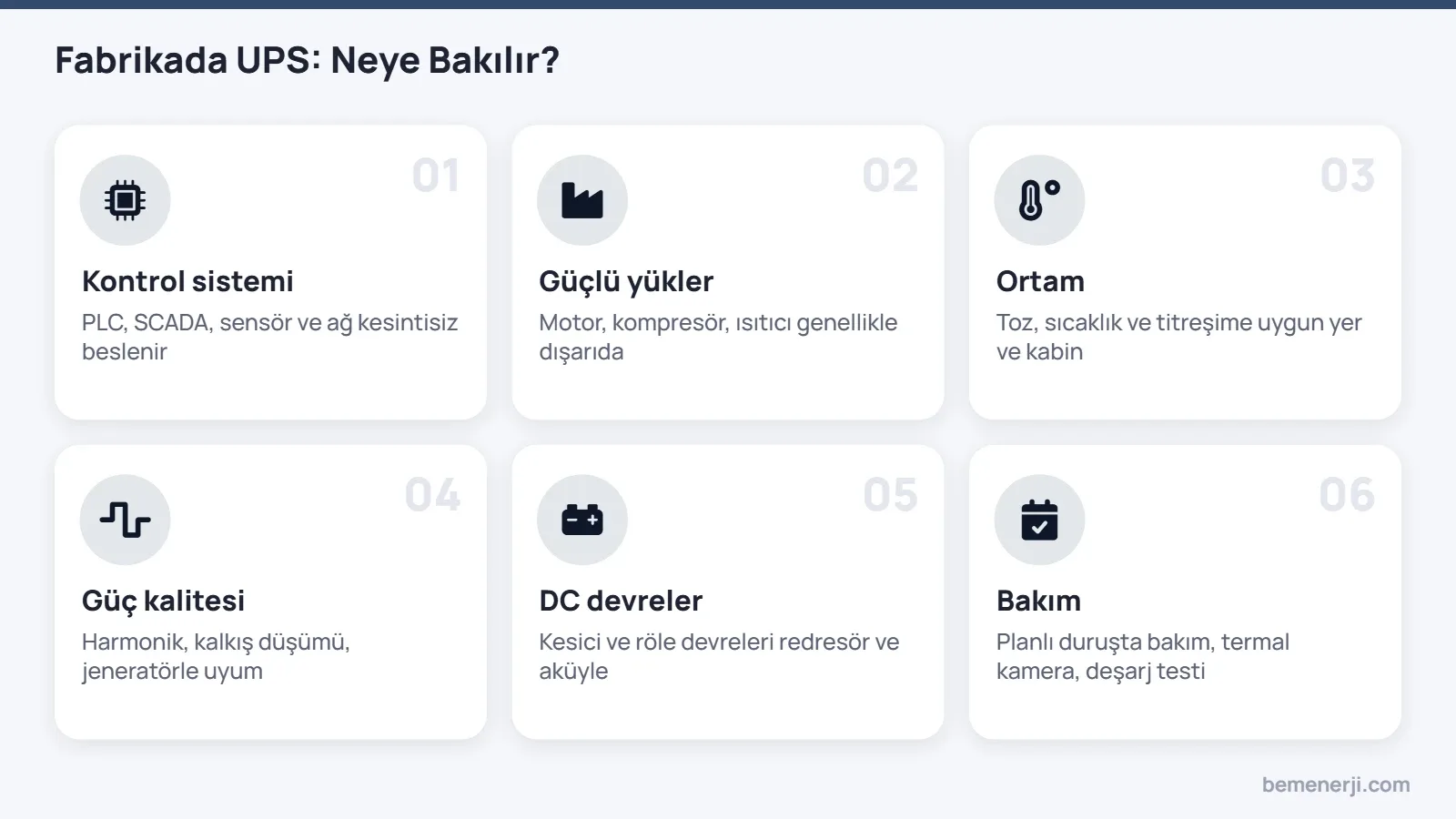
For this reason, the purpose of a UPS in a factory is often not to keep the entire facility running, but keep the control system running: The control system detects the outage, brings the machines to a safe state, and the line is restarted in a controlled manner once the outage is over.
Devices Protected by a UPS, and Those That Are Generally Not Protected
| Load | Does it connect to a UPS? | Why? |
|---|---|---|
| PLCs and automation panels | Yes | It maintains process data and ensures that the machines stop in a controlled manner. |
| SCADA and operator computers | Yes | Monitoring, recording, and alarm data are not lost during an outage. |
| Sensors and measuring instruments | Yes | The measurement and recording chain remains unbroken even during an interruption. |
| Servers and network devices | Yes | Production software, databases, and communication continue. |
| Control circuits and safety systems | Yes | The alarm, camera, card-based access control, and emergency signals are operational. |
| Large motors, compressors, heaters | Usually no | They require UPS systems with very high power ratings and inrush currents; they can usually tolerate brief power outages or are powered by a generator. |
Which load actually requires an uninterrupted power supply? What is a critical load? We explained this in our article. Isolating non-critical, high-power loads directly determines the size of the UPS and its battery runtime. The choice of which control circuit to include in the UPS is determined in the automation project with the aim of preventing machines from starting up automatically when power is restored.
Industrial Environment: Dust, Temperature, Vibration
The operating conditions for a UPS in a server room are very different from those in a production area. Dust clogs fans and cooling ducts; heat shortens the lifespan of both the electronics and the batteries; and vibration can loosen connections over time. Therefore:
- If possible, the UPS and batteries should be placed in a cool, clean room outside the production area. Batteries are generally designed for temperatures between 20 and 25 °C.
- If it is to remain in the production area, it must be suitable for the environment protection class (IP) A cabin is selected, and plans are made for how the cabin will dissipate heat.
- Ventilation filters are cleaned or replaced regularly; a clogged filter causes the UPS to overheat silently.
- Connections in areas subject to vibration are inspected during maintenance.
The Effect of Heat on the UPS UPS overheating and fan failure We discussed this in our article.
Harmonics, Motor Starts, and Generators
In a factory power grid, frequency converters, welding machines, and large motors generate harmonic currents and cause voltage drops during startup. This also affects the UPS input; an online UPS isolates the load from these disturbances. Details on the topic What is power quality? In our article. Facilities are mostly three-phase; the selection of the phase configuration The difference between three-phase and single-phase UPS systems We explained this in our article.
During prolonged outages, the facility is typically powered by a generator; the UPS acts as a bridge until the generator kicks in. How the UPS responds to voltage and frequency fluctuations from the generator is tested during commissioning; details The Difference Between a UPS and a Generator in our article.
DC Control Circuits: Rectifier and Battery
Not every critical circuit is powered by AC. The opening and closing circuits of circuit breakers in medium-voltage switchgear, protective relays, and some control systems operate on direct current. These circuits are typically a rectifier It is powered by a rectifier and a battery bank connected to it: the rectifier normally supplies power to the load and keeps the battery charged; in the event of a power outage, the battery maintains uninterrupted power to the circuit. The DC voltage value and battery runtime are determined based on the facility’s design. Like UPS systems, these systems also require battery monitoring, control of charging settings, and testing.
Redundancy on Critical Lines
If the failure of a single UPS would shut down the entire line, redundancy is evaluated: two UPS units operating in parallel, an N+1 configuration with additional modules, or powering critical panels from two separate sources. Which configuration makes sense where UPS Redundancy: N+1, 2N, and Parallel UPS We explained this in our article. Just as important as redundancy is maintenance, maintenance bypass is that it is present; this ensures that the line does not go down while the UPS is in operation.
Maintenance: Using Scheduled Shutdowns
The best time for maintenance at the factory is during scheduled shutdowns, when production has already stopped. Battery replacement, tightening connections, or tests that require a shutdown are scheduled for these times. During operation, however, thermal camera inspection It displays hot connections without shutting down the system. The only way to know whether the batteries will actually provide enough power during an outage is battery discharge test ...indicates. In dusty and hot environments, maintenance intervals are set more frequently than in offices; maintenance is recommended every three months for critical systems.
All work on panel connections, battery banks, and the rectifier qualified technical staff ...must be carried out by [name], with the necessary safety precautions in place.
- IEC 62040-3 — Uninterruptible Power Systems (UPS), Part 3: Method for Specifying Performance and Test Requirements
- IEC 61000-4-30 — Power Quality Measurement Methods
Sources
UPS at the Manufacturing Facility: At a Glance
The UPS's role in the factory is not to keep the entire facility running, but to keep the control system and critical circuits operational.

When you plan which loads to protect, where to place the unit, power quality, and maintenance schedules together, the UPS will do its job in the event of an outage. You can find details on each of these topics later in this article.
Frequently Asked Questions
01Is it necessary to connect all the machines in the factory to a UPS?
02Why is the line down even though there's no power outage?
03Can we place the UPS in the production area?
04Are UPSs used for DC control circuits?
05How often should UPS maintenance be performed at the factory?
UPS and Battery Systems for Your Production Facility
We install UPS, inverters, rectifiers, and battery systems of all brands and models throughout Istanbul and the surrounding provinces; we also travel to distant cities to install industrial systems. The process from site survey to commissioning UPS Installation and Setup, the scope of maintenance visits Periodic Battery and UPS Maintenance We explained this on our website. The list of protected cargo and your facility's information Please let us know; let’s work together to determine the system that best suits your needs.