Short Circuits, Overcurrent, and Selectivity at the UPS Output

When a short circuit occurs on a line connected to the UPS output, the protective device is expected to trip quickly and isolate the faulty line. However, in systems with a UPS, this does not always happen automatically. This is because the UPS is not designed to provide a very high short-circuit current, as the utility grid does. In this article, we explain how to properly design protection on the output side.
Current Is Limited in Inverter Mode
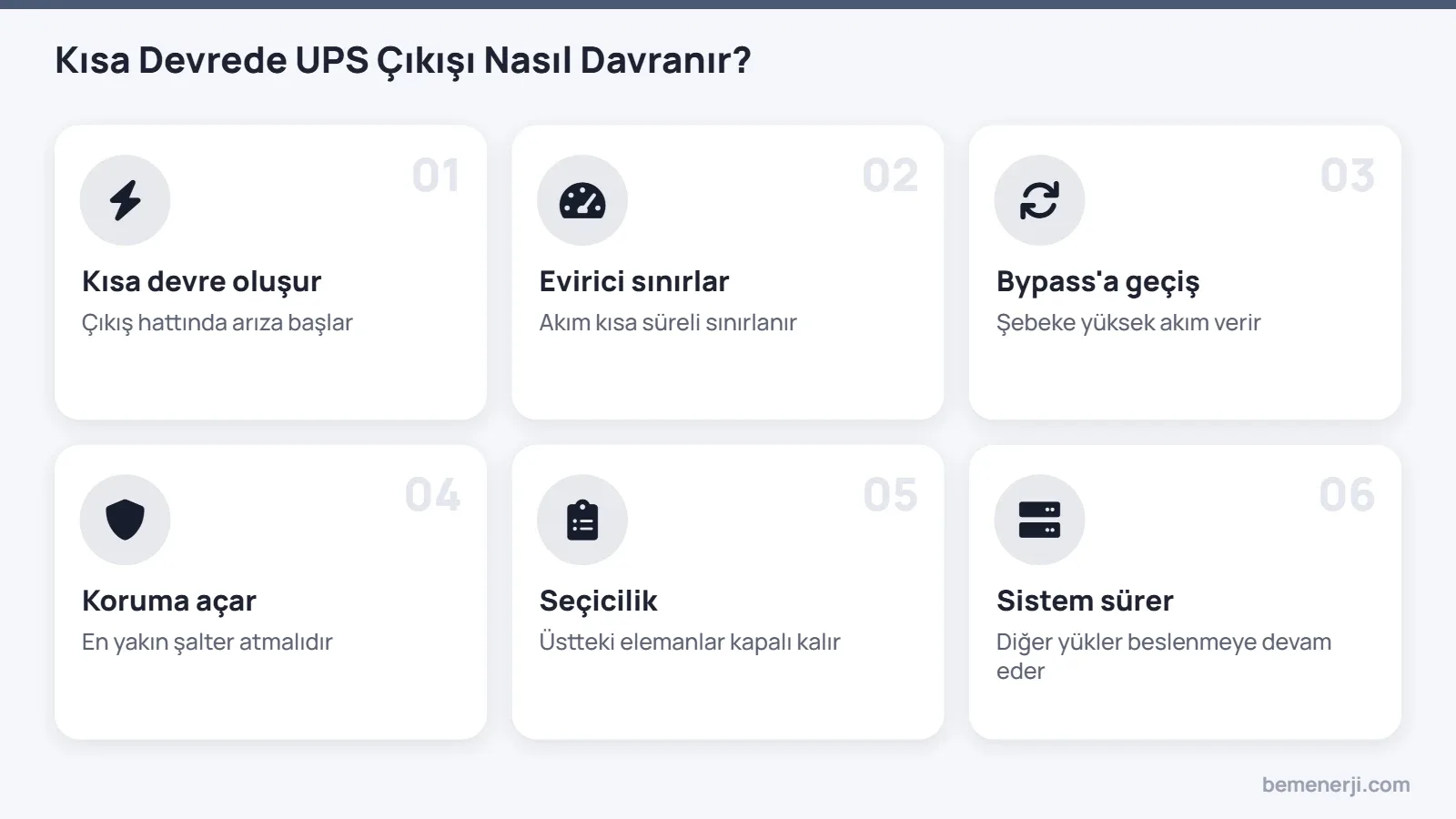
Due to the structure of the power grid, transformers, and cables, a short circuit can generate extremely high currents; this current causes the fuse or circuit breaker to trip very quickly. The UPS inverter, however, operates using semiconductor components and limits the output current to protect these components. This limit is a certain multiple of the rated current and is applied only for a short time; its value varies by product and is specified in the data sheet.
The result is this: If a short circuit occurs in a small circuit at the output while the UPS is operating in inverter mode, the current may not rise high enough to trip the circuit breaker quickly. The UPS limits the current, the voltage drops, and this situation can cause other loads to be affected as well. Therefore, the protection must be selected based on the UPS.
The Situation Is Different in Bypass Mode
When the UPS switches to bypass mode, the output is powered directly from the utility grid, and the short-circuit current is supplied by the grid. In this situation, fuses and circuit breakers trip as expected. In fact, if a short circuit occurs, the UPS switching to bypass mode is sometimes a design-intended stability measure: the load is powered through the bypass, and the faulty line is isolated by the protection mechanism. How static bypass works What is a UPS bypass? This is explained in detail in our article.
Another aspect of this is that the current and duration that the bypass can withstand are limited. The bypass line and the semiconductor switch on it cannot withstand very high short-circuit currents for longer than a certain period of time; therefore, it is important for the output protections to trip quickly.
What Is Selectivity?
Selectivity is the principle that, in the event of a fault, only the protective device closest to the fault trips, while the devices upstream of it remain closed. For example, a short circuit in an outlet should cause only the small circuit breaker supplying that outlet to trip; the UPS output circuit breaker or the main fuse should not trip. Without selectivity, a single faulty device would cause the entire system to lose power, rendering the UPS’s intended protection ineffective.
The fundamental approach that ensures selectivity is the graded protection scheme: the components become smaller as they move from the switchboard toward the feeder lines, and their tripping characteristics differ from one another. In practice, the following points are taken into account:
- Each output circuit must be isolated with its own protective device; power should not be distributed through a single large circuit breaker.
- The nominal value of the upper element should be significantly greater than that of the lower one, and its delay should be longer.
- Manufacturers' selection tables or curves should be examined together; it is not enough to look only at the amperage value.
Switch Curves and Inrush Current
For small circuit breakers, the B, C, and D curves determine the threshold at which a circuit breaker trips and how quickly it trips under short-circuit current conditions. The D curve is used for loads with high inrush current, while the B curve is used for sensitive loads with low inrush current. Transformers, motors, and some power supplies draw a brief, high inrush current when they start up; this current can cause the circuit breaker to trip unnecessarily. For this reason, the circuit breaker curve is selected based on the type of load. How inrush current affects UPS power How to Calculate UPS Power You can find it in our article.
| Subject | Converter mode | Bypass mode |
|---|---|---|
| Short-circuit current | Limited by UPS | The network is strong; the signal is strong |
| Fuse or circuit breaker | It may not fire quickly | It fires as expected |
| The effect of voltage | The output voltage may drop | It remains at line voltage |
| Attention | Select the protection based on the UPS | The bypass line has limited capacity |
What Should Be Done in Practice?
- The output current limit and bypass capacity listed on the UPS data sheet should be reviewed before selecting a protection option.
- The output distribution system must be set up with a panel that divides critical loads among separate circuits.
- Overload should not be confused with a short circuit; an overload UPS overload alarm We explained this in our article.
- The replacement of protective devices and work inside the panel must be performed by qualified electrical personnel.
Taking these steps during the installation phase prevents unplanned outages later on; tasks performed before installation technical survey You can read more about it in our article.
- IEC 62040-3 — Uninterruptible power systems (UPS) — Performance and test requirements (standard title).
- IEC 60898-1 — Overcurrent protection circuit breakers for use in residential and similar installations (Curves B, C, D; standard designation).
- IEC 60947-2 — Low-voltage switchgear and controlgear — Circuit breakers (standard title).
Sources
The Fault Should Only Affect Its Own Line
Because the UPS inverter limits the current, the output short-circuit circuit breaker does not always trip immediately. In bypass mode, however, the utility grid supplies high current, and the protection operates as expected.

With staged protection and the correct trip curve, only the faulty circuit is de-energized, while critical loads continue to be supplied.
Frequently Asked Questions
01If there is a short circuit at the UPS output, will the UPS break down?
02Why doesn't the circuit breaker trip on the UPS-powered circuit, but the voltage drops?
03Do you absolutely need an expensive switch for selectivity?
04Can we use the curved switch anywhere?
05Who should replace the output protection devices?
Let's Review Your Exit Strategy Together
We can assess on-site whether the output protection is compatible with the UPS, whether in a new installation or an existing system. UPS Installation and Setup Check out our page; if you have any questions, Write to us.