UPS Output Voltage Issues: Low, High, and Fluctuating Output

Devices connected to the UPS output sometimes behave unexpectedly: the screen flickers, some devices shut down on their own, or the voltmeter displays a value other than 230 V. The first thought is that the UPS has failed; however, the expected output voltage depends on the operating mode and the type of UPS. In this article, we explain the framework that will help you distinguish between what is normal and what is a problem.
What Should the Output Voltage Be?
In Turkey, the rated voltage for single-phase systems is 230 V, and for three-phase systems, it is 400 V between phases. The grid itself is not a fixed point at this value; the TS EN 50160 standard for grid voltage generally assumes a range of approximately 10 percent above and below the rated value during normal operation. Therefore, a measured voltage of 215 V or 245 V from the grid falls within the grid’s own tolerance limits.
The UPS output behaves differently depending on the operating mode:
- Online (double-conversion) UPS: The output is always generated by the inverter. Even if the input voltage fluctuates, the output must remain within the tight tolerance specified in the product’s datasheet.
- Line-interactive UPS: Normally, the system switches to grid output; when the voltage goes outside the limits, the automatic voltage regulator (AVR) corrects it by changing stages. For this reason, the output varies gradually within a band that follows the input voltage.
- In bypass mode: The output comes directly from the utility grid; the UPS does not regulate it. If the system is switched to bypass mode, the output voltage follows the input voltage.
The difference between the types Types of UPSs, when the bypass was activated What is a UPS bypass? We explained this in detail in our article. Only your device’s data sheet specifies the acceptable tolerance; before deciding whether a value is problematic, check which mode the UPS is operating in.
If the Output Voltage Is Low
Common causes of low voltage at the output include the following:
- The input voltage is already low, and since the UPS is operating in bypass or line-interactive mode, it is passing this low voltage on to the output.
- The UPS is overloaded; the inverter is having trouble maintaining the voltage, or the UPS switches to bypass mode as a protective measure. For more details, UPS overload alarm Check out our article.
- The output cable is either long or has a small cross-sectional area; as the load current increases, there is a voltage drop across the cable. If you are taking the measurement at the load end rather than at the UPS output terminal, this could be the source of the difference.
- The UPS is in battery mode and the battery is low; as it nears discharge, the inverter cannot maintain power.
- There is a fault in the inverter stage or the output filter; in this case, an alarm code is usually displayed.
If the Output Voltage Is High
High voltage is usually caused by the utility grid. In a line-interactive UPS, the AVR attempts to reduce high input voltage, but if the range is insufficient, the output may remain high; in bypass mode, however, there is no correction at all. In an online UPS, a high output voltage may indicate a malfunction in the inverter control or a faulty configuration parameter and should be taken seriously. In some models, the nominal output voltage can be adjusted; an accidentally altered setting can also result in a reading that is too high or too low.
A Volatile and Unstable Rise
Fluctuations in the output voltage are usually a reflection of a problem on the input side: a loose terminal, a high-resistance connection, or a large motor or welding machine sharing the same line and drawing a sudden load. In a line-interactive UPS, as the utility grid fluctuates, the AVR frequently switches between voltage levels, which manifests as voltage spikes accompanied by clicking sounds. If the output fluctuates while the input is also fluctuating, the problem lies not with the UPS but with the supply line; regarding this, power quality Our article provides additional information.
A Quick Comparison Chart
| Symptom | To be considered first | Possible direction |
|---|---|---|
| Output is low; UPS is in bypass mode | Input voltage | Power grid or power line |
| Output is low, but the load percentage on the screen is high | Load percentage, connected devices | Overload |
| Low output, in battery mode | Battery level | Low battery, remaining time |
| High-output, line-interactive | AVR stage, input | Grid height |
| High-output, online UPS | Setting parameter, alarm code | Inverter or control failure |
| The exit is shaking, and so is the entrance | Klemens, shared line | Feeder line issue |
Before Notifying Customer Service
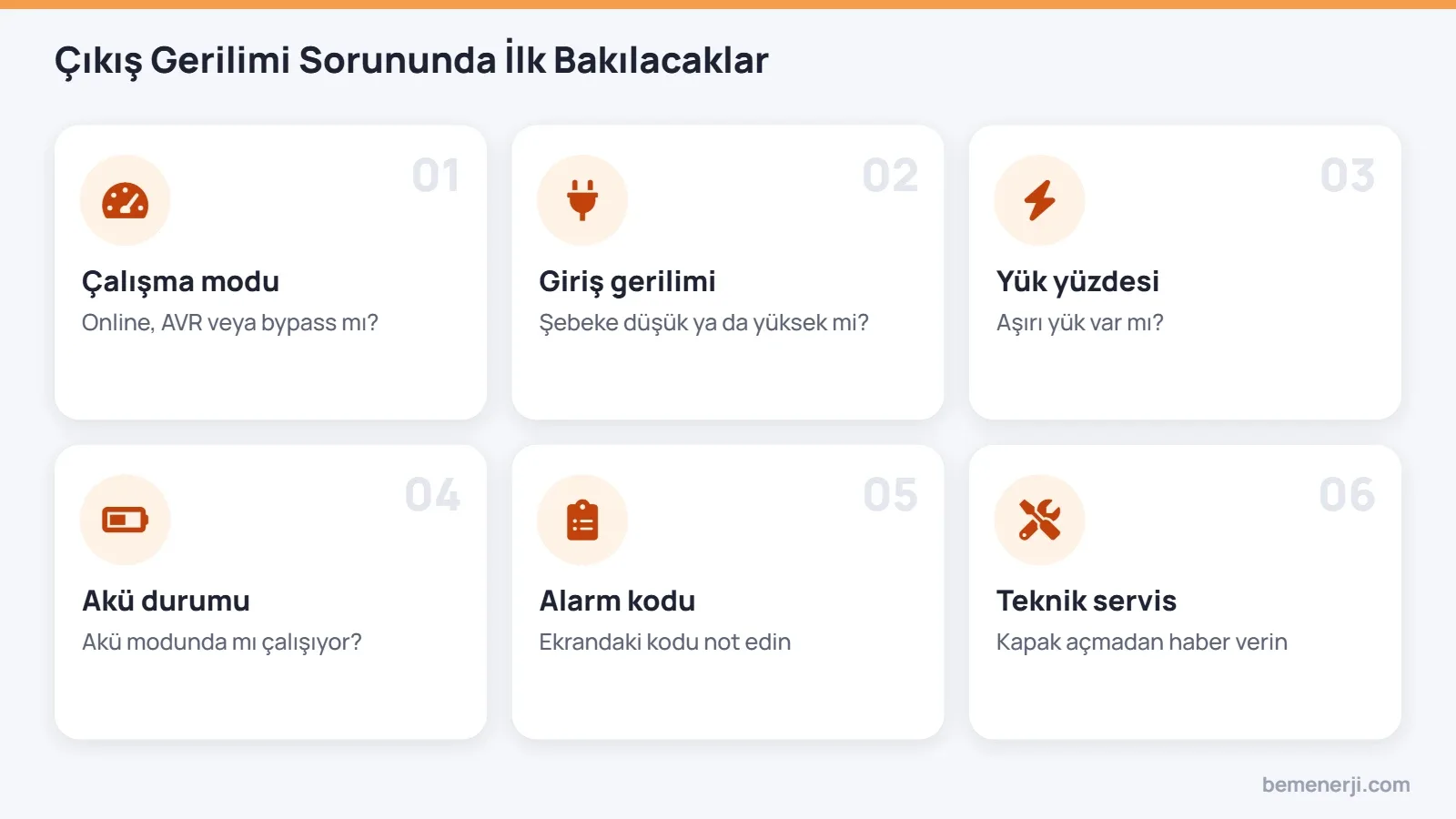
Some safe checks can be performed by unauthorized personnel: The operating mode, load percentage, input and output voltage readings on the UPS display, and any alarm codes should be noted. How to interpret alarm codes UPS alarm codes We explained this in our article. Opening the output terminals, disconnecting cables, or taking measurements on a live panel, however, is the job of authorized technical personnel. The information you’ve noted will help the service team narrow down the problem much more quickly. If the problem persists, Troubleshooting and Technical Support You can contact us through our website.
- TS EN 50160 — Voltage characteristics of electricity distributed in public distribution networks (as stated in the standard).
- IEC 62040-3 — Uninterruptible power systems (UPS) — Performance and test requirements (standard title).
Sources
Read the Mode First, Then the Voltage
The output voltage behaves differently depending on the mode, even within the same UPS. In bypass mode, the output follows the utility grid; in line-interactive mode, the AVR corrects it in stages; and in online mode, the inverter generates the output.

Noting the mode, input voltage, load percentage, and alarm code helps narrow down the problem before the service technician arrives.
Frequently Asked Questions
01I'm measuring 220 V at the UPS output instead of 230 V—is this a problem?
02Why does the output voltage drop as the load increases?
03Is the clicking sound from a line-interactive UPS a sign of a malfunction?
04Can we adjust the output voltage ourselves?
05When is a voltage problem considered an emergency?
Are You Having Problems with the Output Voltage?
Please contact us with the mode, voltage, and alarm information you have noted. Troubleshooting within Istanbul is free of charge; Troubleshooting and Technical Support You can review the process on our website, or directly Contact You can submit a request on our website.