


Rooftop Solar and UPS for Businesses: How Are Critical Loads Powered During an Outage?

Many business owners who install solar panels on their roof assume that when the power goes out, at least the lights, computers and cash registers will keep running. In fact, a standard grid-connected rooftop GES (solar power plant) shuts itself down the moment an outage occurs. Even if the sun is shining on the panels, the business can be left in the dark. Generation and continuity are two different matters, and each has to be solved separately.
This guide explains why a rooftop GES and a UPS cannot replace each other, which ways exist to supply critical loads during an outage, and how to size those solutions. The article is written for business owners, technical managers, facility managers and purchasing departments. You will find example calculations, comparison tables and common mistakes.
Safety note: The connection and panel layouts described here are conceptual information. The separation of the critical panel, the UPS and storage connections, and the GES integration must be designed and carried out by authorized electrical personnel.
Why Does a Business with a Rooftop GES Still Go Dark When the Power Fails?
The inverter of a grid-connected GES operates by taking the grid's voltage and frequency as its reference. When the grid goes down, the inverter detects this and cuts its output. This behavior is called anti-islanding protection (anti-islanding). Its purpose is to prevent personnel working on the line, who believe the grid is de-energized, from encountering voltage fed back from the building. Manufacturers' support pages also state clearly that in grid-connected systems, production stops during an outage even when the sun is shining. Grid-connected inverters are designed to shut down automatically on loss of grid for safety reasons and do not provide backup power.
In other words, the function of a rooftop GES is to reduce the grid electricity consumed during the day. Supplying loads during an outage requires a source that can operate disconnected from the grid, such as a battery and a suitable inverter or UPS. You can find the logic of systems with and without batteries in a broader context in our article Is a battery necessary in a solar energy system? .
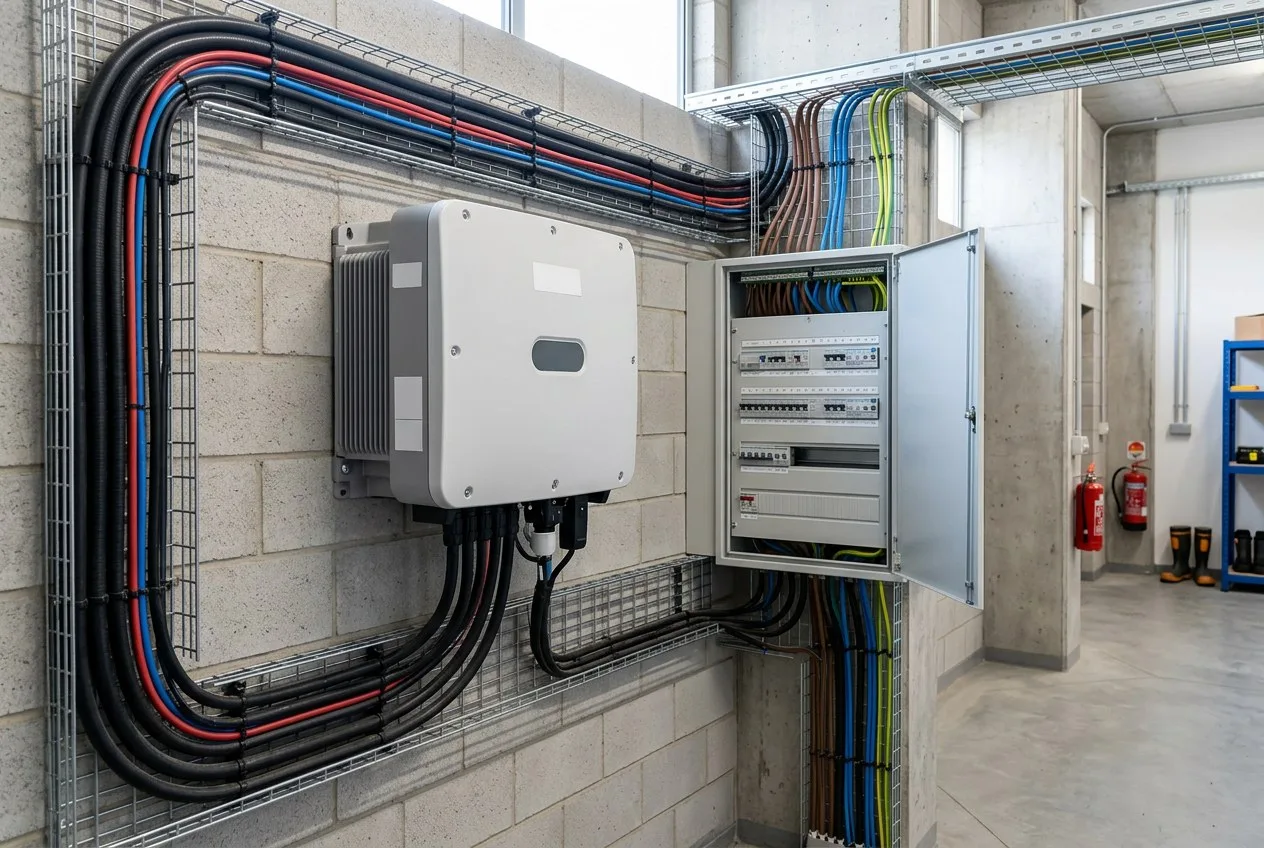
Rooftop GES, UPS and Generator Do Not Do the Same Job
The three systems have different responsibilities. Confusing them leads to both wrong expectations and wrong investments.
| System | Primary role | What does it do in an outage? | Limitation |
|---|---|---|---|
| Rooftop GES (grid-connected) | Generate energy during the day and reduce the bill | Shuts down for safety reasons | Provides no backup without a battery and a separable configuration |
| UPS | Supply the load without interruption and with clean voltage | Switches in instantly from the battery | Only as long as battery capacity allows, typically minutes to hours |
| Generator | Generating power during long outages | Starts up within a few tens of seconds | Has a start-up delay; requires fuel and maintenance |
| Solar PV with storage / hybrid system | Storing production in batteries and using it later | Can supply critical loads if designed correctly | Depends on the design, battery and inverter class |
How a UPS and a generator complement each other Differences between a UPS and a generator is covered in detail in the article. For the operational side of storage-based solutions, see the article on solar PV with storage .
What Is a Critical Load and Which Ones Are Critical in Your Facility?
Critical load, refers to devices and circuits whose loss of power creates risks to life safety, data, production, revenue or equipment damage. The definition is explained in more detail in the article what is a critical load Here we focus on the practical side: first classify your loads, then choose the solution.
| Load class | Examples | Outage tolerance | Suitable supply approach |
|---|---|---|---|
| Zero tolerance for interruption | Servers, network devices, PLCs, cash register/POS, security panel | Even a millisecond-level interruption can be a problem | Double-conversion (online) UPS |
| Tolerates short interruptions | Emergency lighting, cameras, card access | A few seconds to minutes | UPS or storage inverter |
| Can be supplied with a delay | Cooling, pumps, elevators, air conditioning | Minutes | Generator or high-power storage |
| Deferrable | General sockets, kitchen, heating | Hours | No backup required, or a generator |
Putting a number on what an outage costs the business makes it easier to decide how much to invest in which load; for this you can use the method in our article on the cost of a power outage to a business
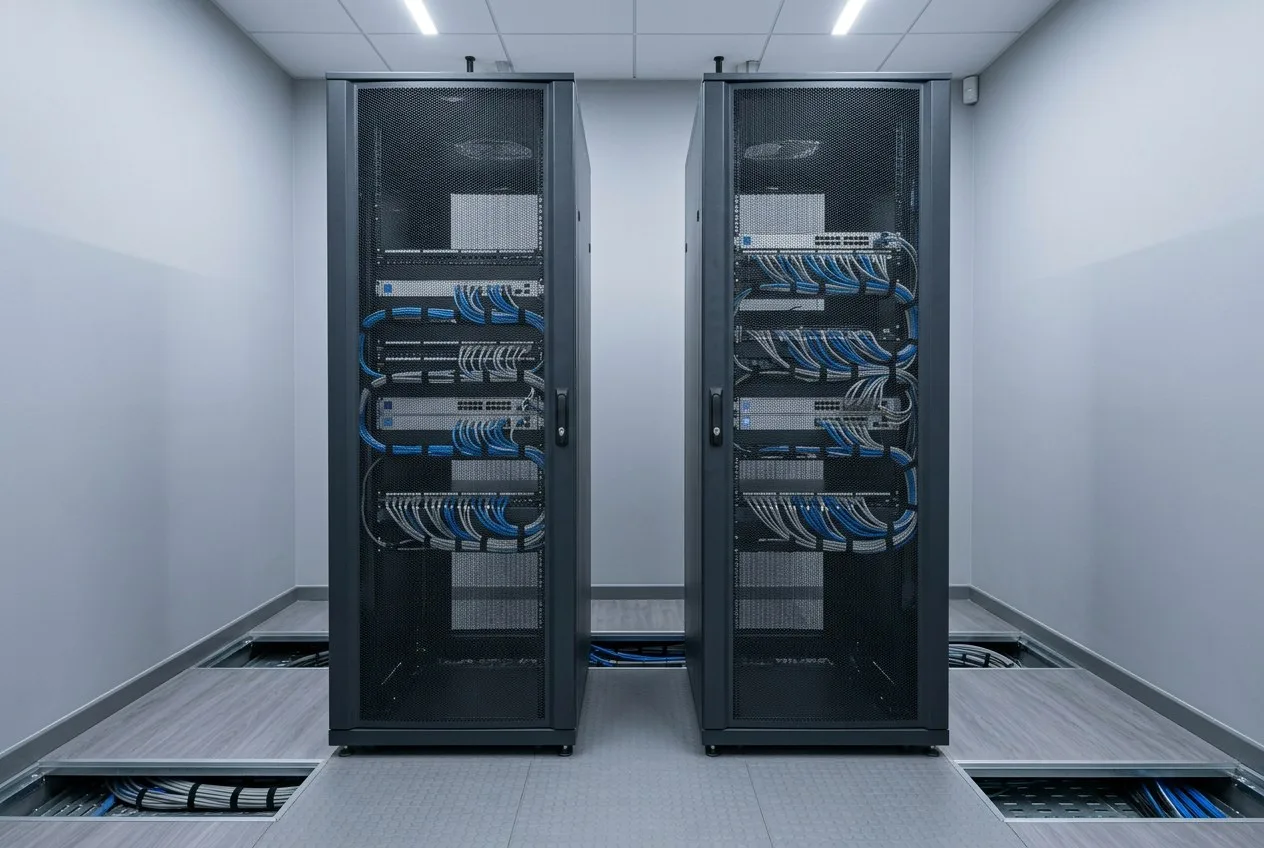
Four Ways to Supply Critical Load During an Outage
1. Grid-connected PV + separate UPS
This is the most common and simplest setup. The PV system continues to operate grid-connected; critical loads are grouped on a separate panel and placed behind the UPS. During an outage the PV system shuts down, but the UPS battery carries the load. Runtime is limited by battery capacity. If a generator is present, the UPS only bridges the gap until the generator comes online. In this setup the PV system never provides "backup power" to the UPS; it only reduces the power drawn from the grid during the day.
2. Hybrid inverter and battery
The hybrid inverter manages the energy flow between the panels, battery and grid. When the grid goes down, it switches to its own backup (EPS/backup) output and supplies the selected circuits from the battery and, if available, from solar. It can be practical for small businesses and offices; however, transfer time and output power vary by product. You can find details in the articles what is a hybrid inverter and UPS mode and transfer time in hybrid inverters
3. Generator-backed setup
For long outages, the most robust complement is a generator. The UPS covers the first seconds, and when the generator comes online the load is transferred to it. However, operating a PV system and a generator on the same busbar requires special control; details are covered below.
4. PV with storage (battery energy storage)
With a lithium-based storage system and an islanding-capable (separable) configuration, PV production can also be used during an outage. This approach is the most complex option in terms of project design, inverter, protection and panel architecture; fire safety and placement must also be considered separately. See fire safety in lithium battery storage.
How Do a UPS and Rooftop PV Fit Together?
In a correct configuration, the two systems do not interfere with each other's operation. The logical flow is as follows:
- The grid and the PV system meet at the main distribution panel. PV supplies daytime loads, and any surplus goes to the grid (see net metering in rooftop PV).
- A separate feeder is run from the main panel to the critical load panel.
- The UPS is placed at the input of this critical panel; its output supplies only the critical loads.
- If there is a generator, an automatic transfer switch selects between the grid and the generator and feeds the UPS input through that line.
The point to watch here is that the PV output must not be connected directly to the UPS output. The PV inverter looks for a grid reference; the UPS output is not designed to take on this role reliably. Such a connection can stress both devices and cause alarms or faults. The exact wiring diagram must be drawn by a qualified engineer using the manufacturer documentation of the UPS and inverter in use. For panel preparation and cabling, the article cabling and panel preparation in UPS installation serves as a guide.
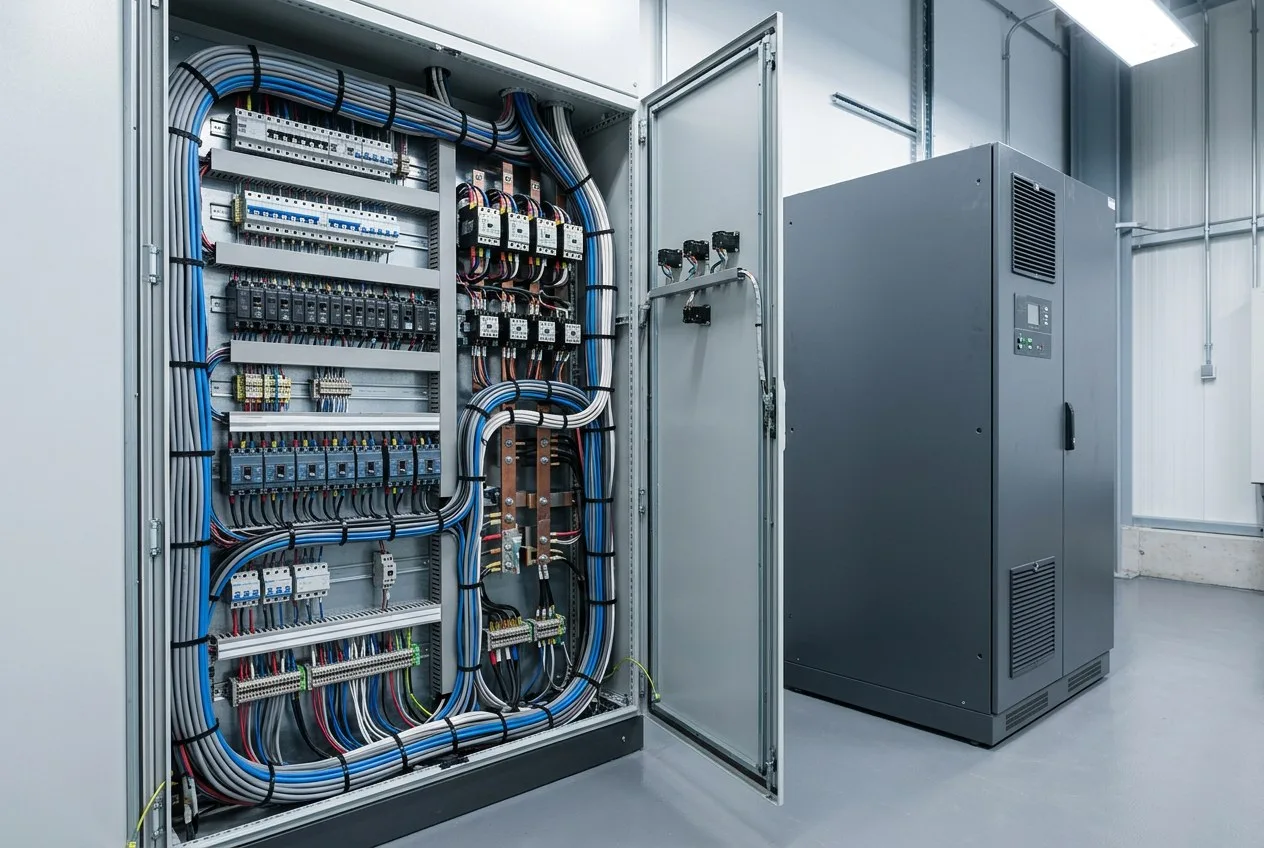
Transfer Time and UPS Class: What Do They Mean for Critical Load?
One of the most important questions for a critical load is whether it notices when the energy source changes. The IEC 62040-3 standard, which defines UPS performance, classifies UPS output with a three-part code: input dependency, output waveform and dynamic output performance. This structure defines output performance in the form AAA-BB-CC. The current edition of the standard reduces the classification code to 7 characters. For its scope, see our article on UPS standards and certificates
In practice, it is enough to know the following:
- VFD (offline/standby): The output depends on input voltage and frequency; typically, detecting the outage, turning the switch and starting the inverter takes about 10 ms.
- VI (line-interactive): Provides output regulation against voltage fluctuations; transfer time is still on the order of milliseconds.
- VFI (online double conversion): The output is independent of input changes. Even if the source changes, the power path does not change, so the transfer time is 0 ms. It is therefore preferred for loads that cannot tolerate any interruption.
In testing and measurement, it is examined whether a UPS output stays within the specified voltage limits during transfer; for example, the transfer time assessment is verified by the output voltage settling within the limits stated in the standard (typically within a 50 ms window). So reading the class code on the datasheet answers the question "what does the load see during transfer?" The differences between topologies are explained in more detail in the article types of UPS
In hybrid inverter EPS outputs, transfer time generally varies from milliseconds to tens of milliseconds depending on the model; the exact value must be confirmed from the manufacturer datasheet. This uncertainty should not be accepted for servers and sensitive process loads.
Example Calculation 1: UPS Battery Runtime in a Business with a Generator
Assumptions: Critical panel load of 12 kW (servers, network, security, point of sale and lighting). An automatic generator is in place and the load is transferred within 5 minutes. As a safety margin in the design, we want 15 minutes of autonomy. UPS efficiency is assumed at about 95%, and the battery aging/temperature allowance at 20%. These values are examples; in a real project, manufacturer data is the basis.
| Step | Operation | Result |
|---|---|---|
| 1. Output energy | 12 kW × 0.25 h | 3 kWh |
| 2. Battery-side energy | 3 kWh ÷ 0.95 | ≈ 3.16 kWh |
| 3. Aging margin | 3.16 kWh ÷ 0.80 | ≈ 3.95 kWh |
| Result | Battery bank suitable for high discharge current | ≈ 4 kWh nominal |
In short-duration, high-current discharge, the capacity that can be drawn from the battery may fall below the rated label value (Peukert effect). For this reason, battery selection is made according to the UPS manufacturer's short-duration high-power table. For the general logic of runtime calculation, see how to calculate battery runtime in a UPS and battery-backed inverter .
Example Calculation 2: Critical Supply with Storage in a Facility Without a Generator
Assumptions: Critical load of 5 kW (network, security, cash register, lighting without cooling); target of 4 hours. Solar panel production is conservatively not taken into account (an outage may occur at night or in cloudy weather). Inverter efficiency is assumed to be 95%, and the usable depth of discharge of the lithium battery is assumed to be 90%.
| Step | Operation | Result |
|---|---|---|
| 1. Required energy | 5 kW × 4 hours | 20 kWh |
| 2. Inverter loss | 20 kWh ÷ 0.95 | ≈ 21.1 kWh |
| 3. Depth of discharge | 21.1 kWh ÷ 0.90 | ≈ 23.4 kWh |
| Result | Nominal capacity to be selected with a safety margin | ≈ 24-28 kWh |
To supply the same load with a lead-acid battery, the usable depth of discharge must be kept much lower, so the nominal capacity increases significantly. For this difference, see the article on lithium-ion UPS batteries . The general calculation method is shown step by step in the article on how to calculate solar energy battery capacity .
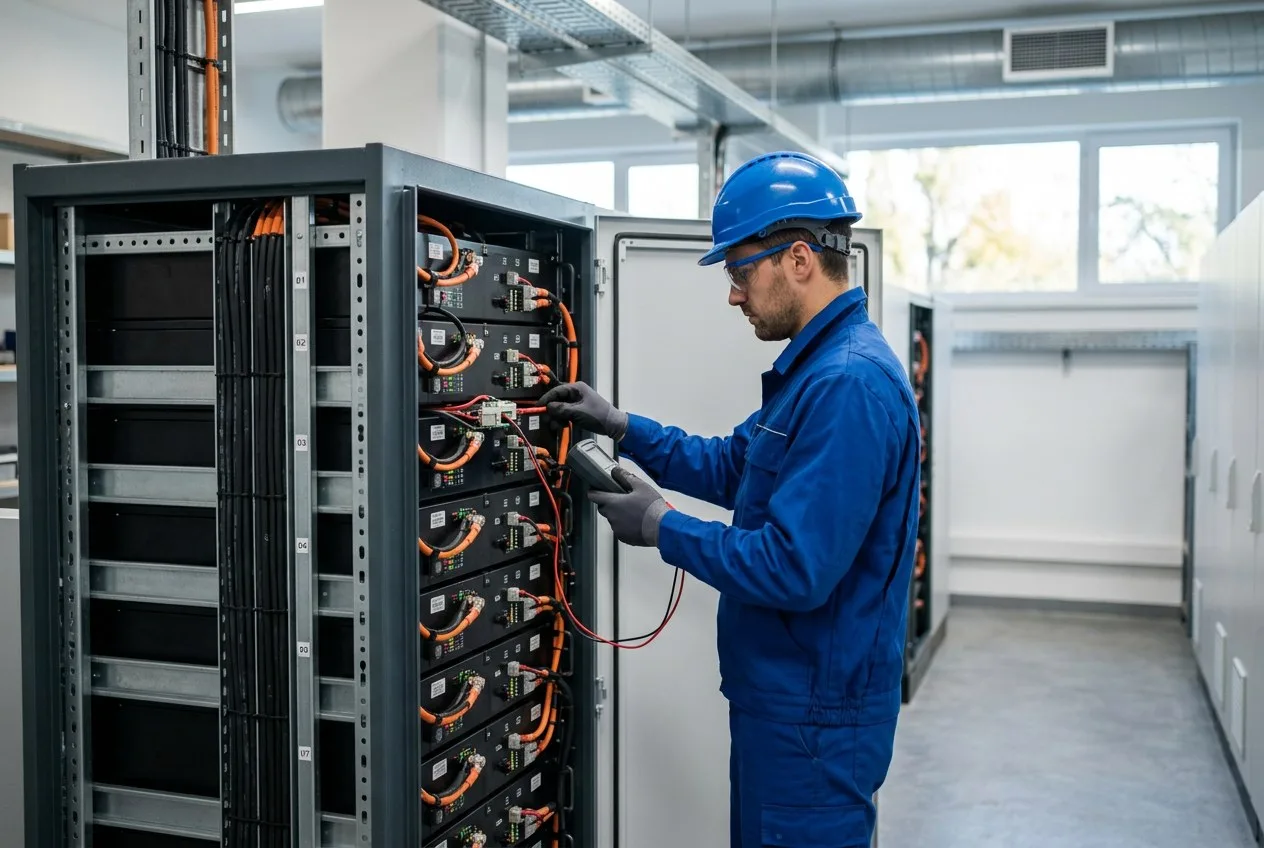
Why Are Air Conditioning, Motor and Cooling Loads Separated from the UPS?
Compressor and motor loads draw several times their rated current when starting up. This sudden current (inrush) unnecessarily increases the size of the UPS and battery and can trigger the inverter's overload protection. For this reason, loads such as air conditioners, pumps and elevators are usually not placed behind the UPS; they are left to the generator or to storage with high instantaneous power. For details, see the article on the inrush current problem of motors, air conditioners and laser printers .
In temperature-sensitive facilities such as the cold chain, the role of the UPS is not to run the compressor but to keep the monitoring and alarm system up; this topic is covered in the article on cold chain monitoring and UPS .
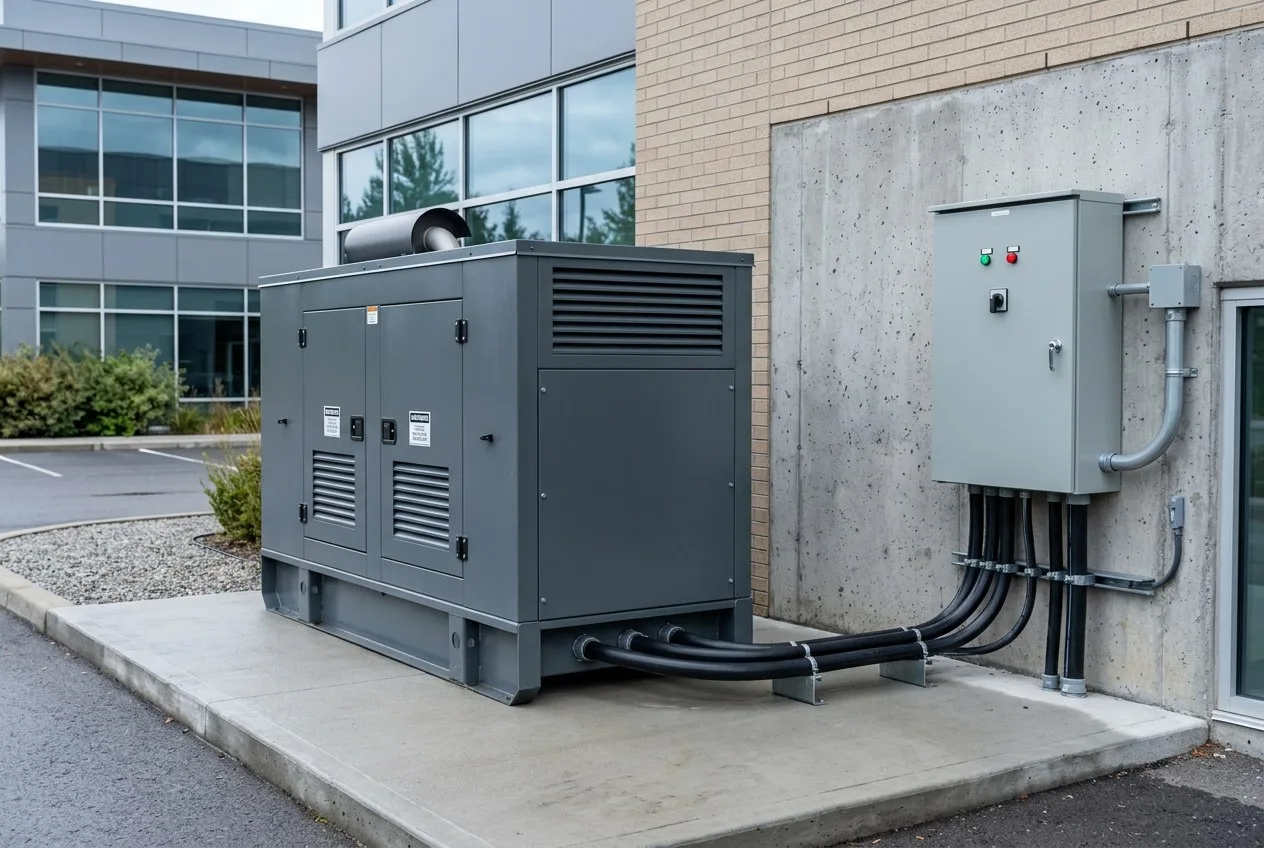
Can a Generator, UPS and Rooftop Solar Power Plant Work Together?
Yes, but only with a deliberate design. Three points need attention:
- Grid-connected solar inverter while the generator is running: The generator's voltage and frequency are not as stable as the grid's; the inverter may reject them or have to limit its output. Otherwise, reverse power flow to the generator and instability may occur. The manufacturer's instructions and an additional control/limiting arrangement are required.
- When the UPS input is fed from the generator: The rectifier input must be selected to tolerate generator voltage and frequency fluctuations; harmonics and synchronization issues must also be evaluated separately. See frequency and synchronization problems in generator-fed UPS systems.
- Transfer sequence: When the grid fails, the UPS switches to battery first; once the generator stabilizes, the automatic transfer switch takes the load onto the generator. When the grid returns, the load, UPS and solar plant return to the grid in a controlled manner.
For the general framework of hybrid scenarios, the article on how solar energy, batteries and a generator work together is useful.
Which Solution Suits Which Business? Decision Table
| Business situation | Recommended solution | Why |
|---|---|---|
| Small office, a few computers and network devices | Desktop/rack UPS; solar separate | Simple, inexpensive, quick installation |
| Organization with a server room | Online UPS + generator; solar only for savings | Zero transfer time, controlled shutdown |
| Facility without a generator and at risk of long outages | Solar with storage + critical panel | Hours of autonomy and the option of charging during the day |
| Production facility, PLC and automation | UPS or DC UPS + generator | The process must shut down safely or keep running |
| Multiple branches | One UPS per branch, central monitoring | Standard maintenance and spare parts arrangement |
If a redundancy design (N+1, 2N) is required Redundancy in UPS article, in dual-source power supply static transfer switch serves as a guide.
Why Should UPS Planning Be Done from the Start in a Rooftop Solar (GES) Project?
A solar project usually starts with a focus on savings; continuity is thought of later. In that case, critical loads remain scattered across the main panel, a separate panel cannot be built, and no space can be found for the UPS and batteries. The following questions should be clarified at the outset:
- Which loads are critical, and what is their total power in kW/kVA?
- How many minutes/hours must operation continue during an outage?
- Is there an accessible area with ventilation for the UPS and batteries? See battery room ventilation and safety.
- Is there a generator, or is one planned?
- What is the status of the solar capacity and the distribution company's conditions? For unlicensed generation, applications are made to the relevant grid operator according to the connection point of the generation facility . For current rules, please refer to the official pages of EPDK and the distribution company; this article does not give regulatory figures. The process is outlined in general terms in unlicensed electricity generation and rooftop solar article.
Common Mistakes
| Mistake | Result | Correct Approach |
|---|---|---|
| The thinking "We have solar, so we don't need a UPS" | The whole system stops during an outage | Separate the roles of the solar system and the UPS |
| Connecting the entire facility to the UPS | An overly expensive, inefficient system left without batteries | Separate the critical panel |
| Putting air conditioning and motor loads on the UPS | Overload alarms, short autonomy | Plan for a generator or storage |
| Relying on solar and keeping battery capacity small | Insufficient runtime during night/cloudy outages | Size without counting on panel production |
| Not asking about the transfer time of a hybrid inverter for servers | Instant restarts | Confirm the transfer time from the datasheet |
| Not performing battery and UPS tests | The expected runtime cannot be achieved when needed | Implement a periodic test and maintenance plan |
| Placing lithium storage in an unventilated/cramped area | Heat and safety risk | Include layout and safety distances in the project |
Commissioning, Testing and Maintenance: Will the System Work When Needed?
A backup system is valuable only if it works when required. An outage may come years later; until then, batteries age, connections loosen, and fans weaken. For this reason, commissioning and regular testing are critically important:
- Commissioning: Load transfer, transfer and bypass scenarios must be tested with a real load. See UPS initial commissioning and acceptance tests.
- Autonomy test: Whether the design runtime is actually met must be measured. See UPS autonomy time test.
- Periodic maintenance: Battery condition, connection tightness, and fan and capacitor checks must be performed. See UPS maintenance checklist.
- Remote monitoring: Outage, battery and alarm information must be sent to the authorized person. See UPS remote monitoring and alarm management.
On the solar side, panel cleaning, inverter checks and production monitoring are a separate maintenance item; for the solar system side, periodic maintenance checklist for solar energy systems can be used.
Checklist Before Making a Decision
- List your critical loads and their power ratings (W/VA); separate the loads that draw inrush current.
- Define the acceptable outage duration for each load: zero, seconds, minutes, hours.
- Write down the outage scenarios: short, medium, long; night or day.
- Is there a generator? If so, clarify its compatibility with the UPS input and the solar power plant (GES).
- Select the UPS topology (online, line-interactive) and the output class according to load sensitivity.
- Include battery technology, placement, ventilation, and fire safety in the project.
- Have the acceptance test, autonomy test, and maintenance plan written into the contract.
The general framework of these steps is also found in the articles how to choose a UPS and UPS in business continuity planning .
Complete Your Rooftop Solar Investment with Outage Resilience
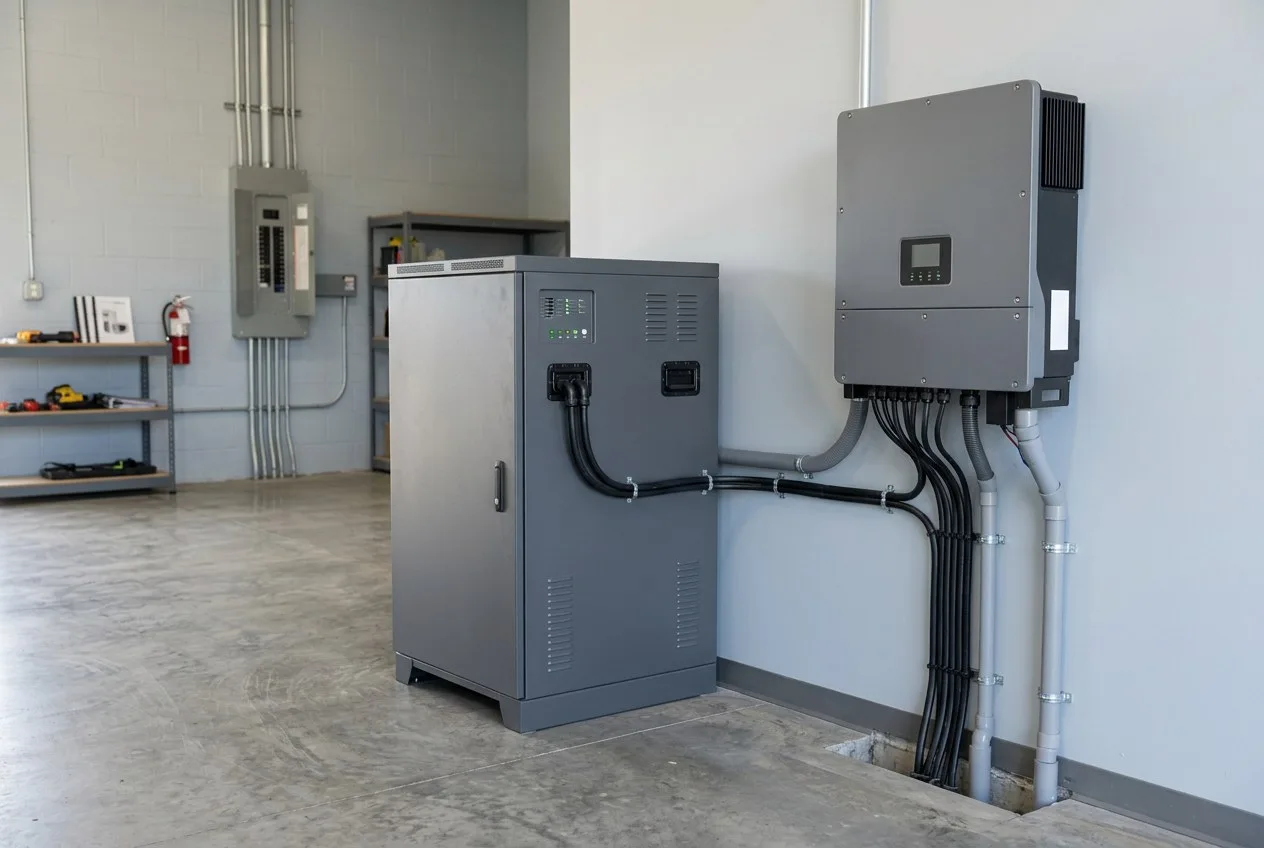
The Bempower team offers on-site surveys and technical service in Istanbul and the surrounding provinces to plan, install, and regularly maintain the UPS, battery, and inverter systems that keep your business's critical loads running during an outage. If you would like to assess the adequacy of your existing system or get advice for a new installation, you can reach us via the contact page .
- What happens when the power goes out in a grid-tied solar energy system? - Anti-Islanding protection — Enphase Support, 2025. https://support.enphase.com/s/article/What-happens-when-the-power-goes-out-in-a-grid-tied-solar-energy-system-Anti-Islanding-protection
- Solar inverter — Wikipedia, 2025. https://en.wikipedia.org/wiki/Solar_inverter
- IEC 62040-3:2021 - UPS Performance and Test Requirements Standard — iTeh Standards, 2021. https://standards.iteh.ai/catalog/standards/iec/3bf25b13-d57a-4501-a468-db74ebc2011e/iec-62040-3-2021
- Appendix B: Excerpts From Draft IEC Standard 62040-3 Ed. 2.0 FDIS — ENERGY STAR, 2010. https://www.energystar.gov/sites/default/files/specs/private/UPS_Final_Draft_Test_Method_Appendix_B_IEC62040_FDIS_Excerpts.pdf
- Validating UPS Transfer Time According to IEC 62040-3 — Yokogawa Test & Measurement, 2025. https://tmi.yokogawa.com/us/library/resources/application-notes/validating-ups-transfer-time-according-to-iec-62040-3/
Sources
