


How to Set Up a Solar Power System for a Country House or Hobby Garden

In a country house or hobby garden, electricity is often both the most wanted and the most expensive thing to arrange. If the grid pole is far away, running a line and completing the subscription procedures can make up most of the investment. Even where there is a grid connection, outages, low voltage and the fixed costs of a house used only on weekends lead people to look for an alternative. Solar energy is a reasonable option at this point; but there is a serious difference between "buying a few panels and connecting them to a battery" and building a system that actually works.
This guide is written for owners of country houses, hobby gardens, cabins and small farmhouses. We explain in what order to plan the system and how to get from daily consumption to panel, battery, charge controller and inverter ratings, with a worked example. We also cover cabling, protection, grounding and installation safety.
Note: The calculations in this article are preliminary sizing to help you make a decision. Because panel, battery and inverter connections involve high DC current and voltage, the work must be carried out by authorized electrical personnel. Manufacturer datasheets and local conditions always take precedence.

First Decision: Is There a Grid, and What Will You Use It For?
The right system is determined by the condition of the land and the purpose of use. Before moving on to technical design, answer three questions clearly:
- Is there a grid connection? If not, the system will be entirely battery-based (off-grid). If there is one and the goal is to reduce the bill or get backup against outages, hybrid solutions come into play.
- How often is the house used? The panel and battery needs of a house used only on summer weekends and one lived in all year round differ by several times.
- Which loads are indispensable? Lighting, a modem and phone charging can be met by a small system. Electric heating, air conditioning, a combi boiler, a washing machine and similar heating loads quickly enlarge the system.
You can find details of the system types in our article on the comparison of on-grid, off-grid and hybrid systems For the general approach on land with no grid at all, our off-grid installation guide is also useful. This article focuses on the country house scale.
If you are thinking of feeding surplus production into the grid or of net metering with a grid-connected system, application conditions, power limits and tariffs change over time; check the current official pages of EPDK, the Ministry of Energy and Natural Resources and your distribution company. For panel structures built on the land or changes to buildings, it is also wise to learn the zoning status in advance from the municipality or the relevant authority.
Step 1: Draw Up the Load List and Daily Energy Consumption
Everything starts with consumption. Write down the power (W) of each device and how many hours a day it runs; the product gives you the daily energy, that is, the watt-hour (Wh) value. The power on a device label is often the maximum value; for cycling devices such as refrigerators, the actual daily consumption is much lower than the label power running all day. For an exact result, you can use a plug-in or clamp-type meter.
The table below is a hypothetical load list for a country house used on weekends:
| Device | Power | Daily duration | Daily energy |
|---|---|---|---|
| LED lighting (6 pcs × 8 W) | 48 W | 5 hours | 240 Wh |
| Small refrigerator (average consumption) | - | 24 hours (cycling) | 800 Wh |
| Television | 60 W | 3 hours | 180 Wh |
| Modem / camera | 12 W | 24 hours | 288 Wh |
| Phone, laptop charging | - | - | 150 Wh |
| Hydrophore / garden pump | 750 W | 0.5 hours | 375 Wh |
| Total | ≈ 2,033 Wh (about 2.0 kWh/day) |
This table should yield two numbers: total daily energy (which determines panel and battery size) and the total power of loads that may run at the same time plus the starting power of motors (which determines inverter size). Motor-driven devices such as refrigerators, pumps, compressors and drills can draw several times their rated current at start-up. For the UPS-side equivalent of this topic, see our article on running a refrigerator, combi boiler and air conditioner on solar power .
Saving is far cheaper than enlarging the system. An A-class refrigerator, LED lighting and a pump that runs during the day greatly reduce the calculated requirement. Leaving loads such as electric water heaters, heaters, air conditioners and ovens out of the first system (using alternatives such as bottled gas, wood or a solar collector) is the smartest decision for most country houses.
Step 2: Choose the System Type
Three common setups are seen in country houses. Which one is suitable depends on your load profile and grid situation.
| System type | How does it work? | Suitable when | Point to watch |
|---|---|---|---|
| Battery-backed off-grid | Operates without the grid using panels, a charge controller, batteries and an inverter. | Land where there is no grid or where connecting to it is expensive | The battery bank and winter production are at the center of the design. |
| Hybrid (grid + panels + battery) | Even when the grid is available, the battery and panels are used together; household loads are powered during an outage. | A home that has grid power but suffers outages | Subject to grid connection rules and the distribution company's requirements. |
| Direct system without batteries | Panel power is fed directly to a pump or fan. | An irrigation pump that runs only during the day | Power drops when it clouds over; no load runs at night. |
In a vineyard house with grid access, a hybrid inverter combines panel, battery and grid inputs in a single unit, so the installation is neater. If only a single function such as an irrigation pump is needed, solar-powered pump systems offer a simpler and more economical solution.
Step 3: Calculate the Solar Panel Capacity
According to the Solar Energy Potential Atlas (GEPA) of the Ministry of Energy and Natural Resources, the average daily irradiation across Türkiye is approximately 4.18 kWh/m². However, this is an annual, country-wide average. For a vineyard house system, what matters is the "peak sun hours" (PSH: equivalent hours at 1 kW/m² irradiance) of the weakest month in which you will use the system. You can get monthly data specific to your location from the GEPA maps or the European Commission Joint Research Centre's free PVGIS tool; PVGIS provides irradiation and PV production estimates for most of the world.
The simple preliminary calculation formula is as follows:
Panel power (Wp) = Daily energy (Wh) ÷ (PSH × system efficiency)
System efficiency covers cable, charge control, battery and inverter losses, as well as the effects of temperature and dirt. A range of 0.70-0.80 is commonly used in preliminary calculations; we use 0.75. The table below uses default PSH values with the 2,033 Wh/day example above (actual values vary by region; verify with PVGIS):
| Usage period | Default PSH | Calculation | Required panel power |
|---|---|---|---|
| Summer (June-August) | 5.0 hours | 2.033 ÷ (5,0 × 0,75) | ≈ 540 Wp |
| Spring-autumn | 3.5 hours | 2.033 ÷ (3,5 × 0,75) | ≈ 780 Wp |
| Winter (December-January) | 2.0 hours | 2.033 ÷ (2,0 × 0,75) | ≈ 1,350 Wp |
The table shows the difference between year-round and seasonal use. In a garden house used only between April and October, an array of about 800 Wp may be sufficient, whereas in a home that is occupied in winter as well, you need to go up to 1.3-1.6 kWp or make up the shortfall with a generator. To convert the calculation into a number of panels, you can follow the method in our article how many solar panels are needed
Where Should the Panels Be Placed?
- Orientation and tilt: In the northern hemisphere, a south-facing surface is preferred. For year-round use, the tilt is set slightly above the latitude; for summer-only use, slightly below it.
- Shade: Shade from trees, chimneys, fences and neighboring buildings can disproportionately reduce an array's output, even with partial shading. Choose a spot with the least shade between 10 a.m. and 3 p.m.
- Ground or roof: For roof mounting, the roof's load-bearing capacity and wind load matter; for ground mounting, the ground anchoring and contact by animals or people matter. Do not underestimate wind and snow loads at a vineyard house.
- Distance from the panels to the battery room: As the distance grows, the DC cable cross-section and losses increase. Keep it short if possible.
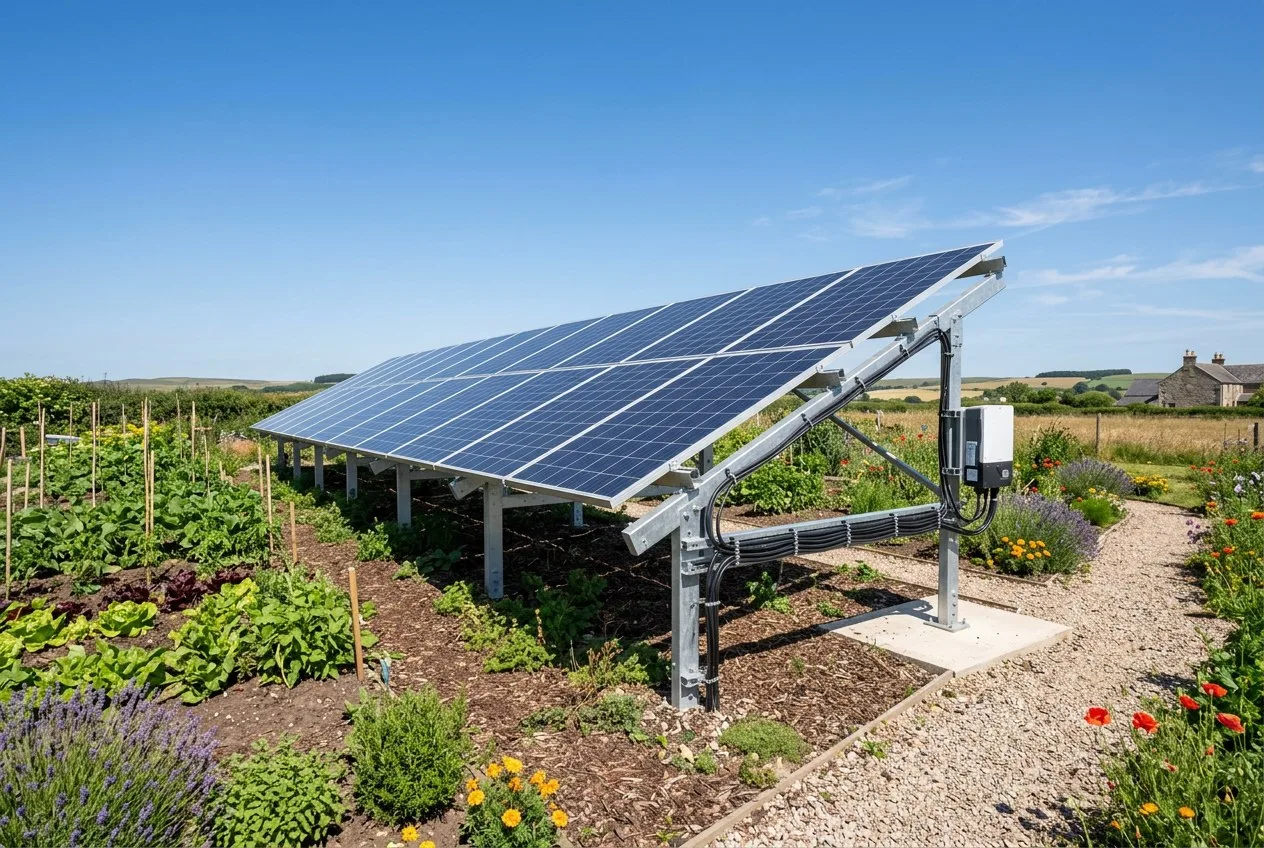
If you would like to see the effects of angle, orientation and shading in detail, also take a look at factors that reduce panel efficiency ; however, for the step-by-step installation process in this article, we will fix the panel capacity for now and move on to the battery calculation.
Step 4: Size the Battery Bank
The battery carries energy during the times when the panels do not produce, and it is often the most expensive and most sensitive part of the system. The calculation follows this logic: daily energy is converted to the battery side by adding inverter losses; it is multiplied by the number of days of autonomy (operating time without sun) desired; and it is divided by the battery's usable capacity ratio (depth of discharge, DoD).
Battery energy (Wh) = Daily energy ÷ inverter efficiency × days of autonomy ÷ DoD
Assumptions: daily AC consumption of 2,033 Wh, inverter efficiency of 0.90, autonomy of 1 day (for a weekend house; 2-3 days is considered for homes occupied year-round). A DoD of 0.80 is used for lithium and 0.50 for lead-acid (AGM/gel).
- Energy on the battery side: 2,033 ÷ 0.90 ≈ 2,260 Wh
- LiFePO4: 2,260 ÷ 0.80 ≈ 2,820 Wh (about 2.8 kWh). In a 51.2 V system, 2,820 ÷ 51.2 ≈ 55 Ah; a commercially available 100 Ah 51.2 V module (about 5.1 kWh) meets this requirement comfortably and leaves extra margin.
- Lead-acid: 2,260 ÷ 0.50 ≈ 4,520 Wh (about 4.5 kWh). At 48 V, 4,520 ÷ 48 ≈ 94 Ah; that is, a 48 V 100 Ah array (4 pieces of 12 V in series) is required.
These results are preliminary sizing; capacity varies with temperature, discharge rate and battery age. To see the relationship between Ah, Wh and C-rate in detail, solar battery capacity calculation article.
Which Battery Type Is Suitable for a Vineyard House?
| Criterion | AGM / Gel (lead-acid) | LiFePO4 (lithium) |
|---|---|---|
| Usable capacity | Around 50% for longevity | Typically around 80-90% |
| Standby resilience | Risk of sulfation if left at a low charge for long | Low self-discharge; protected by the BMS |
| Weight / space | Heavy, large volume | Lighter and more compact |
| Cold weather | Capacity drops but it can still be charged | There may be a charge limit at low temperatures; check the datasheet |
| Initial investment | Generally lower | Generally higher; cost per cycle is often better |
| Safety | Hydrogen may be released during charging; ventilation is required | BMS, fuse and placement rules are important; fire risk must be managed |
Typical cycle life, efficiency and temperature behavior vary by manufacturer; always check the cycle-DoD curve in the manufacturer's datasheet. For definitive selection criteria, you can also read our article on the need for a battery in a solar energy system .
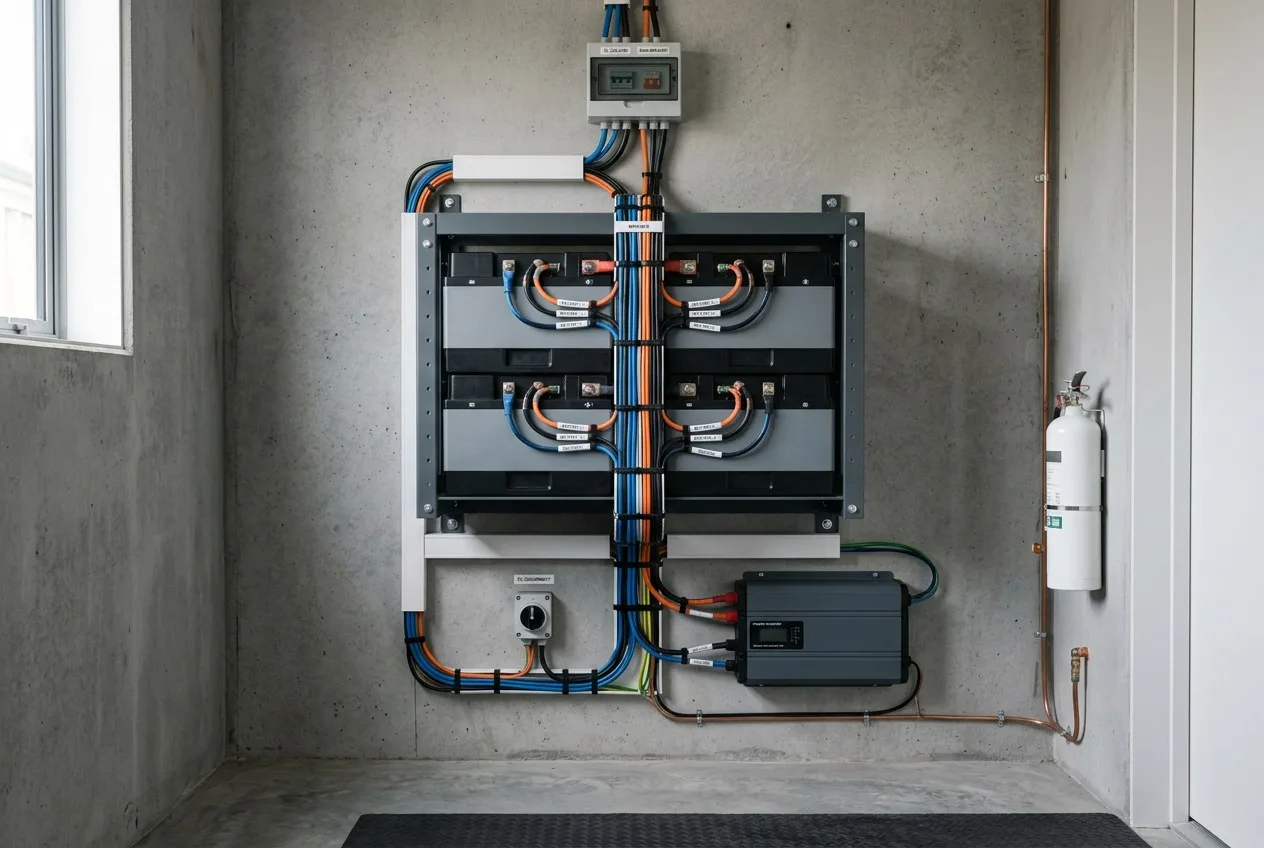
Mixing second-hand batteries or batteries of different ages in the same bank is a common mistake in vineyard house systems; one weak battery drags down the whole bank. The battery bank area should be dry, well ventilated, and out of reach of children and animals; it must be kept away from heat sources and flammable materials.
Step 5: Choose the Battery Voltage: 12 V, 24 V or 48 V?
The choice of voltage determines the current for the same power: current = power ÷ voltage. As the current increases, cables get thicker, connection points heat up, and fuse and breaker costs rise. For a 3,000 W inverter, the battery-side current is approximately as follows (without accounting for efficiency):
| Battery voltage | Approx. DC current for 3,000 W | Typical use |
|---|---|---|
| 12 V | ≈ 250 A | Small systems of a few hundred watts, caravans |
| 24 V | ≈ 125 A | Mid-sized systems between 1-2 kW |
| 48 V | ≈ 63 A | Systems of 2-3 kW and above, expandable systems |
The actual current will be slightly higher due to efficiency losses. For systems of a few kW, 48 V generally gives a more reasonable result; a 250 A DC line means both expensive cables and a serious risk of arcing and overheating. For a detailed comparison of voltages, you can use the article on choosing between 12 V, 24 V and 48 V battery voltage . Manufacturers such as Victron also describe off-grid design as the job of an authorized installer, since it involves many variables that depend on local climate and costs.
Step 6: Choose the Charge Controller and Inverter
Charge Controller (MPPT)
The charge controller converts the energy coming from the panel into a charging profile at the voltage and current the battery requires. There are two types: PWM (simple, cheap; the panel voltage must be close to the battery voltage) and MPPT (tracks the panel's most efficient operating point and converts the higher panel voltage to a voltage suitable for the battery). In vineyard house systems of 1 kWp and above, MPPT is almost standard; for details, you can see the article on the difference between MPPT and PWM .
Example calculation: 1,200 Wp panel array, 48 V battery. Charge current is approximately 1,200 ÷ 48 = 25 A. Adding a 25% margin gives about 31 A; in this case a 40 A class MPPT is sufficient. The other critical check is that the array's open-circuit voltage (Voc) in cold weather must not exceed the device's maximum input voltage. For this reason, the series-parallel arrangement of the panels must be made according to the device's datasheet. Victron's documentation describes, as an example practice, sizing the array power about 20% above the MPPT's input limit because of inefficiencies such as long cables and high temperatures, but this does not apply to every device; the manufacturer's own limit values must be used as the basis. For more details, see the page on choosing a charge controller .
Inverter
The inverter converts the battery's DC voltage to 230 V AC mains voltage. For refrigerators, pumps and electronic devices, choose a pure sine wave output model. Sizing is based on two figures:
- Continuous power: the total of the loads that can run at the same time. In the example, pump 750 W + refrigerator approx. 150 W + TV 60 W + lighting 48 W ≈ 1,000 W.
- Surge (peak) power: the pump and refrigerator compressor can draw several times their rated value at startup. Assuming the pump's startup is 2-3 times, 1,500-2,250 W plus the other loads gives a temporary peak of around 2.4 kW.
In this example, a 3 kW inverter is a reasonable choice in terms of both continuous power and startup margin. Choosing an inverter much larger than necessary increases its idle self-consumption and cost; choosing one that is too small causes alarms and shutdowns at pump startup. Models that combine charge control, inverter and grid input in a single device simplify installation. The pump startup issue occurs with the same logic in UPS systems as well; for a similar topic, the inrush current problem of motors and air conditioners article.
Step 7: Cables, Fuses, Switches and Grounding
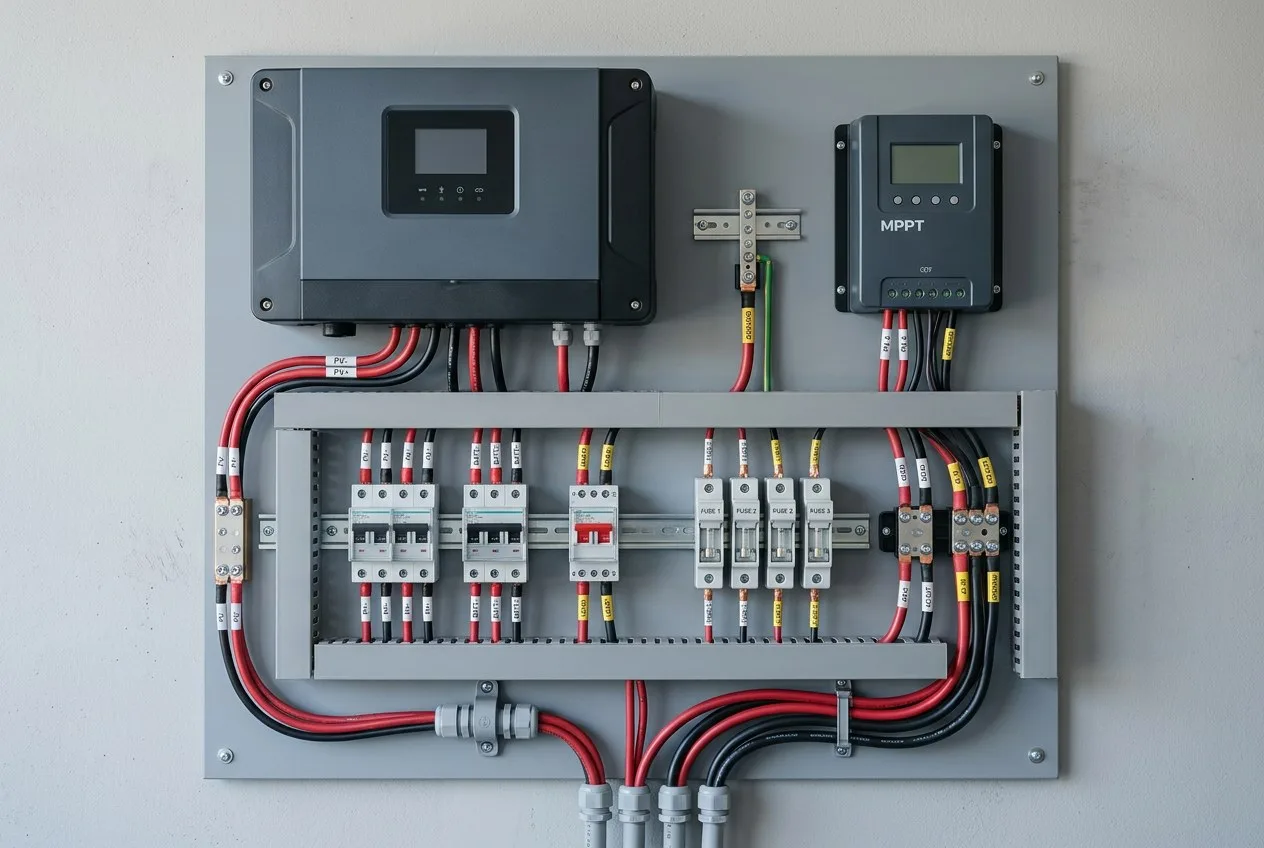
In vineyard house systems, most faults and fires are caused not by the panels or batteries, but by the wrong cable cross-section, loose connections and missing protection. The rule here is simple: every cable must have a cross-section that can carry its own current and must be protected by a fuse or switch at the point closest to its source.
- DC cable cross-section: It is calculated for both current-carrying capacity and voltage drop. In low-voltage systems, short and thick cables are used. You can find the formula in our article on DC cable cross-section selection.
- Fuses and switches: A DC-rated fuse should be used at the battery output, a DC switch on the panel array, and a surge protector where necessary. AC switches cannot safely interrupt DC current; therefore, equipment rated for DC is essential. For details, see DC fuse, switch and surge protection article.
- Grounding and lightning: In open terrain, panel arrays at high points are exposed to overvoltages caused by lightning and nearby strikes. The panel structure, inverter and panel enclosure must be properly grounded, and surge protection must be planned.
- Connection quality: A loose or improperly tightened cable lug heats up at high current. Labeling, suitable lugs and connections with verified torque significantly reduce the risk of fire.
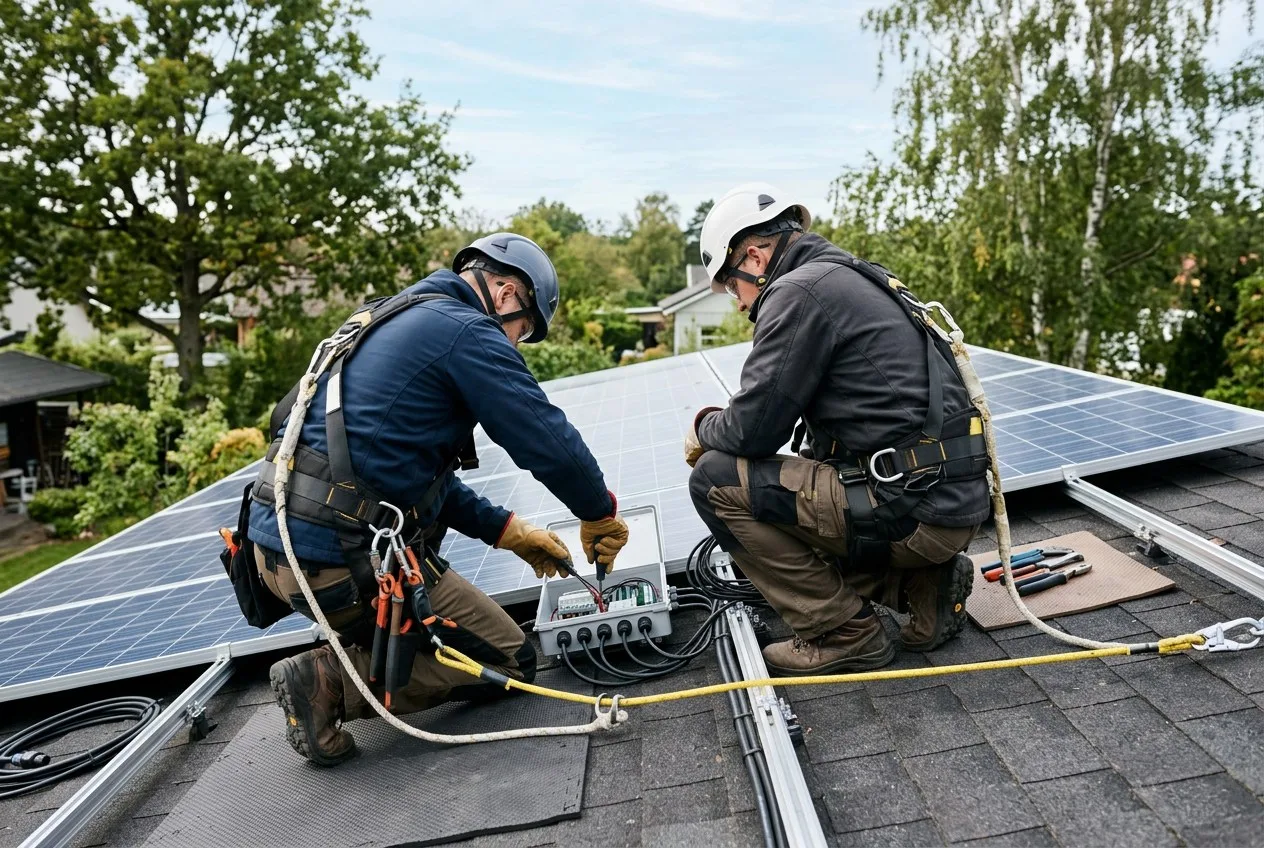
Solar panels keep producing voltage while they receive light; in other words, the panel side is not completely de-energized when you "turn off the switch." A battery bank can also deliver a very high current in a short circuit. Therefore, connections must be made by trained, authorized personnel using appropriate PPE, with attention to panel voltage and short-circuit arc risk. If lithium batteries are used, the BMS, fuses, layout and ventilation must be implemented as specified by the manufacturer.
Installation Sequence: In What Order Does the Work Proceed?
Installation details differ for every system; the sequence below is a general framework that helps you see what happens when during the planning stage, and it is not an installation instruction. Authorized personnel follow their own procedure according to the manufacturer's manual.
- Survey and measurement: Shade analysis, panel location, battery room and cable route are determined on site; the load list is verified.
- Sizing and equipment list: Panel power, battery capacity, voltage, charge controller and inverter ratings are finalized.
- Mechanical installation: The panel structure is fixed in a corrosion-resistant manner suitable for wind and snow loads; the battery rack or cabinet is put in place.
- Wiring and protection: DC lines, fuses, switches, grounding and surge protectors are installed; on the AC side, the distribution board and residual current protection are arranged.
- Commissioning: Voltage, polarity and insulation checks are performed; charge settings are programmed according to the battery type; a load test and a start-up test are carried out.
- Handover and training: Diagrams, setting values and the emergency shutdown procedure are given to the system owner; how to monitor the system is demonstrated.
Wiring a battery bank correctly and ensuring current balance requires separate expertise; if you are interested, see the article on battery bank wiring and busbar layout. The survey, installation and periodic maintenance of the battery bank, inverter and protection components fall within Bempower's field of work; panel installation and the solar power plant (GES) application are a separate job.
Common Mistakes in Vineyard House Systems
| Mistake | Result | Precaution |
|---|---|---|
| Sizing for summer but using it in winter | In December–January the battery drains and the system shuts down frequently. | Size the system according to the PSH value of the weakest month you will use it. |
| Selecting the inverter only by its nameplate power | Overload alarm when the pump and refrigerator start | Take the starting current into account; consider a soft starter if necessary. |
| Small cross-section DC cable | Heating, voltage drop, fire risk | Choose the cross-section according to current and distance; set the fuse according to the cable. |
| Different ages and types in the battery bank | Unbalanced charging, early failure | Use batteries of the same brand, type, age and capacity. |
| Leaving charge settings at default | Overcharging or undercharging, loss of lifespan | Program the battery manufacturer's voltage and current values. |
| Neglecting grounding and surge protection | Inverter and controller damage during lightning | Plan grounding and surge protection in open terrain. |
| Not ventilating the battery room | Heat and gas accumulation (in lead-acid) | Make the placement dry and ventilated, following the manufacturer's manual. |
| Not thinking about growth at all | When a new device is added, the system falls short. | Choose the voltage and inverter power so they allow for expansion. |
Winter, Maintenance and a House Left Unused for Long Periods
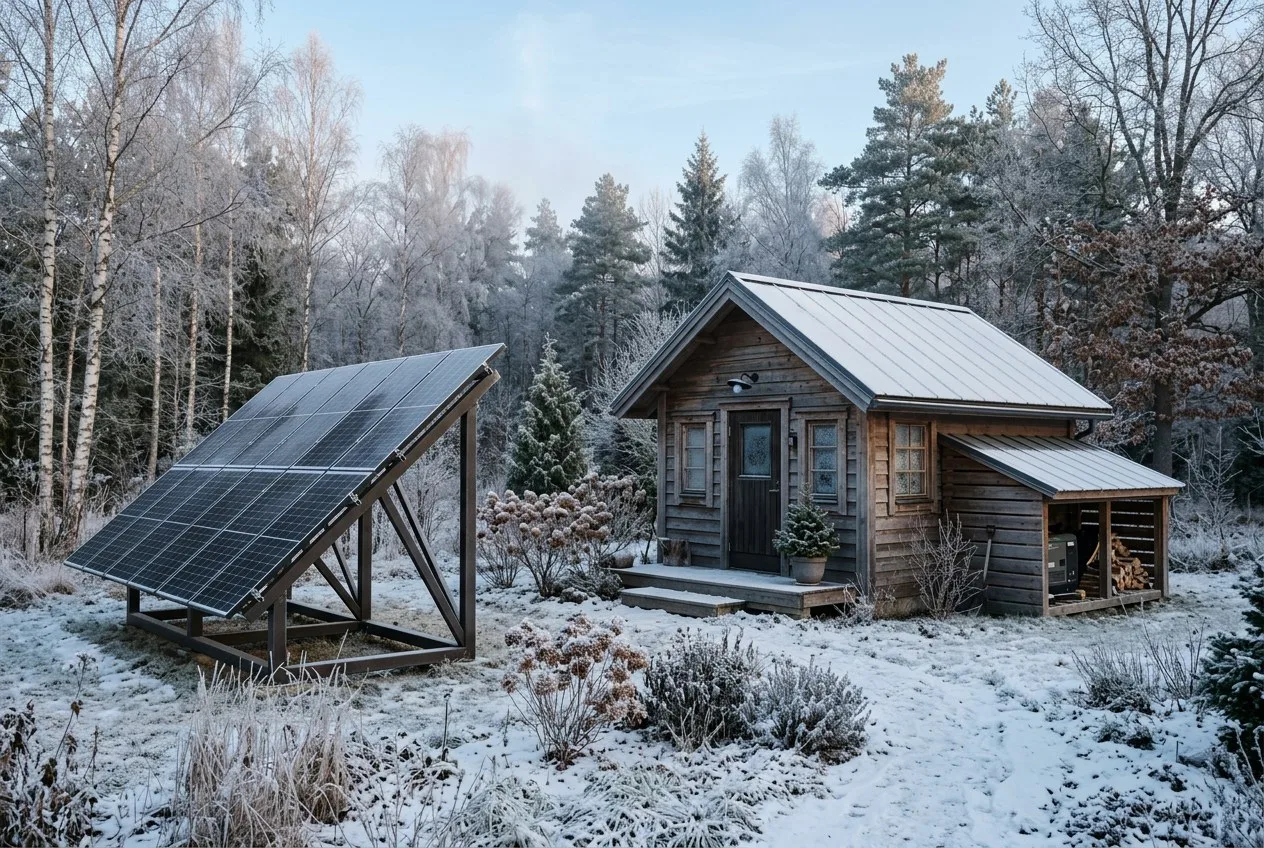
The biggest characteristic of vineyard houses is that the system is left "unattended" for days. This makes the maintenance plan different from that of a regular home.
- Panel surface: Dust, pollen and bird droppings reduce production; after long periods without rain, clean the surface with a suitable method. Abrasive materials and high-pressure water are not recommended; safe access to the roof should also be planned separately.
- Battery condition: When the house is empty, switch off unnecessary loads and prevent the battery from sitting at a low state of charge. An inverter or BMS with remote monitoring lets you check the battery status without going to the house.
- Connection check: Vibration and temperature changes can loosen connections. Connections should be checked visually at least once a year, and with a thermal camera if necessary.
- Winter backup: Production drops in winter; in homes occupied year-round, having a small generator charge the battery is often more economical than increasing panel capacity. Plan charging control and fuel safety in advance.
- Temperature: In cold weather, battery capacity drops, and some lithium batteries cannot be charged below a certain temperature. Placement and insulation should be arranged accordingly.
What Should You Consider When Planning the Budget?
Because current prices change frequently and vary by brand and region, we do not give TL amounts in this article. However, the following order of priorities is useful when making a decision:
- First reduce consumption; efficient appliances, savings and loads that run during the day make the system smaller.
- Do not cut costs on the battery bank and inverter quality; these determine the lifespan and safety of the system.
- Since panels are a relatively inexpensive item, choosing slightly larger ones (especially for winter use) reduces deep discharge of the battery.
- Include "invisible" items such as cables, fuses, switches, grounding and surge arresters in the budget from the start.
- Compare the payback period with real alternatives, such as the cost of running a grid line and the losses caused by outages.
For a method of calculating how long the system will take to pay for itself, the article on payback period of a solar energy investment will guide you. The investment decision should be evaluated not only by looking at the electricity bill, but together with the comfort and added value that an off-grid or outage-prone property provides.
Contact Bempower for Your Vineyard House System
If you want technical advice on the battery bank, inverter, cabling and protection while preparing your plan, Bempower's survey, installation, periodic maintenance and technical service offerings in the field of batteries, UPS and inverters can support you. To discuss the condition of your existing batteries, your inverter selection or your maintenance plan, you can reach us through our contact page.
- Solar Energy (values from the Turkey Solar Energy Potential Atlas) — T.C. Ministry of Energy and Natural Resources (via ekb.gov.tr), 2025. http://ekb.gov.tr/Icerik-216-GunesEnerjisi
- Resources - General Directorate of Energy Affairs (GEPA) — T.C. Ministry of Energy and Natural Resources, 2025. https://enerji.gov.tr/enerji-isleri-genel-mudurlugu-kaynaklar
- Resources - Republic of Türkiye Ministry of Energy and Natural Resources — T.C. Ministry of Energy and Natural Resources, 2025. https://enerji.gov.tr/eigm-resources
- Photovoltaic Geographical Information System (PVGIS) — European Commission, Joint Research Centre, 2025. https://joint-research-centre.ec.europa.eu/pvgis-online-tool_en
- Photovoltaics Geographical Information System: Status Report 2025 — European Commission, Joint Research Centre, 2025. https://publications.jrc.ec.europa.eu/repository/handle/JRC145327
- Off-grid - Victron Energy — Victron Energy, 2025. https://www.victronenergy.com/markets/off-grid
- Off-grid power systems for homes - Victron Energy — Victron Energy, 2025. https://www.victronenergy.com/markets/off-grid/family-home
- Guide to designing off-grid and hybrid solar systems — Clean Energy Reviews, 2025. https://www.cleanenergyreviews.info/blog/designing-off-grid-hybrid-solar-systems
- Beginner's Guide: Sizing Your Off-Grid Solar System — Renogy, 2026. https://www.renogy.com/blogs/learn-center/learn-system-sizing
Sources
