


How to Reactivate UPS and Batteries That Have Been Off for a Long Time?

A summer business closes at the end of the season, the maintenance line of a factory is stopped for months, and the spare UPS in the warehouse is waiting on the shelf "in case it is needed". Six months, a year, sometimes more pass and the device is wanted to be reactivated. It seems tempting to plug in and press the button; however, both chemical and electronic changes have occurred inside the UPS during this time. The battery may have discharged on its own, the capacitors may have been without voltage for a long time, and the contacts and display settings may have changed.
This guide; It was written for home users, business owners, technical managers and purchasing units. We discuss step by step which pre-check is required according to the downtime, what changes in the batteries, how and how long the charge is completed, what tests are performed after commissioning, and in which case it is necessary to call service directly. Numerical calculation examples are given with assumptions.
An important note: The UPS and battery banks can carry high DC voltage and high short-circuit current. The following information is to help you make a decision and speak correctly to the service; operations such as opening the cabinet, connecting the battery, and measuring should be performed by authorized electrical personnel.
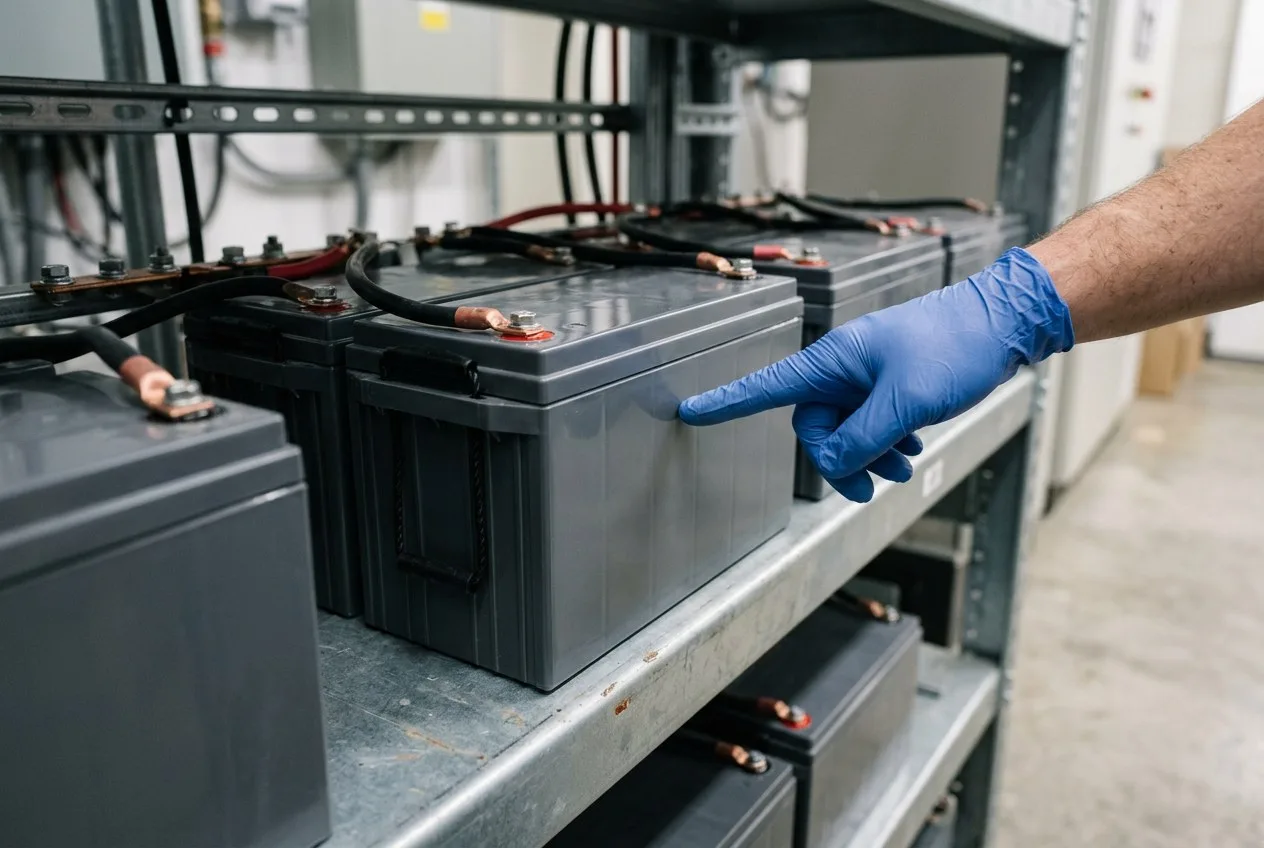
Why Should a UPS That Has Been Turned Off for a Long Time Not Turn On Immediately?
A closed UPS looks like a "standing" device, but the parts inside continue to age over time. There are three main risks:
- Battery loss: A lead-acid battery without a mains connection constantly loses charge due to self-discharge. If it waits long enough, sulfation begins on the plates and the capacity is permanently reduced.
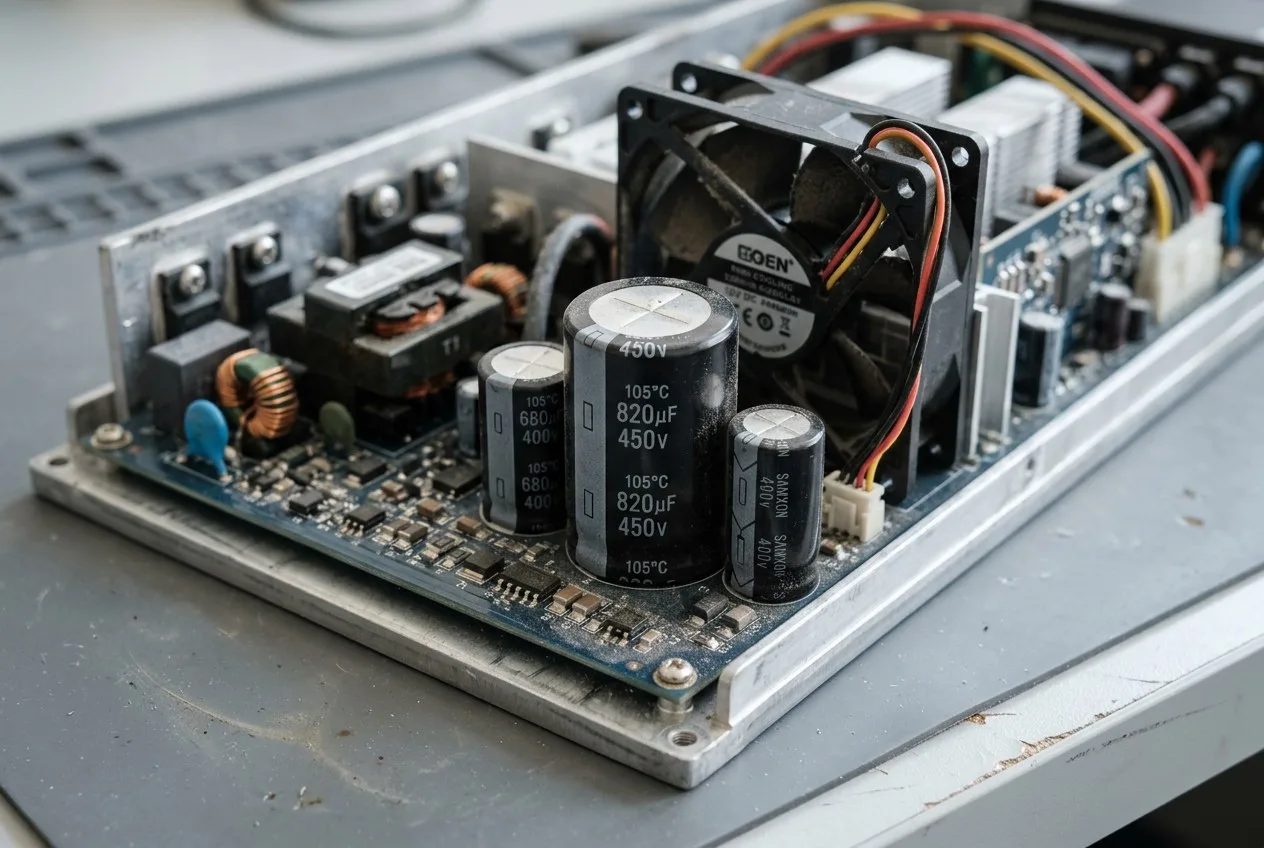
- Capacitor aging: The insulating oxide layer of aluminum electrolytic capacitors used in the DC intermediate circuit of the UPS can thin when it remains without voltage for a long time. When sudden full voltage is applied, leakage current increases.
- Environmental Impacts: Moisture, dust, temperature fluctuation, rodent or insect ingress; oxidation on the terminals, bearing problems on the fans, and pollution on the card surface.
The common consequence of these risks is that even if the device appears to be working in the first minutes, it may not be able to deliver the expected time when a power outage hits. Since the main job of the UPS is to activate in case of an outage, it is necessary to close the gap between "opened" and "ready" with tests.
What Action Is Required Based on Downtime?
The table below provides a general approach. Time thresholds vary depending on the manufacturer, battery type, ambient temperature, and battery state of charge before shutdown; the device manual and battery datasheet should be consulted for exact values.
| Downtime | Possible situation | Recommended approach |
|---|---|---|
| 1-3 months | Partial loss of charge in batteries; permanent damage is generally not expected. | Visual check, connect to the mains and wait for charging to complete, followed by no-load monitoring and simple battery testing. |
| 3-6 months | Many manufacturers require a refresh charge in this range; the risk increases in a hot environment. | Voltage measurement, controlled long charge, then capacity or discharge test. |
| 6-12 months | Sulfation and capacitor effect may occur; loss of capacity is possible. | Service check recommended. Block-based voltage and internal resistance measurement, long charge, test; capacitor and fan control. |
| Longer than 1 year | There is a high probability that the battery bank is weak or unusable; the electronics may also be aged. | Full inspection with an authorized service. Be prepared for the possibility of battery pack regeneration; testing is essential before connecting the load. |
Manufacturers' recommendations draw a picture that is compatible with this picture. A fact sheet from a UPS manufacturer recommends charging lead-acid batteries in storage every 3-4 months, while the same article recommends keeping the battery at about 10 °C or below if it cannot be charged. A different manufacturer gives the charging interval for single-phase UPS batteries as six months and the total standby time as one year. This discrepancy indicates that there is no single "correct" number; documentation of each device is essential.
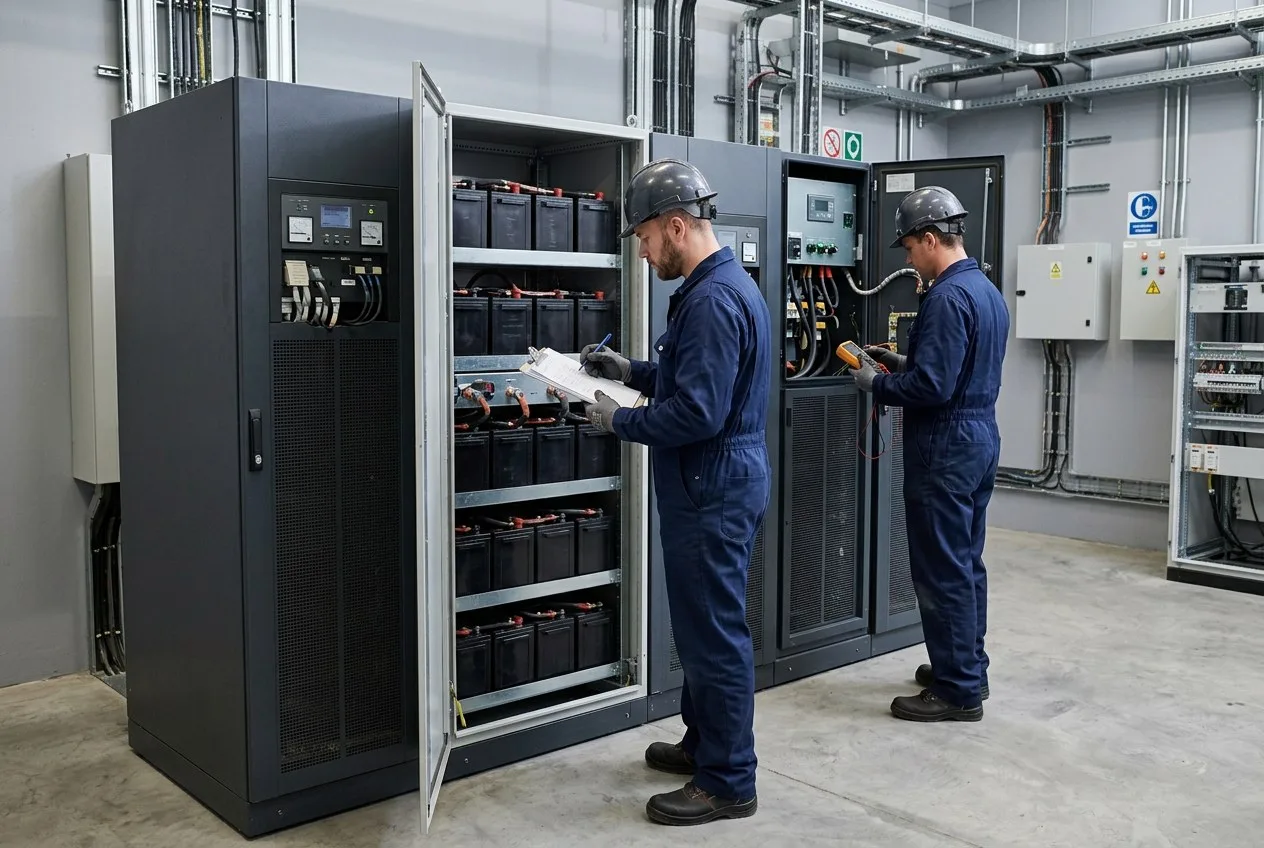
What Happens When the Battery Is Off? Self-Discharge and Sulfation
Self-discharge is when the battery slowly loses charge due to small chemical differences in the plates, even if it is not connected to any load. This is constantly compensated for by float charging when the grid is present; when the grid is cut off, the compensation stops. A battery manufacturer mentions a monthly loss of about 3 percent for VRLA batteries at 20 °C. This rate rises markedly as the temperature rises.
A simple example: A battery that is 100 percent charged at the time of shutdown drops to roughly 64 percent charge (linear approximation) in 12 months, with a loss of 3 percent/month. In reality, the loss is non-linear and depends on temperature; but the order of magnitude is important: At the end of a year, a third of the battery may be discharged. A discharged battery is prone to sulfation.
Sulfation is the hardening and crystallization of lead sulfate formed during discharge over time; this layer is an insulator and lowers its ability to accept charge. For detailed explanation What is battery sulfation, symptoms and prevention You can look at the article. The importance of the storage conditions of the battery and the production date is Shelf life of the battery It is explained in the article.
Eaton defines VRLA battery shelf life as the time it takes to wait without any current flowing in the battery to the point where it cannot return to full capacity on a single charge, treating this point as the loss of roughly 40-50 percent of its initial capacity. In other words, shelf life refers to the threshold at which the battery cannot be recovered on a single charge, not when it "degrades".
The good news is that in a past field case, hundreds of 12V 200 Ah VRLA batteries that had been sitting for more than 18 months without a refresh charge were reported to be able to recover to a large extent with the appropriate charge voltage; among these batteries, about half have largely retained their capacity. However, this result cannot be generalized to every battery; recovery is verified only by measurement, and such applications should be carried out by experts under controlled conditions.
What Ages Other Than the Battery? Capacitor, Fan and Cards
In a UPS that remains without voltage for a long time, not only the battery but also the power electronics themselves require attention.
DC intermediate circuit capacitors
In aluminum electrolytic capacitors, the insulating layer is an oxide film protected by the applied voltage. If there is no voltage for a long time, this film can be inspected. In the storage guidelines published by capacitor manufacturers, it is stated that no special treatment is required for waiting up to about 2 years, typically at 5-35 °C and low humidity, and that "reforming" can be applied with voltage if it is at longer waiting or high temperature. The decision depends on the data sheet of the series and the waiting conditions.
Practical implication: Instead of directly supplying full mains voltage in a large UPS that has been switched off for several years, service is expected to proceed with gradual voltage and measurement if necessary. This should be done by people who know the circuit and set points. In this article, we do not give step-by-step voltage values; because the correct profile depends on the device. For maintenance decisions on the capacitor and fan side UPS capacitor and fan replacement article would be useful.
Fans, contacts and cards
- Fans: The bearing may make noise or not rotate on the first operation due to drying. Putting a load on the fan before it starts will lead to overheating.
- Contacts and contactors: In a humid environment, the surface oxidizes; contact problems may occur at the first switching.
- Boards and connectors: Dust and moisture accumulation can create leakage currents. The situation is different in a humid environment or after flooding; for this UPS and battery left in flood or humid environment See the article.
- Built-in clock and settings: The time, date, and alarm thresholds may have been reset; this affects the reliability of the records.
The device's software may also have lagged behind over time. Whether an update is needed is determined by manufacturer announcements and service evaluation; about this When and how to update the UPS firmware The article guides the way.
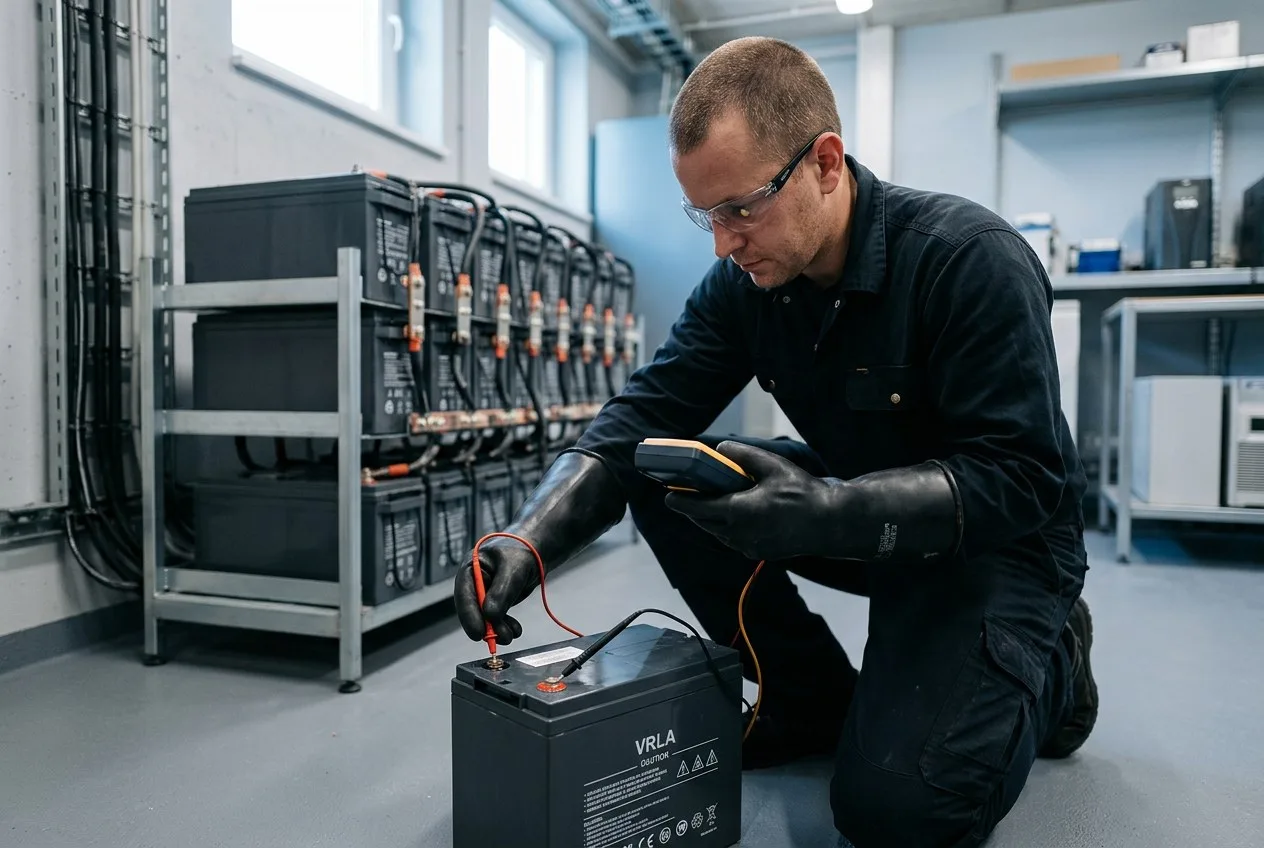
Before Opening: Visual Inspection and Preliminary Measurements
The first step is to look at it without doing anything related to energy. The following checklist summarizes the first points that a competent personnel looks at in the field; the goal is to direct you not to take action, but to record what is observed.
| Control | What to look for? | If there are findings |
|---|---|---|
| Battery housing | Swelling, cracks, leaks, discoloration, burning smell | Do not charge; report to an authorized service center. See Causes of battery swelling |
| Poles and connections | White-green oxide, looseness, heating trace | Cleaning and torque control should be done by the service |
| UPS interior and ventilation | Dust, insect-rodent tracks, moisture, corrosion | Opening if there is moisture; drying and checking are required |
| Cable and enclosure | Damaged insulation, loose terminal block, waste fuse | Entry-exit protections should be checked if they are appropriate |
| Tags and dates | Battery production/charging date, last maintenance record | Reconsider the possibility of renewal in the older group |
| Environment | Temperature history, humidity, ventilation | Be more cautious if it stays in a closed, hot room in summer |
What does battery voltage tell?
The service measures the block or string voltage with the car turned off and safe conditions in place. Example: The idle voltage of a 12V VRLA block at rest (sitting for some time after load and charging) is typically around 12.6-12.9 V when fully charged; as the value decreases, the charge level decreases. Voltages that are too low, for example below 11.5 V, are a sign of severe deep discharge and may not accept a charge. These ranges vary by manufacturer; how the measurement is taken and interpreted How to measure and interpret battery voltage It is explained in the article.
Voltage alone does not tell capacity. Therefore, a second measurement is required, such as capacity or internal resistance after charging. For these What is a UPS battery test You can look at the article.
Work safety is a prerequisite: insulated hand tool, gloves and goggles, removing metal jewelry in the battery area, working with the appropriate procedure instead of one person due to the risk of arcing and short circuits. Reasons Occupational safety in UPS and battery work It is explained in the article.
Recommissioning Sequence: General Flow
The following flow describes the general logic that service teams follow in the field. The order in the manufacturer's manual applies to your specific device; in particular, the connection sequence and circuit breaker locations vary by model and power class.
- Recording and documentation: Downtime, environment, status before shutdown and alarms are recorded. Device and battery serial numbers are noted.
- Separation of load: Critical devices must be disconnected from the UPS output. Initial start-up is no-load.
- Visual inspection and preliminary measurement: The checks in the previous section are made; if there is a suspicious battery or cable, the process stops.
- Controlled energization: Mains input is applied. In large systems that are closed for a long time, the service can apply a step-down approach for the capacitor and charging unit.
- Charging monitoring: Charging current, total string voltage and temperature are monitored. If the battery heats up, swells or gives off a strange smell, it is stopped.
- Alarm and setting control: Time, date, alarm thresholds, battery settings (Ah, pcs, float voltage) are verified.
- Battery test: After the charge is completed, a capacity or discharge test is performed.
- Load lashing: If the test result is sufficient, the loads are connected starting with the progressive and non-critical ones.
This sequence has a lot in common with the "first commissioning" logic in large systems; for acceptance criteria UPS initial commissioning and acceptance tests You can find a checklist in the article.

How long does battery charging take? Account Example
There is no single answer to the question "How long does it take to charge?"; but you can calculate an approximate magnitude. The example below is just to illustrate the logic; the actual time varies with the charger's current limit, temperature, and battery status.
Assumptions: A set of 12 V 100 Ah VRLA batteries; after a long wait, approximately 50 percent of the usable capacity is discharged. The current limit of the UPS charger is 10 A.
- Undercharge: 100 Ah × 0.50 = 50 Ah
- Theoretical time in the constant current phase: 50 Ah ÷ 10 A = 5 hours
- Coefficient of about 1.2 for loss of charge efficiency: 5 × = 1.2 6 hours
- In the last stage, additional time is required while the voltage remains constant and the current decreases (absorption); practical total is mostly 12-24 hours It is at the level.
This period may be longer in battery groups that are deeply discharged, have difficulty accepting current, or heat up; some manufacturers predict a full charge up to 24-72 hours after long waits. The charge that seems to be dead on the first day is therefore not sufficient for the test; it is necessary to wait for the point where the charging current is low and constant, and the string voltage stops at the float level.
Float tension example: For VRLA batteries, the float voltage is given between about 2.25-2.30 V per cell, according to the manufacturer; one manufacturer says 2.275 V/cell ± 0.025 V for 25 °C. Since the 12 V block has 6 cells, 6 × is 2.275 V ≈ 13.65 V. In an array of forty blocks, this makes roughly 40 × 13.65 ≈ 546 V. Checking that this value is set correctly is one of the important steps during commissioning. Why settings are critical How Battery Charging and Discharging Works It is explained in the article.
Post-Charge Tests: The Difference Between "Turned On" and "Ready"
Tests performed after the charge is finished show the actual condition of the battery pack. The table below summarizes which test answers which question.
| Testing | What does it indicate? | Point to note |
|---|---|---|
| Block tension measurement | Is there a weak block with significant deviation within the array? | If the charge has just run out, it is necessary to rest it for a while and measure it |
| Internal resistance/conductivity | The tendency of the battery to age and sulphate | Compared to the previous measurement or manufacturer reference; see Battery internal resistance |
| Capacity/discharge test | Actual backup time, acceptance limit | The risk of interruption should be planned; see. Battery discharge test |
| UPS function test | Grid-to-battery switching, bypass, alarms | It is done first with no load or light load |
| Thermal control | Heated connection, hot spot | It is done under load; see. Thermal camera control |
If the test shows that the capacity is above the acceptance limit, the UPS can be loaded and the charging and alarm logs are closely monitored in the first weeks. If it is below the limit, the level of aging determines the decision between partial solutions (replacing weak blocks) and renewing the entire group; for this discussion Should a single battery or the whole group be replaced? article helps. In an already middle-aged group that has been confined for a long time, the second option is often healthier.
What Happens When Lithium Battery UPSs Are Turned Off?
Lithium-ion and LiFePO4 batteries are less self-discharged than lead-acid; still, it wouldn't be correct to say "shut down and forget". The built-in BMS (battery management system) and monitoring circuits draw continuous, albeit low, current. If the cell voltage falls below the lower limit, the BMS can lock the battery (put it in protection mode), and in some cases, the cells will be permanently damaged.
For storage, manufacturers usually recommend a partial charge level; the common range for lithium-ion in the sources used is around 30-60 percent, and sitting at full charge or very low charge for a long time is an aging accelerator. A safety source also states that a charge level of 30 percent or less reduces the risk of storage and is exempted accordingly in some fire regulations. For lithium batteries integrated into the UPS, it is the device's firmware and procedure that sets this level; do not attempt to reduce the battery capacity on your own.
For systems using lithium batteries, "wake-up" (reactivating the locked BMS) and initial charging should be done following the order in the manufacturer's documentation. Points different from lead-acid, lithium battery UPS maintenance: controls that are different from lead-acid It is discussed in the article. A similar logic applies to solar energy systems: for periodic checks on hybrid inverters and battery banks that remain closed seasonally Periodic Maintenance Checklist for Solar Energy Systems You can look at the article.
Common Mistakes and the Right Approach
| Error | Why the problem? | The right approach |
|---|---|---|
| Connecting and unfastening the load | If the battery is low, the devices will suddenly shut down at the first outage; fan and charging unit problems occur under load. | Run without load first, complete charging and testing. |
| Saying "A few hours of charging is enough" | Absorption is not complete; in the test, the capacity appears to be understated. | Wait until the current drops and the voltage stabilizes. |
| Charging a swollen or leaking battery | The risk of off-gassing, heating and thermal runaway increases. | Do not start charging; notify service. |
| Looking at a single block and deciding | The weak block in the array pulls the whole group down. | Compare voltage and internal resistance on a block basis. |
| Not checking settings | Incorrect float voltage or battery capacity setting creates an overcharge or undercharge. | Ah, verify the number of batteries, floats, and alarm thresholds. |
| Keeping no logs | Comparison cannot be made in the next maintenance. | Report initial voltage, charging time, and test results. |
| Intervention in the cabin on its own | There is a risk of high DC voltage, arcing and electric shock. | Leave the cabinet and battery operations to authorized personnel. |
To Avoid Happening Again: Closure and Storage Plan
Planning from the beginning for seasonal closures or UPSs that will not be used for a while prevents many of the problems that may occur during the opening. The recommended framework is as follows:
- If possible, leave it on the mains: If the UPS remains mains-connected, on, and protected, the charger will hold the battery. If it needs to shut down, at least schedule periodic charging.
- Periodic refresher charging: According to the manufacturer's documentation, schedule a full charge cycle for lead-acid batteries, typically every 3-6 months. Shorten the interval in hot environments.
- Battery connection: If left without a mains, the battery circuit breaker or connection must be opened according to the manufacturer's instructions so that the UPS does not drain the battery slowly. This must be done by authorized persons.
- Environment: Prefer a cool, dry, dust-free, ventilated room. High temperature accelerates self-discharge and shortens battery life.
- Recent status record before closing: Note the battery voltage, test result, alarm history and settings. This allows comparison during commissioning.
- Batteries in reserve or storage: Keep track of the production and "need to charge" dates on the label; organizations should record these dates.
In multi-branch businesses, this follow-up should not be left to a person's memory; it should be written in the periodic maintenance calendar. The difference in cost and risk between planned maintenance and emergency response Emergency room or planned maintenance It is compared in the article.
When Should You Call Direct Service?
If you have one of the following situations, proceed with an authorized service center instead of trying it yourself:
- The downtime has exceeded one year or the duration is unknown.
- If the battery is swollen, leaking, overheating, or emitting a strong odor.
- If the UPS is three-phase or high-power (kVA level), the battery bank is of high DC voltage.
- It has been closed after an event such as flooding, fire, excessive humidity or lightning.
- If there are persistent alarms, bypass mode, or fan/heating issues at power-up.
- If the UPS will feed a load where downtime is costly, such as a hospital, data center, production line.
To speed up the service request, have the device's brand-model information, number of batteries and Ah value, downtime, alarm codes and the last maintenance report, if any, ready. Thus, both the inspection and the charging plan can be set up together on the first visit.
Post-Commissioning Monitoring: The First Weeks
Even if the test passes successfully, it's wise to monitor the device closely in the first weeks:
- Verify that the charging current decreases over time and settles at the float voltage.
- Monitor temperature and fan behavior under load.
- Look for any recurring alerts in the alarm history.
- If possible, ask for the measurements to be repeated after a month and compared with the initial values.
- If remote monitoring is available, confirm that the clock and threshold settings are correct.
A UPS that has been down for a long time is considered "reliable" for a critical load only after this monitoring period has gone smoothly. If you see unexpected deviations, schedule a retest.
Bempower offers on-site exploration, commissioning, battery testing, periodic maintenance and technical service for all brands of UPS, battery packs and inverters. If you have a UPS or battery pack that has been off for a long time, you can evaluate the situation together and draw up a safe commissioning plan. From our contact page You can contact us.
- Safety, Storage, Operating and Maintenance Manual VRLA Battery Systems — EnerSys, 2008. https://www.enersys.com/493c0d/globalassets/documents/product-documentation/powersafe/_multi/amer/us-vr-om-002_0308.pdf
- Recommendations for prolonging the life of your UPS battery — Schneider Electric Blog, 2014. https://blog.se.com/digital-transformation/it-management/2014/08/28/recommendations-prolonging-life-ups-battery/
- Lifespan of UPS Batteries (White Paper) — Riello UPS, 2020. https://www.riello-ups.com/uploads/file/767/2767/Riello_UPS_WhitePaper_02-20_Lifespan_of_UPS_Batteries_EN.pdf
- VRLA Battery User Manual (Operation and Handling Manual) — CSB Battery, 2025. https://csb-battery.com/wp-content/uploads/2025/03/CSB-Operation-and-Handling-Manual-032025.pdf
- Aluminum Electrolytic Capacitor Storage Guide — Lorida Capacitor, 2025. https://www.loridacapacitor.com/news/aluminum-electrolytic-capacitor-storage-guide.html
Resources
