


Lithium Battery UPS Maintenance: Controls That Differ From Lead-Acid

Lithium-ion batteries are now a common option in the UPS world. They offer longer expected life, smaller volume, and improved monitoring. That's why there's a phrase that's often heard: "A lithium battery doesn't require maintenance." This sentence is half true. Some of the work in a lead acid battery is truly gone, but replaced by other controls. Skipping these checks means leaving the battery "unmaintained." In a system that maintains critical load, this can be expensive.
This guide explains what has changed and what has remained the same in the maintenance of a UPS with lithium batteries. We cover step by step how to read BMS data, why temperature and charge level are important, how to plan capacity testing and critical points on the safety side. Article; It is aimed at server room, building, factory or data center managers, technical officers, purchasing units and business owners who are considering switching to lithium.
A word of caution from the outset: Lithium battery modules contain high energy and voltage. The control points in this article describe what is to be requested and what to monitor; cabinet opening, connection, adjustment and testing must be carried out by authorised electrical personnel or technical service according to the manufacturer's procedure.
Why Is Maintenance Still Necessary on a Lithium Battery UPS?
Manufacturers are also cautious about this. One manufacturer white paper makes it clear that lithium batteries are not maintenance-free in critical system applications and calls for customization of maintenance procedures for lithium. Another source says that the need for maintenance is very low. The two are not contradictory: the workload is reduced, but not to zero.
There are three main reasons why maintenance is still necessary:
- The battery side may still be the weakest link. According to information provided by a company that produces monitoring solutions, based on an industry study, the majority of UPS failures are caused by batteries. Although the chemistry varies, the interface between the UPS and the battery, wiring and ambient conditions are the same source of risk.
- There is a new component: the BMS. The setting, communication, software and alarm logic of this component are included in the scope of maintenance.
- The error format is different. A lead acid battery usually weakens gradually. In lithium, BMS protection can suddenly disable the battery when it exceeds a limit. Therefore, saying "looks working" is not sufficient proof.
For general maintenance logic Why UPS maintenance should be done regularly You can take a look at our article. Here we only cover the differences specific to lithium.
How Do Maintenance Items Differ in Lead Acid and Lithium Batteries?
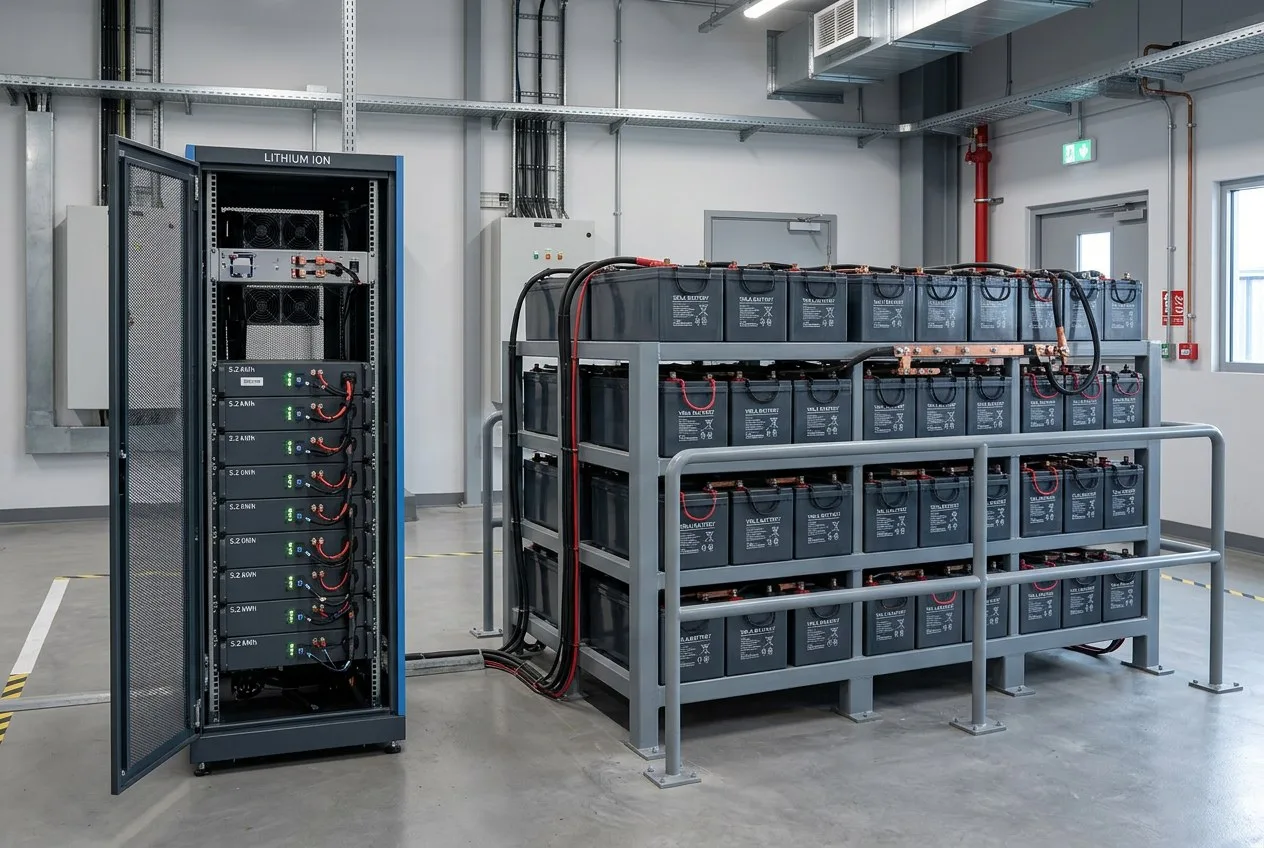
The table below compares the maintenance items of a typical VRLA (valve-controlled lead-acid) group and the lithium module. The table is a general framework as lithium chemistries and manufacturer designs differ; the manufacturer's maintenance manual is essential for precise coverage. Chemistry and difference detail of lithium batteries Lithium-Ion UPS Batteries You can find it in our article.
| Maintenance pen | Lead-acid (VRLA) | Lithium-ion |
|---|---|---|
| Block/cell voltage | Individual block measurement and comparison common | BMS continuously monitors cell and module voltage; records are read |
| Internal resistance/conductivity | Frequently used as a health indicator | Module-level BMS data; spike may be a clue |
| Swelling, leakage, corrosion | Visual inspection on every visit | Case deformation and heat trace control; pole head corrosion less trouble |
| Charging profile | Float tension, temperature compensation | Compatibility of UPS charging settings with lithium module and BMS |
| Communication | Often absent or additional monitoring system | BMS-UPS communication, alarm transmission, firmware |
| Temperature sensitivity | High temperature seriously shortens life | It may be more tolerant; but low temperature and long high temperature in charging are harmful |
| End of life | Block/group change according to age and test results | SOH, cycle count and capacity test; module-based change |
For the detail of the classic works on the lead acid side UPS battery maintenance You can look at the article.
What is BMS and Why is it at the Center of Maintenance?
BMS (Battery Management System) monitors the voltage, current and temperature of the cells in the lithium battery; It is an electronic control layer that protects the battery when the limit is exceeded. According to Eaton's white paper, in lithium systems connected to the UPS, the BMS can disconnect the battery from the UPS when the protection limits are exceeded; therefore, it is important to know these limits. The typical BMS structure for UPSs consists of multiple layers: a rack-level BMS and cell balancing function are one of them. For a detailed explanation What is BMS and what does it do You can check our article.
The importance of BMS in maintenance comes from this: In lithium battery, most of the "health" information comes from BMS. So the first thing to do in the maintenance visit is to read the BMS. Standards also care about this layer: the 2022 version of IEC 62619 for industrial lithium batteries emphasizes BMS requirements and overcharge, overcurrent, and overheating protection.
What Data to Read from BMS?
- SOH (State of Health): Estimation of the remaining capacity based on the new state of the battery. It is checked in a maintenance list along with the number of cycles.
- SOC (State of Charge): Instantaneous charge rate. The expected level of the float is written in the manufacturer's documentation; a consistently low or fluctuating SOC indicates a charging problem.
- Cell voltage difference: The difference between the highest and lowest cell. A growing difference may be a sign of a balancing problem.
- Temperature values: Temperature difference between modules and peak value.
- Alarm and event history: Overvoltage, undervoltage, overcurrent and temperature events; past protection interruptions.
- Number of cycles and total Ah passes: It shows the life consumption according to the frequency of grid outages.
An increase in internal resistance can also be interpreted: In a lithium battery, internal resistance usually remains more stable, so a sudden increase can be an indication of BMS interference or thermal imbalance. For the general logic of internal resistance Battery internal resistance You can look at the article.
Periodic Maintenance Checklist on Lithium Battery UPS
The manufacturer's manual always takes precedence. The following table presents the intervals and control items as a typical approximation. In critical facilities (hospital, data center, production line), intervals are shortened.
| December | Control | What to look for? |
|---|---|---|
| Continuous / daily | Remote monitoring and alarm notification | Active alarm, loss of communication, temperature warning |
| Monthly | UPS and BMS display/indicator control | Status LEDs, SOC, SOH, error code; number of recorded events |
| 3-6 months | BMS log review and trend | Cell difference, temperature trend, past protection interruptions |
| Yearly | Physical and electrical control (authorized personnel) | Connection tightness, cable and busbar condition, casing, ventilation, thermal screening |
| Yearly - 2 years | Capacity validation | Actual backup time, BMS's SOH estimation and measurement agreement |
| When necessary | Firmware and settings control | Compatibility of BMS and UPS software versions |
The manufacturer and field experience may find it sufficient to perform a physical inspection and registration review of the lithium battery once a year or every six months. However, this is a lower limit; it makes sense to look at it more frequently in a critical load and hot environment. For a general UPS checklist UPS maintenance checklist Check out the article as well.

Temperature and Charge Level: What Determines Lithium Life?
Ambient temperature seriously shortens the life of lead acid batteries, and this is a well-known rule. Lithium batteries can be considered more tolerant of high temperatures; however, this does not mean "temperature is unimportant". Calendar aging is the loss of capacity that occurs over time, even if the battery is not used. In a study on LiFePO4/graphite cells, it was reported that capacity loss increases significantly as storage temperature and filling level increase, and the effect of temperature is more dominant than the filling level. Another peer-reviewed study summarizes that too high and too low temperature both accelerate capacity loss, increasing the risk of polarization and lithium plating at low temperatures.
In terms of maintenance, it means:
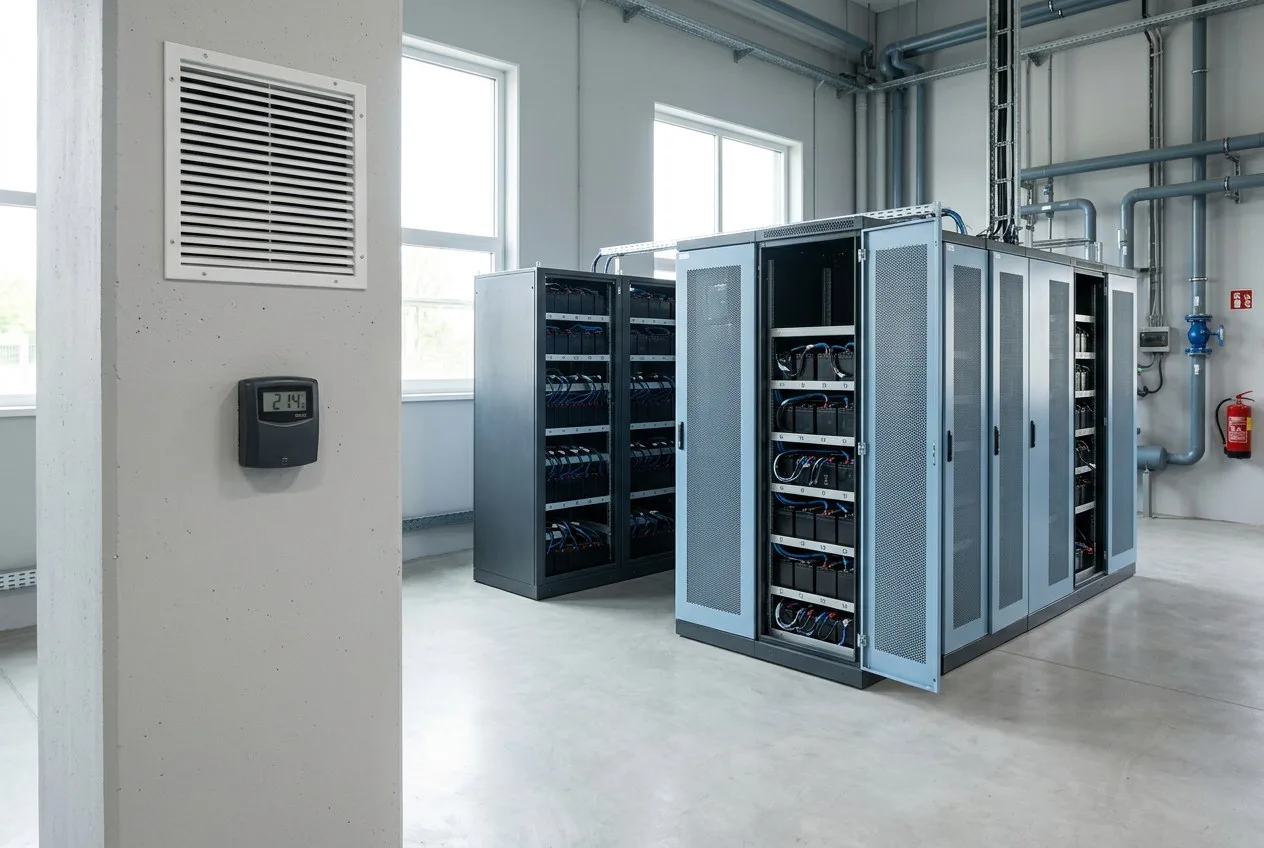
- Record the battery room temperature. An air conditioner failure can go on for days without being noticed; use a data logger or monitoring system.
- Evaluate charging in cold environment against manufacturer limits. In unheated outdoor cabinets, winter conditions can exceed charging limits.
- Do not leave the charge level randomly. For long-term retention, the target SOC varies by manufacturer; for details recommissioning of UPS and batteries that have been switched off for a long time See the article.
- Look at heat sources and ventilation. Hot spots may occur at the rear of the cab or near the UPS exhaust. The thermal imager shows these spots during the annual check.
Cell and modulus level aging values vary by manufacturer and chemistry; refer to the operating and storage temperature section in the product's datasheet for typical ranges.
UPS–BMS Interface: A Control Domain That Doesn't Exist in Lead-Acid
The most overlooked point in lithium systems is the "integration" between the UPS and the battery. A BattCon presentation lists five touchpoints in the integration of lithium batteries: module–string BMS, module–module, string BMS–system BMS, battery–UPS, and system BMS–building management/monitoring systems. The same source also highlights that BMS integration requires a different field expertise than conventional lead-acid jobs.
Interface Items to be Checked in Maintenance
- Communication health: Does the UPS receive data from the BMS? If communication is lost, the UPS may calculate the wrong SOC or throttle charging.
- Charging Parameters: Compatibility of the UPS's charging voltage, current limit, and float/protection settings with the lithium module's datasheet. No unauthorized modifications.
- Alignment of BMS protection limits with UPS: Eaton recommends verifying that the limits within which the BMS will disconnect the battery comply with the UPS operating conditions.
- Supported combination: Only lithium battery systems supported by the UPS manufacturer should be used. When replacing batteries later, this point is UPS battery compatibility It should be considered together with the checklist in the article.
- Alarm transmission: Test via dry contact, SNMP or Modbus that the alarm has actually reached the monitoring center. For details UPS remote monitoring and alarm management See the article.
- Return after protection: Lithium systems protect themselves after a failure; the way it is reactivated after the problem is fixed varies according to the manufacturer. It is necessary to know under what condition this behavior is automatic or manual.
Firmware and Software Update
The lead acid battery pack has no software; the lithium module does. In the maintenance lists, it is an item to update the BMS firmware when the manufacturer recommends it. Two rules work here: Update only after it has been verified that the UPS and BMS versions are supported together, and prepare a load backup plan before the update. For the general framework of the subject UPS firmware update You can check our article.
Capacity Testing: Is It Enough to Rely on SOH?
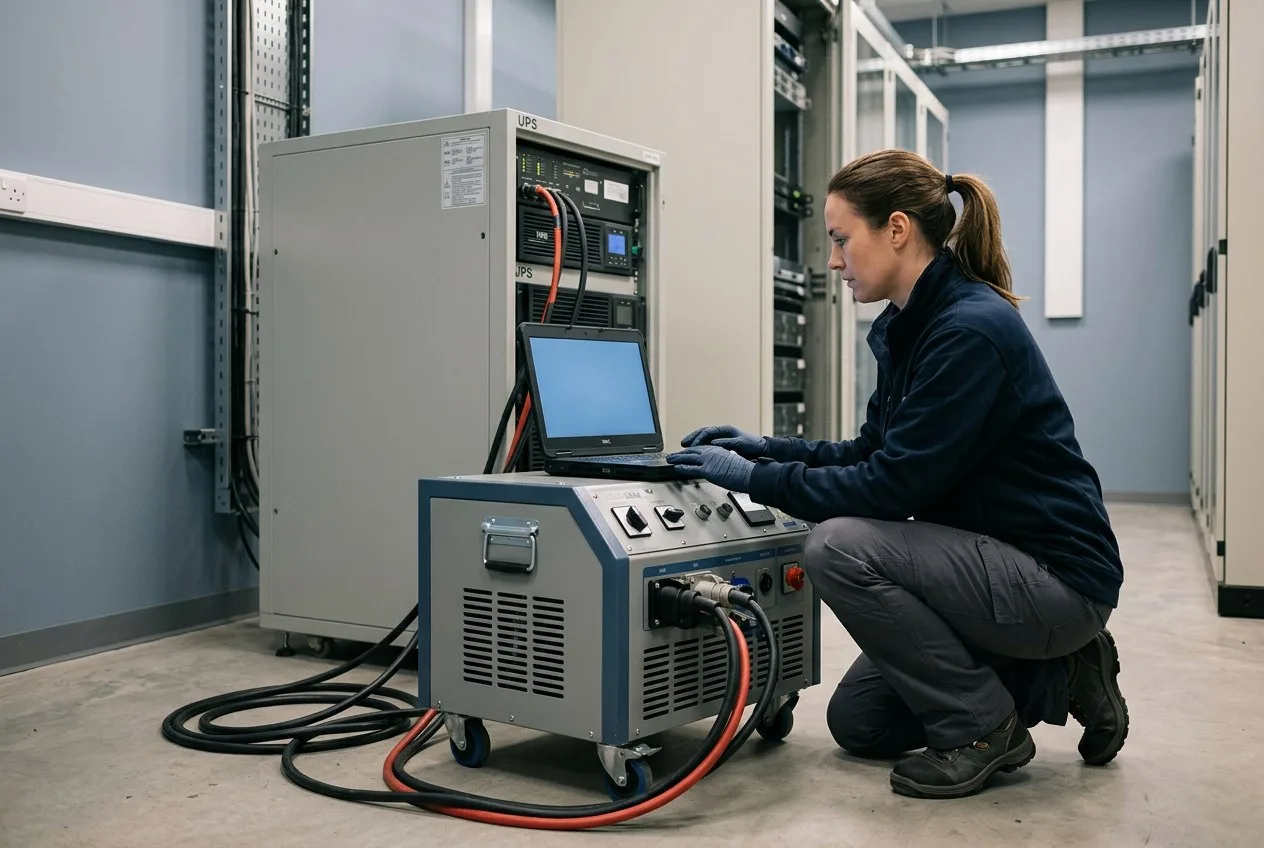
The SOH value of the BMS is an estimate. Cell aging, temperature, and calibration error can deviate from this estimate from the actual capacity. At critical load, the real question is: Does the system stay afloat for the planned time if the power goes out? Only a controlled discharge test says that.
Differences to note when testing in lithium:
- The BMS may cut off the battery when it reaches the protection limit; if the test is finished halfway, whether it is capacity or protection should be separated from the log.
- The end-of-discharge voltage and current limits are different from lead-acid; the lead-acid procedure should not be copied.
- After testing, it should be confirmed that charging is complete and the BMS has returned to its normal state.
- A test, load and backup plan should be made and implemented by the authorized team.
We have a separate guide on this topic: Lithium Battery Capacity Test and Its Difference from Lead Acid Test. For UPS-level testing Autonomy Duration Test, for the load to be realistic, Load Bank Test can be consulted.

Account Example: Backup Time and Capacity Share
The following example shows why SOH is important. Values are assumptions; manufacturer data should be used in the actual system.
- Assumptions: 20 kVA UPS, power factor 0.9; load is 14.4 kW, not 100%. Inverter efficiency 95%; target backup time 10 minutes; usable depth of discharge 90% (varies by manufacturer).
- Battery output power: 14.4 kW ÷ 0.95 ≈ 15.2 kW.
- Energy required: 15.2 kW × (10/60) hours ≈ 2.53 kWh.
- Nominal energy requirement (new battery): 2.53 kWh ÷ 0.90 ≈ 2.8 kWh.
- SOH share: If the end-of-life capacity is considered 80%, 2.8 kWh ÷ 0.80 = 3.5 kWh nominal energy is required.
- Care comment: If the system is nominal at 3.5 kWh and SOH has dropped to 85%, the usable energy is approximately 3.5 × 0.85 × 0.90 ≈ 2.68 kWh. It is above the target (2.53 kWh), but the share has decreased. If SOH drops to 75%, 3.5 × 0.75 × 0.90 ≈ 2.36 kWh remain; the 10-minute target is not met.
So a threshold of around 80% is the end-of-life reference for most manufacturers; but your threshold should be determined according to the load and target time. Monitoring this calculation in regular test and maintenance reports allows you to plan the replacement time in advance. For the basic logic of load and time calculation How to calculate UPS battery time See the article.
Physical and Electrical Controls: What Stays the Same in Lithium?
Switching lithium does not eliminate some classic risks. The following items are part of the maintenance in both chemistries:
- Connection tightness and warming: A loose bus or cable end heats up under current and poses a risk of arcing. The tightening torque is checked according to the manufacturer's value; this work is the responsibility of authorised personnel.
- Cable, fuse and DC disconnector status: Discoloration, crushing, oxidation and moisture traces are sought.
- Cabinet and module body: If deformation, traces of heating, abnormal odor or impact signs are detected, the module is deactivated and reported to the manufacturer.
- Grounding and labeling: Ground continuity, warning labels, and disconnector location. See UPS grounding.
- Thermal scanning: Hot spot search under load; for details Control with thermal camera See the article.
Pole head corrosion, electrolyte drying and swelling control, which are common in lead-acid, are less prominent in lithium; however, "swelling" is a more serious sign in lithium. Case swelling in a lithium module may indicate internal gas formation and a failure process. Such a module should not be touched, ambient safety should be ensured and the manufacturer/service should be informed.
Fire and Thermal Runaway Safety is Part of Maintenance
The most discussed risk in lithium batteries is thermal runaway: the uncontrolled heating of one cell spreading to neighboring cells. Although chemistries such as LFP are considered more resistant in this respect, the risk is not zero. Topic What is thermal runaway We also covered it in our article. In the context of maintenance, add the following to the checklist:
- Certificates of the product used: For industrial lithium batteries, IEC 62619 is a basic product safety standard. This standard covers the battery product and its BMS; elements such as cabinet, fire suppression, or building application are outside its scope.
- Fire spread test data: UL 9540A is a test method that evaluates fire propagation due to thermal runaway in energy storage systems. In large systems, this report is used for layout and distance decisions.
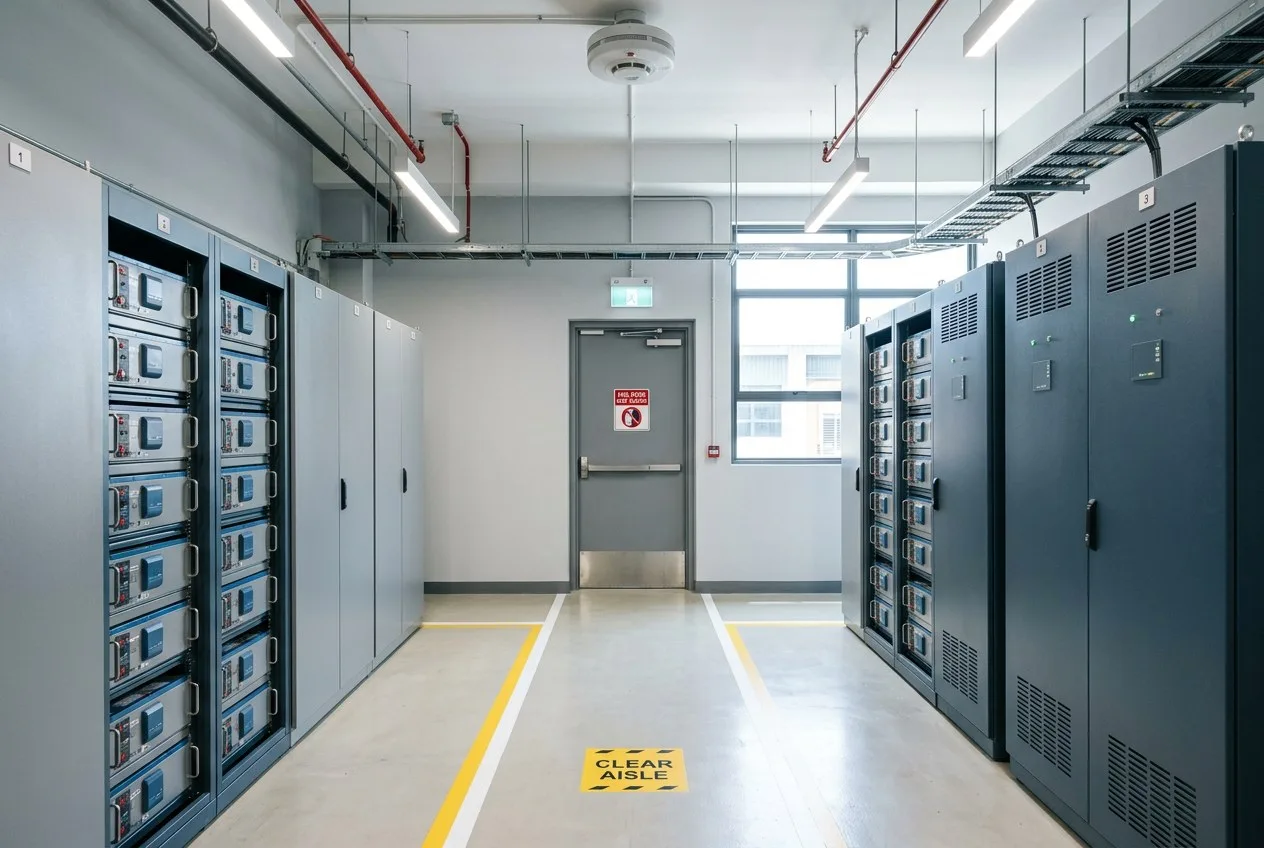
- Layouts and distances: Distance between cabins and to the wall, room separation, ventilation and detection requirements; should be considered in conjunction with relevant local legislation, fire brigade and insurance requirements. See Lithium Battery Cabinet Installation.
- Detection: It is tested that the smoke/heat detector is working and the alarm goes to the monitoring center. If there is a fire extinguishing system, its own maintenance schedule is carried out separately.
- Emergency action plan: It should be written who will open which breakers and how; personnel should know what not to do in the battery room. For the general occupational safety framework Occupational safety in UPS and battery work See the article.
Local legislation and insurance requirements are decisive in physical security requirements; this letter is not a substitute for legal or engineering approval.
Common Mistakes and Correct Approaches
| Error | Why the problem? | The right approach |
|---|---|---|
| Not checking at all by saying "lithium is maintenance-free" | Alarm and temperature issues are not noticed, SOH drop is not monitored | Monthly indicator, 3-6 month log, annual physical control |
| Blindly trusting SOH | BMS does not guarantee estimated actual backup time | Verify with periodic capacity/autonomy testing |
| Applying the lead acid test procedure to lithium | BMS protection interrupts test, false result | Manufacturer's lithium procedure |
| Using a lithium module that the UPS does not support | Charging profile and BMS behavior may be incompatible | Combination supported by the UPS manufacturer |
| Not monitoring battery room temperature | Temperature accelerates aging | Temperature recording and alarm threshold |
| Ignoring the BMS communication alarm | UPS can work with the wrong SOC | Treating communication loss as an emergency alarm |
| Performing maintenance when a malfunction occurs | Emergency intervention is both expensive and risky | Planned maintenance vs. risk: Emergency room or planned maintenance? |
Lithium Battery Replacement and End of Life
Lithium module life is specified in years and cycles; in the field, the actual value varies based on temperature, depth of discharge, frequency of outages, and usage pattern. A maintenance checklist gives the typical replacement period for lithium UPS batteries in the range of about 8-15 years, linking it to cycling and the environment. Don't rely on a single number; the manufacturer data sheet and warranty terms are decisive.
In the change decision, look for:
- Is SOH approaching a level where it cannot meet the target backup time?
- Is the capacity and voltage difference between modules growing?
- Are there recurring protection interruptions in the BMS event history?
- Is the new module supported by the existing UPS and BMS? Mixed new-old module use is generally tolerable on some sources; but this decision should be left to the manufacturer.
Before making the decision to change completely, in general When to replace a UPS battery to lithium. The disposal of used lithium modules is a separate process from lead-acid; it must be done through manufacturer buy-back and authorized waste management.
Lithium-Specific Clauses in the Maintenance Contract
When you enter into a UPS maintenance contract, make sure you also cover the lithium battery. Ask and ask in writing:
- Reading BMS data and adding it to the report (SOH, cell difference, temperature, event history).
- How often and by what method the capacity or autonomy test will be performed.
- Firmware management and change logging.
- Emergency response time and backup module availability.
- Competence of service personnel in lithium systems and manufacturer training.
To assess contract coverage UPS maintenance agreement and to read aftercare reports How to read a UPS maintenance report His articles will be useful to you.
Contact Bempower for Lithium Battery UPS Maintenance
Maintenance of a UPS with lithium battery; It requires reading BMS data, checking the UPS-battery interface, verifying capacity and handling cabin safety together. Bempower provides discovery, installation, periodic maintenance and technical service for all brands of UPS and battery groups; It offers on-site support in Istanbul and surrounding provinces.
To assess the scope of maintenance for your existing system or to plan the transition to lithium From our contact page You can contact us.
- An Update on Lithium-ion Battery Use in Critical Facilities: Safety Rules — Vertiv. https://www.vertiv.com/4a12fa/globalassets/documents/white-papers/vertiv-lithium-ion-batteries-safety-wp-en-emea_239293_0.pdf
- Considerations for Using Lithium-ion Batteries with UPS Modules (BattCon) — Vertiv, 2017. https://www.vertiv.com/4aff5e/globalassets/documents/battcon-static-assets/2017/considerations-for-using-lithium-ion-batteries-with-ups-modules.pdf
- FAQs for Using Lithium-ion Batteries with a UPS, White Paper 231 — Schneider Electric Data Center Science Center. https://totalpowersolutions.ie/wp-content/uploads/WP231-FAQ.pdf
- EN IEC 62619:2022 - Safety requirements for secondary lithium cells and batteries for industrial applications — CENELEC / IEC (iTeh Standards catalog), 2022. https://standards.iteh.ai/catalog/standards/clc/0a608ab2-098a-4a73-9a6f-2301be35c92b/en-iec-62619-2022
- UL 9540A Test Method for Battery Energy Storage Systems (BESS) — UL Solutions. https://www.ul.com/services/ul-9540a-test-method
- White paper battery monitoring system — Socomec. https://go.socomec.com/white-paper-battery-monitoring-system/EN
Resources
