


How to Calculate Solar Battery Capacity: From Daily Consumption to Battery Ah

In a solar energy system, the battery is one of the most expensive and fastest-wearing components. If it is chosen too small, the system gives up on the first cloudy day, and the battery uses up its life through constant deep discharge. If it is chosen too large, your money is buried in idle energy. The right capacity is found not by guesswork, but through a short chain of calculations that starts from daily consumption.
In this article we build that chain step by step: working out daily Wh consumption, accounting for losses, choosing days of autonomy and depth of discharge, and converting the result to an Ah value by dividing by the system voltage. It also includes separate numerical examples for lead-acid and LiFePO4, an outage backup scenario, and common mistakes. The article is for readers and technical managers who want to understand battery capacity for a farmhouse, a summer house, a small business, or a home with a hybrid inverter.
Note: The calculations here are intended to help you understand sizing and prepare for a site survey. Battery connection, DC protection, and commissioning involve high current and arc risk; this work must be carried out by qualified electrical personnel.
The logic of battery capacity calculation: the relationship between Wh, Ah, and V
Battery capacity is expressed in two different units. Ampere-hour (Ah)is the amount of charge a battery can deliver at a specific discharge rate. Watt-hour (Wh) is actual energy and equals Ah multiplied by the nominal voltage. A 12 V 100 Ah battery holds roughly 1,200 Wh of nominal energy, while a 48 V 100 Ah battery holds 4,800 Wh. The two batteries have the same Ah value, but their energy differs by a factor of four. That is why the safest approach is always to start the calculation with energy (Wh) and switch to Ah only at the very end. To understand what the label values (C10, C20, etc.) mean, you can also read about how to read a battery label ; for the general concept, our battery capacity (Ah) article is also helpful.
The general framework of the calculation is the same as in academic system design courses: the required output capacity is found by multiplying the critical daily energy need by the days of autonomy and dividing by the system voltage; then corrections for permitted depth of discharge, temperature, and discharge rate are applied to arrive at the nominal capacity. We will simplify the same logic into five steps:
- Work out daily energy consumption (Wh).
- Add conversion and cable losses.
- Choose the days of autonomy and multiply.
- Divide by the usable depth of discharge (DoD).
- Divide by the system voltage to convert to Ah, then add a margin for temperature and aging.
Reducing consumption before you start the calculation also reduces the size. The U.S. Department of Energy's planning guide recommends analyzing your existing electricity use before buying a system and lowering consumption with efficiency measures; this means a smaller and cheaper system.
Step 1: Working out daily energy consumption (Wh)
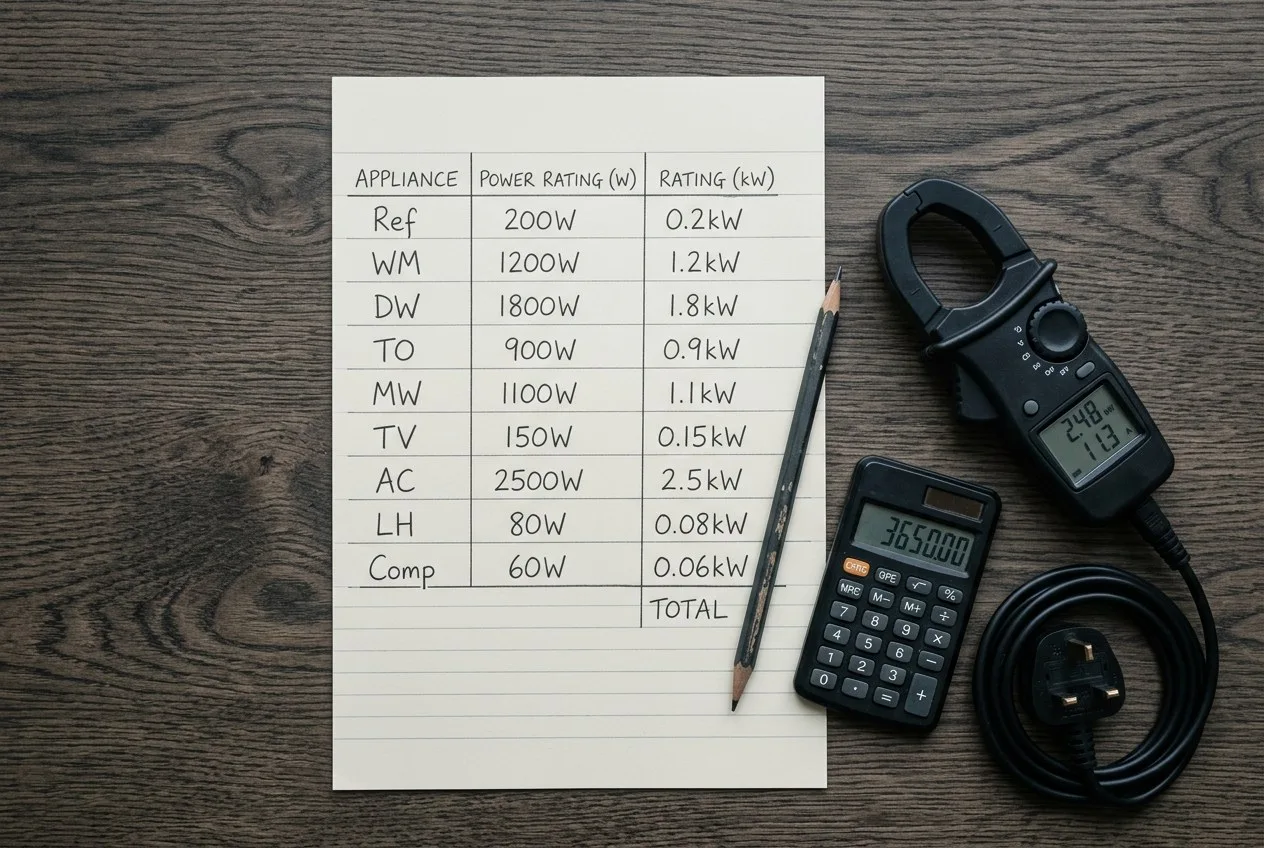
For each device, multiply its power (W) by its daily operating time (hours), then add them all up. For cycling devices such as refrigerators, use the time the compressor actually runs rather than 24 hours; keep in mind that actual measurements are more reliable than nameplate power. Measuring for a week with a plug-in or panel-mounted energy meter gives far more reliable results than estimating.
We will use the following hypothetical farmhouse example throughout the article:
| Device | Power (W) | Actual daily time (hours) | Daily energy (Wh) |
|---|---|---|---|
| Refrigerator | 100 | 10 | 1.000 |
| LED lighting | 48 | 5 | 240 |
| Television | 80 | 4 | 320 |
| Modem and IP camera | 30 | 24 | 720 |
| Laptop | 50 | 4 | 200 |
| Water pump | 400 | 0,5 | 200 |
| Total | - | 2,680 Wh (≈ 2.7 kWh/day) | |
This list gives the energy, but for inverter selection you must also look at instantaneous peak power. Pumps, refrigerator compressors, and motorized devices draw several times their rated current at startup. This is an inverter power question separate from the battery Ah calculation; for household appliances in particular, we cover it in running a refrigerator, combi boiler, and air conditioner on solar power .
Step 2: Accounting for losses: inverter efficiency and cable losses
The battery stores DC energy; most of your devices run on AC. The inverter converts some of the energy into heat during this conversion. The energy leaving the battery is always slightly higher than the energy reaching the devices. Efficiency varies with the model and the load; it is common to assume a range of 85-95 percent, and for the exact value you should check the manufacturer's datasheet. At low loads efficiency usually drops, which increases the share of small continuous loads (modem, camera).
There are also small losses in DC cables and connection points. Let's use a simple approximation in our example:
- Inverter efficiency: 90 percent (0.90)
- Cable, fuse, and connection losses: 5 percent (0.95)
- Combined efficiency: 0.90 × 0.95 = 0.855
Daily DC energy that must be drawn from the battery: 2,680 Wh ÷ 0.855 ≈ 3,135 Wh. In other words, the battery must supply roughly 17 percent more energy than the devices consume. In systems that run directly with DC devices (12 V LED, camera) there is no inverter loss; in that case this division is not applied for that portion. For how cable cross-section affects losses, see DC cable cross-section and voltage drop .
Step 3: Days of autonomy: how many days without sun or grid must the battery last?
Days of autonomyis the design value that shows how many days the system can supply the load with no charging input at all. This number is the most "personal" parameter in the calculation, because it is as much a risk and budget decision as a technical one.
- Grid-connected systems for outage backup: The target is usually the outage duration; hours, or at most one day. Only critical loads (modem, camera, refrigerator, lighting) are included in the calculation.
- Off-grid systems: One to several days are usually planned for cloudy and rainy periods. In regions where production drops in winter, this number increases.
- Systems with a generator: If a generator can be brought online, the days of autonomy can be reduced; the battery then only acts as a buffer until the generator starts running.
Each additional day increases battery capacity linearly; for example, going from two days to three raises the cost by roughly 50 percent. Moreover, during long periods of cloudy weather, increasing panel power or reducing the load may be more economical than simply enlarging the battery. For regional recommended values, sources such as the IEA's building-integrated PV publications suggest autonomy periods for different climates; since location and seasonal differences in Türkiye are large, you need to work with local solar irradiation data. For sizing on the panel side, see our article explaining how many solar panels are needed .
In our example, for the country house, let's choose 2 days of autonomy. Required usable energy: 3,135 Wh × 2 = 6,270 Wh.
Step 4: Depth of discharge (DoD): how much of the battery is actually used?
Depth of discharge (DoD)indicates how much of the battery's total capacity is drawn. The full capacity on the label is not all usable energy. Lead-acid batteries do not like deep discharge; each deep cycle takes away some of their lifespan, and according to Battery University, a deep-cycle lead-acid battery can provide only a few hundred cycles under full-discharge conditions. The battery guide prepared by IEA PVPS for stand-alone PV systems also recommends a DoD of at most 80 percent for a reasonable lifespan in lead-acid batteries and emphasizes not discharging the battery completely.
| Battery type | DoD commonly used in planning | Points to note |
|---|---|---|
| Lead-acid (flooded, AGM, gel) | About 50% for daily use; 50-80% range depending on the source | Deep-cycle models allow a higher DoD, but cycle life decreases; check the cycle-DoD curve in the datasheet. |
| LiFePO4 lithium | Generally 80-90% | Usable capacity depends on the BMS setting and the manufacturer; the manufacturer determines the limit. |
| OPzS / OPzV | According to the manufacturer's curve | Preferred in systems with long autonomy and few cycles. |
PVEducation states that a DoD above 50 percent is permitted in a deep-cycle battery and can go up to 80 percent; the same source also reminds us that a shallow-cycle battery bank must be larger to obtain the same usable capacity. In other words, the DoD value is not a rule on its own, but a design parameter that depends on the type of battery you choose. We covered the relationship between DoD and cycle life in detail in the article depth of discharge and cycle life . To compare battery types, the article choosing a battery for solar energy is also useful.
Step 5: Converting to Ah using system voltage — the formula
After finding the required nominal energy, you convert it to Ah by dividing it by the system voltage. The complete formula is written as follows:
Battery capacity (Ah) = [Daily AC energy (Wh) ÷ combined efficiency] × days of autonomy ÷ (DoD × system voltage, V)
The system voltage is selected together with the inverter and the charge controller. A higher voltage means lower current for the same power; cables get thinner and losses decrease. However, every voltage has a suitable power range. 12 V is typically chosen for small systems, 24 V for medium-sized ones, and 48 V mostly for home-type hybrid systems. For details, see choosing between 12 V, 24 V and 48 V battery voltage .
. The Ah value depends on the discharge rate. In PVEducation's example, if a 500 Ah battery is assumed to be discharged over 20 hours, the discharge current is 25 A; when discharged at a much higher current, the same battery cannot deliver that Ah value, and the more slowly it is discharged, the more energy it provides. For this reason, you need to match values on the label such as C10 and C20 to the average load in your calculation. How the rate reduces capacity is explained in the article on the C-rate and the Peukert effect .
Example calculation: lead-acid and LiFePO4 battery capacity for a country house
Let's sum up our assumptions: daily AC consumption 2,680 Wh, combined efficiency 0.855, autonomy 2 days. We take a DoD of 0.50 for lead-acid and 0.80 for LiFePO4. These figures are for illustration; you should use the values in your own battery's datasheet.
| Calculation step | Lead-acid (AGM/gel) | LiFePO4 |
|---|---|---|
| Daily DC energy | 2,680 ÷ 0.855 ≈ 3,135 Wh | 3,135 Wh |
| Usable energy for 2 days | 6,270 Wh | 6,270 Wh |
| DoD | 0,50 | 0,80 |
| Nominal bank energy | 6,270 ÷ 0.50 = 12,540 Wh | 6,270 ÷ 0.80 ≈ 7,840 Wh |
| Ah in a 48 V system | 12,540 ÷ 48 ≈ 261 Ah | 7,840 ÷ 48 ≈ 163 Ah |
| Ah in a 24 V system | 12,540 ÷ 24 ≈ 522 Ah | 7,840 ÷ 24 ≈ 327 Ah |
For the same load, the lead-acid bank required about 1.6 times the nominal energy of lithium. This means you need to consider lead-acid's price advantage together with its space and weight disadvantages; a total-cost comparison cannot be made by looking at a single label. For the structure of LiFePO4 and the role of the BMS, see LiFePO4 battery .
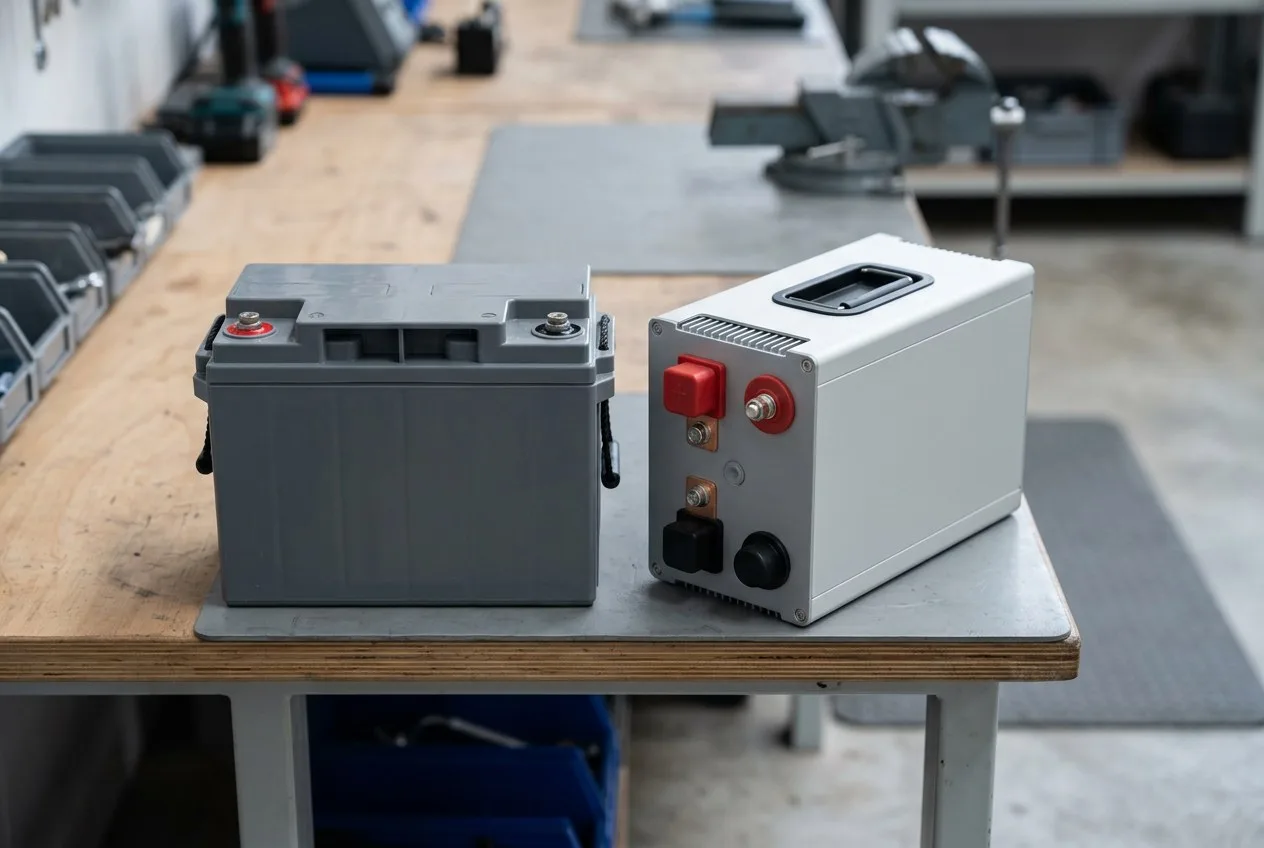
When converting the result into a real product, you need to round to standard modules. For a 48 V lead-acid bank, four 12 V batteries are connected in series; to reach approximately 290 Ah (with the temperature margin we will see in the next section), it is possible to use two of these strings in parallel. For the rules of series-parallel configuration, see battery string and series-parallel connection and for installation details, see see the article on battery bank cabling and current balance.
Second example for outage backup: a hybrid inverter and critical loads
In a grid-connected home, if the goal is not to go without grid power for days but to keep critical loads running during an outage of a few hours, the calculation is much shorter. Suppose the critical loads (modem, camera, refrigerator, a few LEDs) draw a total of 600 W and the target is a 6-hour outage.
- AC energy: 600 W × 6 hours = 3,600 Wh
- DC energy: 3,600 ÷ 0.855 ≈ 4,210 Wh
- LiFePO4, DoD 0.80: 4,210 ÷ 0.80 ≈ 5,260 Wh (about 5.3 kWh)
- On a 48 V system: 5,260 ÷ 48 ≈ 110 Ah
In this calculation, the power the battery can deliver must also be checked; although the current for a 600 W load is very small, if devices with high inrush current are added, the battery's continuous and peak current limits come into play. You can find how backup mode works in the article on hybrid inverters and the transition time for sensitive loads such as computers and servers in the article on EPS and transfer time in hybrid inverters For critical devices that need seamless transfer, a separate UPS can be considered; our article on calculating battery runtime in UPS and battery inverters is also useful for choosing loads.
Temperature, discharge rate and aging margin: bringing the calculation closer to reality
Manufacturers usually measure capacity at a specific temperature and a specific discharge current. The IEA PVPS guide states that nominal capacity is normally measured at a battery temperature of 20 °C, with constant current, down to a specific cut-off voltage. In the field, these conditions are rarely met. You can use three corrections:
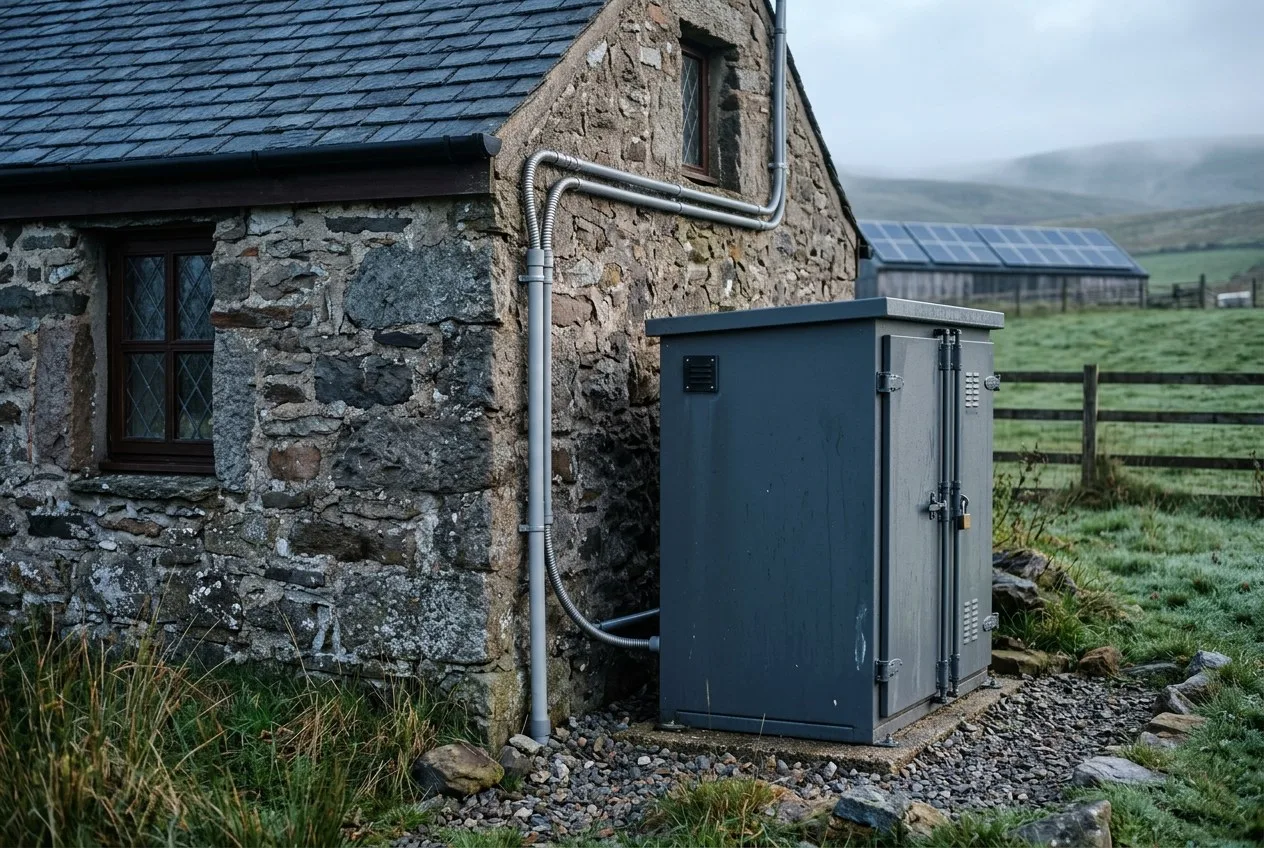
- Cold: According to PVEducation, the capacity of a lead-acid battery decreases by roughly one percent for every degree below about 20 °C. If your battery sits somewhere near 0 °C in winter, its capacity can drop by about one fifth. That is why the battery should be in an insulated place, protected from the cold where possible.
- Heat: While capacity drops at low temperatures, high temperatures accelerate aging. According to Battery University, in sealed lead-acid batteries the lifespan is roughly halved for every 8 °C increase in temperature. Keeping the battery room cool is a cheaper measure than buying a larger battery.
- Discharge rate: The usable capacity of a battery discharged at high current decreases. In system calculations, this effect is treated together with temperature as a single correction factor.
In our example, if we take the temperature and rate correction for the lead-acid bank as 0.90, the nominal energy is 12,540 ÷ 0.90 ≈ 13,930 Wh; at 48 V this means about 290 Ah. Lithium batteries also have charging limits and capacity loss in the cold, so the manufacturer's operating temperature range must be observed.
There is also an aging margin The end of a battery's life is generally defined as its capacity falling to 80 percent. The capacity calculated for a new battery may not be sufficient at the end of its life. If you want a five-to-ten-year outlook, it makes sense to leave an extra margin of 10-20 percent. For solar production that drops in winter and the battery plan, see solar energy in winter conditions .

Battery capacity and panel power must be considered together
The battery is the energy store; the panels are the source. As the battery gets larger, you also need enough generation capacity to recharge it. A 7.8 kWh battery chosen for two days of autonomy will be depleted after two cloudy days. If the panels cannot close this gap within a few days on top of covering daily consumption, the battery stays at a low state of charge, and in lead-acid batteries this accelerates sulfation. The IEA PVPS guide likewise notes that charging in PV systems can be slow and irregular, so sizing for 50 percent discharge under worst-case conditions is useful.
In practice, carry out these three checks:
- Check whether the panel array covers daily consumption even in winter and leaves a small surplus.
- Verify that the current capacity of the charge controller is compatible with the battery voltage; for details, see charge controller selection
- Make sure the battery charge voltages (bulk, absorption, float) are set according to the battery type. A wrong setting wears out even a correctly sized battery.
To see the whole system and the differences between grid-connected and off-grid setups, on-grid, off-grid and hybrid systems is a good starting point; before deciding whether a battery is needed, it is also helpful to look at the comparison of systems with and without batteries
Common mistakes in battery capacity calculation
| Mistake | Result | The right approach |
|---|---|---|
| Assuming the Ah value on the label is the usable capacity | The battery runs out much sooner than expected, and deep discharge shortens its life. | Multiply the capacity by the DoD to find the usable energy. |
| Forgetting inverter losses | The battery lasts 10-20 percent less time. | Divide the daily AC energy by the combined efficiency. |
| Comparing Ah at different voltages | Assuming a 12 V 200 Ah battery equals a 48 V 200 Ah battery, overlooking a fourfold difference in energy. | Always compare by converting to Wh. |
| Ignoring peak power and starting current | The inverter or battery protections kick in and the system shuts down even if the capacity is sufficient. | Check the continuous and peak power ratings separately for the battery, inverter and BMS. |
| Ignoring temperature | Capacity drops in winter, and battery life shortens in summer. | Add a correction factor, and choose a cool, protected location for the batteries. |
| Building a mixed bank from old and new batteries | Unbalanced voltage, rapid wear, and a possible safety risk. | Use batteries of the same type, capacity, and age; for details, see risks of second-hand batteries |
| Trying to solve the problem only by increasing the days of autonomy | Costs multiply, and if the panels are insufficient, the batteries still won't fully charge. | Evaluate it together with alternatives such as panel power, load management, and a generator. |
What to do after the calculation: verification, site survey, and safety
The calculation is only a starting point. When matching the resulting value with real products, verify the following in the manufacturer's datasheet: nominal voltage, usable capacity, recommended DoD, continuous and peak discharge current, operating temperature range, and cycle life curve. Because technical values vary from manufacturer to manufacturer, these datasheets are the deciding reference.
On the safety side, a battery bank carries high current; there is a risk of arcing and heating in a short circuit, gas release in lead-acid batteries, and thermal runaway in lithium. Therefore, leave the connection, DC fuse and breaker selection, ventilation, and commissioning work to qualified personnel. Related articles: DC fuse, breaker, and surge arrester protection and fire safety in lithium battery storage. After installation, it is also important to measure the battery's actual capacity; for this, capacity and health testing of the battery bank .
Determining battery capacity depends on the compatibility of the entire chain, from the panel to the inverter and cabling. Bempower does not provide panel installation or GES (solar power plant) application services; however, it offers support for battery banks, UPS and inverters, including site survey, installation, periodic maintenance and technical service. If you would like an on-site assessment for your battery bank or inverter system, you can reach us via the contact page .
- Characteristics of Lead Acid Batteries — PVEducation, 2025. https://www.pveducation.org/pvcdrom/lead-acid-batteries/characteristics-of-lead-acid-batteries
- Can the Lead-acid Battery Compete in Modern Times? — Battery University, 2025. https://www.batteryuniversity.com/article/can-the-lead-acid-battery-compete-in-modern-times/
- BU-201: How does the Lead Acid Battery Work? — Battery University, 2025. https://www.batteryuniversity.com/article/bu-201-how-does-the-lead-acid-battery-work/
References
