How Is Battery Runtime Calculated for a UPS and a Battery-Powered Inverter?

"How long will these batteries last during a power outage?" is the first question everyone asks when purchasing a UPS or a battery-powered inverter. The answer isn’t a single number; it depends on the size of the load, the energy capacity of the battery bank, and the conditions under which the batteries are operating.
In this article, we use an example to show how backup time is roughly calculated and explain why the actual time is often shorter.
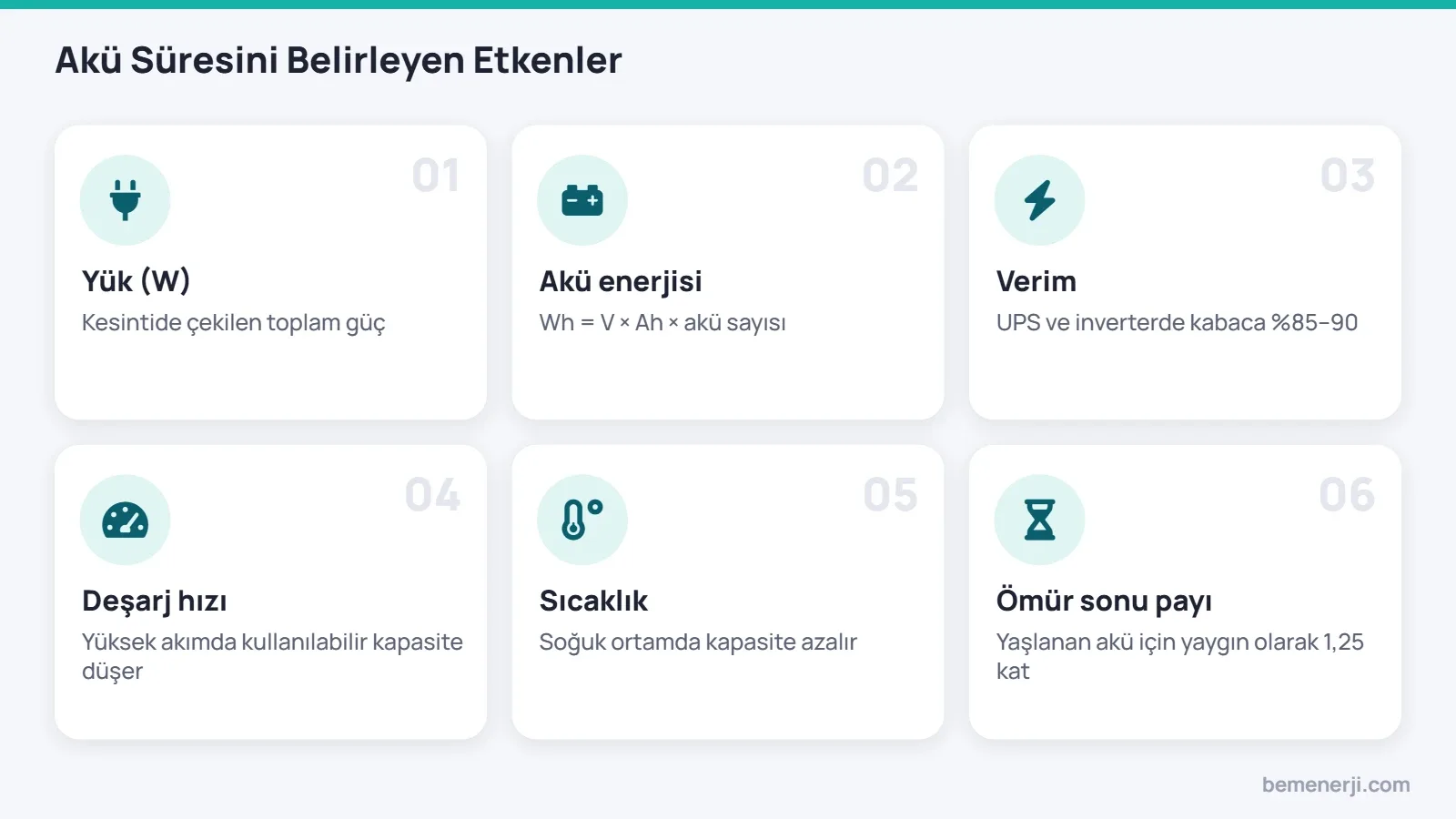
What Factors Affect Backup Duration?
- Load (W): The total power currently drawn by devices connected to the circuit. When the load doubles, the duration may be reduced by more than half.
- Battery power: The voltage, capacity, and number of batteries.
- Yield: The proportion of DC power drawn from the battery that reaches the load after being converted to AC; the remainder is lost as heat.
- Discharge rate: The faster a battery is discharged, the less capacity it provides.
- Temperature and age: A cold and old battery cannot deliver the capacity listed on its label.
The Formula for a Rough Estimate
The calculation is done in three steps:
- Battery capacity (Wh) = Battery voltage (V) × Capacity (Ah) × Number of batteries
- Available energy (Wh) = Battery energy × Efficiency × Utilization rate
- Duration (hours) ≈ Available energy ÷ Load (W)
The efficiency of UPS systems and inverters is generally between 85% and 90%. The usable capacity, on the other hand, is an estimate of how much of the battery’s rated capacity can actually be utilized; it varies depending on the battery type, discharge rate, and the device’s cut-off voltage. Under what conditions is the Ah rating specified? What is battery capacity (Ah)? We explained this in our article.
Sample Calculation: 4 × 12 V, 100 Ah, 1,000 W Load
Let’s consider a battery-powered inverter or UPS set up for long-term use. The assumptions are illustrative and have been rounded off; the result rude It's just a guess.
| My Name | Account | Conclusion |
|---|---|---|
| Battery power | 12 V × 100 Ah × 4 | 4,800 Wh |
| Yield (e.g., 90%) | 4.800 × 0,9 | 4,320 Wh |
| Utilization rate (e.g., 80%) | 4.320 × 0,8 | 3,456 Wh |
| Duration (new battery) | 3.456 ÷ 1.000 | ≈ 3.5 hours |
| With a lifetime share | 3,456 ÷ 1.25 = 2,765 Wh; 2,765 ÷ 1,000 | ≈ 2.8 hours |
When four batteries are connected in series, the total voltage is 48 V. The power drawn from the battery is approximately 1,000 ÷ 0.9 ≈ 1,110 W, and the current is 1,110 ÷ 48 ≈ 23 A. This is more than four times the 20-hour rate current (5 A) of a 100 Ah battery; this is one reason why we use an 80% rather than a 100% utilization rate. Series and parallel connections battery bank We explained this in our article.
Why Is the Actual Duration Shorter?
- High current (Peukert effect): When a lead-acid battery is discharged rapidly, it cannot deliver the same capacity as it would during a slow discharge. As discharge continues, the voltage drops; to deliver the same power, the current increases, and the effect intensifies.
- Cold environment: The storage capacity is typically specified for 20–25 °C; the capacity decreases in colder environments.
- Aging: A battery whose capacity has dropped to roughly 80% of its rated capacity is generally considered to have reached the end of its service life. To ensure that the required runtime is still met at that point, a 1.25-fold end-of-life factor is commonly added to the calculation.
- Battery not fully charged: During frequent power outages, the battery discharges again before it has a chance to fully charge.
As the battery ages, the runtime gradually decreases; even if the voltage reading appears normal, the battery may not provide the expected runtime. The actual runtime today can only be determined by battery discharge test shows. Factors that shorten life expectancy Factors Affecting Battery Life We have compiled them in our article.
The Right Approach for UPS: Constant Power Tables
UPS systems typically discharge the battery at a high current for a period ranging from a few minutes to half an hour. During these periods, the rough method described above may indicate a longer runtime than is actually the case. Therefore, for UPS batteries, the runtime is the value specified by the manufacturer for a given duration and cut-off voltage From the constant power (W/cell) discharge table Read. The steps of the method battery capacity and How to Choose a UPS Battery We explained this with examples in our articles.
Counting Backward: How Many "Ah"s for the Desired Duration?
Let’s say we want to power a 1,000 W load for 2 hours using the same assumptions; let the battery bank again be 48 V:
| My Name | Account | Conclusion |
|---|---|---|
| Energy to be drawn from the batteries | 1,000 W × 2 hours ÷ 0.9 | ≈ 2,222 Wh |
| Based on the utilization rate | 2.222 ÷ 0,8 | ≈ 2,778 Wh |
| With a lifetime share | 2.778 × 1,25 | ≈ 3,472 Wh |
| Required capacity | 3,472 ÷ 48 V | ≈ 72 Ah |
If the calculation yields 72 Ah, a standard capacity higher than this value is selected. It is also verified that the batteries can be fully charged within a reasonable time using the UPS’s or inverter’s charging power.
Power Calculator and Definitive Selection
Power Calculation Our tool applies these factors automatically: It assumes that the UPS will operate at a maximum load of 80%, adds an optional growth factor, takes efficiency and end-of-life factors into account, and applies a correction for high current. The result is a This is a preliminary calculation. The final selection is based on measuring the load during the survey and consulting the battery manufacturer’s tables. Calculating the load itself How to Calculate UPS Power We explained this in our article.
Connecting and replacing battery banks involves dangerous DC voltage and high current; these tasks qualified technical staff must be done by.
- IEEE Std 1188-2005 — Recommended Practice for the Maintenance, Testing, and Replacement of Valve-Regulated Lead-Acid (VRLA) Batteries for Stationary Applications
- The discharge time tables in the battery manufacturer's data sheet and the UPS manufacturer's manual
Sources
Battery Life at a Glance
The approximate runtime is calculated by dividing the available battery energy by the load; however, the result is determined by six factors acting together.

The values in the top row are the account’s inputs; the factors in the bottom row reduce the actual runtime. For UPSs, the exact runtime is taken from the manufacturer’s constant power tables.
Frequently Asked Questions
01If I double the number of batteries, will the runtime also double?
02Why is the remaining time on my UPS screen suddenly dropping?
03Can I trust the time I calculated roughly?
04Why is the runtime with the new batteries shorter than what I calculated?
05Why does battery life decrease over the years?
Let's Measure the Actual Lifespan of Your Batteries
Your shipment and the desired delivery time Power Calculation You can get a rough idea using our tool. We measure how many minutes your current battery pack can provide today through controlled tests; the methods Discharge and Load Tests We explained this on our website. We provide service for UPS and battery systems of all makes and models throughout Istanbul and the surrounding provinces. Please provide the make and model of your UPS or inverter, the battery specifications, and the desired runtime Please let us know.