


How Does a Solar Energy System Work? Panel, Inverter, Charge Controller and Battery

The panels on the roof seem to be silently generating electricity, but behind it is a system in which four separate tasks are daisy-chained: converting light into electricity, storing this electricity without damaging the battery, converting the stored direct current (DC) into alternating current (AC) used by the devices and managing it in accordance with the grid. Knowing which link of this chain does what; It is the first step in choosing the right product, setting the expectation correctly and detecting signs of failure early.
This guide; It was written for home users, small business owners, technical managers and purchasing units. We explain the entire flow in plain language, starting from the photovoltaic event on the panel, to the functions of the charge controller, battery and inverter, system types, a simple sizing calculation and common mistakes. Due to high voltage and battery risks, we do not give the installation steps in a "do-it-yourself" way, but only at a level that helps you understand how it works.
What is a solar energy system and what parts does it consist of?
A solar energy system (photovoltaic, PV system for short) is the whole of the panels that convert sunlight directly into electricity and the auxiliary equipment that makes this electricity usable. The scope of the system varies depending on whether it is connected to the grid and whether it contains a battery; however, the logic is always the same: produce, organize, store (if necessary), recycle, distribute.
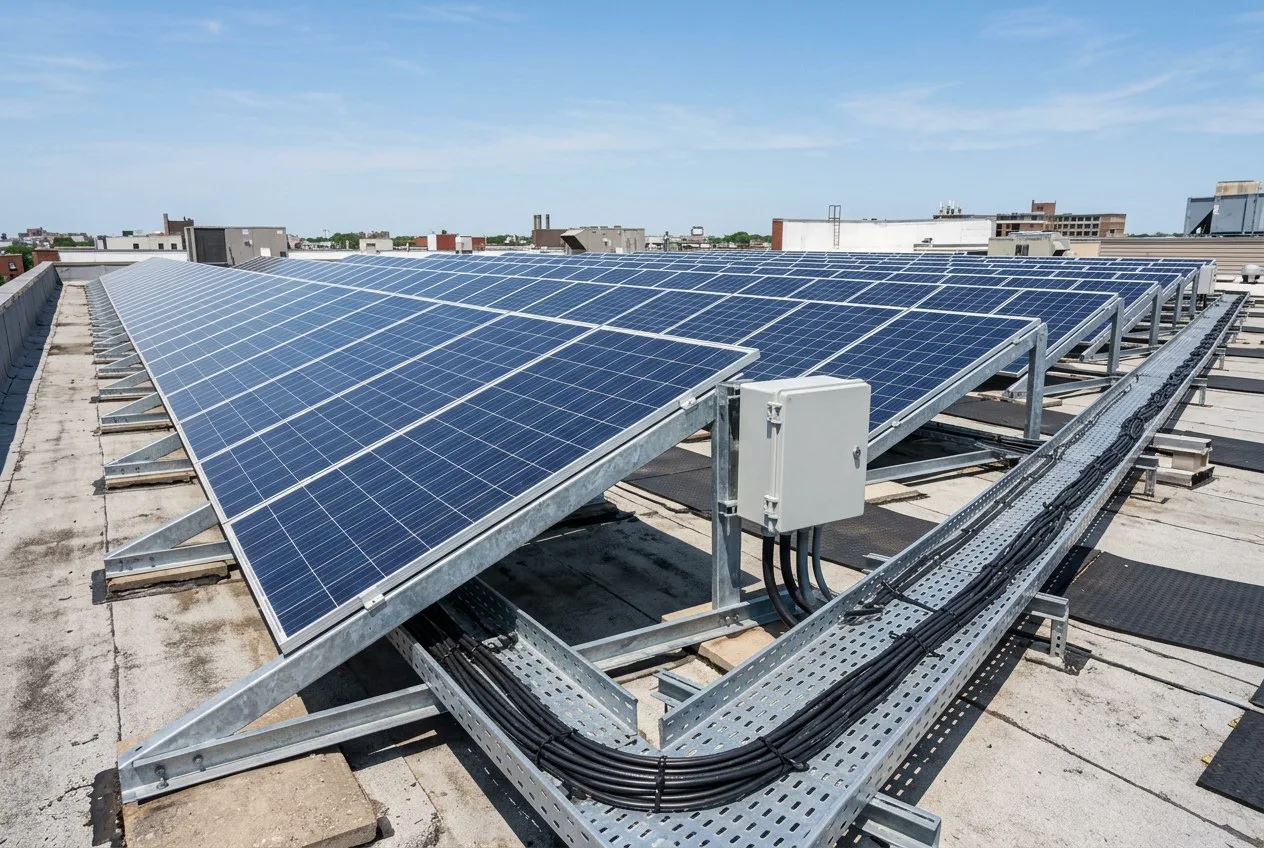
| Component | Mission | What system is it located in? |
|---|---|---|
| Solar Panel (PV Module) | Converts light into DC electricity | On all systems |
| Charge controller | They adapt the panel power to the voltage and current that the battery will accept, preventing overcharging | In battery powered systems (included in hybrid inverter) |
| Battery (battery) | Stores excess energy, gives it at night and during interruption | In off-grid and hybrid systems |
| Inverter | Converts DC to AC; can work synchronously with the grid | On all systems (type varies) |
| Protection and distribution elements | Fuse, switch, surge arrester, grounding, cables | On all systems |
| Monitoring unit | Shows production, consumption and battery status | Usually on the inverter or controller |
In which combinations these ingredients are used Differences between on-grid, off-grid and hybrid systems We also discuss it in the article; Here, let's first follow the path of energy step by step.
How does the panel convert sunlight into electricity?
A solar panel is formed by connecting a large number of photovoltaic cells in series and parallel. A photovoltaic cell contains a semiconductor material that can absorb light and convert it into electricity. When the semiconductor absorbs solar radiation, it transfers energy to electrons, and the electrons flow as an electric current through the material. By far the most common semiconductor in solar cells is silicon.
This process has three practical outcomes:
- The current produced is direct current (DC). The panel output cannot be plugged directly into the outlet; it needs to be converted.
- As the light intensity increases, the current increases. Voltage, on the other hand, is slightly affected by light and significantly affected by temperature.
- Not all light turns into electricity. Part of the spectrum is reflected, part is too weak to produce electricity, and part creates heat instead of electricity.
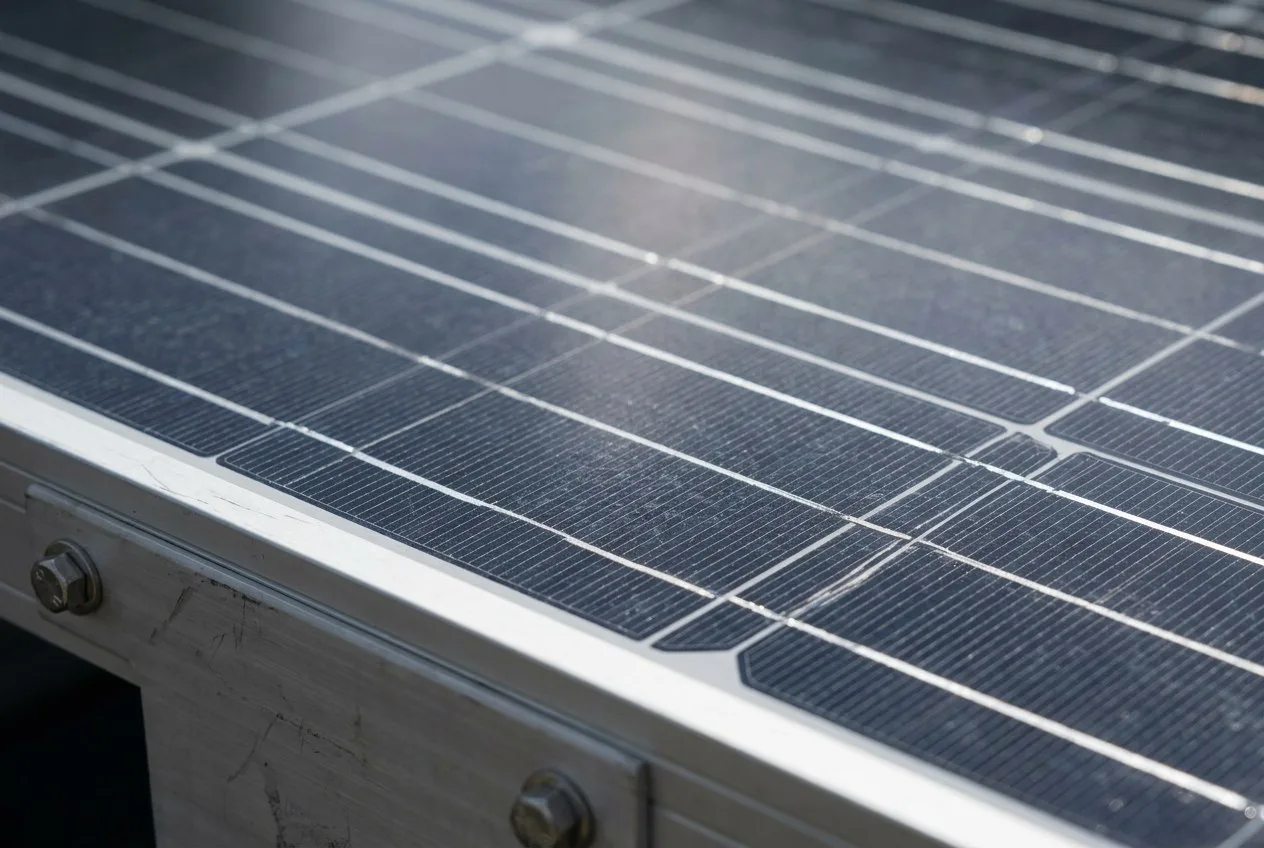
Why is the label value different from the actual production?
The watt-peak (Wp) value on the panel label is measured under standard test conditions. These conditions are defined as 1,000 W/m² irradiance on the panel surface and a cell temperature of 25 °C. On a real roof, the cell temperature is much higher. The module output decreases as a percentage for each degree above the reference temperature according to the temperature coefficient. NREL's PVWatts model uses 0.5 percent reduction per degree as the typical accepted value for crystalline silicon modules. In the data sheets of modern panels, this value is often slightly lower; the manufacturer's data sheet should be consulted for the exact value.
Example calculation (assumptions: 550 Wp panel, temperature coefficient −0.40/°C percent, cell temperature 60 °C at summer afternoon):
- Difference over reference: 60 − 25 = 35 °C
- Power loss: 35 × 0.40% = 14%
- Instantaneous power: 550 × (1 − 0.14) ≈ 473 W
That is, the panel with a label of 550 Wp gives about 470 W in a hot midday. Added to this are dirt, ghosting and cable losses. These factors Factors That Reduce Solar Panel Efficiency You can find it in detail in the article.
How much sun is there in Turkey?
According to the Solar Energy Potential Atlas (GEPA) prepared by the Ministry of Energy and Natural Resources the total annual sunshine duration is 2,741 hours, and the total annual incoming solar energy is 1,527 kWh/m²; this is approximately 4.18 kWh/m² per day on average. This is a country average; Regions such as Southeastern Anatolia and the Mediterranean are above average, while the Black Sea is below. Also, the difference between summer and winter is big; if you install a battery-powered system according to the annual average, you may fall short in the winter months.
How does the charge controller align the panel and the battery?
The panel and the battery cannot be directly connected to each other. The operating voltage of the panel is different from the battery voltage, it constantly changes according to the light, and when the battery is full, there is a situation where the panel still tries to energize. Without a charge controller between the panel array and the battery, the array can transmit too much power and disrupt the batteries and loads. The primary function of a charge controller in a standalone PV system is to keep the battery as full as possible without overcharging it.
The functions of the charge controller are:
- Charging Regulation: Charging at voltage limits suitable for the battery type, reducing or cutting off the current at full.
- Low voltage cut-off (LVD): Disabling loads before the battery is over-discharged. For nominal 12-volt lead-acid batteries in small PV systems, this threshold is typically between 12.5 and 13.0 volts.
- Protection: Protection against reverse polarity, overcurrent, overtemperature (features vary by product).
PWM vs. MPPT: two approaches
PWM (Pulse Width Modulation) controllers limit the current with simple switching; the voltage margin of the panel that is more than the battery voltage is not used. MPPT (maximum power point tracking) controllers are a DC-DC converter. It continuously monitors the string output, finds the voltage-current combination that gives the highest power, and converts it to the voltage and current that the battery wants for charging. In this way, the panel array can be connected in series at a voltage much higher than the battery voltage; the cable cross-section is reduced and the controller reduces the voltage on the battery side.
| By | PWM | MPPT |
|---|---|---|
| Panel voltage | It should be close to the battery voltage | It may be significantly higher than the battery voltage |
| Recovery | Lower, especially in cold and low light | Usually higher; earnings are conditional |
| Cable and voltage drop | Low voltage, high current; thicker cable | High voltage, low current; thinner cable possible |
| Typical use | Small, simple, short-cable systems | Medium and large systems, home and business |
Which one will be chosen under what condition MPPT vs. PWM charge controller, the current-voltage compatibility of the device with the panel array Choice of charge controller You can find it in the article.
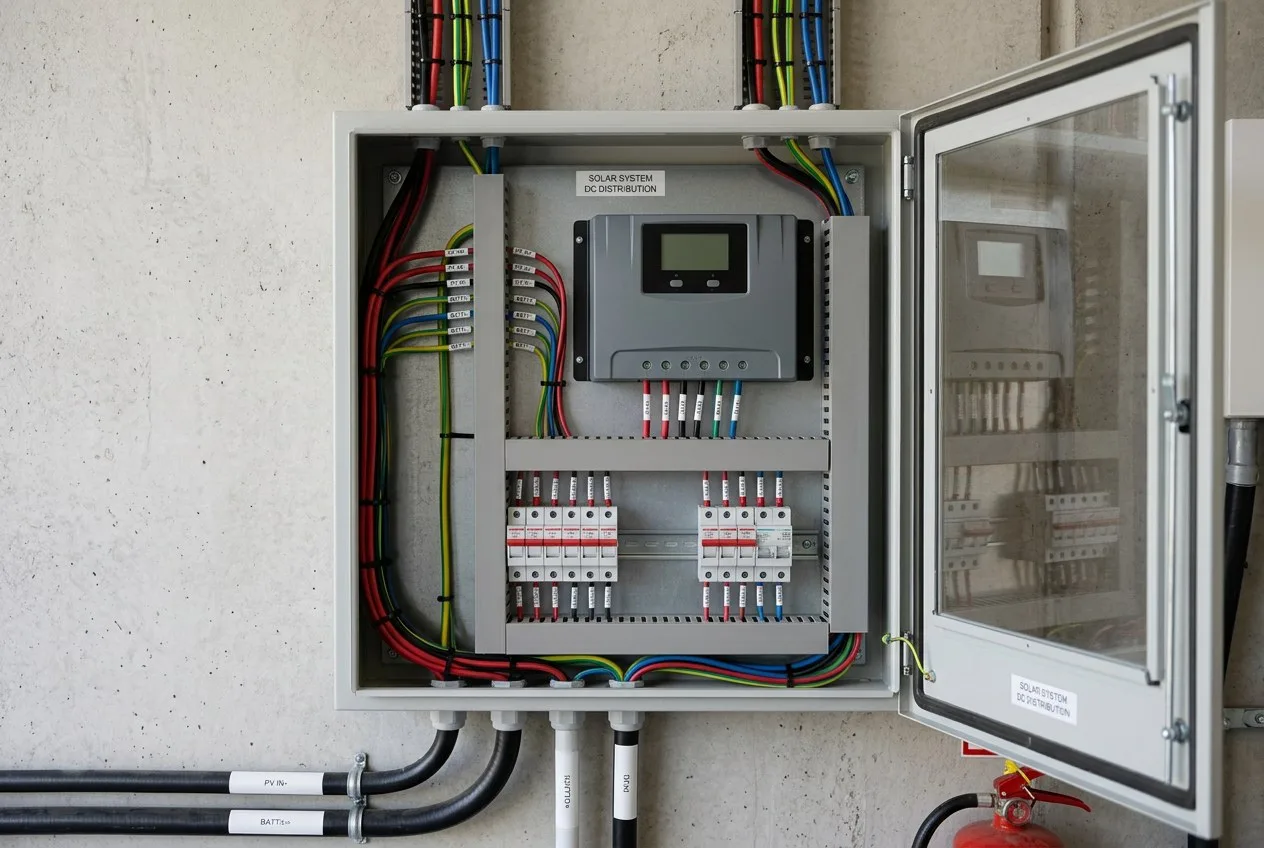
How to roughly determine the charge controller current?
The basic logic is to divide the panel power by the battery voltage. Example (assumption: 1,000 Wp array, 48 V battery, 25 percent safety):
- Charging current: 1,000 W ÷ 48 V ≈ 21 A
- Safety margin: 21 × 1.25 ≈ 26 A
- Result: A 30 A class controller would be a suitable candidate.
This calculation is only on the current side. The highest open-circuit voltage of the array (especially in cold weather) must not exceed the maximum input voltage of the controller; otherwise, the device may be damaged. This check must be carried out by the manufacturer's catalog and the authorized designer.
How does the battery store energy and when does it kick in?
The battery chemically stores the energy produced by the panel during the day but not used at that moment; it returns this energy at night, in cloudy weather or during a grid outage. In off-grid systems, batteries are often referred to as the weakest link ; Because their lifespan is very sensitive to usage patterns, temperature and charging settings.
Four concepts are important in battery selection:
- Capacity (Ah and Wh): Ah is the current-time, and Wh is the actual measure of energy. Wh = Ah × V. For detail What is battery capacity (Ah) You can look at the article.
- Depth of discharge (DoD): How much of the capacity is used. High DoD in lead-acid batteries shortens life; lithium iron phosphate (LiFePO4) batteries have a larger usable share. Typical cycle life ranges vary by product, so the data sheet should be used.
- Battery chemistry: With sealed lead-acid types such as gel, AGM, OPzV, LiFePO4 have different cost, lifespan, and maintenance profiles. For comparison Choosing a battery for solar energy and LiFePO4 battery Check out his articles.
- System Voltage: 12, 24 or 48 V. Higher voltage is preferred to lower the current as the power increases; Detail Choice of 12 V, 24 V and 48 V battery voltage in his article.
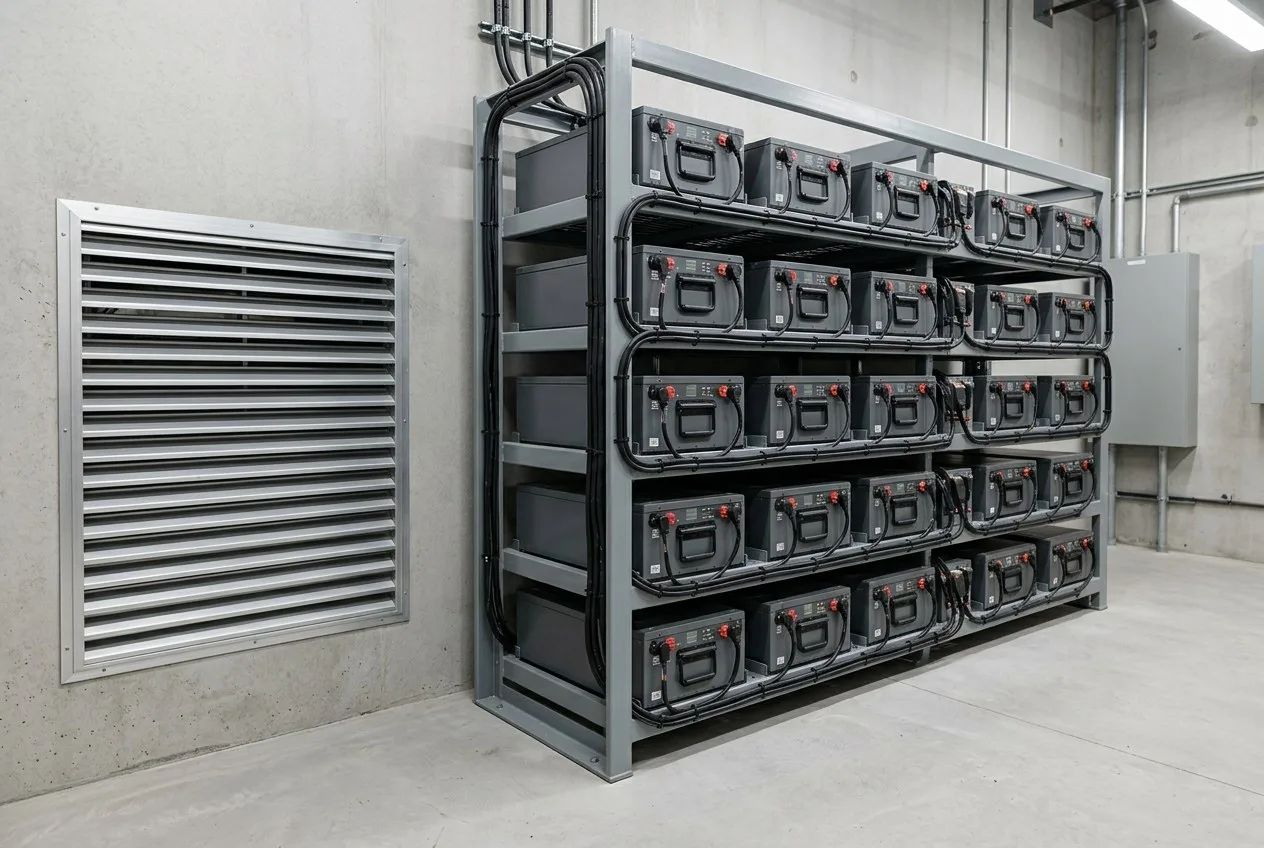
Battery safety: why authorised personnel are required?
Battery banks can deliver very high short-circuit current; bridging the terminals of a measuring probe or tool causes arcs and burns. Hydrogen-containing gas can be released during charging in lead-acid batteries, so ventilation is important. Lithium batteries, on the other hand, need BMS (battery management system) protection and proper placement. Battery connection, series-parallel arrangement and commissioning must be carried out by authorized personnel. General occupational safety framework on the subject Occupational safety in UPS and battery work You can find it in the article.
How does an inverter convert DC to AC?
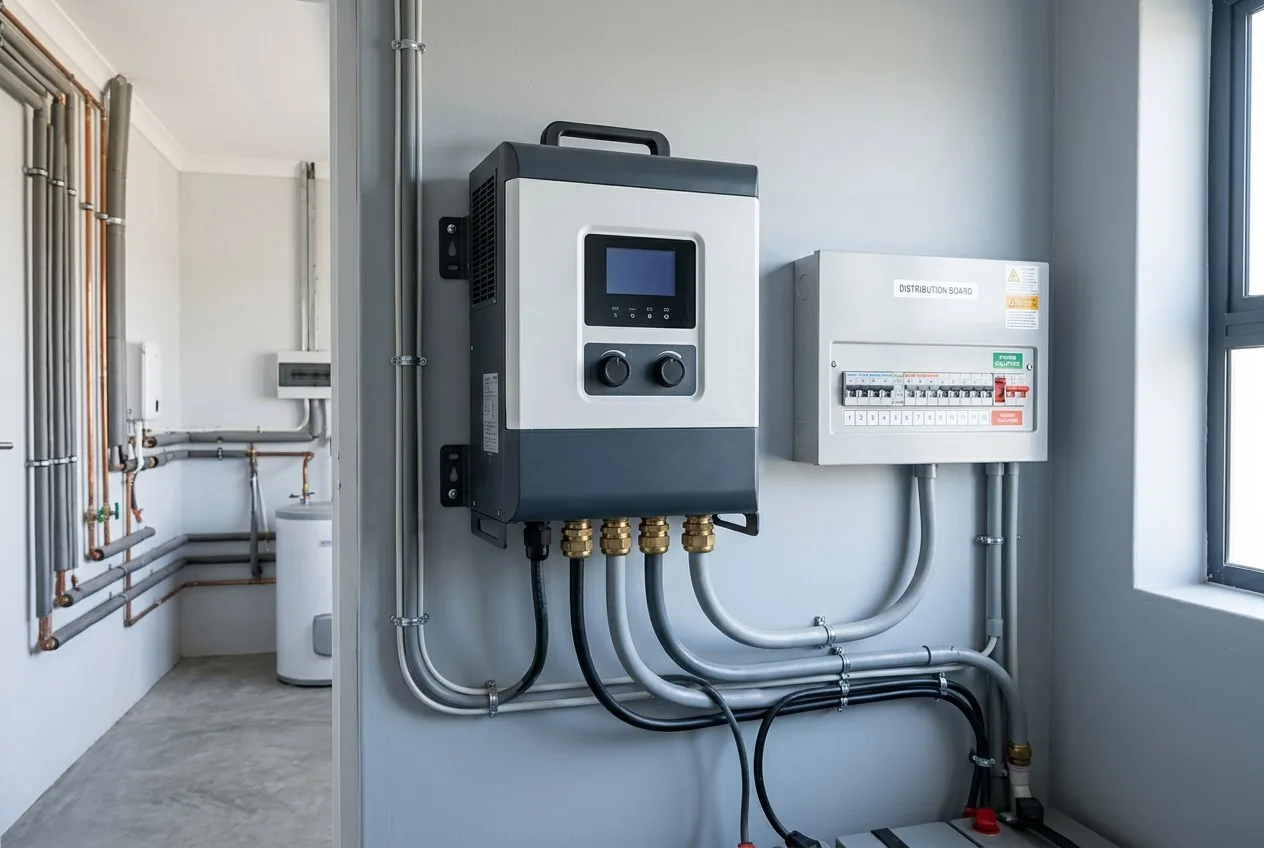
The panel and battery output DC; most of the sockets, motors and devices in the house require AC (230 V, 50 Hz in Turkey). The inverter converts DC into a sine-like AC waveform with semiconductor switches and filters. General logic What is an inverter and how it differs from a UPS You can read it in the article. Three inverter approaches are seen in solar systems:
| Inverter type | How does it work? | What happens in an outage? |
|---|---|---|
| On-grid | Converts the panel DC to AC synchronous with the mains voltage and frequency, and outputs the excess to the grid | It stops for security reasons, does not give backups |
| Off-grid inverter | Creates an AC grid independent of battery DC | The grid does not exist anyway; it works with battery and panel |
| Hybrid inverter | Manages panel, battery and grid in one device | Feeds selected loads if it has a backup output (EPS) |
The reason why grid-tie inverters stop at an outage is not a malfunction, but a conscious safety feature. The conventional grid-connected inverter is designed to detect and disconnect from the grid; this complies with the anti-islanding requirements of the IEEE 1547-2018 standard. The aim is to prevent feedback to the personnel who go to repair the line. Therefore, the answer to the question "I have a panel on my roof, why is there no electricity in an outage?" is that it is often a standard inverter without a battery. Architecture that works in an outage What is a hybrid inverter You can review it in the article.
Waveform and power requirement
For sensitive electronics, motorized device, and medical equipment, pure sine output is often preferred; the difference Pure sine and modified sine inverter We explained in the article. When choosing inverter power, not only the total wattage is considered, but also the inrush current of motorized devices. The refrigerator compressor, pump and air conditioner can draw inrush current several times the operating power; these values should be obtained from the device label or catalog.
What path does energy follow in the system?
We can summarize the flow during the day through a hybrid (panel + battery + grid) system as follows:
- Morning: It starts to produce panels. First, the instant consumption of the building is met.
- Noon: Production exceeds consumption. Excess energy first charges the battery; if the battery is full (system and legislation allow), it is supplied to the grid or production is throttled.
- Evening: Production decreases. Consumption is covered by the battery and the grid according to the set priority.
- Night: The panel is disabled. The battery supplies the load up to the specified discharge limit, then the system returns to the grid.
- Deduction: The inverter stops sensing the grid, disconnects to the utility line, and feeds critical loads from the backup outlet from the battery (and panel, if applicable).
Profit-making behavior in each system can be set by the manufacturer: battery priority, grid charging allowance, lower discharge limit, etc. These are set up differently depending on the product and usage target. Offsetting and grid switching depends on legislation and may change over time; for current rules, refer to the official pages of the Ministry of Energy and Natural Resources, EMRA or your distribution company.
Cordless and battery-free system: which makes sense and when?
The battery-free system is cheap and simple; however, it does not provide service in case of an outage and is dependent on the grid at night. The battery-powered system provides energy continuity and increased self-consumption, but the cost, maintenance and settlement requirements increase.
| Status | Without battery (on-grid) | Cordless (hybrid / off-grid) |
|---|---|---|
| Energy in outage | None | Yes (within the reserve output and capacity limit) |
| Off-grid location | Not suitable | Suitable (off-grid) |
| Initial cost | Lower | Higher |
| Care | Panel cleaning, inverter control | Additionally, battery health and charging settings |
| Typical user | Businesses and homes with high daytime consumption | High outage cost or off-grid user |
For this decision Is a battery required in a solar power system? You can follow the criteria in the article. If you have a critical load (such as server, case, medical device), the transition time becomes important; remember that the transition time of a hybrid inverter is not zero, while a real UPS provides uninterrupted output with its double-conversion structure. For this difference, How UPS works and UPS mode and changeover time in hybrid inverter The article guides the way.
How to size a simple solar system?
The exact design is from a competent designer; however, seeing the order of magnitude makes it easier to make a decision. The following example is prepared with round assumptions for a small house (or vineyard house) without a grid.
Assumptions: Daily consumption 3 kWh (3,000 Wh); system voltage 48 V; LiFePO4 battery and usable DoD 80 percent; inverter efficiency 90 percent; average daily irradiance for the panel side 4.2 kWh/m² (i.e. approximately 4.2 peak sun hours); panel, cable and charging chain total efficiency 70 percent.
| Step | Account | Conclusion |
|---|---|---|
| 1. DC energy on the battery side | 3.000 Wh ÷ 0.90 | ≈ 3,333 Wh |
| 2. Required rated battery energy | 3,333 Wh ÷ 0.80 | ≈ 4,170 Wh |
| 3. Battery capacity (Ah) | 4,170 Wh ÷ 48 V | ≈ 87 Ah → 100 Ah are chosen |
| 4. Panel power | 3,000 Wh ÷ (4.2 × 0.70) | ≈ 1.020 Wp → approx. 1 kWp |
| 5. Controller current | 1,000 W ÷ 48 V × 1.25 | ≈ 26 A → 30 A class |
There is no one-day backup in this account. If autonomy (battery for more than one day) is desired for cloudy days, the battery capacity is multiplied. Since the daily irradiance drops well below average during the winter months, the panel power must also be re-evaluated according to the season; How much solar energy produces in winter article helps in this regard. For step-by-step methods How many solar panels do you need and Solar Battery Capacity Calculation You can look at his articles.
10-20 percent losses that reduce the overall efficiency of the system should also be taken into account. Balance-of-system (BOS) efficiency is typically considered to be between 80 and 90 percent. Cable cross-section, cable length and connection quality directly affect this loss; DC cable cross-section and voltage drop article deals with this subject.
Why are protection, grounding, and monitoring part of the system?
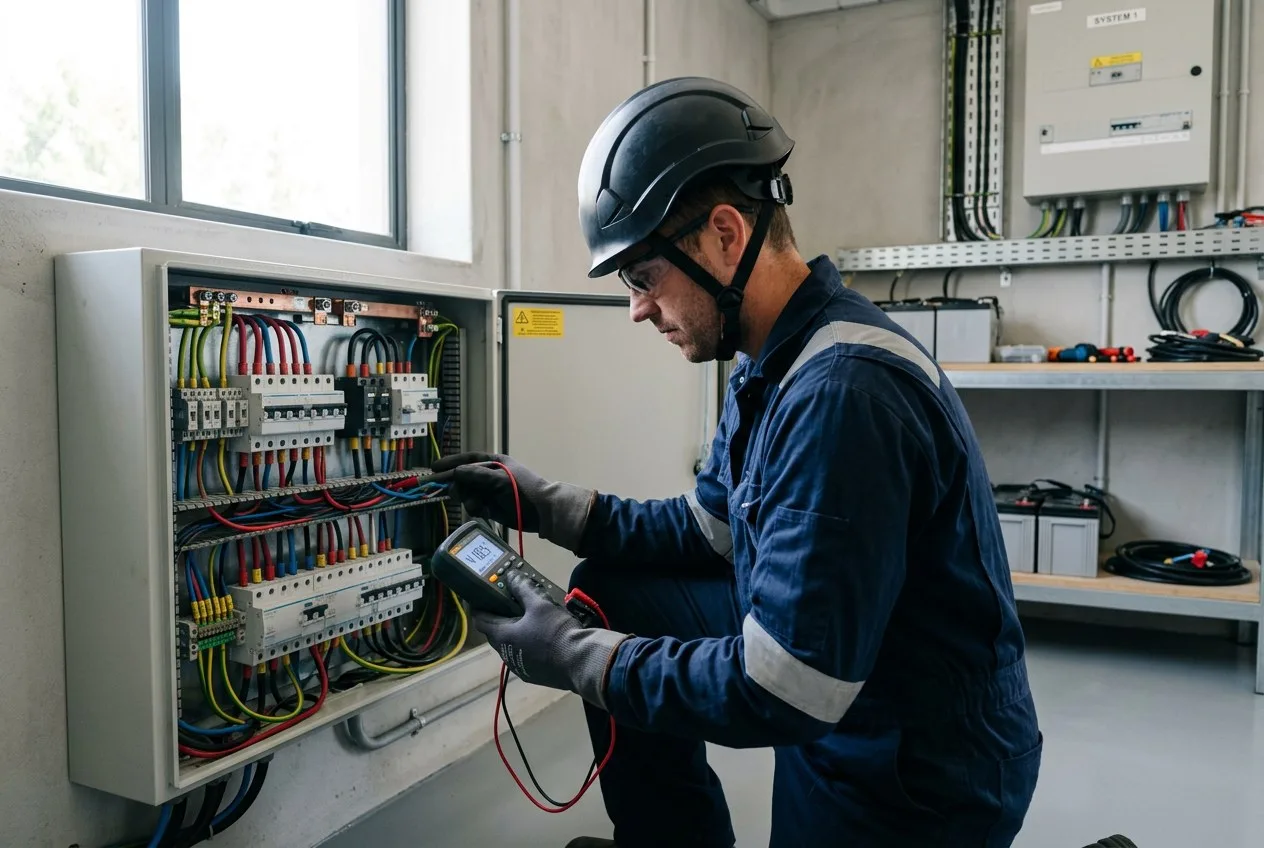
A solar energy system is not just a "panel + inverter". The DC side can create an arc; because the arc does not go out on its own because the DC current does not pass through zero. Therefore, DC fuses, DC choppers, surge arresters and grounding are mandatory components for the safety of the system. Related details DC fuse, switch and surge arrester protection and Grounding and lightning protection can be found in his writings.
Seeing the production and battery status allows the fault to be caught early. Production falls below expectations are often caused by contamination, ghosting, loose connection or adjustment error; If the solar energy system produces less The checklist in the article makes the first glance easier.
Common mistakes and the right approach
| Error | Conclusion | The right approach |
|---|---|---|
| Calculating panel power with label value | Expected production does not occur | Taking into account temperature, loss and seasonal influence |
| Considering the entire battery usable | The battery wears out prematurely or the load is interrupted | Accounting for available DoD and yield allowance |
| Charging setting that is not suitable for the battery type | Overcharging, gassing, or undercharging | Using generative voltage values; see Battery Charge Settings |
| Connecting the inverter to the controller's load output | Inrush current may exceed controller | Connecting the inverter directly to the battery line with appropriate protection |
| Skipping protection elements | Risk of fire and arcing in short circuit | To install fuses, switches and surge arresters in accordance with the project |
| Expecting energy from every grid-connected system in case of outage | Expectation and reality do not match | Replanning the redundant egress hybrid architecture |
How to think of a solar system and a UPS and generator together?
The solar system is a source of energy production; UPS is a protection layer that provides uninterrupted and quality power to critical loads. These two do not have to be interchangeable, they can also be planned together. Installing panels on the roof does not eliminate the need for a UPS in the server room; because panel production is fluctuating and the standard grid-connected inverter stops in an outage. In rooftop systems, this relationship Is there a need for a UPS if solar panels are installed on the roof? We discussed it in the article; for businesses rooftop SPP and UPS cooperation may be more appropriate. For the role of the generator in long outages How solar, battery and generator work together You can look at the article.
Solar panel installation and official application processes are outside the service area of this site; however, if planning, maintenance or breakdown support is required on the UPS, battery and inverter side of the system, the following section will guide you.
Checklist before making a decision
- What is the goal: reduce bills, backup in case of outage, use without a network?
- Which are the critical loads, how many watts and how many hours should be supported?
- Is shading, orientation and slope appropriate on the roof or land?
- Have winter production and night consumption been taken into account?
- Have battery type, placement, ventilation, and fire safety been determined?
- Are DC and AC protection, grounding and surge arrester involved in the project?
- Have the document and standard requirements been obtained from the manufacturer?
- Will installation and commissioning be done by authorized personnel?
Support on the side of UPS, battery and inverter
When choosing a solar energy system, storage and uninterrupted use are as important as the production of energy. Bempower; It provides exploration, installation, periodic maintenance and technical service for all brands of UPS, battery packs and inverters. To assess the condition of your battery group, plan a UPS for your critical loads or have your existing inverter and battery system maintained from the contact page You can contact us.
- Solar Photovoltaic Cell Basics — U.S. Department of Energy, 2025. https://www.energy.gov/cmei/systems/solar-photovoltaic-cell-basics
- Photovoltaics and electricity — U.S. Energy Information Administration, 2025. https://eia.gov/energyexplained/solar/photovoltaics-and-electricity.php
- Understanding Solar Photovoltaic System Performance — U.S. Department of Energy, 2022. https://www.energy.gov/sites/default/files/2022-02/understanding-solar-photo-voltaic-system-performance.pdf
- Batteries and Charge Control in Stand-Alone Photovoltaic Systems — Florida Solar Energy Center (FSEC), 1997. https://www.fsec.ucf.edu/en/publications/pdf/FSEC-CR-1292-01.pdf
- How Does a Solar Charge Controller Work? — Morningstar Corporation, 2024. https://www.morningstarcorp.com/faq/how-does-solar-charge-controller-work/
- Solar Energy Potential Atlas (GEPA) – Resources — Republic of Turkey Ministry of Energy and Natural Resources, 2025. https://enerji.gov.tr/eigm-resources
- Analysis of Turkey's Solar Energy Potential with PVSyst — DergiPark, 2024. https://dergipark.org.tr/tr/download/article-file/3906370
- A Reconfigurable Solar Photovoltaic Grid-Tied Inverter Architecture for Enhanced Energy Access in Backup Power Applications — arXiv, 2019. https://arxiv.org/pdf/1907.03080
Resources
