


Home Power Outage Options: UPS, Inverter, Generator and Solar Energy

A power outage at home often starts as a few minutes of inconvenience, but its consequences, such as a lost internet connection, a computer shutting down mid-work, and a refrigerator and combi boiler stopping, can quickly cascade. UPS, battery inverter, generator and solar energy are the solutions mentioned most often. They are not interchangeable products; each is designed for different runtime, power and safety conditions.
This guide approaches the outage problem from the needs side first: what do you want to keep running, and for how long? It then explains how the four options work, when each makes sense, their safety risks, and how to find the battery requirement with a simple worked example. It is written for homeowners, people running a small office from home, and anyone starting to research backup power for the first time.
This article is for general information only. Connection to the electrical installation, battery and inverter installation, and generator connection must be carried out by authorized electrical personnel; no section of this article is a DIY instruction.
First, Determine What You Want to Protect
The first step in choosing the right solution is to clarify the list of devices that must keep running during an outage and the expected outage duration. In the same outage, a few watts are enough for a modem, while a combi boiler and a refrigerator need far more energy. You can divide outages into three simple classes:
- Short outage (seconds to minutes): Grid fluctuations and brief on-off switching. The main risk is the computer shutting down and data loss.
- Medium-length outage (1-6 hours): Faults and maintenance work. Communication, lighting, the refrigerator and the combi boiler come to the fore.
- Long outage (days): Disasters, storms and major faults. Energy generation (generator, solar) and a fuel/storage plan are required.
Separate the devices that really need to run during an outage as "critical loads"; high-power devices such as air conditioners, electric ovens, kettles, washing machines and dishwashers are usually left out of most home backup setups. This distinction directly determines both the cost and the size of the system. If you get stuck on power concepts (W, VA), the article how UPS power is calculated explains the basic differences.
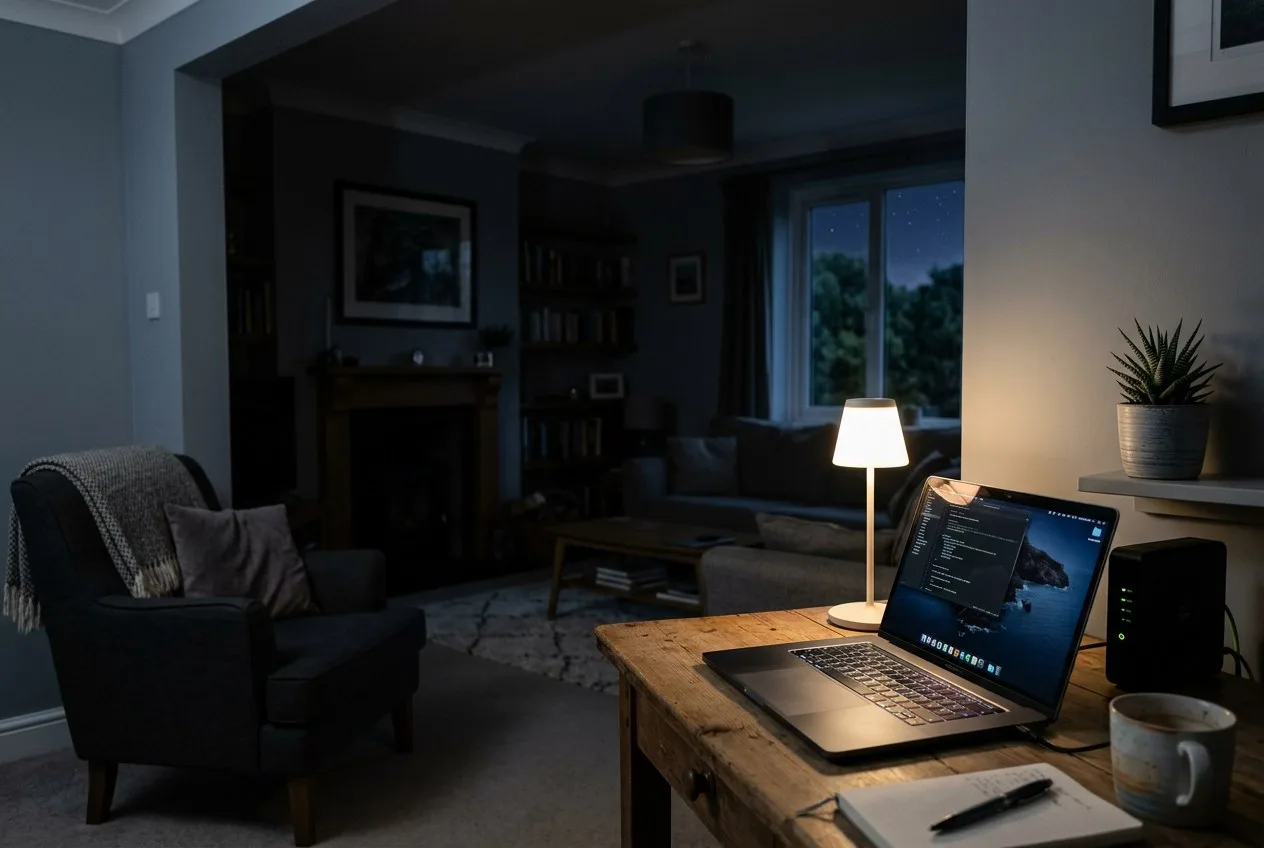
UPS: For Short-Term and Sensitive Loads
A UPS (uninterruptible power supply) is a device that switches the load to its own battery when the grid goes down and keeps the output running without interruption. The international IEC 62040 series divides static UPS systems into three groups according to their operating mode: passive standby (off-line), line-interactive and double-conversion (online). The standard distinguishes between these three operating modes . To see the basic operation in detail, you can look at the article UPS types .
The most common types for home use are passive standby and line-interactive models. In these types, the load is supplied from the grid during normal operation, and the inverter kicks in when an outage is detected; therefore there is a very short transfer time, which varies by model. Computers, modems, NAS devices and network equipment generally handle this short transfer without trouble. For the exact transfer time, check the manufacturer's datasheet.
Strengths and weaknesses of a UPS
- Strength: Fast transfer, voltage protection and regulation, and the ability to shut down computers and network devices in a controlled way.
- Weakness: The battery pack is small; backup time is usually between a few minutes and an hour or two. Expanding the battery is not possible on every model.
- Unsuitable loads: Motorized devices, air conditioners, laser printers and others that draw a high starting current. For details, see the article on connecting motors, air conditioners and laser printers to a UPS .
You can find what you should connect in the guide UPS for home and small office . General rule: a UPS is intended not to "stretch an outage over hours" but to "keep the system safely running or shut it down safely at the moment of the outage."
Battery Inverter and Hybrid Inverter: Hourly Backup
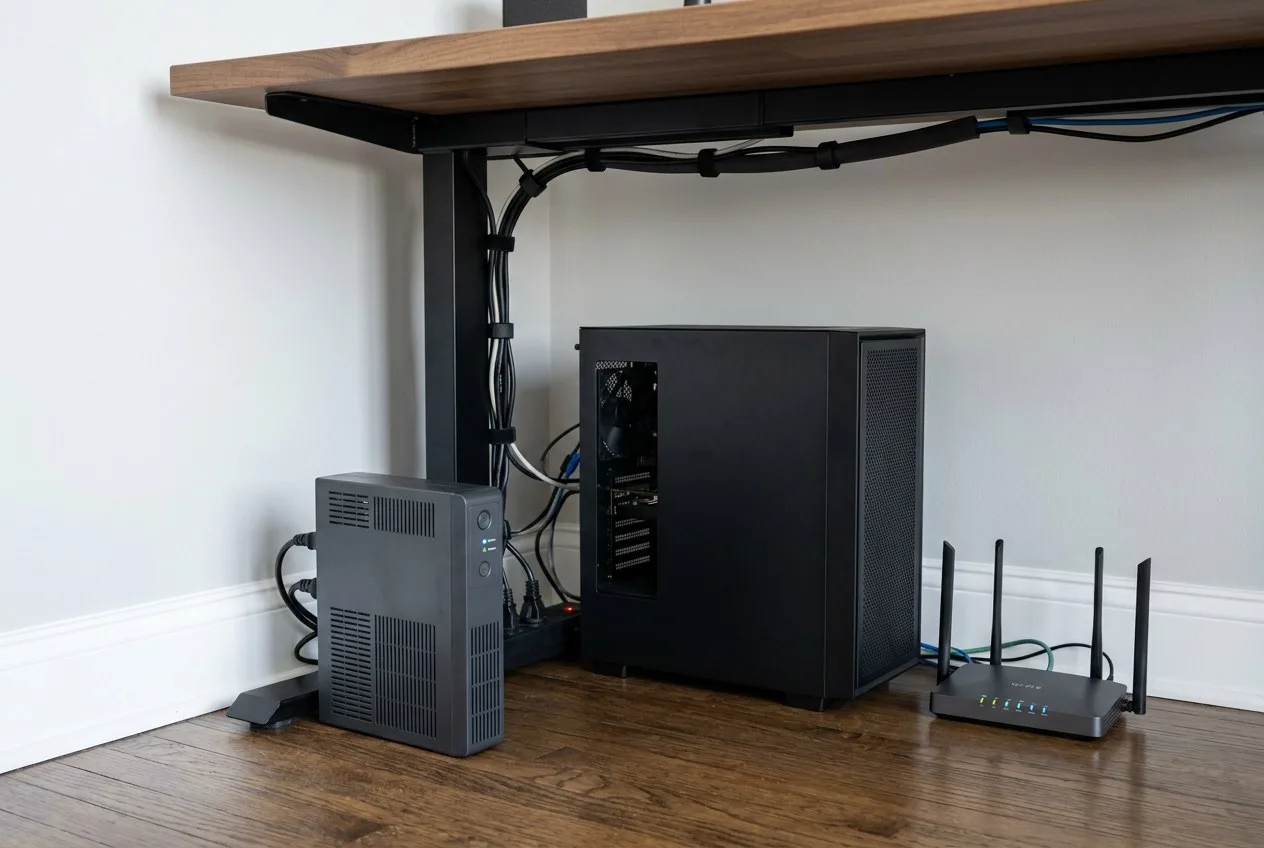
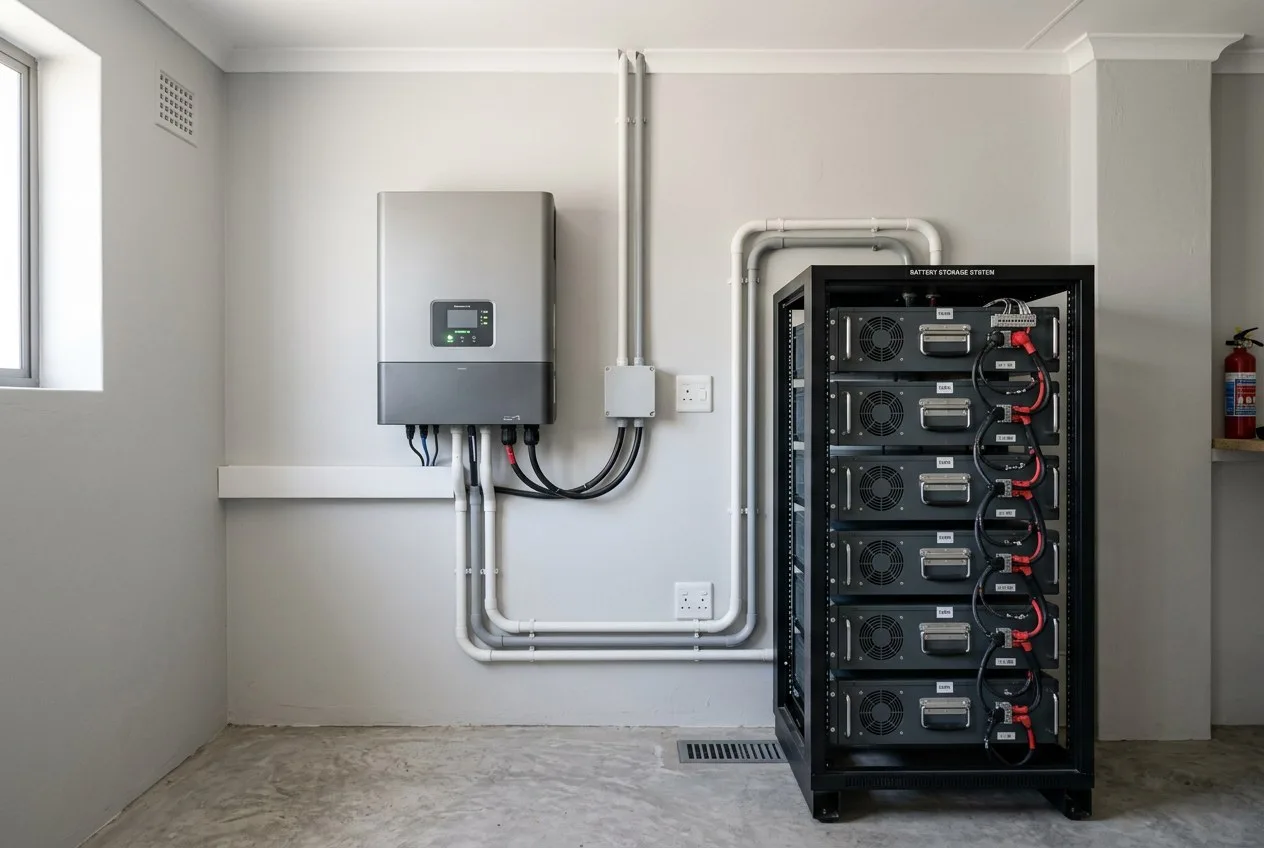
An inverter converts the direct current (DC) of the battery into the alternating current (AC) used in the home. In a battery inverter system, the battery bank sits in a separate cabinet and can be expanded as needed; this means a much longer backup time than a UPS. You can see the distinction between a UPS and an inverter in the article what is an inverter and how it differs from a UPS , while the installation logic for a home is explained in the article how a battery inverter system is installed .
A hybrid inverter manages the energy coming from the solar panel, the grid and the battery in a single device. You can find the details in the article what is a hybrid inverter and how does it work during a power outage . There are three points to watch here:
- Transfer time: The backup (EPS) output of some hybrid inverters may not be as fast as a UPS. For sensitive computers and servers, check this in the datasheet; the topic is covered in the article UPS mode and transfer time in a hybrid inverter .
- Output waveform: Pure sine output is preferred for motorized devices and sensitive electronics; the difference between pure and modified sine explains this choice.
- Scope of the backup output: In most systems, only the lines connected to a separate "critical load" panel are supplied during an outage; the whole house is not backed up automatically.
The size of the system is determined by the battery capacity. Battery selection (lead-acid or lithium), depth of discharge and service life are separate decisions; the article on battery capacity (Ah) is a good starting point.
Generator: Power Generation for Long Outages
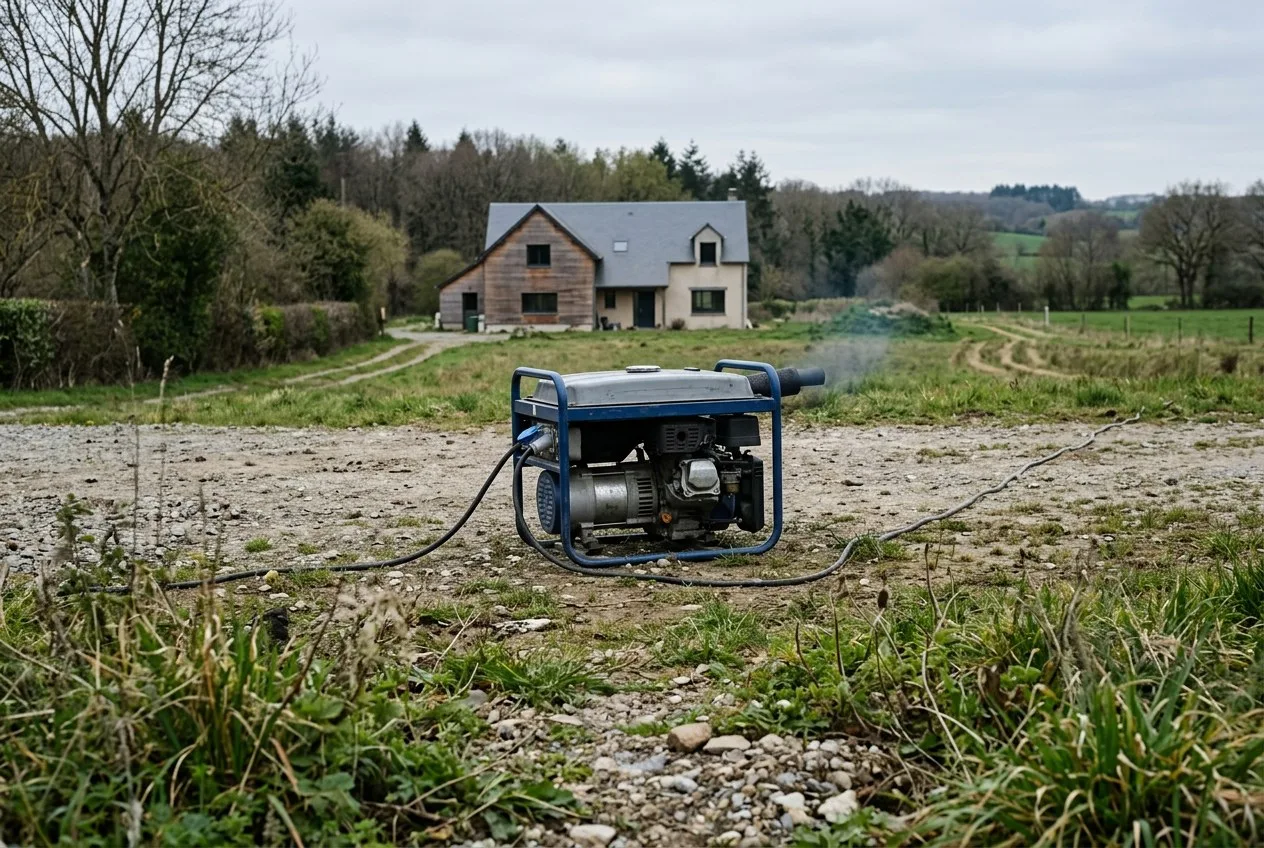
A generator converts fuel, not stored energy, into electricity. Therefore, no matter how long the outage lasts, it keeps running as long as there is fuel. It can supply large loads (air conditioner, pump, electric heater). In return, it brings noise, exhaust, fuel storage and regular maintenance. How a UPS and a generator complement each other The differences between a UPS and a generator are explained in the article.
The first characteristic of a generator is that it can take anywhere from a few seconds to a few minutes to kick in; in other words, it is not "uninterruptible" on its own. For loads such as computers and network devices, placing a UPS in between closes this gap.
The most critical issue with generators: carbon monoxide
Gasoline and diesel generator exhaust contains carbon monoxide (CO). The U.S. Consumer Product Safety Commission (CPSC) states that generator exhaust contains carbon monoxide, an invisible and odorless poison . The agency also says that deadly carbon monoxide levels can build up quickly in such spaces and can linger for hours even after the generator has been shut off . A generator must not be used in enclosed spaces such as a home, garage, basement or shed, even if doors or windows are open.
- Location: The CPSC recommends running a generator only outdoors and at least 20 feet (about 6 m) away from the house ; this is a U.S. recommendation, but the principle applies everywhere. Balconies, porches and enclosed parking garages are not suitable.
- Exhaust direction: The exhaust should be directed away from the home's entrances and ventilation openings, and nearby windows should be kept closed.
- CO shut-off feature: The CPSC advises looking for models with a safety feature that automatically shuts off the generator when the surrounding carbon monoxide level rises .
- Detector: A working carbon monoxide detector in the home is an additional layer of safety for every type of fuel-burning appliance.
The second critical issue is how the generator is connected to the home's electrical installation. Plugging a generator into an outlet with a cable or connecting it directly to the installation can cause backfeeding; energy flowing back into the grid endangers utility workers and neighbors. The connection to the home's installation must only be made through a suitable transfer switch installed by qualified electrical personnel. For scenarios where solar, batteries and a generator are designed together, see how solar, battery and generator work together .
Why Doesn't Solar Power Always Work During an Outage?
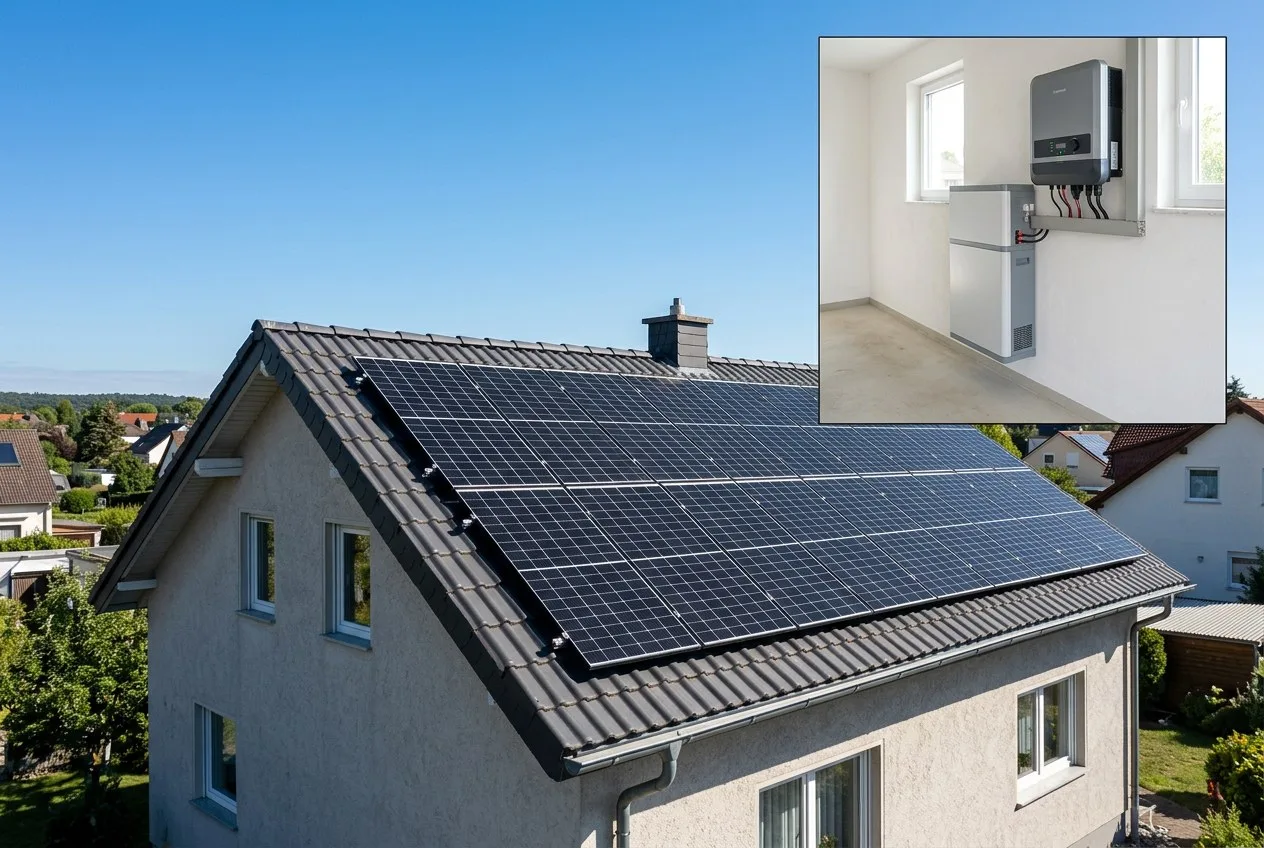
Having panels on the roof does not mean you will have electricity at home during an outage. Grid-tied (on-grid) inverters stop producing when the grid goes down, for line safety. An academic study summarizes this as follows: in the event of a grid fault, a conventional grid-connected inverter is designed to detect island formation and disconnect from the grid . The same study states that this function complies with the anti-islanding requirements of IEEE 1547-2018 and that, as a result, a conventional inverter cannot make use of solar energy during an outage .
So if your goal is to benefit from the sun during an outage, the system must be designed accordingly:
- On-grid without batteries: Reduces your bill, does not work during an outage. You can see the difference in the article on on-grid, off-grid and hybrid systems .
- Hybrid system with batteries: Supplies selected loads through the backup output during an outage; the panels charge the battery during the day. This requires the battery and inverter to be sized correctly together.
- Off-grid: Operates independently where there is no grid; for details, see the off-grid installation guide .
To decide whether a battery system is needed, you can read is a battery necessary in a solar power system . The design, application process and panel installation of solar systems are outside Bempower's scope of services; however, support can be provided for the batteries, inverters and UPS connected to the system. You can find out how much production may drop in winter conditions in how much does solar energy produce in winter .
Portable Power Stations: Practical but Limited
Portable power stations are ready-made units containing a battery, an inverter and a charging circuit. They are a short-term solution for phones, laptops, modems and lighting. In most models the capacity (Wh) is limited, and not every model switches over automatically when the grid goes down. For appliances such as refrigerators, you should check in the manufacturer's datasheet whether both the continuous power and the starting current values are suitable. For a detailed assessment, see can a portable power station be used instead of a UPS .
Four Options Side by Side: Comparison Table
| Criterion | UPS | Battery / hybrid inverter | Generator | Solar + battery |
|---|---|---|---|---|
| Typical backup time | Minutes to a few hours | Hours (depending on battery capacity) | As long as there is fuel | Depends on battery and daylight |
| Transfer speed | Very short (varies by model) | Varies by model; see the datasheet | Seconds to minutes, not uninterruptible | Depends on hybrid inverter model |
| High-power loads | Generally not suitable | Depends on inverter power | Suitable (with proper sizing) | Depends on battery and inverter power |
| Main risk | Battery life, overload | Battery and DC connection safety | Carbon monoxide, backfeed, fuel | DC voltage, battery safety |
| Best use | Computer, modem, NAS | Lighting, refrigerator, combi boiler, communications | Long outages, large loads | Those who want both savings and backup |
| Maintenance needs | Battery replacement, periodic testing | Battery and connection check | Fuel, oil, periodic test runs | Battery, inverter, panel check |
There is no single absolute winner in the table. For many homes, the most balanced solution is a layered one: a small UPS for network devices and computers, a battery-backed inverter or hybrid system for the refrigerator and lighting, and a fuel-powered backup for very long outages.
Example Calculation: Battery Requirement for a 4-Hour Home Outage
The calculation below is an example based on approximate values; you should use the label or datasheet values of your own devices. Assumptions: outage duration 4 hours, inverter efficiency 90%, system voltage 24 V, usable depth of discharge 80% for a lithium (LiFePO4) battery and 50% for a lead-acid battery.
| Device | Average power | Energy for 4 hours |
|---|---|---|
| Modem and network device | 15 W | 60 Wh |
| LED lighting (5 units) | 40 W | 160 Wh |
| Laptop | 60 W | 240 Wh |
| Television | 80 W | 320 Wh |
| Refrigerator (cycle average) | 50 W | 200 Wh |
| Combi boiler (pump and electronics) | 100 W | 400 Wh |
| Total | 345 W | 1,380 Wh |
- Add the inverter loss: 1,380 Wh ÷ 0.90 ≈ 1,533 Wh is drawn from the battery.
- Nominal capacity for lithium: 1,533 ÷ 0.80 ≈ 1,917 Wh, i.e. approximately 1.9-2 kWh.
- Ah equivalent at 24 V: 1,917 Wh ÷ 24 V ≈ 80 Ah.
- For lead-acid: 1,533 ÷ 0.50 ≈ 3,067 Wh, i.e. approximately 128 Ah at 24 V (about 130 Ah).
- Inverter power: Even though the average load is 345 W, keep in mind that the refrigerator compressor can temporarily draw several times that power at startup. For this reason, an inverter is chosen whose continuous power is clearly higher than the load and whose surge capacity is sufficient; for example, a 1,000 W class unit is a sensible starting point for this example.
To supply the same load, a lead-acid battery requires more nominal capacity than lithium, because its usable depth of discharge is lower. Actual values vary with battery type, temperature, and discharge rate; check the manufacturer's datasheet. The logic of the calculation is covered in more detail in the articles solar energy battery capacity calculation and how to calculate battery runtime .
For comparison: a 1,000 VA class home UPS typically carries two small 12 V batteries (for example, 2 × 9 Ah). The nominal energy is 24 V × 9 Ah ≈ 216 Wh; after efficiency and usable capacity losses, about 150 Wh can be assumed in practice. A modem and laptop (about 75 W) can run roughly 2 hours on this battery, while at a 345 W load the runtime drops below half an hour. This shows with numbers why a UPS is a solution for "short-duration and sensitive loads."
Which Solution for Which Situation? Scenario Table
| Situation | Recommended approach | Point to watch |
|---|---|---|
| Works from home and cannot tolerate even a short outage | Line-interactive or online UPS | The total power of the computer, modem and monitor must stay below the UPS's watt rating |
| Boiler and refrigerator must keep running during an outage | Battery-backed inverter / hybrid inverter | Inrush current, critical load panel, battery capacity |
| Outages lasting several days | Generator (with a transfer switch) + small UPS | Outdoor operation, fuel management, CO detector |
| Is considering installing panels and wants power during outages too | Hybrid system with battery | An on-grid system without batteries does not work during an outage |
| Summer house, vineyard house, area with a weak grid | Off-grid solar + battery, with a generator if needed | Winter production and battery life |
| Only phone, lights, modem | Small UPS or portable power station | Capacity (Wh) is limited |
For special cases such as a summer house or vineyard house solar power system for a vineyard house and hobby garden and UPS for villas and summer houses articles are useful.
Special Notes on Boilers and Refrigerators
For many users, the main concern is keeping the boiler and refrigerator running during an outage. A combi boiler is an electrical appliance: the heating energy comes from natural gas, but the pump, fan and control board need electricity. When the power goes out, the boiler shuts down for safety reasons. For these loads you need to choose an inverter or UPS that is suitable in terms of power and inrush current; the details are in how to choose a UPS for a boiler and solar power for refrigerators, boilers and air conditioners articles. Connecting appliances wired into the building installation, such as a boiler, to a backup line must be done by qualified electrical personnel.
Common Mistakes
- Confusing watts with VA: The VA rating on a UPS is not directly the wattage you can run; the power factor comes into the calculation.
- Forgetting the inrush current: The current at the moment a refrigerator, pump or air conditioner compressor starts can be several times the continuous current.
- Expecting power during an outage from a solar system without batteries: An on-grid inverter disconnects for safety reasons.
- Running a generator in an enclosed space: This is one of the most dangerous mistakes and carries a risk to life. The CPSC stresses that carbon monoxide poisoning can develop so quickly that people can lose consciousness before they notice the symptoms.
- Connecting a generator to a socket with a cable: There is a risk of backfeed; only a suitable transfer switch should be used.
- Neglecting battery maintenance: No matter how well the system is chosen, an aged or never-tested battery will not deliver the expected runtime during an outage. The article When should a UPS battery be replaced provides guidance on this.
- Trying to back up every appliance: Including loads such as heaters, ovens and air conditioners makes the system unnecessarily large.
Safety: Battery, DC Voltage and Fire Risk
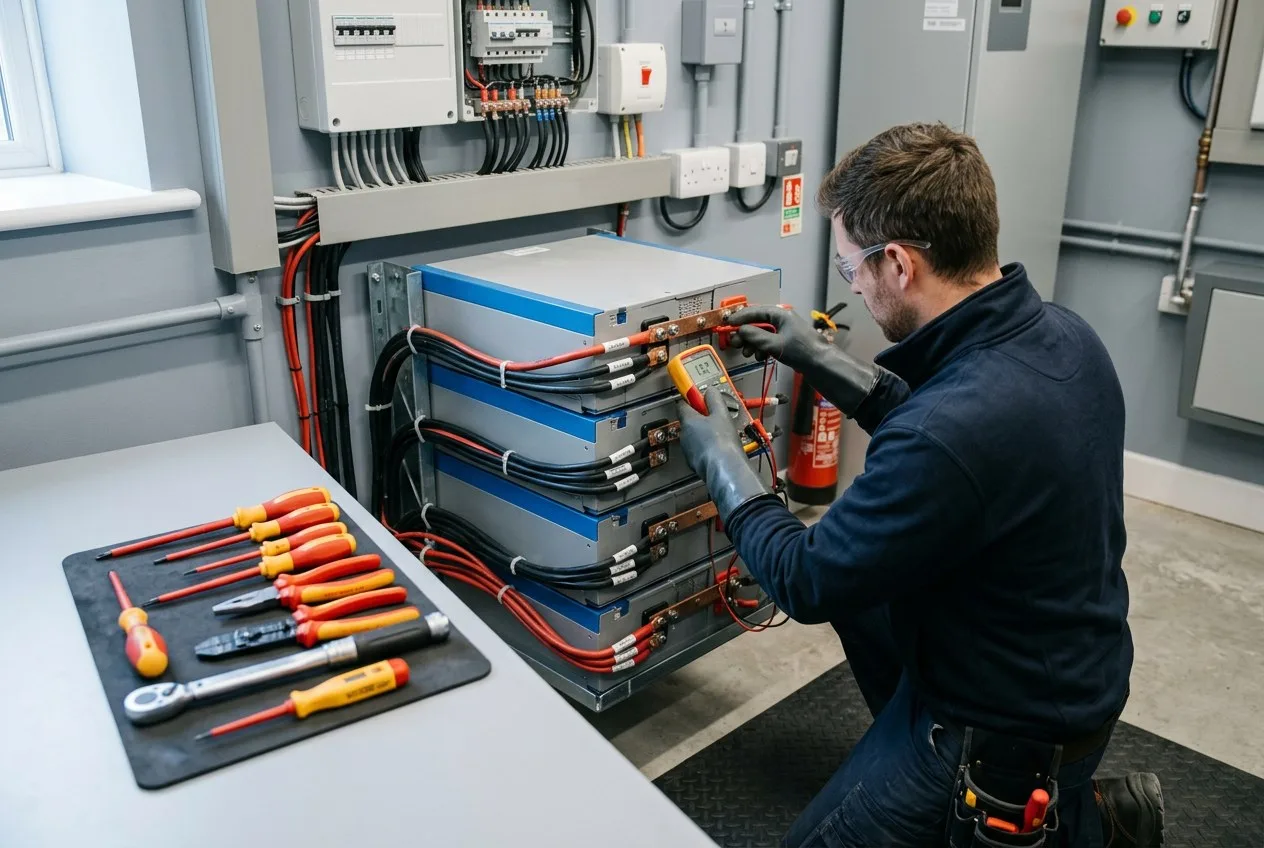
In battery-based systems (UPS, inverter, hybrid) the risks differ from those of a generator, but they do exist. A short circuit at the battery terminals can produce very high current; a high-current arc can cause serious burns. Lead-acid batteries can release gas during charging, so they need ventilation. Lithium batteries must be used with a proper BMS (battery management system) and correct placement. You can find the topic in the article fire safety in lithium battery storage For a general occupational safety approach, see occupational safety in UPS and battery work .
- Have the battery and inverter connections, fuse/breaker selection and grounding done by qualified electrical personnel.
- For battery placement, follow the rules on heat, ventilation and access; for details see battery cabinet and battery installation .
- Do not place batteries where they are exposed to water and moisture, direct sunlight or excessive heat.
- Keep the battery cabinet out of the reach of children and pets.
After Installation: Testing and Maintenance
Once a backup power system is installed, seeing it work once is not enough. To avoid surprises during a real outage, periodically:
- Update the critical load list; when a new appliance is added, recalculate the total power.
- Have the battery condition tested and monitor it for signs of aging. UPS battery maintenance explains the basic checks.
- Test a mains outage in a controlled way; check whether the backup line really kicks in and whether your devices are affected during the transfer.
- If you have a generator, have it run regularly and have the fuel freshness and the transfer switch checked.
The lifespan of battery-powered systems is closely related to temperature, depth of discharge, and maintenance. For these factors, you can take a look at the article on factors affecting battery life
Ask Yourself When Deciding
- Which devices must keep running during an outage, and what is their total power in watts?
- How many hours does an outage last in the worst-case scenario?
- Are the devices that must keep running sensitive electronics or motorized loads?
- Is there a safe, ventilated place for the battery?
- If a generator is being considered, is a safe outdoor location and a suitable connection possible?
- If solar power is planned, is it a goal for it to keep working during an outage too?
The answers to these questions show which product class is needed, before deciding which product to buy. Manufacturer datasheets and a site survey by authorized personnel are essential to confirm the final sizing.
Get Support for UPS, Batteries, and Inverters
To determine the UPS, battery bank, or inverter solution suited to the outage risk in your home, the Bempower team offers on-site survey, installation, periodic maintenance, and technical service support; we serve Istanbul and the surrounding provinces. To describe your needs and request a survey, you can visit the contact page
- CPSC Safety Alert: Portable Generator Hazards — U.S. Consumer Product Safety Commission (CPSC), 2017. https://www.cpsc.gov/s3fs-public/Portable-Generator-Safety-Alert-2017_5123.pdf
- Safety Standard for Portable Generators — Federal Register / CPSC, 2023. https://www.federalregister.gov/documents/2023/04/20/2023-07870/safety-standard-for-portable-generators
- A Reconfigurable Solar Photovoltaic Grid-Tied Inverter Architecture for Enhanced Energy Access in Backup Power Applications — arXiv, 2019. https://arxiv.org/pdf/1907.03080
Sources
