


Fire Safety in Lithium Battery Storage: What to Watch for at Home and in Business

As energy storage becomes more widespread at home and in business, lithium batteries are quietly settling into garages, boiler rooms and technical rooms like a piece of furniture. For most users, the only questions are capacity and price. Yet a home battery mounted on a wall can hold tens of kilowatt-hours of energy, and if that energy is released in an uncontrolled way, the result is a fire. This guide was written not to frighten, but to explain in plain terms where the risk comes from and how it is managed.
In this article you will find how fires start in lithium batteries, site selection for homes and businesses, electrical protections, standards and documents, periodic inspections, and what to do in the event of an incident. It is written for home users, business owners, technical managers and purchasing departments. The installation, connection and repair steps are not DIY instructions. These jobs must be carried out by qualified electrical personnel and technical service.
Where Does the Fire Risk in Lithium Batteries Come From?
A lithium-ion cell is a sealed, energy-dense structure containing a flammable organic electrolyte. In normal operation this structure is stable. The risk arises when the cell is pushed beyond its own limits. Typical triggers are:
- Overcharging: Cell voltage exceeds the safe upper limit and the internal structure degrades.
- Short circuit: In an external short circuit, very high current flows and the connection points and cables heat up. In an internal short circuit, heat is generated from inside the cell.
- Overheating: High ambient temperature, a closed and unventilated installation, or resistive heating at a loose connection.
- Mechanical damage: Dropping, crushing, puncturing, or internal damage that occurs during transport and cannot be seen with the naked eye.
- Manufacturing defects: Causes such as metal particles inside the cell or separator defects.
- Incorrect system design and installation: Incompatible inverter settings, insufficient cable cross-section, wrong fuse, loose torque.
The key point is this: most of the risk comes not from the cell itself but from the system surrounding it (BMS, connections, protection components, layout and operation). That is why two systems with the same cell chemistry can have very different safety levels.
What Is Thermal Runaway and Why Does It Propagate in a Chain?
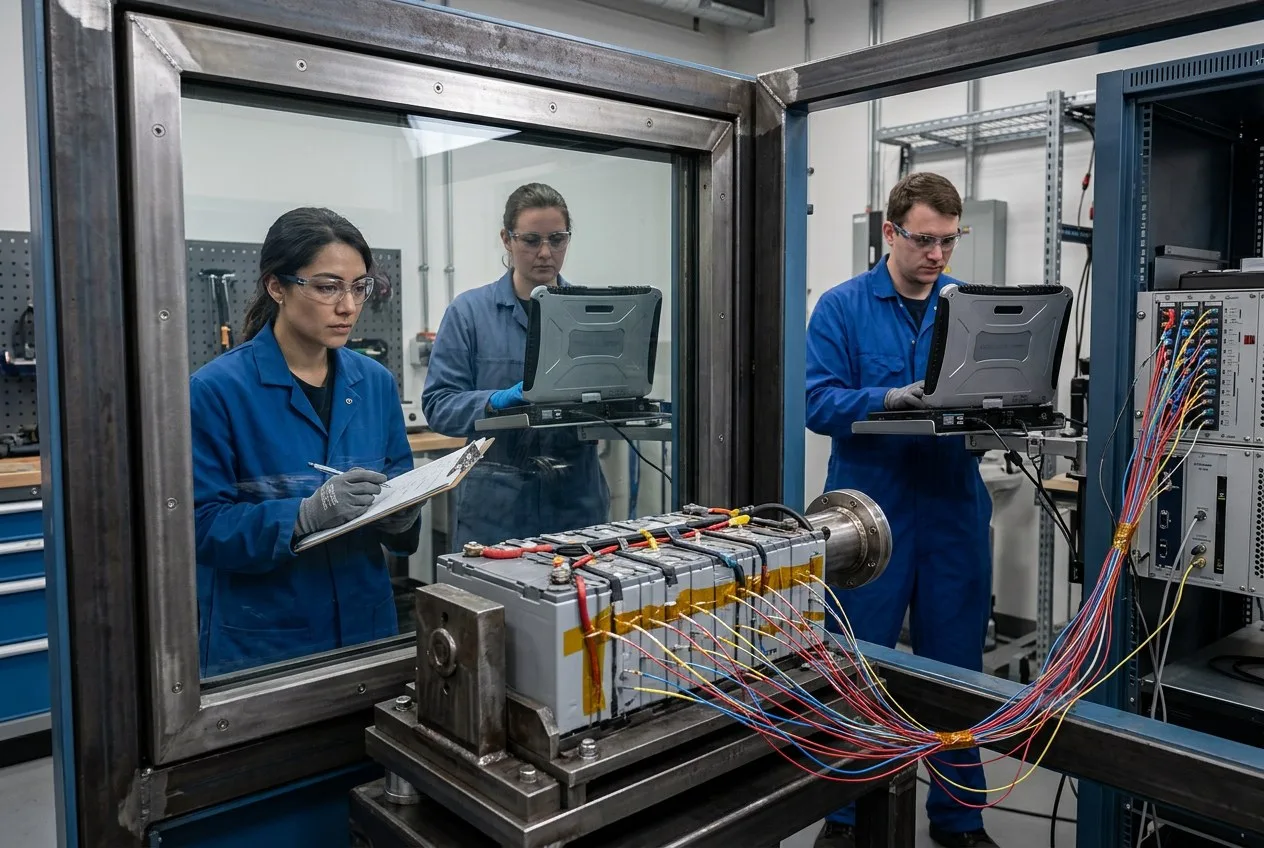
Thermal runaway is when a cell produces more heat than it can dissipate and the temperature rises in a self-reinforcing way. A heating cell triggers more chemical reactions, which produce even more heat. According to a testing organization's definition, this can be summarized as the cell short-circuiting, beginning to heat up uncontrollably and potentially leading to a fire. Thermal runaway begins when the cell short-circuits and heats up uncontrollably, and it can lead to a fire. We explained the detailed mechanism in our article on thermal runaway . Here, let's look at the practical consequences.
Research shows that thermal runaway can spread through an array and that, in the process, toxic and flammable gases can be released along with heat, which may create an explosion risk. Thermal runaway can propagate through battery arrays; along with thermal energy, it can release toxic and flammable gases and vapors. For this reason, there are three separate objectives in lithium battery safety:
- To prevent the incident from starting (BMS, protection components, correct installation).
- If it starts, to limit its spread (module design, distance, compartmentalization).
- If it spreads, to protect life and property (detection, ventilation, evacuation, fire service response).
Smoke is a separate hazard as well. Even in a small battery incident, the gases released can cause breathing problems in a closed home before the fire does. For this reason, site selection and early detection are more important than extinguishing a fire.
Which Lithium Chemistry Is Safer? LiFePO4 vs NMC Comparison
The two most common chemistries in storage systems are LiFePO4 (lithium iron phosphate) and NMC (nickel manganese cobalt). The general trend is that LiFePO4 is more thermally stable. However, this alone is not a guarantee of safety. For details, you can see LiFePO4 and NMC differences and the LiFePO4 battery guide .
| Criterion | LiFePO4 | NMC |
|---|---|---|
| Thermal stability | Generally higher; enters thermal runaway at a higher temperature | Lower threshold; the incident can be more severe |
| Energy density | Lower; bulkier for the same capacity | Higher; compact |
| Typical use | Home and stationary storage, UPS | Compact home batteries, electric vehicles |
| What determines safety | BMS, installation and connection quality | BMS, compartmentalization and spacing, cooling |
Choosing the chemistry is only a starting point. Even within the same chemistry, cell quality, module design and protection architecture can differ. When deciding, don't fall for the easy assumption that "it says LiFePO4, so it's safe." Ask for the product's test reports and certificates.
What Does a BMS Do for Safety, and What Can It Not Do?
A BMS (Battery Management System) is the electronic supervisor that monitors cell voltages, current and temperature and cuts off charging or discharging when necessary. Its basic duties are overcharge, over-discharge, overcurrent, short-circuit and overtemperature protection, as well as cell balancing. For more, see our BMS article you can also read.
The safety role of the BMS is important. The 2022 edition of IEC 62619, the industrial lithium standard, has been expanded to cover topics such as the BMS's functional safety, software, and electromagnetic compatibility. IEC 62619:2022 is the core standard for stationary systems and UPS; it also includes BMS safety, EMC, and software requirements.
However, the BMS also has its limits:
- The BMS often cannot prevent a sudden internal short circuit inside a cell; it can only limit the consequences.
- The BMS It does not always detect the heating at a loose cable connection; the temperature sensor is not at that point.
- If the BMS settings are not communication-compatible with the inverter and charger, the protection may be disabled.
- A faulty BMS is itself a source of danger; therefore, additional independent protections (fuses, circuit breakers) are required.
Where Should a Lithium Battery Be Installed at Home?
Choosing the location is the decision with the greatest impact on fire safety for a home user. The right location protects people and escape routes if an incident occurs.
Suitable and Unsuitable Locations
| Location | Assessment | Points to note |
|---|---|---|
| Garage | Commonly preferred | Must be protected from vehicle impact, extreme heat and cold, humidity, and stored flammable materials |
| Utility room / technical room | Generally suitable | Ventilation, distance from heat sources, easy access |
| Outdoors (cabinet with an appropriate protection class) | May be suitable | Manufacturer's IP rating and temperature range, exposure to sun and water, risk of vandalism |
| Bedroom and living area | Not recommended | Smoke and gas reach the living space directly |
| Stairwell and escape route | Not suitable | May block the evacuation route |
| Next to a combi boiler, stove, or water heater | Not suitable | Risk of additional heat and ignition sources |
This table is a general framework. The exact rules are set out in the product manual, the building management plan, and local fire department requirements. If you live in an apartment building, management approval may be required to use a common area.
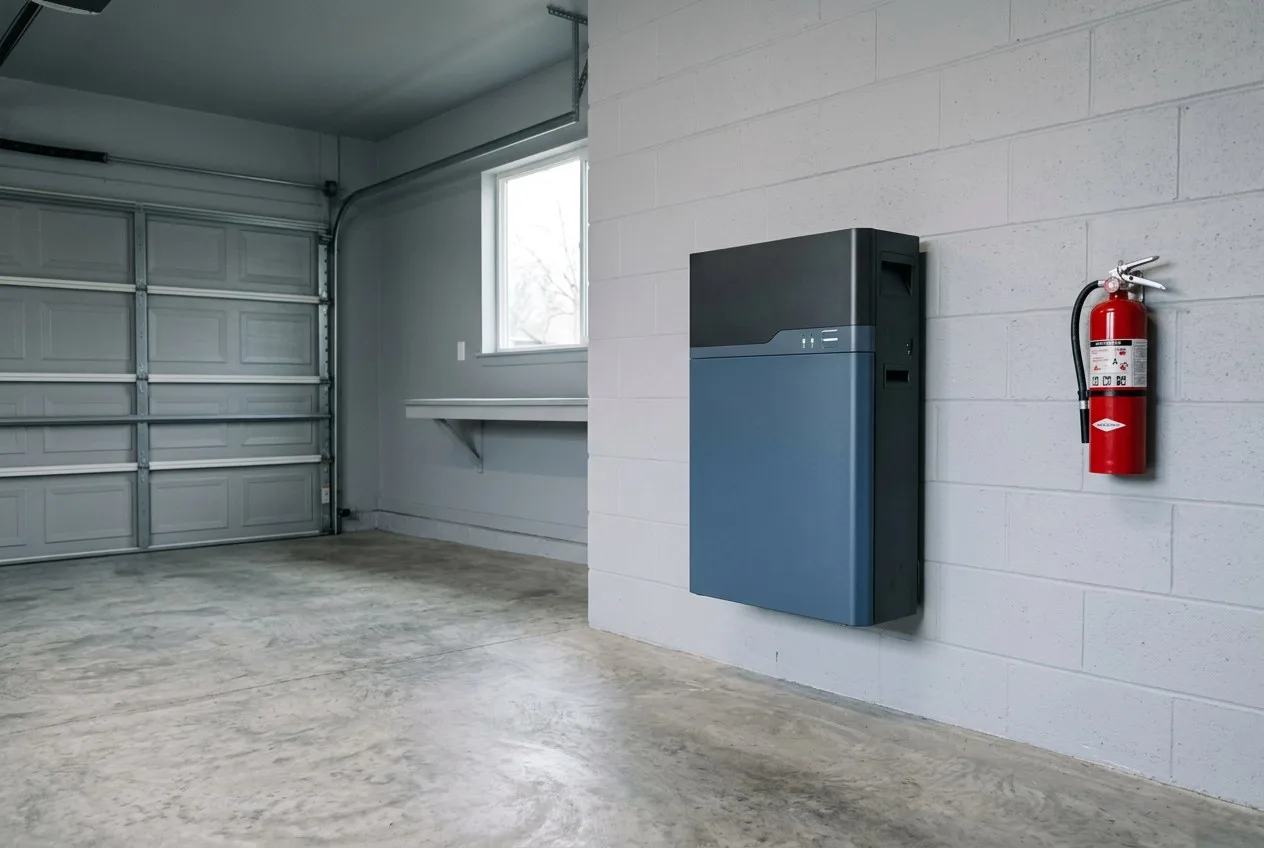
General Placement Principles at Home
- Keep the battery separate from living areas and bedrooms; if possible, choose a location with a door and a path leading outside.
- Leave the clearance specified by the manufacturer around it. Do not store boxes, paint, gas cylinders, or paper.
- There should be a smoke detector at the installation site. If possible, have the detector alarm sent to your phone in smart systems.
- Do not use the battery in places outside its temperature limits (direct sunlight, risk of freezing). The temperature limit is stated in the manufacturer's datasheet.
- Having the connections and the display easily visible allows problems to be noticed early.
- Secure it so that children and pets cannot touch it.
For the components of a home system and the installation process, you can also read our home energy storage system guide as well.
Battery Room and Cabinet Planning in Businesses
In businesses, the amount of energy is higher, and the consequences of a fire combine downtime, property loss, and employee safety. Therefore, choosing the location is a design task. The headings below are the main topics to be addressed during the pre-installation survey.
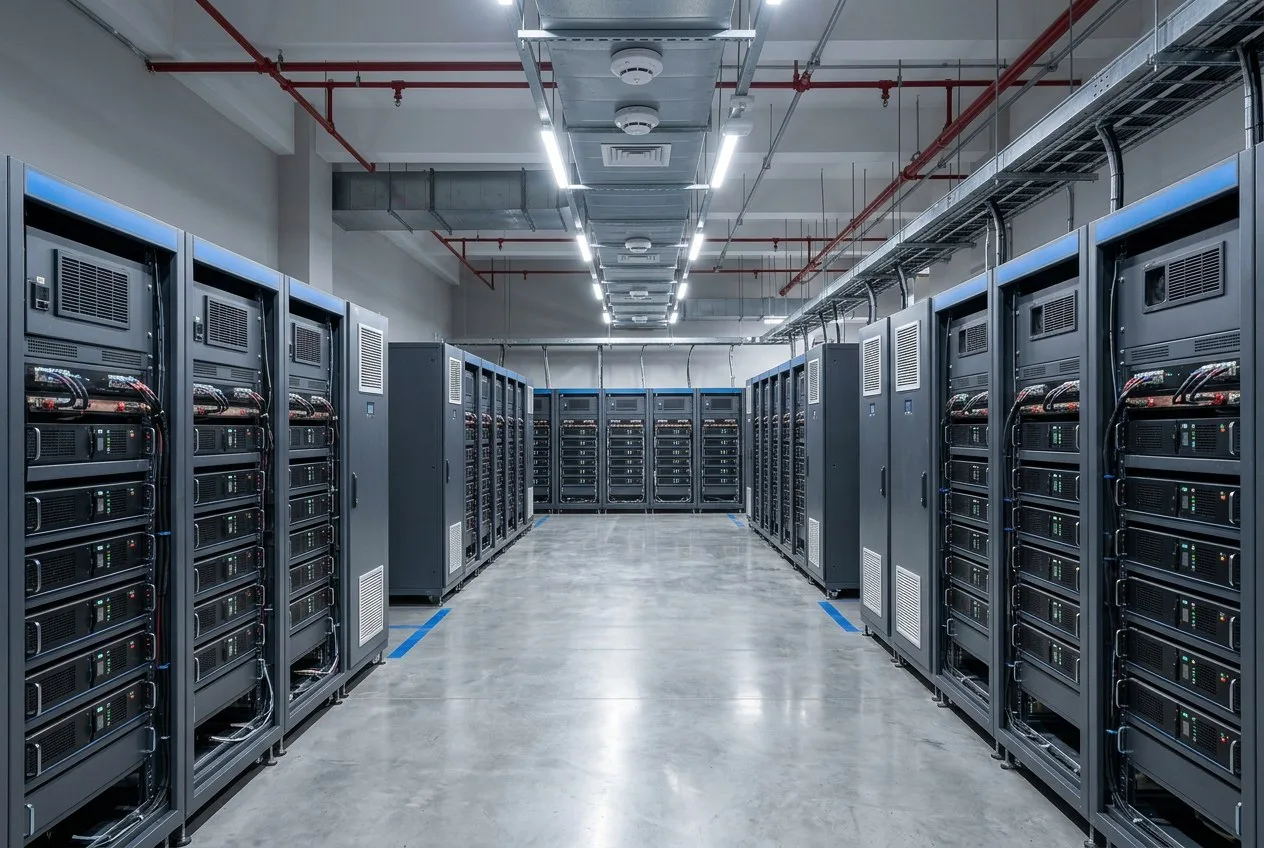
- Separate room or compartment: The battery area must be separated from production, storage, and office areas by fire-resistant building elements. The required fire resistance duration is determined by the project and fire department requirements.
- Ventilation and temperature control: Lithium batteries do not release hydrogen the way lead-acid batteries do, but thermal management is important. Excessive heat adversely affects both service life and safety. For the rules that apply to a lead-acid battery room, see our battery room article The requirements are different for lithium.
- Access and clearance: Clearances between cabinets and to the wall are determined according to the manufacturer's installation documentation and test results. A passage area must be left for maintenance and emergency response.
- Floor and weight: The weight of the cabinet must not exceed the load-bearing capacity of the floor.
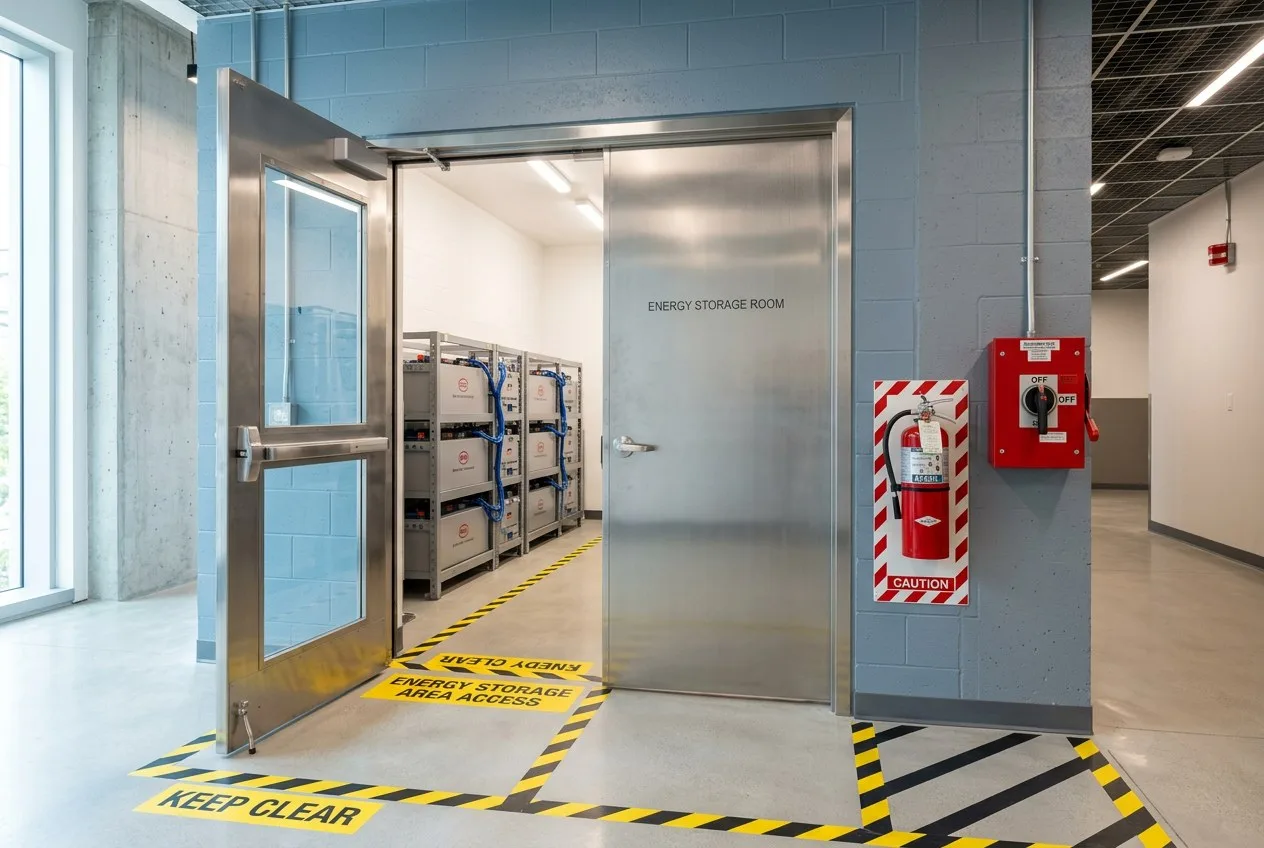
- Emergency stop (E-stop): There must be a marked, easily accessible disconnect point outside the room.
- Warning and signage: The entrance door must display clear information indicating that it is an energy storage area and who to call in an emergency.
You can find details on cabinet placement and clearances in the article lithium battery cabinet installation If your facility is considering a rooftop solar power plant (GES) together with storage, the content on solar plant with storage (GES) is also useful for planning.
Electrical Protection: Fuse, Switch, Cable and Connections
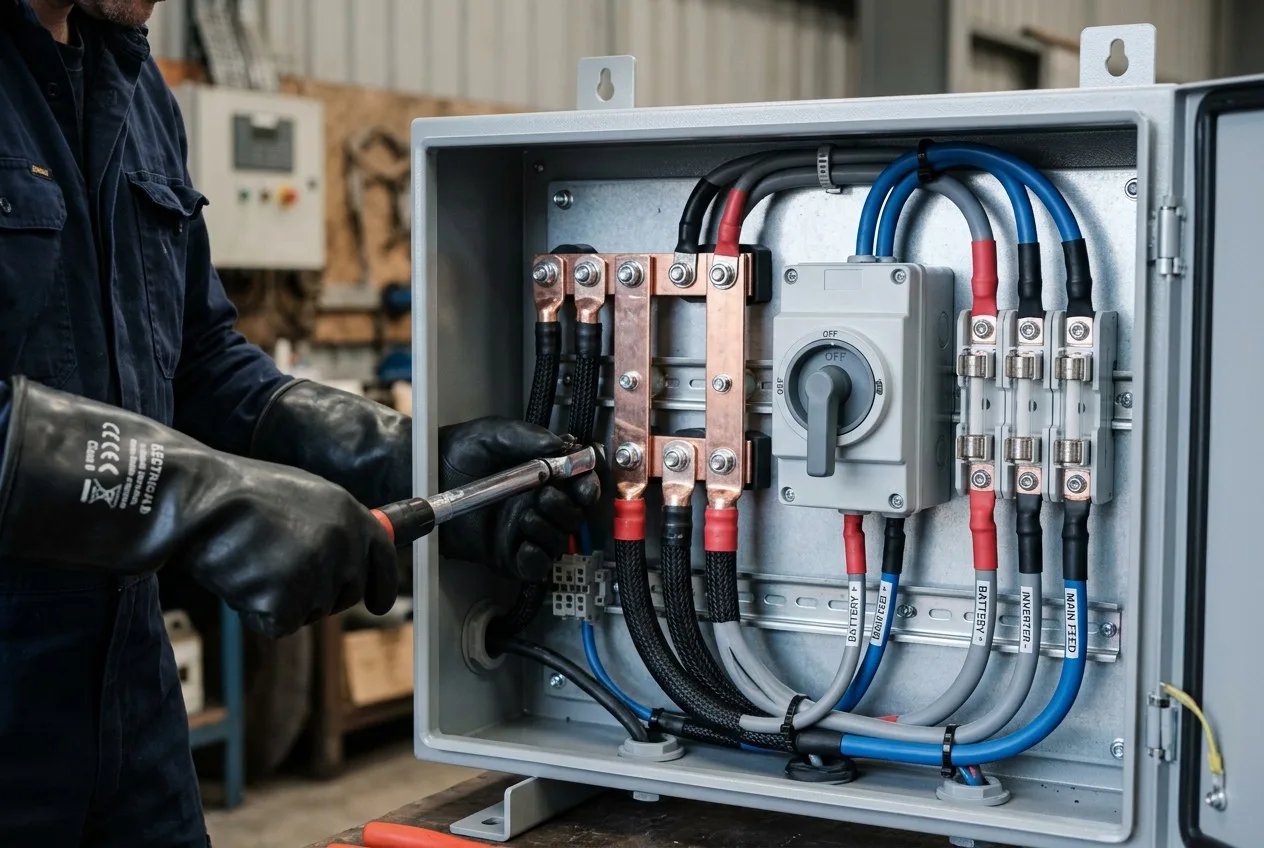
A lithium battery can deliver a very high current in a short circuit. The system must not be left without a DC fuse or a suitable DC circuit breaker that can safely interrupt this current. Keep in mind that protective devices used for AC do not work the same way on DC. Extinguishing an arc is harder in DC current. For details, see DC fuse, switch and surge arrester article.
Sample Calculation: Battery Line Current
Assumptions: A system with a nominal voltage of 48 V, an inverter drawing a continuous load of 5 kW, and an inverter efficiency of approximately 93%. These values are examples; for a real project, manufacturer data is the basis.
- Power drawn from the battery: 5,000 W ÷ 0.93 ≈ 5,376 W
- Battery line current: 5,376 W ÷ 48 V ≈ 112 A
- When the battery voltage drops during discharge (for example, to 44 V), the current rises to approximately 122 A.
This calculation shows why the cable cross-section and the fuse must be selected based on manufacturer data and the relevant calculations, not "approximately." If the cable is chosen too thin, the cable itself heats up. If the fuse is chosen too large, it fails to provide protection. For cable cross-section, the article DC cable cross-section and voltage drop is a useful guide.
Connection Quality
Many battery incidents are caused not by the cell but by the connection. A loose cable lug heats up under load, melts the insulation, and can ignite the surrounding material. To prevent this:
- Connections must be tightened to the torque value specified by the manufacturer and rechecked during the first few days.
- Cable lugs must be crimpedwith the proper crimping tool; connections made by hand or by feel must not be used.
- Do not mix batteries of different brands or different ages in the same string.
- Cables must be routed so that they do not rub against sharp edges and respect the minimum bending radius.
- In parallel battery strings, current balance must be checked. See battery bank cabling and current balance.
All of this work must be carried out by authorized electrical personnel. Because of the high DC voltage and arc risk, working on an energized system carries a serious risk of injury. For the general framework, see occupational safety in UPS and battery work .
Standards and Certificates: What Do They Mean?
When purchasing, the word "certified" alone does not provide enough information. You need to know which standard covers which level (cell, module, system).
| Standard / Method | What does it cover? | Why is it important? |
|---|---|---|
| IEC 62619 | Safety requirements and tests for industrial lithium cells and batteries, including stationary applications | Design safety of the product, electrical and mechanical abuse tests |
| UL 9540A | Test method for evaluating thermal runaway propagation (cell, module, unit, installation level) | Generates data for determining spacing and protection requirements |
| UL 9540 | Safety standard for energy storage systems and equipment | System-level safety assessment |
| NFPA 855 | Installation of stationary energy storage systems (spacing, fire protection, operation, emergency response) | US-origin installation rule; international reference |
Let us briefly explain the scope of these standards:
- IEC 62619 defines the safe operation requirements and tests for secondary lithium cells and batteries used in industrial applications, including stationary applications. IEC states that UPS and electrical energy storage systems are also within the scope of the standard. Stationary applications such as UPS and energy storage fall within its scope.
- UL 9540A is not a certification; it is a test method. UL 9540A is not a certification standard; this test does not result in a "listing." The test proceeds in sequence through cell, module, unit, and installation levels. The test is carried out at the cell, module, and unit levels, and finally at the installation level. The data obtained serve as the basis for the spacing and the fire and explosion protection required in the manufacturer's installation instructions. The data generated are used to support the separation distances in the manufacturer's installation instructions.
- NFPA 855 covers the entire life cycle, from design through operation to decommissioning. The standard sets minimum requirements for separation distances, fire protection, operation and training, and emergency response. Among the changes in the 2026 edition is the explicit mention of fire detection by thermal imaging. The 2026 edition explicitly adds the "thermal image fire detection" method. The same sources report that a Hazard Mitigation Analysis (HMA) has become a default expectation for most installations.
An important reminder: NFPA 855 and the UL standards originate in the United States and are not binding in Türkiye on their own. You should clarify which standards and regulations apply to your project by consulting the local fire department, building management, and a qualified engineering firm. For a comprehensive list of documents to check at the purchasing stage, you can use our article on which documents and standards to check .
Early Detection and Suppression: Detectors, Ventilation, and Response
The most effective defense against a lithium battery fire is noticing the incident early. A small temperature rise or gas release is usually a stage at which detectors and BMS data give a signal before any flame appears.
Detection Layers
- BMS and inverter alarms: Remote monitoring of cell temperature, voltage deviation, and current warnings.
- Smoke and heat detectors: At home, at least a smoke detector; in a business, heat and smoke detectors connected to the fire alarm panel.
- Gas detection (commercial): Some designs use sensors that detect cell venting gases.
- Thermal imaging: Considered a continuous temperature monitoring method in large facilities.
Realistic Expectations for Suppression
A lithium battery fire is difficult to extinguish. In addition, the goal is often not to put the fire out completely, but to slow its spread and protect the surrounding structure until the fire department arrives. The appendix of the 2020 edition of NFPA 855 states water as the preferred agent for lithium-ion battery fires. Water is considered the preferred agent for suppressing lithium-ion battery fires. However, this does not mean that a person at home should spray water on an energized system. An energized DC system poses an electric shock risk. The response must be carried out by fire department crews.
In commercial facilities, options such as sprinklers, gas suppression, or aerosol are determined according to the product's test data and the project risk analysis. In evaluations carried out by UL, the installation-level test is conducted in a room equipped with sprinklers or other fire and explosion mitigation methods. The installation-level test is performed in a room that has sprinklers or other fire and explosion prevention methods. For this reason, choose a fire suppression solution not because it is "good in general," but after verifying its compatibility with the battery system you use.
Periodic Inspection Checklist: For Homes and Businesses
Lithium batteries are marketed as maintenance-free. This is true in the sense of "no need to add water," but it does not mean that no safety checks are needed. The list below is a general framework that complements the manufacturer's maintenance recommendations. The interval is determined by the product documentation and the risk level.
| Inspection | What to look for | Who should do it? |
|---|---|---|
| Visual inspection | Swelling, cracks, leakage, discoloration, odor, burn marks | User (visual) and authorized personnel |
| Connection and torque | Looseness, oxidation, signs of heating | Authorized personnel |
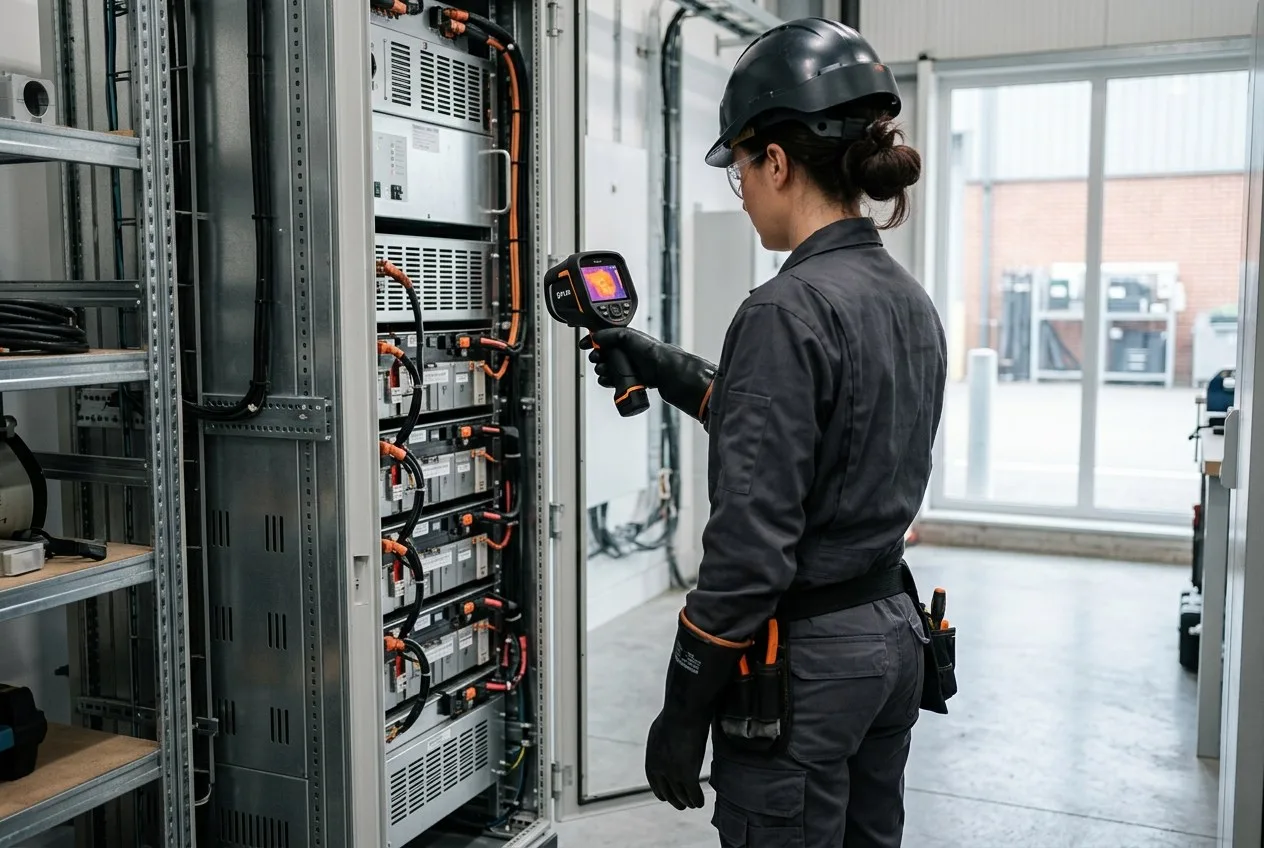
| Thermal scanning | Hot spots on lugs, busbars, and fuses | Authorized technician |
| BMS and inverter logs | Recurring alarms, cell imbalance, temperature deviation | Authorized service |
| Charge and discharge settings | Compliance with the manufacturer's recommendations, setting changes | Authorized service |
| Environment | Temperature, humidity, dust, accumulation of flammable materials, ventilation | User and facility manager |
| Detection and alarm | Detector test, alarm transmission, emergency shutdown operation | Facility manager, authorized company |
Thermal camera inspection is a practical way to spot heating at connection points early. The principle is the same as that used for UPS systems. You can check our article on thermal camera inspection for this topic. For maintenance steps specific to UPS systems with lithium batteries, the article on lithium battery UPS maintenance is also useful.
Common Mistakes
- Building a "DIY" pack with uncertified, cheap cells. Cell quality and BMS design remain uncertain.
- Using second-hand batteries. Their history, damage, and internal condition are unknown. For the risks, see the article on second-hand batteries see.
- Not setting up communication between the BMS and the inverter, or manually raising the charge settings.
- Upsizing the fuse because it "keeps tripping." If a fuse trips, the cause should be investigated.
- Squeezing it into a closed, hot cabinet. Heat buildup reduces both service life and safety.
- Placing the battery next to the exit route. In the event of an incident, it blocks the escape route.
- Postponing a swelling, odor or temperature warning with "we'll look into it if it happens again."
- Wrong system assumption: Applying rules written for lead-acid batteries to lithium as they are. The rules for the two technologies are different. For selection and comparison, see our articles on choosing batteries for solar energy and lithium-ion UPS batteries
What Should You Do If You Notice a Problem?
Typical signs are: swelling in the battery or cabinet, an unusual chemical or burning smell, crackling or hissing sounds, excessive heat, liquid leakage, and repeated protection alarms. If you notice any of these, act in the following order.
- Your safety comes first. If smoke, odor or heat is obvious, do not linger near the system.
- If there is smoke or fire, evacuate the area, close the door and call 112. Do not try to extinguish the fire yourself. Tell the fire department that this is a lithium energy storage system and give its location.
- If there is no smoke but there are signs of a problem, and you can reach them safely, open the main breakers on the grid and panel side in the order given in the manufacturer's instructions. Do not touch the DC connections on the battery side.
- Ventilate the area and keep people and animals away.
- Call the authorized service. Do not open, move or try to charge the battery yourself.
- After the incident, dispose of the damaged battery in accordance with insurance, manufacturer and waste management rules. Burned or swollen batteries must not be thrown into regular trash.
In businesses, these steps should be turned into a written emergency plan: who is called, where the disconnect point is, which evacuation route to use, and what information (cabinet layout, chemistry, amount of energy) is given to the fire department. It is good practice to review the plan with a drill at least once a year.
Questions to Ask Before Purchase and Installation
When requesting a quote for a home or business, these questions quickly reveal the safety level of the product:
- What safety test reports exist at the cell, battery and system level? (For example, IEC 62619 compliance, thermal runaway propagation test data.)
- What protections does the BMS provide, and does it communicate with the inverter?
- What clearances, temperature range and placement conditions does the manufacturer's installation document require?
- How are the DC fuse, switch and emergency disconnect solution planned?
- Will installation and commissioning be carried out by authorized personnel, and will a commissioning report be provided?
- What are the warranty, service and log monitoring methods? When an alarm occurs, who responds and within how long?
- How does the end-of-life and take-back or disposal process work in case of possible damage?
If a rooftop PV system, batteries and UPS are planned together for critical loads in businesses, the architecture decision is also a safety decision. You can find this connection in the article rooftop PV and UPS for businesses
Safe Battery and UPS System Planning with Bempower
Bempower provides on-site survey, installation, periodic maintenance and technical service for UPS, battery banks and inverter systems. To get support with battery area layout, checking connections and protection devices, thermal scanning and maintenance planning, you can reach us through our contact page
- Understanding UL 9540A, NFPA 855 and Large-Scale Fire Testing for Battery Energy Storage Systems — UL Solutions, 2025. https://www.ul.com/thecodeauthority/knowledge/understanding-UL-9540A-NFPA-855
- UL 9540A Edition 5: Test Method for Evaluating Thermal Runaway Fire Propagation in Battery Energy Storage Systems — UL Standards & Engagement, 2025. https://www.shopulstandards.com/ProductDetail.aspx?productId=UL9540A_5_S_20250312
- IEC 62619:2022 Safety requirements for secondary lithium cells and batteries, for use in industrial applications — IEC Webstore, 2022. https://webstore.iec.ch/en/publication/64073
- IEC publishes standard on battery safety and performance — IEC, 2022. https://www.iec.ch/blog/iec-publishes-standard-battery-safety-and-performance
- Full-scale walk-in containerized lithium-ion battery energy storage system fire test data — Data in Brief (PubMed Central), 2022. https://www.ncbi.nlm.nih.gov/pmc/articles/PMC9679666/
- NFPA 855: Improving Energy Storage System Safety — American Clean Power Association, 2025. https://cleanpower.org/wp-content/uploads/gateway/2024/01/NFPA855_Safety_240111.pdf
Resources
