Elevator Rescue Systems and Elevator UPS: How Does the Cabin Reach the Floor During a Power Outage?

The moment the power goes out, an elevator in motion comes to a stop: the car is between two floors, the doors are closed, and there are people inside. Even if the outage lasts only a few minutes, those minutes feel like an eternity to those inside the car; if there are elderly people, children, or anyone prone to panic in enclosed spaces, this creates a serious liability for the building management. Waiting for the elevator company to arrive and manually pull the car to a floor is no longer necessary today; systems that bring the car to the nearest floor and open the door during a power outage are widespread and readily available. This article distinguishes between these systems and the very different products marketed as “elevator UPSs,” explaining which one operates in which elevator and how much power is required. The building’s other systems UPS for apartment buildings and housing complexes We discussed this in our article.
Two Different Things: The Backup System and the UPS That Powers the Elevator
When people refer to an "elevator UPS" on the market, they are referring to two distinct products, and there is a power difference of up to ten times between them.
| Rescue system (ARD / rescuer) | The UPS that keeps the elevator running | |
|---|---|---|
| What does it do? | During a power outage, the elevator brings the car to the nearest floor, opens the door, and stops | The elevator continues to operate normally |
| Power | Remote control, door, and a slight maneuver; 1–3 kVA range | Total motor power: Three-phase 10–30 kVA UPS for 5.5–15 kW motors |
| Battery | A small group for a few maneuvers | Large battery bank for full load for several minutes |
| Where? | Apartment buildings, housing complexes, office buildings—most buildings | Hospitals, residential buildings, high-rise buildings, and locations where accessibility for people with disabilities is required |
| Cost | Low; per elevator | High; is usually considered in conjunction with a generator |
The first option is the correct one for most buildings. The elevator does not need to continue operating during a power outage; people should not be left inside the car. A UPS that continuously powers the elevator, however, must also handle the motor’s starting current and the energy returned during regenerative braking; this is not the job of a standard UPS and often requires an investment as large as the number of elevators. When three-phase UPSs are needed The difference between three-phase and single-phase UPS systems We explained this in our article.
The Type of Elevator Determines the Solution
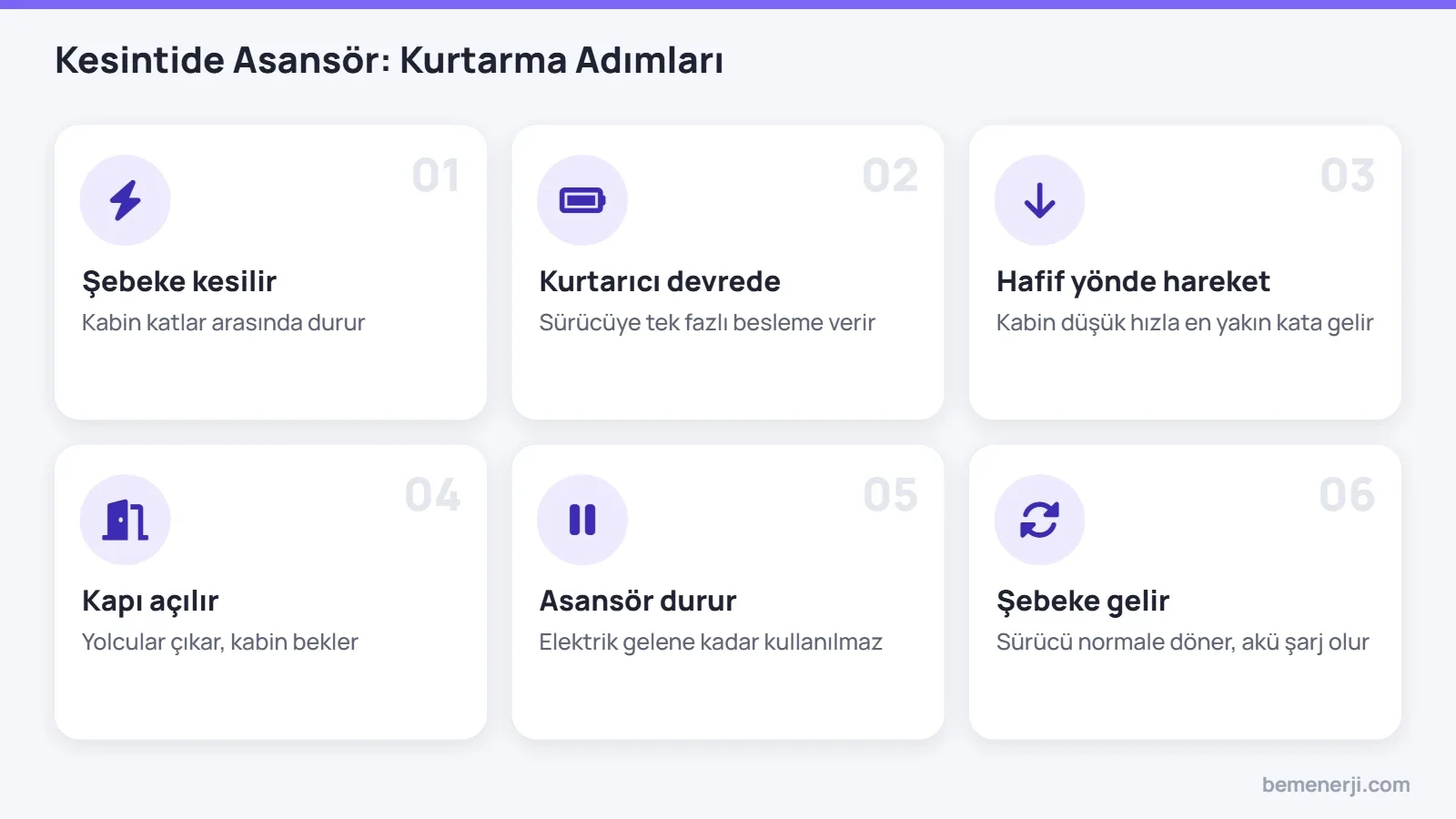
- VVVF (variable-frequency drive) elevator: This is the simplest type of rescue system. The rescue device supplies single-phase voltage to the elevator, and the elevator carries the car in the direction of least resistance (a full car goes down, an empty car goes up) at a low speed to the nearest floor. Nearly all new buildings use this type of system.
- Hydraulic elevator: The cabin rises using a pump and descends under its own weight. There is no need to start the engine for rescue; a small mechanism that operates the descent valve and the door is sufficient. A pump is needed only if the cabin is stuck on the lower level and the upper level is required—which is rare.
- Two fast vintage motorcycles: Since there is no drive unit, the rescue device must drive the motor directly; this cannot be applied to every elevator and must be evaluated in consultation with the elevator company. In elevators of this type, drive unit modernization often takes precedence over the rescue system.
What Loads Are in the Elevator During a Power Outage?
The loads not involved in the rescue maneuver are small: the control panel and the driver’s control circuit, the door motor, the cabin lighting, the emergency phone, and the intercom. Their total power consumption ranges from 150 to 400 W in most elevators. The main determining factors are the power drawn by the motor during light-load operation and the current at startup; these values depend on the motor power, the car’s balance, and the speed limit of the drive in rescue mode. The manufacturer of the rescue device specifies a model based on the motor power; one cannot generalize by saying, “1.5 kVA is sufficient for every elevator,” as the rescue device for a 15 kW motor is different.
In-cab emergency lighting and emergency communication systems are already required and come with their own small batteries; a rescue system or UPS does not replace these and should be considered separately. If the alarm sounds during a power outage but no one hears it, the problem lies not with the elevator but with the destination of the communication signal; the building’s intercom power supply UPS for intercoms and doorphones We discussed this in our article.
Time Target
In a backup system, time is measured in maneuvers rather than minutes: bringing the car to a floor at the moment of a power outage is one maneuver; a second is required when the power comes back on and then goes out again. The battery allocated for a few maneuvers is sufficient; that is why the battery bank is small. In a UPS that keeps the elevator running, however, the goal is to cover the time until the generator kicks in—or 15–30 minutes if there is no generator. A longer runtime would rapidly increase battery costs; in a building with a generator, the UPS merely bridges the transfer gap and the few minutes during the outage. How the generator and UPS share the load The Difference Between a UPS and a Generator We explained this in our article.
Installation and Commissioning
The rescue device is installed next to the elevator control panel, in the machine room, or—in elevators without a machine room—on the panel at the top of the shaft. Two factors are important here. First is temperature: in the machine room, temperatures can exceed 40 °C under the roof in the summer, causing the battery life to decrease rapidly; the device should be placed in as cool a location as possible, and the shaft ventilation should be kept open. Second, the connection must be made in coordination with the elevator company: the driver’s rescue mode parameters, door-opening authorization, and floor detection must be configured to be compatible with the rescue device. Connecting the rescue device without notifying the elevator company may result in the car getting stuck between floors at the first power outage; furthermore, this modification must be documented during periodic inspections.
A full power-outage test must be performed during commissioning: the power is cut off, the car is observed to reach the floor and open the door, and then power is restored to verify that the elevator returns to normal operation. This test must be repeated once a year as part of the elevator’s periodic inspection. If the battery is left unchecked for three years, it will not function when it is most needed during a rescue situation; reasons why UPS systems fail to operate during a power outage The UPS isn't turning on We've compiled them in this article.
If There Is a Generator, Is a Backup System Necessary?
It takes 10–30 seconds for the generator to kick in, and by that time the elevator has already come to a stop; once the generator starts, most elevators resume operation from where they left off. In other words, the time spent stranded in a building with a generator is short, but not zero: if the generator fails, runs out of fuel, or the elevator circuit isn’t connected to the generator panel, the car will remain stationary. The rescue system bridges this gap and is much cheaper than a generator; the two solutions are not alternatives but rather complementary. In residential buildings and office towers, both are typically found together; details UPS in residential and smart buildings in his article.
What Does the Legal Framework Say?
During periodic inspections of elevators, bringing the car to a floor in the event of a power outage and evaluating the rescue system are among the topics covered; since regulations are updated from time to time, it is best to check with your elevator company and review the latest periodic inspection report to determine which provisions apply to your building. From a management perspective, the practical rule is as follows: if people are left in the car during a power outage and a solution exists but has not been implemented, the responsibility lies with the building management. The rescue system is the most cost-effective way to fulfill this responsibility.
Common Mistakes
- Buying a small UPS and hoping the elevator will keep running; the driver overloads the UPS when starting up, and the car gets stuck between floors again.
- Connecting the rescue device without notifying the elevator company; rescue mode will not work because the driver parameters have not been configured.
- If you place the device in a machine room exposed to sunlight and never check the battery, it will remain silent during a power outage in the third year.
- Do not perform a shutdown test during commissioning; consider the installation to be commissioned.
- Don’t forget that just because the cabin emergency lighting and the phone’s battery backup system have been installed, they still require separate maintenance.
- Trying to share a single rescuer among multiple elevators; each elevator has its own driver and its own equipment.
During the site survey, the drive and motor specifications are reviewed to determine the appropriate solution for the elevator type in your building; Pre-installation technical survey In that article, we explained what was being asked. For setup and installation, UPS Installation and Setup You can access it from the page.
What does the rescue system do and what doesn't it do?

Frequently Asked Questions
01Does the elevator UPS keep the elevator running continuously?
02How many kVA are required for an elevator?
03Can a hydraulic elevator have a rescue system?
04Is a rescue system required by law?
05If there is a generator, is a backup system necessary?
Does Your Elevator Stop at Your Floor During a Power Outage?
Let’s work together to identify the rescue system compatible with your elevator’s drive type or the UPS solution that will provide continuous power to the elevator; for on-site installation in Istanbul and surrounding provinces, commissioning in collaboration with your elevator company, and annual rescue system testing Contact Us.