


Differences Between Transformered and Transformerless UPS

When you see the phrase "transformerless" or "transformerless" in UPS catalogs, you may think that this is just a detail about weight and size. However, whether there is a transformer at the inverter output; It directly affects efficiency, short circuit behavior, insulation options, installation space and total operating cost. A UPS selected with the wrong assumption can lead to either unnecessary energy loss or lack of the needed insulation.
In this article, you will find out how the two designs work, where they really differ, and where there are common misconceptions. We will quantify the difference in efficiency with an example calculation, explain the relationship of galvanic isolation to the transformer, and give selection criteria according to the type of plant.
Article; It was written for business owners, technical officers, purchasing units and engineers who prepare UPS specifications. Home and small office users can also see where their needs stand in this discussion from the first sections.
What does UPS with and without transformer mean?
The distinction between "transformer" or "transformerless" in UPSs is mostly used in double-conversion (online) UPSs. inverter (the part that converts DC voltage to AC) tells whether there is a power transformer at the output. In the transformer design, the inverter output is given to the load through a transformer. In the transformerless design, the inverter generates the load voltage directly from the high-voltage DC bus.
The historical reason for this distinction is simple. The semiconductors used in older designs could not easily carry high voltages; the inverter operated with a low DC voltage, and a transformer was required to increase the output voltage to the appropriate level for the load. When power transistors called IGBTs could safely switch at high voltage, the need for a transformer to step up the voltage was eliminated. This point is also emphasized in ABB's technical publication: one of the main tasks of the transformer was to increase the output voltage, and the inverter with IGBT removed this necessity.
Let's separate two confusions from the beginning here:
- "Transformer" in small UPSs: Line-interactive type devices have an automatic voltage regulation (AVR) transformer that raises and lowers voltage. This is a different part from the inverter output transformer in a double conversion UPS. For type differences online, line-interactive and offline UPS comparison You can look at it.
- Transformer = isolation assumption: The sentence "UPS with transformer has galvanic isolation" is partially true and needs detail; it is covered in a separate section below.
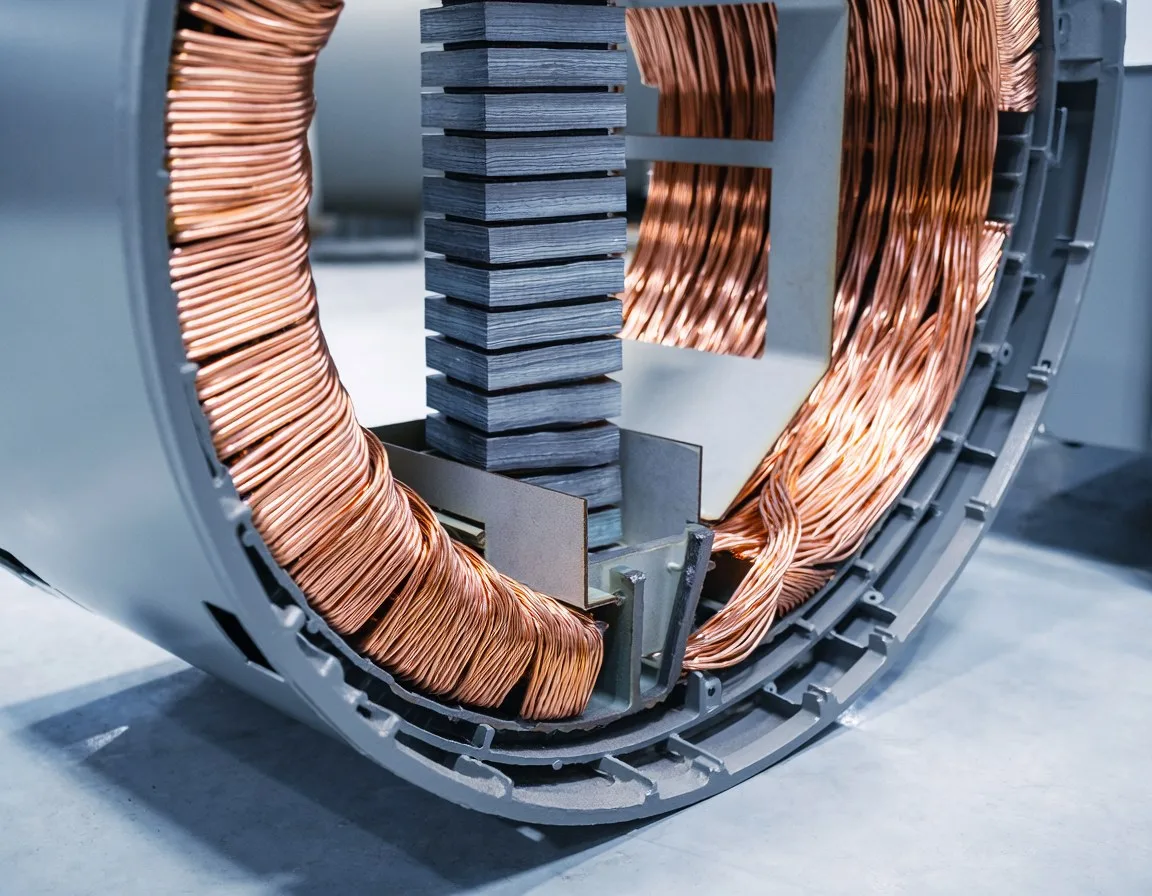
How does a transformer UPS work?
The basic flow of a double conversion UPS is: the mains AC is converted to DC at the rectifier, the batteries are fed through the DC bus, and the inverter converts the DC back to a clean AC. (For basic operating logic How UPS works You can take a look at our article.) In the transformer model, an inverter output transformer is added to this chain. Some designs also have a transformer at the entrance.
The practical contributions of the transformer within the UPS include:
- Voltage adaptation: It is used to obtain the appropriate output voltage for the load from low DC bus voltage.
- Fault current capacity: Thanks to its output impedance, it can generate high current in short circuits at the output and help protection devices (fuses, switches) to open selectively. For short circuit and selectivity Short circuit and selectivity in UPS output gives details.
- Barrier against DC component: If the inverter fails and leaks a DC component to the output, the transformer naturally prevents this DC from reaching the load.
- Neutral separation: The secondary side of the transformer allows to establish a separate neutral reference. This works well in facilities with a complex layout of ground and neutral.
The cost is weight, volume, transformer losses (copper and core losses), heat and generally higher initial investment. While Riello's technical publication emphasizes the robustness and insulation aspect of transformer design, Emerson's publication states that transformer design can still provide a continuity advantage in high-power critical facilities; that is, the debate does not proceed over a single winner under all circumstances.
How does a transformerless UPS work?
In a transformerless UPS, the rectifier and inverter work as IGBT-based high-frequency power inverters. The output is taken directly from the inverter, no heavy transformers and large filter elements are required. Many designs have an additional DC-DC inverter that precisely manages the DC bus and batteries; this makes battery charging more controlled and the DC line less fluctuating. ABB describes this as an advantage in terms of battery life, but the actual battery life depends on many factors such as temperature, number of cycles and maintenance (see Table 1). Factors Affecting Battery Life).
Typical features of transformerless design:
- Lighter and more compact body; manufacturers state that at high powers, the weight is significantly reduced compared to the old design.
- Higher double conversion efficiency and lower heat loss.
- Thanks to the IGBT rectifier, low harmonic (THDi) and high input power factor (see Table of Materials) What is harmonics, its effect on UPS and generator).
- Fast dynamic response to load variations; electronic control over output voltage.
- Suitability for modular structure; capacity and redundancy can be gradually enlarged (see Table 1). Modular UPS).
The aspect of transformerless design that requires attention is that there is no transformer barrier between the inverter and the output. For this reason, manufacturers use DC component detection and fast cutoff circuits, i.e. electronic protection. According to Rehlko's technical explanation, in well-designed transformerless systems, this protection is designed redundantly and the probability of the DC component reaching the output is reduced to very low in practice.
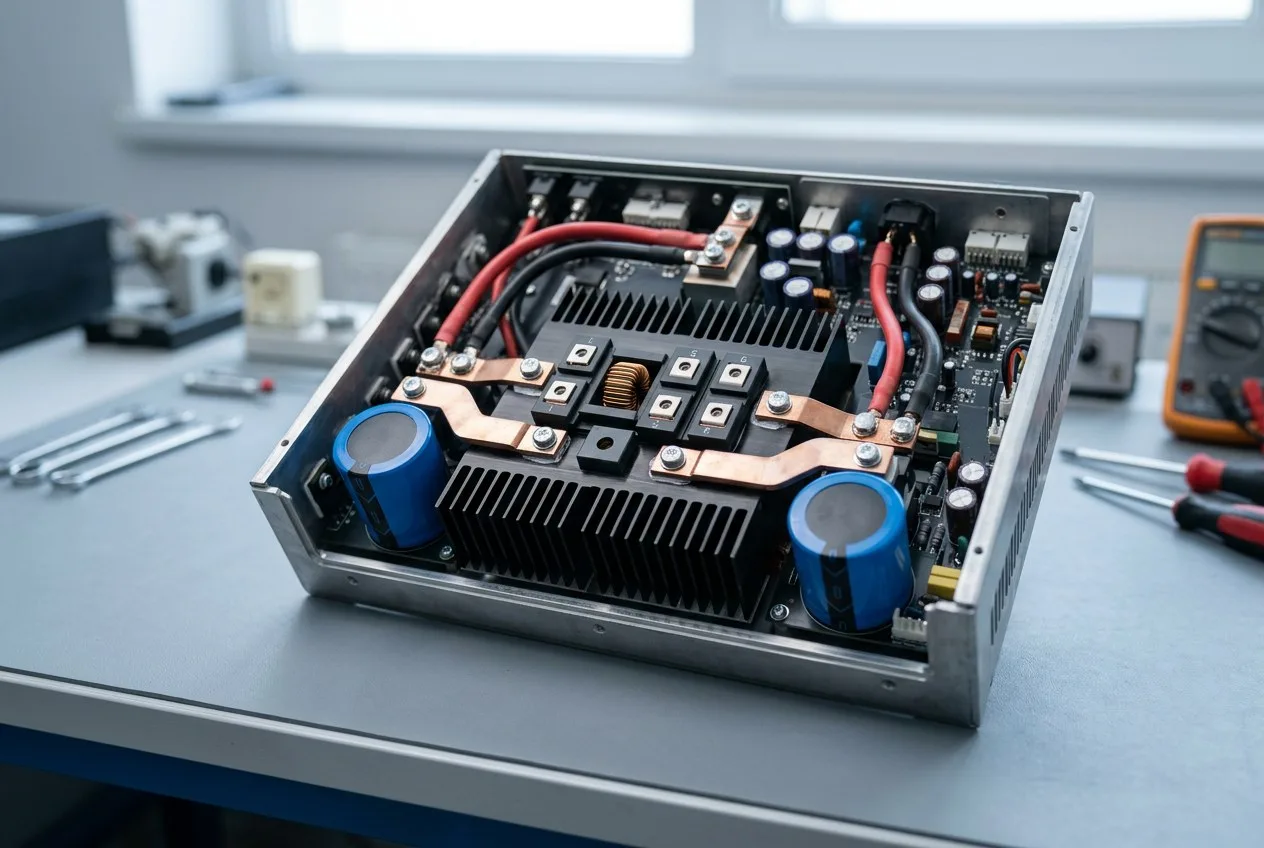
UPS comparison table with and without transformer
The table below summarizes the general trends. Values vary by design, power class, and manufacturer; the specific model's datasheet should be consulted for exact figures.
| By | UPS with Transformer | Transformerless UPS |
|---|---|---|
| Double conversion efficiency | Usually a few percentage points lower due to transformer losses (typically 90-93% band in sources) | Usually higher (typically 92-97% band at welds) |
| Weight and footprint | Heavier and larger; ground loading and transportation plan is important | Lighter and more compact; more flexible layout |
| Galvanic isolation | The inverter output transformer forms a separate circuit zone; however, the bypass line must also be addressed for complete isolation | No natural insulation; if necessary, external isolation transformer is added |
| DC component protection | The transformer physically prevents the DC from switching to the output | Relies on electronic protection circuits |
| Short circuit and overload resistance | Usually stronger | Dependent on electronic current limitation; generally more limited |
| Input harmonic | Depending on the type of rectifier; may be high on old thyristor rectifiers | Low THDi and high input power factor with IGBT rectifier |
| Dynamic response | The transformer can slow down the response somewhat | Usually fast |
| Initial investment | Due to more materials and assembly work, it is usually high | Usually lower |
| Heat and cooling load | More loss, more heat | Less loss, less heat |
What is galvanic isolation, does the transformer always provide it?
Galvanic isolation, the ability of two circuits to transfer energy without being electrically directly connected. Isolation transformer is the classic way to do this. The benefits of isolation include reducing common-mode noise, decoupling erroneous ground references, and redefining the neutral on the load side.
A common misconception is to think that every transformer UPS completely isolates the load from the grid. As emphasized in Rehlko's publication, the use of a transformer does not automatically mean full galvanic isolation. The UPS has three separate isolation issues: the isolation between the input and the output, the isolation between the grid and the battery, and the isolation between the DC circuit and the output. Since the bypass line is a separate path, when the UPS passes through the bypass, the load is directly connected to the grid and the insulation provided by the inverter transformer is disabled. If you want complete isolation, it may be necessary to add a separate transformer to the bypass line (for the concept of bypass, Static and maintenance bypass See the article).
If there is a need for isolation in a transformerless UPS, an external isolation transformer is placed at the input, bypass or output as a solution. Fuji Electric's technical guide states that in this case, the total efficiency decreases by at least 2-3%; Riello reminds that the external transformer can also have a negative effect on dynamic response and output voltage regulation. APC's publication on isolation transformers discusses that it may be more flexible to position the transformer at the point where it is needed (e.g. on the load distribution side) rather than in the UPS. In other words, the real question is not "should there be a transformer", but "at what point and why is isolation necessary".
If you have sensitive devices that have problems with electrical noise, it is necessary to first measure whether the problem is really common mode noise. Details of the issue EMI/RFI and its impact on sensitive devices It is explained in the article; for the grounding side UPS grounding The text is also useful.

How much money and energy is the yield difference actually worth?
It's easy to see the yield difference as a percentage, and to see it as a kilowatt-hour makes it easier to make a decision. The example below is purely hypothetical and is only to illustrate how to do the calculation.
Assumptions: A UPS with 40 kVA with an output power factor of 0.9; load 36 kW constant; The UPS operates in double conversion throughout the year (8,760 hours). The efficiency of the model with transformer at this load level is 91%, and the efficiency of the model without transformer is 94%.
| Step | Transformer (91%) | Without transformer (94%) |
|---|---|---|
| Input power (36 kW ÷ efficiency) | ≈ 39.6 kW | ≈ 38.3 kW |
| UPS loss (input − 36 kW) | ≈ 3.6 kW | ≈ 2.3 kW |
| Annual energy loss (lost × 8,760 hours) | ≈ 31,000 kWh | ≈ 20,000 kWh |
The difference is approximately 1.3 kW; it is approximately 11,000 kWh annually. Since this energy is also converted into heat, it means additional cooling load in a closed UPS room. You can find the annual cost difference by multiplying the unit electricity price by your own tariff; the official announcements of your distribution company and EMRA should be checked for current tariffs.
Let's also take into account the external isolation transformer. Suppose an isolation transformer with 98% efficiency is added to the front or back of the UPS without a transformer. The total efficiency is approximately 0.94 × 0.98 ≈ 92%. In other words, the efficiency advantage of the transformerless model is greatly reduced, but not completely lost. If isolation is really necessary, this comparison should be made between "UPS with transformer" and "UPS without transformer + external transformer", not with UPS without bare transformer.
Manufacturers emphasize efficiency at full load; whereas in real plants, the UPS is often loaded at 30-60%. In this region, the efficiency curve may be different and the idle losses of the transformer (core losses) become more pronounced. So make the comparison with the efficiency values at your actual load level. High efficiency operating modes such as ECO mode also change this calculation; for the pros and cons of this ECO mode on UPS You can check the article. For a broader cost framework UPS efficiency and total cost of ownership The article is useful.
Fault behavior: DC component, short circuit and overload
The most important technical distinction of transformer and transformerless design is the behavior at the time of failure.
DC component risk
If an IGBT in the inverter does not transmit, the output waveform loses its symmetry and a DC component can form at the output. In a transformer-based UPS, the transformer physically prevents this DC from passing to the load. A transformerless UPS has electronic protection at the output that detects the DC component, quickly disables the inverter, and bypasses the load. Manufacturers such as Eaton and Rehlko argue that this protection is redundant and fast; manufacturers such as Riello, which emphasize the transformer design, emphasize that the physical barrier is redundant and valid in all conditions. Both views are technically reasonable; the choice depends on the risk tolerance and redundancy architecture of the facility.
Short circuit and selectivity
In a short circuit at the output, the lower protection element (fuse, switch) must be able to open before the UPS. UPSs with transformers can generally give higher and longer-lasting fault currents. The inverter output of a transformerless UPS electronically limits current; in a short circuit, the load is mostly met by transferring it to the grid via static bypass. The fault current capacity of the bypass line is therefore a critical design data.
Inrush current and overload
Loads such as motors, compressors, air conditioners, and laser printers can draw several times the rated current on the first start. The overload resistance of a UPS with a transformer is usually advantageous in such short-term current pulses; however, it varies by power class and manufacturer. Whether such loads can be connected to the UPS is a separate sizing issue; Details Inrush current problem of motors, air conditioners and laser printers in his article.
| Fault / condition | Typical behavior in a UPS with a transformer | Typical behavior in a transformerless UPS |
|---|---|---|
| DC component formation in the inverter | Transformer blocks DC | Electronic protection cuts off the inverter, the load passes to the bypass |
| Short circuit at the output | Higher fault current possible; protection selectivity can be facilitated | Current is limited; bypass line and switch selection becomes important |
| High load with inrush current | Generally more tolerant | The inverter current limit is decisive; sizing allowance may be required |
| When the load passes to the grid by bypass | The insulation of the inverter transformer is not activated | The same is true; isolation depends on external transformer |
Input side: harmonic, power factor and generator match
Regardless of whether it is with or without a transformer, the rectifier type of the UPS determines the quality of the current drawn from the mains. Old 6-pulse thyristor rectifiers can produce high current harmonics; 12-pulse rectifiers reduce this; IGBT-based rectifiers, on the other hand, keep the harmonic very low and bring the input power factor closer to each other. In the sources, it is stated that the THDi value of thyristor rectifiers can reach serious levels for systems with transformers, while it can remain at low levels in systems with IGBT rectifiers. The important thing is not whether the UPS has a "transformer", but the technology of the rectifier.
This difference produces real results in facilities with generators. High harmonic and low input power factor may cause the generator to be selected larger than necessary or cause voltage distortions. If the generator and UPS are to work together, frequency, voltage and synchronization issues generator powered UPS From his article, the general relationship Differences between UPS and generators You can review it in the article.
Does IEC 62040-3 classification determine transformer?
The international standard that defines UPS performance is IEC 62040-3. The standard classifies the UPS based on input dependency (VFD, VI, VFI), output waveform, and dynamic output performance. As stated in the standard citations published by ENERGY STAR, this classification is performance-based and does not exclude any technology or topology. In other words, the standard does not say "must be transformered" or "must be transformerless"; it defines the requirement in terms of output performance.
This gives an important clue when writing a specification: it is healthier to express the need in performance language (VFI class, dynamic performance class, isolation requirement, short circuit capacity, efficiency values and measurement conditions) instead of writing "UPS with transformer" in the specification. For general framework about standards and documents UPS standards and certifications You can look at the article.
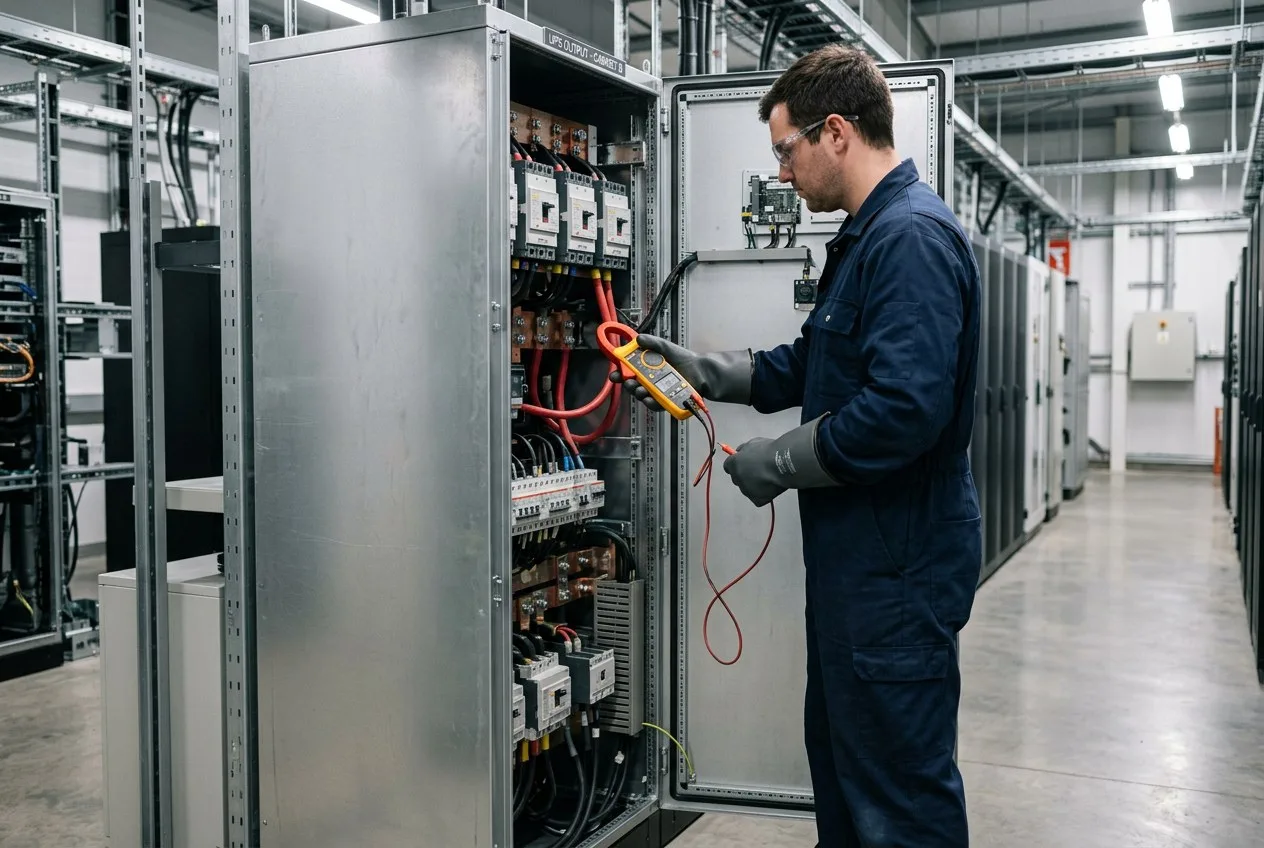
Which plant has which? Selection criteria
The table below is not a definitive judgment but a guide for the initial screening. The final decision should be validated by the plant's electrical project, load analysis, and manufacturer data.
| Scenario | Often the featured option | Cause |
|---|---|---|
| Home, small office, camera and network devices | Standard small power UPS; transformer discussion usually not required | Loads are light and sensitivity is low; power and battery time determine the choice |
| Server room, office floor, IT loads | Transformer-free, high-efficiency online UPS | Efficiency, compact size and low harmonic stand out |
| Data center (medium/large power) | Modular structure, mostly without transformers; redundancy design decisive | Scalability and throughput; redundancy comes from architecture such as N+1, 2N |
| Factory, hard loads, engine starts | Transformer or industrial grade UPS | Overload, short circuit resistance and harsh environment tolerance |
| Loads required for medical imaging, laboratory, isolation | UPS with transformer or UPS without transformer + isolation transformer | The need for separate neutral/grounding and insulation depends on the device manufacturer's condition |
| Critical line where dual source feeding is required | It depends on the architecture; also a static transfer switch can be considered | Continuity and resource separation are designed independently of the UPS topology |
The concept of "industrial UPS" also comes to the fore for factory and heavy load conditions; why transformer design is common in this class Differences between industrial UPS and commercial UPS You can find it in the article. For the device that selects the source in dual-source feeding static transfer switch (STS) can be read.
Questions to ask before buying
When collecting offers, it is not enough to just ask "with or without transformer". The following questions make the real difference between the designs visible:
- Is isolation necessary? Does the device manufacturer require a grounding system (TN, TT, IT) or galvanic isolation as a project requirement? If so, is the bypass line included?
- At what load and under what conditions was the yield given? Ask for efficiency values at 25%, 50%, 75% and 100% load; check if the measurement method is compatible with the standard.
- What is short circuit and overload capacity? Time-current information should be obtained for the inverter and bypass line; selectivity should be verified with protections in the lower distribution.
- How is the input current character? Rectifier type, THDi and input power factor should be given according to the load level; if there is a generator, compatibility should be checked with this data.
- Are the weights and dimensions suitable for the floor and door? In models with transformers, ground load, transport and placement should be planned separately (see. UPS handling, placement and mechanical assembly).
- What is the heat load? Efficiency loss converts into heat in kW; it must be added to ventilation or air conditioning capacity.
- What is maintenance and life expectancy? Components such as transformers, fans, capacitors, and batteries have different lifespans (see Table 1). UPS lifespan and life-determining components).
Common mistakes
- The assumption that "if there is a transformer, the noise problem is solved": Recommending a transformer without measuring the source and path of the noise may lead to wrong investment. Power quality measurement should be done first (see Table 1). Power Quality Measurement and Analysis).
- Reading the throughput only from the full load value: The actual operating load is usually lower; the yield curve at different load levels must be compared.
- Not accounting for external isolation transformer: Adding a transformer to a transformerless UPS later changes the efficiency, location and cost items.
- Overlooking short-circuit selectivity: It should be checked whether the lower switches at the UPS output are opened with the fault current that the UPS can give.
- Deciding according to one criterion: Price, efficiency, insulation, weight and service access must be weighed together.
- Intervention by the user: The high DC bus voltage, battery energy and transformer area of the UPS may pose a fatal risk. Cover opening, measurement, connection and repair works should be carried out by authorized electrical personnel or authorized technical service in accordance with occupational safety rules.

Differences in terms of maintenance and service
In a transformer-based design, the transformer contains no moving parts, which usually requires regular maintenance; however, heat, vibration, connection tightness, and winding temperature must be monitored. In a transformerless design, high-frequency power electronics, fans, and DC bus capacitors approach the center of gravity of the maintenance plan. Thermal imager checks can show loose connections and overheating spots early in both designs (see Table 1). Thermal camera control in UPS maintenance).
In practice, the following control heads are valid in both designs: measurement of input-output voltages and currents, bypass transient test, battery voltages and test results, fan and capacitor status, examination of alarm records. When determining the maintenance period and content UPS maintenance checklist and Maintenance frequency and plan You can benefit from his articles.
The transformer may not only be the part inside the UPS; in some facilities, there is a separate transformer at the UPS input, output or distribution side. When calling for service, in addition to the brand and model of the UPS, informing the external transformer, bypass diagram and protection elements in the system shortens the response time (see Table 1). UPS technical service process).
Transformer decision in capacity increase and renewal projects
When renewing a UPS with an old transformer, it is often recommended that the new model be without a transformer; it can really provide advantages in terms of efficiency, size and harmonics. However, the existing installation does not always accept this transition directly. The insulation, neutral arrangement or short circuit selectivity provided by the old transformer may behave differently in the new UPS. Therefore, the following checks should be made in renovation projects: the source of the existing insulation requirement, the grounding type of the output neutral, the capacity of the bypass line, the current cable and switch values and the floor-room conditions. For other topics to be considered in renovation UPS capacity expansion and refurbishment projects can be a guide.
Note that the distribution on the output side, for example, has a PDU's It is also important whether it has its own transformer or not. In some installations, the need for insulation and neutrality is solved on the PDU floor, not in the UPS; in this case, it would be a double investment to buy a separate transformer for the UPS.
A short roadmap for making a decision
- Extract the power, power factor, and inrush current characteristics of your loads.
- Clarify whether insulation, separate neutral or special grounding is required with the device manufacturers' documentation and electrical project.
- Identify architectural elements such as generators, second sources, or STS.
- Compare the efficiency, heat loss, and weight at your load level for each candidate UPS.
- Verify short-circuit, overload, and bypass capacities with your protection system.
- Purchase price; Evaluate it together with the total cost of ownership, including energy, cooling, battery renewal and maintenance.
The result is usually as follows: if there is no need for isolation and the loads are not excessively harsh, the transformerless design offers efficiency and space advantages; if there is isolation, high fault current or hard load conditions, a design with a transformer or an external transformer planned with a transformerless UPS is more suitable. In both cases, on-site discovery and measurement shows which option suits your facility.

Determine the right UPS configuration with Bempower
It is safest to decide on UPS with or without transformer, not with catalog information, but with load analysis and facility conditions. Bempower offers discovery, installation, periodic maintenance and technical service for all brands of UPS, battery packs and inverters on-site in Istanbul and surrounding provinces. If you want to talk about your needs for the renewal of your existing UPS or a new critical line from the contact page You can contact us.
- Advantages of a Transformer-Based UPS System (White Paper) — Riello UPS, 2018. https://www.riello-ups.com/uploads/file/288/2288/Advantages_of_a_Transformer-Based_UPS_White_Paper.pdf
- Isolation in a UPS system — Rehlko (Kohler Uninterruptible Power), 2019. https://www.ups.rehlko.ie/isolation-in-a-ups-system-ups-voltage-regulation/
- UPS design: Transformer-free vs. transformer-based (Power protection) — ABB, 2017. https://power-backup.ro/wp-content/uploads/2018/04/Transformer_Less.pdf
- The Role of Isolation Transformers in Data Center UPS Systems (White Paper 98) — APC by Schneider Electric, 2011. https://www.insight.com/content/dam/insight/en_US/pdfs/apc/apc-role-of-isolation-transformaers-in-data-center-ups-systems.pdf
- IEC 62040-3:2021 Uninterruptible power systems (UPS) - Part 3: Method of specifying the performance and test requirements — IEC (iTeh Standards catalog), 2021. https://standards.iteh.ai/catalog/standards/iec/3bf25b13-d57a-4501-a468-db74ebc2011e/iec-62040-3-2021
- Appendix B: Excerpts From Draft IEC Standard 62040-3 Ed. 2.0 FDIS — ENERGY STAR, 2010. https://www.energystar.gov/sites/default/files/specs/private/UPS_Final_Draft_Test_Method_Appendix_B_IEC62040_FDIS_Excerpts.pdf
Resources
