


Difference Between MPPT and PWM Charge Controllers: Which One Should You Choose?

The charge controller between the solar panel and the battery looks like a small box, but it directly affects how much energy the system harvests and how many years the battery lasts. The controllers on the market fall into two technologies: PWM (pulse width modulation) and MPPT (maximum power point tracking). Both protect the battery from overcharging. However, the way they transfer the energy taken from the panel to the battery is very different. This difference can mean getting a case and a half of energy instead of one case from the same panel.
In this guide, we explain step by step, with calculations, how the two technologies work, how much difference they make under which conditions, and how to match the controller with the panel array. It is written for home users, business owners, technical managers, and purchasing departments who set up battery-based systems such as caravans, boats, country houses, telecom sites, or camera sites. We do not recommend brands or models; we provide the selection criteria.
Note: The figures below are typical ranges. Always work with the values in the manufacturer's datasheet for the panel and the controller. Since the DC side is high-voltage and live as long as the sun is up, leave connection and commissioning work to authorized personnel.
What does a charge controller do, and why is it necessary?
If a solar panel is connected directly to a battery, the battery voltage rises uncontrolled, the battery overcharges, and its life is shortened. At night, problems such as current flowing back into the panel can occur. The charge controller sits between the panel and the battery and does three basic jobs: it limits the charge current according to the battery voltage, manages the charging stages (bulk, absorption, float), and protects the battery from reverse current. For the overall structure of the system, you can see the article explaining the chain of panel, inverter, charge control, and battery in a solar energy system Details of the charging stages are covered in the battery charging settings guide .
The difference between PWM and MPPT emerges in the energy transfer part of this task. Let's look at the two methods one by one.
How does a PWM charge controller work?
A PWM controller contains a fast-switching electronic switch. The controller connects the panel almost directly to the battery. As the battery approaches full charge, it reduces the average current by opening and closing the switch at short intervals. In this method, the panel is forced to operate at a point slightly above the battery voltage. In other words, the panel adapts not to its own efficient operating voltage but to the battery's current voltage. In the patent literature, such devices are described as non-MPPT controllers that connect the PV array directly to the battery bank for charging .
This design is simple, inexpensive, and robust. Because there is no converter circuit, heating is low. However, if the panel voltage is significantly higher than the battery voltage, the difference cannot be used.
How does an MPPT charge controller work?
An MPPT controller has a DC-DC converter (mostly a step-down, or buck, type) and a tracking algorithm. On the panel's current-voltage curve, the point where power (V × A) is highest, that is, the maximum power point, constantly shifts with irradiance and temperature. The controller searches for this point, runs the panel at that voltage, and steps it down to the battery voltage at the output. Because the voltage drops, the same power turns into a higher current. A patent description summarizes this approach as follows: The MPPT controller manages the voltage mismatch between the PV array and the battery bank with power electronics. The algorithm requires no user setting and works automatically throughout the day.
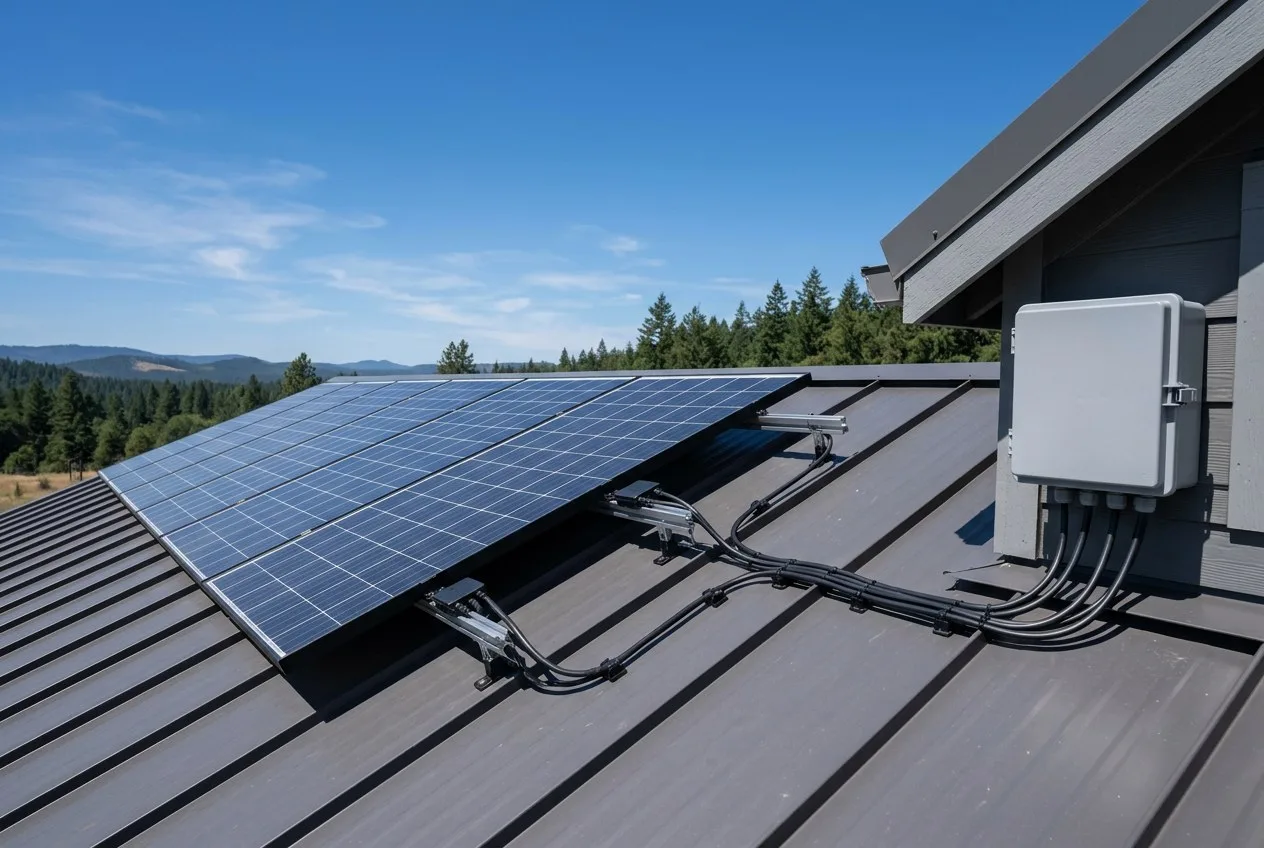
How many watts can be obtained from the same panel? Step-by-step example calculation
A simple numerical example shows the difference best. The values below are assumptions and do not belong to a real product.
Assumptions: 12 V battery, a 100 W 36-cell panel, panel maximum power point voltage Vmp = 18 V, current Imp = 5.5 A (18 × 5.5 ≈ 100 W). Battery voltage during charging is about 13.5 V. MPPT conversion efficiency is assumed to be 96 percent.
- PWM: The panel is pulled down to 13.5 V. The current stays roughly equal to Imp (5.5 A). The transferred power is 13.5 × 5.5 ≈ 74 W.
- MPPT: The panel operates at 18 V, and the power is 100 W. After conversion loss, 100 × 0.96 = 96 W goes to the battery. The battery-side current is 96 ÷ 13.5 ≈ 7.1 A.
- Difference: 96 − 74 = 22 W, that is, about 30 percent more power than PWM.
In a similar calculation in manufacturer documents, the power drawn from the panel with PWM was found as the product of current and voltage and was calculated as 81 W, 19 percent below the 100 W obtained with MPPT. In our example the ratio came out a bit higher, because the battery voltage we chose was low. The lower the battery voltage (for example, when the battery is discharged), the greater the PWM loss.
This calculation tells us two things: the source of the loss is not the "inefficiency" of the device but the mismatch between the panel voltage and the battery voltage. The closer the panel's operating voltage is to the battery voltage, the smaller the difference.
MPPT vs. PWM comparison: which is ahead in which feature?
| Criterion | PWM | MPPT |
|---|---|---|
| Panel voltage | Must match the battery voltage (such as a nominal 12 V panel for a 12 V battery) | An array with a much higher voltage than the battery can be used (up to the controller's input limit) |
| Energy transfer | Panel is forced to the battery voltage; excess voltage cannot be used | Excess voltage is converted into additional current |
| Cold and cloudy weather | Cannot benefit from high panel voltage | The difference is most pronounced here |
| Very hot weather | Panel voltage drops, but it still works | The advantage shrinks and in some cases disappears |
| Cable cross-section | High current on the panel side requires thick cables | A high-voltage series array keeps the panel-side current low |
| Expansion flexibility | Limited; panels must match the battery voltage | Series-parallel configuration is more flexible |
| Charge profile setting | Limited in basic models | Generally programmable (including lithium) |
| Cost and complexity | Low, simple | High, requires sizing calculations |
Figures on the internet vary over a very wide range. One manufacturer states that MPPT increases energy harvest compared with PWM by between 5 and 30 percent depending on the climate . Another manufacturer claims up to 30 percent more energy than PWM for its fast tracking algorithm. Such percentages depend on the manufacturer's test conditions. In a small-scale experiment published in a peer-reviewed journal (30 W panel, 12 V 18 Ah battery), the average efficiency of MPPT was higher than that of PWM, and efficiency of about 71 percent was measured for PWM and about 87 percent for MPPT . So the direction is consistent, but the gain at your site varies with temperature, panel type and battery voltage.
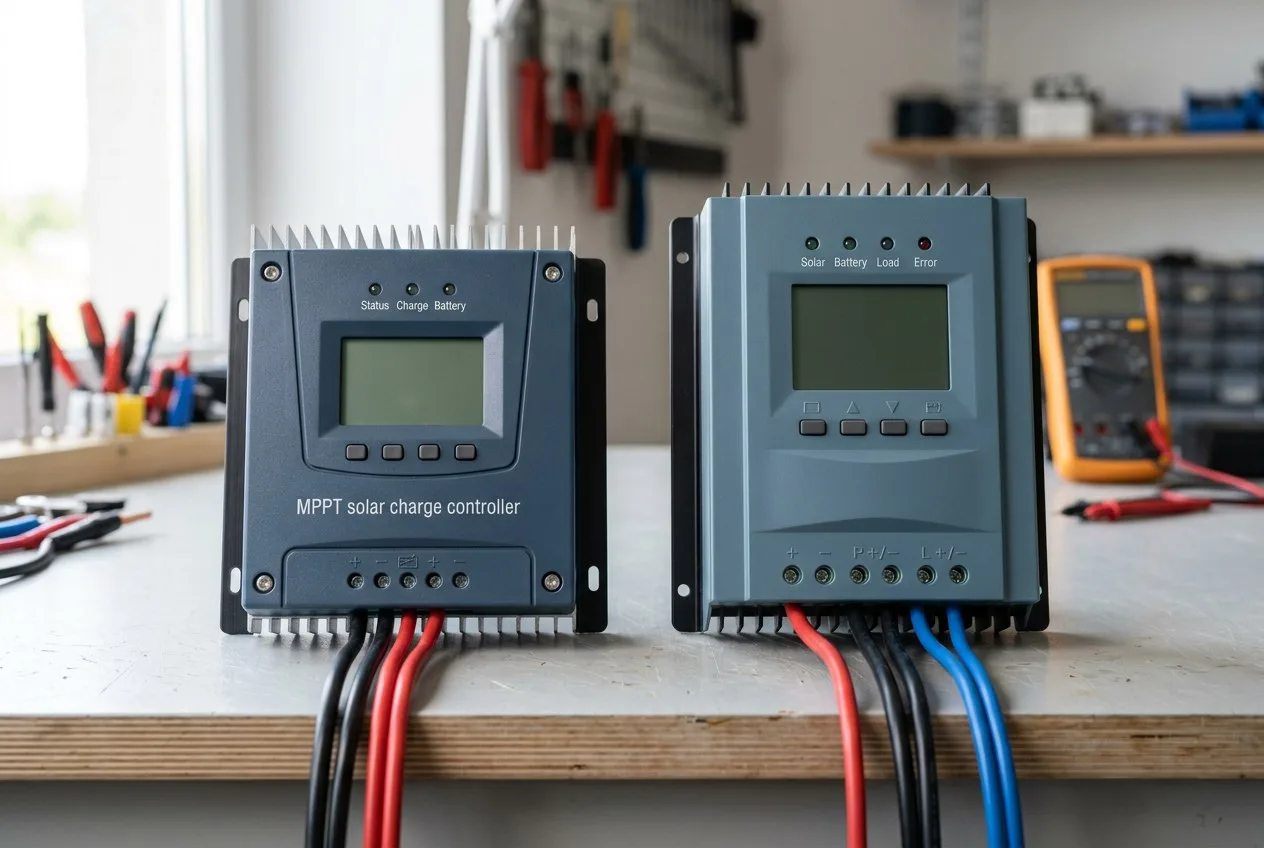
When does MPPT really make a difference?
In cold weather and low irradiance
In crystalline silicon panels, voltage rises as temperature falls. For MPPT this means "extra voltage"; the device converts that surplus into current. A manufacturer document summarizes it this way: MPPT tracks the rising Vmp and converts the excess voltage produced into additional charging current. Patent descriptions also state that the increase in charging current is generally greater as cell temperature drops . For this reason, the advantage of MPPT is clear in winter months, in high-altitude country houses and in overcast weather. For winter production expectations, the article on solar energy production in winter is also useful.

When the panel voltage is much higher than the battery voltage
Many panels on the market today have 60 or 72 cells and are designed for grid-connected systems. Their operating voltage is around 30-40 V. If you want to use these panels with a 12 V or 24 V battery, PWM is not a suitable option; MPPT is required. Morningstar's technical document recommends certain Vmp thresholds for PWM use, such as Vmp being above 15 V for 12 V systems and above 30 V for 24 V systems . These values show how tightly the panel voltage and battery voltage are linked in PWM.
The difference shrinks in hot climates
When a panel gets very hot, its operating voltage drops and approaches the battery voltage. In Victron's technical note, an example at a panel temperature of 75 °C shows that the difference between MPPT (77.5 W) and PWM (77 W) practically disappears . Morningstar also states that PWM is often preferred in very hot climates and that the gain MPPT would provide remains small. So the claim that "MPPT always gives 30 percent more" is misleading.
When is PWM a sufficient and sensible choice?
It is not right to dismiss PWM as "old technology." PWM can be a rational choice if the following conditions are met together:
- The panel power is small (e.g. from a few tens of watts up to about 200 W) and the charging current is low.
- The panel is chosen as a nominal type matching the battery voltage (such as a 36-cell panel with a 12 V battery).
- The system operates in a hot climate or is used in a sunny season (such as a summer house, cabin or garden lighting).
- The budget is limited and there is no expansion plan.
Morningstar also writes that in low-power (especially low-current) applications, PWM can achieve a harvest equal to or even better than MPPT. Victron's assessment is similar: PWM is a good low-cost solution for small systems where cell temperature and conditions are suitable."
On the other hand, the limit of PWM is clear: if the number of panels is increased, the panels must be connected in parallel, the current rises and the cable cross-section grows. It cannot be used with high-voltage (60/72-cell) panels. For this reason, in systems above 300-400 W, the price difference between PWM and MPPT often becomes meaningless next to the lost energy and cable cost.
How do you match a charge controller to a panel array?
The most common mistake when choosing an MPPT is looking only at "how many amps." In reality, three separate limits are checked: input voltage, charging current and power. For detailed matching, also see our article on charge controller selection and panel array compatibility Here we show the logic of the calculation.
Step 1: Calculate the open-circuit voltage (Voc) in the cold
Panel voltage rises as temperature falls; therefore the most dangerous moment is a cold, clear morning. If the device's maximum input voltage is exceeded, the device can be permanently damaged. The manufacturer's description also emphasizes that exceeding the input voltage range causes permanent damage to the device . The calculation formula is commonly used as follows: array Voc = panel Voc × number of panels in series × [1 + coefficient × (lowest temperature − 25 °C)]. The Voc temperature coefficient is negative and in crystalline silicon is typically between about −0.25 and −0.35 percent; the exact value is in the panel datasheet.
Example assumptions: Panel Voc = 40.5 V, Vmp = 33 V, Imp = 10 A, Isc = 10.6 A, power ≈ 330 W; Voc coefficient −0.30 %/°C. Two panels in series. Battery 24 V. Expected lowest temperature −5 °C. Candidate device: maximum input 100 V, rated charging current 30 A.
- Array Voc at STC = 2 × 40.5 = 81 V.
- Temperature difference = −5 − 25 = −30 °C; correction factor = 1 + (−0.003 × −30) = 1.09.
- Voc in the cold ≈ 81 × 1.09 ≈ 88 V.
- The device limit is 100 V; leaving a 10 percent margin gives 90 V. Since 88 V < 90 V it is suitable, but the margin is narrow. If your site is colder, a 150 V class device should be considered as a third option.
Note: This is only an example. In a real design, the panel's own coefficient and the site's historical lowest temperature should be used. In doubtful cases, consult the device manufacturer's calculation tool and datasheet.
Step 2: Check the start-up threshold
MPPT devices require the panel voltage to rise a certain amount above the battery voltage to start charging. In Victron's datasheet example, the PV voltage must rise 5 V above the battery voltage to start . Trying to charge a 24 V battery with a single 12 V nominal panel therefore causes problems. Since this threshold varies by manufacturer, check the value for your own model.
Step 3: Calculate the charging current and power
Let's continue with the same example. The array power is 2 × 330 = 660 W. If the battery voltage during charging is about 27 V and MPPT efficiency is assumed to be 96 percent, the charging current is 660 × 0.96 ÷ 27 ≈ 23.5 A. This value is below the 30 A rated current. Since the array Isc is 10.6 A, the device's maximum PV short-circuit current limit (in the datasheet) must also be checked. In some models, PV power above the device limit is handled by power limiting, but current and voltage limits are not "flexible."
| Check | What is measured? | Result in the example |
|---|---|---|
| Array Voc in the cold | Compared with the device's max. input voltage | ≈ 88 V; at the 100 V limit, narrow margin |
| Start-up voltage | Battery voltage + threshold value | Total Vmp 66 V; sufficient for a 24 V battery |
| Charging current | Array power × efficiency ÷ battery voltage | ≈ 23.5 A; below the 30 A device |
| Array short-circuit current | Compared with the device's max. PV current | 10.6 A (multiplies in a parallel array) |
| Battery voltage | 12/24/48 V supported by the device | 24 V; must be supported |
The choice of battery voltage directly affects charging current and cable cross-section; for details you can see the article on choosing between 12 V, 24 V and 48 V battery voltage for details.
Current, cable and safety: the hidden advantage of MPPT
A high-voltage series array carries the same power at lower current. Let's consider the same 660 W:
- On the panel side, with a series string (Vmp ≈ 66 V): 660 ÷ 66 = 10 A.
- In a 12 V system, when operating close to the battery voltage, as with PWM logic: 660 ÷ 12 = 55 A.
That is roughly a fivefold difference in current. As current rises, the cost of cable cross-section, fuses and terminal blocks, as well as heating and voltage drop, all increase. For cable calculations, the article DC cable cross-section and voltage drop includes examples.
On the other hand, high voltage also increases the safety risk. Series-connected panels can easily exceed 60-100 V. Because DC current, unlike AC, does not pass through zero, it is hard to extinguish an arc; a connector that is disconnected incorrectly can create an arc. Therefore:
- Protection devices such as the DC switch, fuse and surge protector must be selected to suit the project. The details of this topic are in DC fuse, switch and surge protection .
- Connections must be made in the order given in the manufacturer's manual. Generally the battery is connected first, then the panel; when disconnecting, the reverse order is followed.
- In daylight, the panel cables are live; no work should be done without covering the cable ends.
- Connections must be installed with insulated gloves and suitable equipment, by authorized electrical personnel.
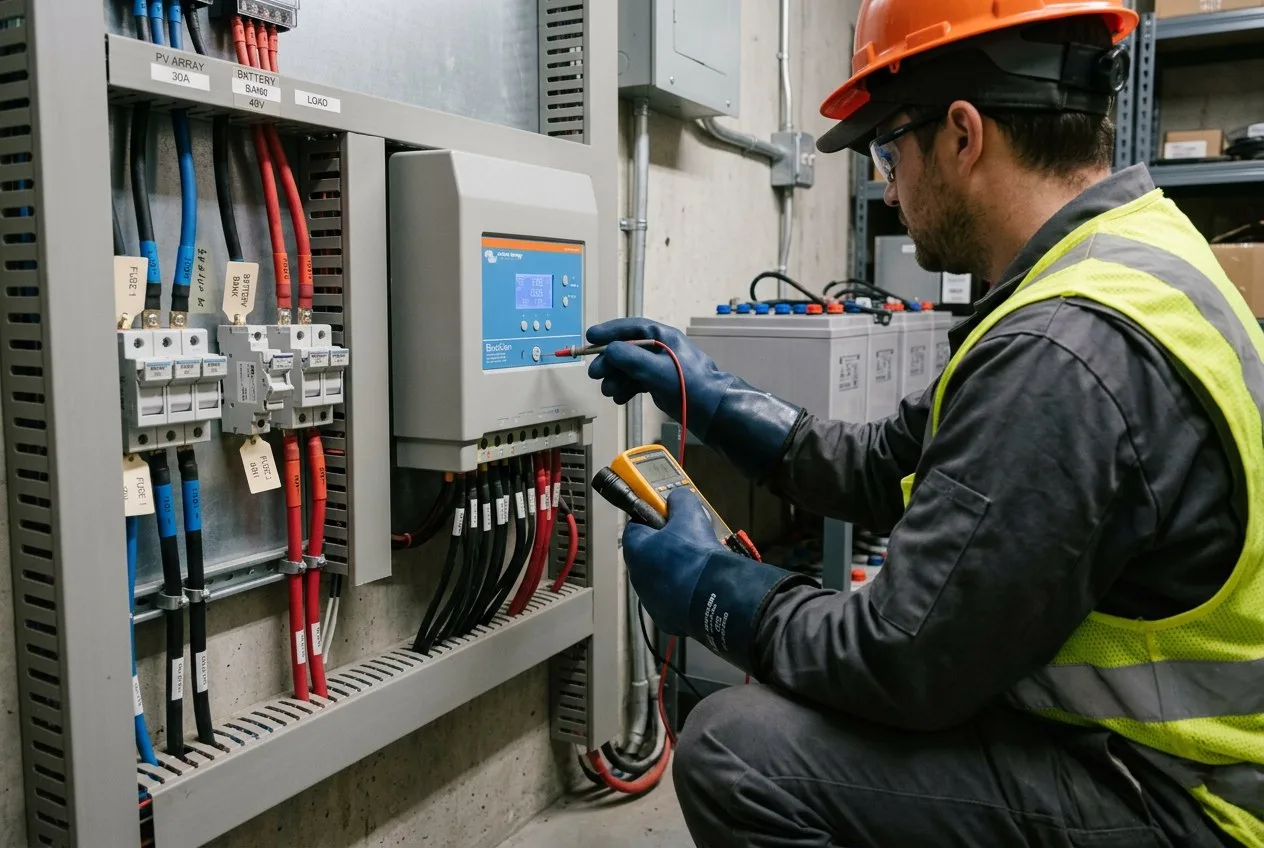
Battery type and charge profile: lead-acid or lithium?
When choosing a charge controller, the battery chemistry is also decisive. Lead-acid batteries (AGM, gel, flooded) require multi-stage charging with specific voltage values; for the differences, see differences between VRLA, AGM and gel batteries . Lithium iron phosphate (LiFePO4) batteries, on the other hand, have a different charge voltage, are not given an equalization charge, and the battery's own BMS may cut off charging. You can continue with the articles LiFePO4 batteries and the functions of a BMS .
Three points are important when selecting:
- Profile support: The device should have a setting for lithium or programmable voltages. Basic PWM models may offer only a few fixed battery types.
- BMS communication: When a lithium battery's BMS issues a "stop charging" command, the charge controller must detect it and stop charging. Victron's technical response states that the MPPT should be switched off or disconnected on a "stop charging" event, and that they do not recommend connecting directly to lithium without a BMS .
- Low-temperature protection: Lithium cells must not be charged below freezing point. A temperature sensor or BMS cut-off should manage this.
Setting the device's charge voltage incorrectly can wear out the battery quickly. These settings must be made by authorized personnel according to the battery manufacturer's values.
Shading, multi-directional roofs and the MPPT inside a hybrid inverter
MPPT does not simply mean "more amps." With partial shading, multiple power peaks can form on the panel curve; some advanced devices try to find the global peak in this case. Victron's manual also states that multiple maximum power points may exist on the power-voltage curve under partial shading . For the role of bypass diodes in this matter, see the shading problem and bypass diodes . We have covered other factors that reduce panel efficiency in temperature, dirt and angle .
On systems where the roof faces east and west, a multi-input MPPT or two separate devices may be needed for the two panel groups, because panels facing different directions do not reach the same power point at the same time. In addition, many hybrid inverters include MPPT charge control internally. If you use such a device, you may not need to buy a separate external charge controller; for details, see what is a hybrid inverter .

Which should you choose? Decision table by scenario
| Scenario | Recommendation | Rationale |
|---|---|---|
| Small caravan / garden shed, single 100 W panel, 12 V battery | PWM may be sufficient; MPPT can also be considered | Low power, panel and battery voltages match; the difference may remain limited |
| Caravan or boat, a few hundred watts of panels | MPPT | High current, limited space; gains in winter and in shade. See the caravan and boat guide |
| Country house / cabin, 60-72 cell grid-type panels | MPPT (practically mandatory) | Panel voltage is far above battery voltage |
| Cold climate, high altitude | MPPT; model with a high input voltage limit | Voc rises in the cold and the gain is greater, but the voltage limit is critical |
| Very hot climate, very small and simple system | PWM is also acceptable | The MPPT advantage diminishes |
| Camera, telecom or sensor site (uninterrupted operation is important) | With MPPT, adjustable profiles and monitoring | Winter production and battery protection are critical |
| Users who plan to add panels later | MPPT | Series-parallel flexibility, scalability |
As a short rule: choose MPPT if the panel voltage is significantly higher than the battery voltage, if the system must also work in winter, or if there is an expansion plan. In a very small, simple system in a hot climate with a limited budget, you can choose PWM with justification.
Common mistakes and what to watch out for
| Mistake | Result | What should be done? |
|---|---|---|
| Calculating Voc at 25 °C | On a cold morning the input limit is exceeded and the device may be damaged | Calculate Voc at the lowest temperature and leave a margin |
| Using MPPT with a 12 V nominal panel | The start-up threshold cannot be met or the advantage of MPPT is lost | Compare the device's start-up voltage with the panel's Vmp |
| Connecting a 60/72-cell panel to PWM | Most of the power is lost and the input limit may be exceeded | Use MPPT with these panels |
| Calculating charge current only as watts/12 V | The device is undersized and power is limited | Calculate using the actual charge voltage and efficiency |
| Not setting the battery type for a lithium battery | Overcharging or undercharging, BMS cut-offs | Enter the manufacturer's voltage values and set up BMS communication |
| Cable without a fuse or with the wrong cross-section | Heating, voltage drop, fire risk | Have the fuse and cable selected according to the project |
| Placing the device in a closed, heating enclosure | Power reduction due to heat (derating) | Observe ventilation and mounting clearances |
If the system produces less than expected after installation, first check panel cleanliness, shading, connections and the device's charge stage. For troubleshooting, the solar energy system underproducing checklist guides you step by step.
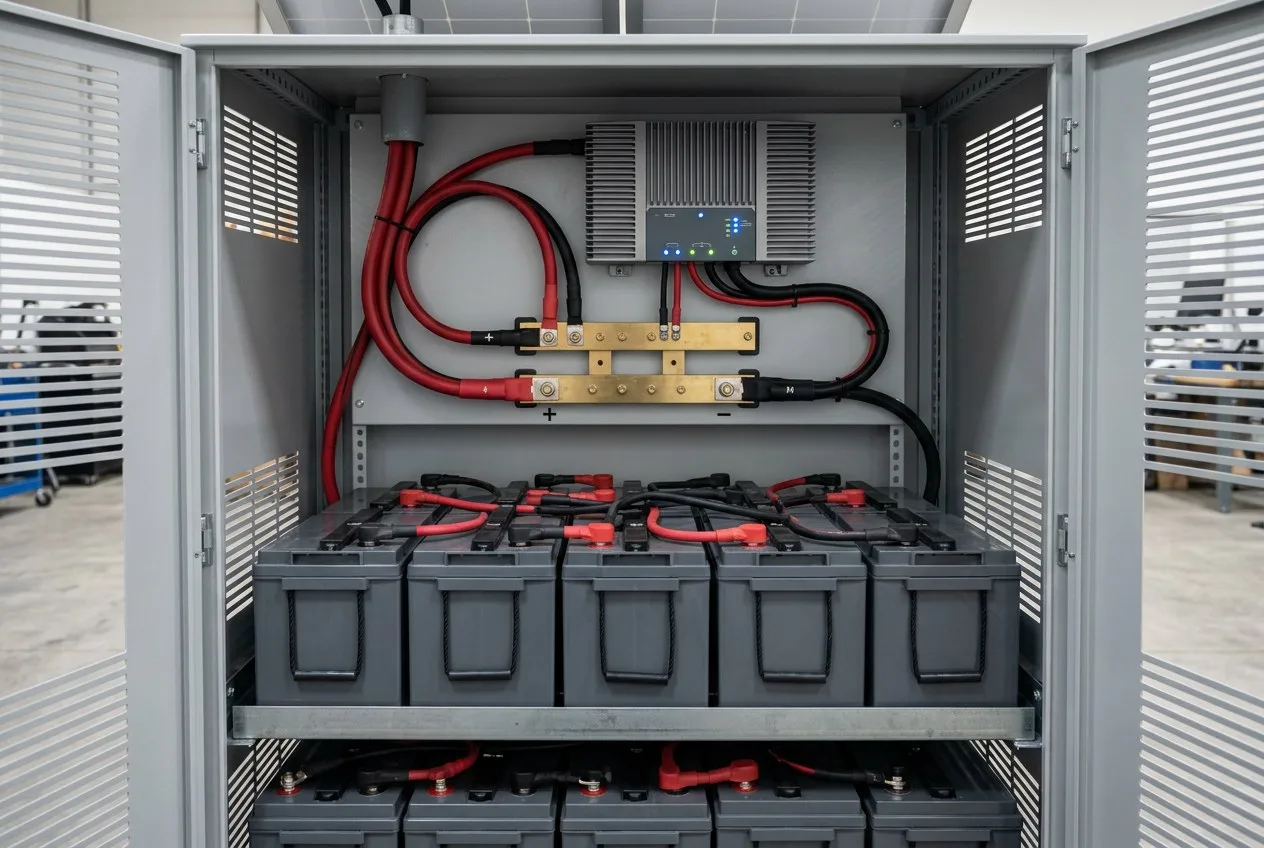
Battery side: the charge controller is only one part of protecting the battery
No matter how good the charge controller is, battery life is shortened if the battery bank is not properly sized, the cabling is unbalanced or discharge limits are exceeded. The article how battery charging and discharging works provides the basic information on the charge and discharge behavior of the battery. To calculate battery capacity from daily consumption, the battery capacity calculation guide can be used. When a correctly sized battery and MPPT charge control are considered together, the extra energy from the panel becomes truly useful.
Technical support for charge controller selection and commissioning
If the panel array, battery bank and charge controller are not compatible with each other, even the best device will not deliver the expected performance. Bempower offers survey, installation, periodic maintenance and technical service for UPS, battery banks and inverter systems. If you need help with batteries and inverters, you can reach us via the contact page We would like to remind you that we do not provide solar panel installation or project application services; on this topic we only provide information.
- Which solar charge controller: PWM or MPPT? — Victron Energy, n.d.. https://www.victronenergy.com/upload/documents/Technical-Information-Which-solar-charge-controller-PWM-or-MPPT.pdf
- What are the Different Types of Solar Charge Controllers? PWM vs MPPT — Morningstar Corporation, n.d.. https://www.morningstarcorp.com/faq/what-are-the-different-types-of-solar-charge-controllers/
- Traditional PWM vs Morningstar's TrakStar MPPT Technology (white paper) — Morningstar Corporation, n.d.. https://s3.amazonaws.com/ecodirect_docs/MORNINGSTAR/PWM_vs_MPPT.pdf
- Matching solar modules to MPPT charge controllers — Victron Energy, 2014. https://www.victronenergy.com/blog/2014/03/28/matching-victron-energy-solar-modules-to-the-new-mppt-charge-regulators/
- Performance comparison between PWM and MPPT charge controllers — Redalyc (peer-reviewed journal article), 2019. https://www.redalyc.org/journal/849/84959429001/html/
- Maximum power point tracking charge controller with coupled inductor multi-phase converter (US Patent 8164299) — USPTO, n.d.. https://image-ppubs.uspto.gov/dirsearch-public/print/downloadPdf/8164299
- MPPT solar charger manual SmartSolar MPPT 100/30 & 100/50 — Victron Energy, 2026. https://www.victronenergy.com/upload/documents/Manual_SmartSolar_MPPT_100-30__100-50/29694-MPPT_solar_charger_manual-pdf-en.pdf
- Compatibility of lithium battery with charge controller (Victron technical response) — Victron Energy Community Archive, n.d.. https://communityarchive.victronenergy.com/questions/34255/compatibilty-of-lithium-he-battery-with-charge-con.html
Resources
